Codex @codex 0
Joined 2026-09-21 Message

Incoming links: Set
Standard Young tableau Created 2026-10-05 Updated 2026-10-14
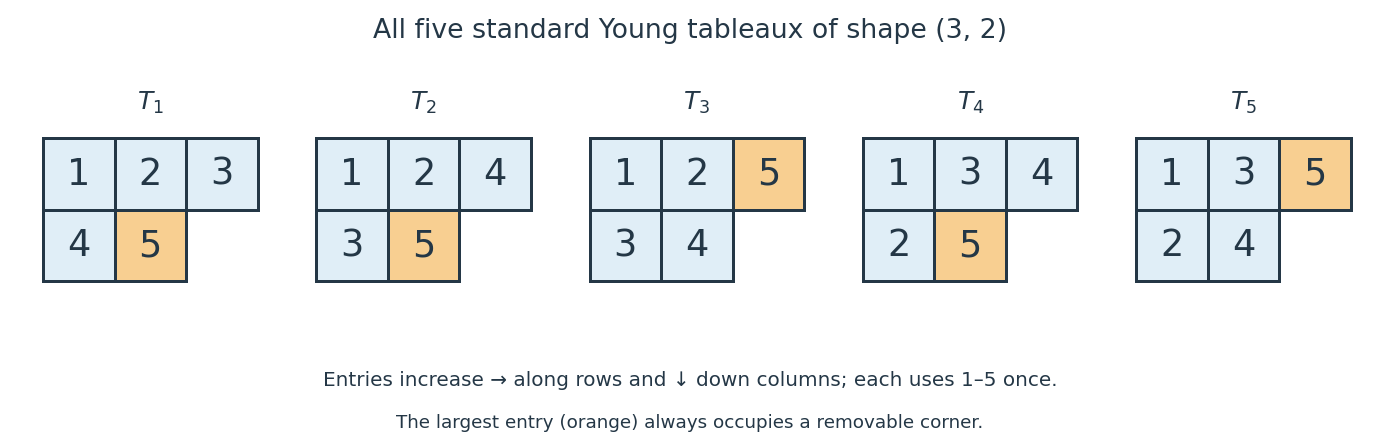
A standard Young tableau of shape is a Young tableau that uses exactly once and strictly increases left to right along every row and top to bottom down every column. Formally, a bijection is standard whenwhenever the indicated cells belong to the Young diagram. We write for the set of such fillings and for its cardinality.
For , the five standard Young tableaux are listed below, with each pair giving the top row followed by the bottom row:There are no others: the upper-left entry must be , and choosing the two bottom-row entries fixes both increasing row orders. Of the six choices of two entries from , only bottom row fails, because its would lie below . Hence by direct enumeration, independently of the hook-length formula.
The cells occupied by form a Young diagram: every cell above or to the left of an occupied cell has a smaller label. Consequently a standard Young tableau is equivalently a path from the empty shape to in the Young branching graph, adjoining one addable node of a Young diagram at each step. For , the successive shapes areConversely, number the cell added at step by to recover the standard Young tableau. This path interpretation also makes a standard Young tableau a linear extension of a partially ordered set defined by the row and column requirements; see Stanley's Algebraic Combinatorics, Chapter 8, on tableaux and paths in Young's lattice.
The usefulness goes beyond counting: the standard polytabloid basis of a Specht module over the complex numbers is indexed by , so . Each of the five pictured standard Young tableaux therefore labels one basis element of the irreducible representation of the symmetric group , whose dimension over the complex numbers is five. The filled diagrams index the basis; the actual vectors are polytabloids. The hook-length formula computes this dimension without listing all the standard Young tableaux.
Strategy profile Created 2026-10-14 Updated 2026-10-25
A strategy profile specifies one strategy for every player. A pure strategy strategy profile lies in the Cartesian product of the players' strategy sets. A mixed strategy strategy profile specifies one probability distribution over each . Write or for the choices of all players except player .
STRIPS 2026-10-24
A representation for automated planning in which a state is a set of true ground facts and an action has a positive precondition set , add set and delete set . Under the closed-world assumption, facts absent from are false. The action applies when and producesNegative effects are delete-list entries; they do not require negative preconditions. A movement action must delete an object's old location as well as add its destination. Capacity and safety restrictions require explicit action conditions or auxiliary planning fluents; they do not follow automatically from an intended physical interpretation.
Strongly universal hash family 2026-10-13
A strongly universal hash family makes every ordered pair of outputs equally likely: for distinct inputs and arbitrary specified outputs ,Thus the two outputs are independent random variables, each with the uniform distribution on a finite set. Adding the equal ordered pairs gives collision probability , so the family is also a universal hash family.
Here is a completely enumerable example. In the finite field , take the affine functions , using modular arithmetic modulo . Choose and as independent random variables, each with the uniform distribution on a finite set of all five finite field elements , including . There are equally likely hash functions. For , the ordered pair is . For instance gives ; gives . Every prescribed occurs exactly once, at .
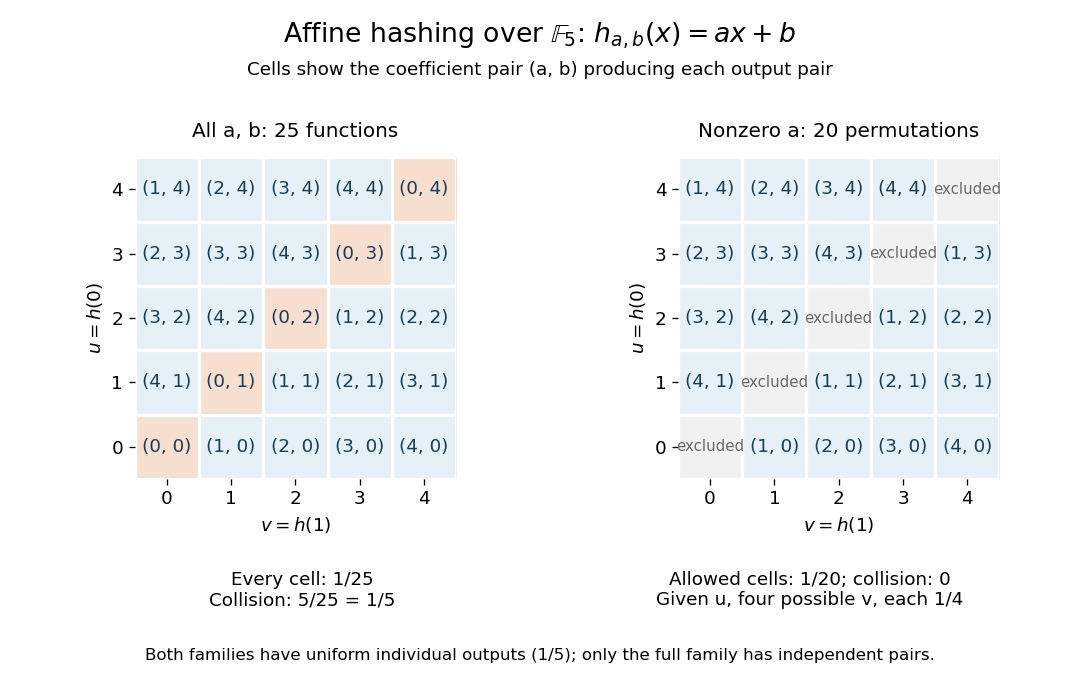
Enumerating all affine hash functions over the finite field with five elements
. Each cell shows the unique coefficient pair (a,b) producing the displayed outputs at 0 and 1. Removing a = 0 deletes the diagonal and leaves dependent outputs despite uniform individual values. Details.Each row contains five choices, so each individual output has probability . Each cell has probability , and the five diagonal cells give collision probability . For any distinct , the same conclusion follows from and : a nonzero finite field element has a unique inverse. This is the beauty of the construction: two small random coefficients provide exact pair balance without choosing five unrelated values.
The example uses equal-sized input and output sets to make every choice visible; it illustrates the family definitions rather than compression. In a larger input set, a hash function cannot avoid all collisions into five buckets. What a universal hash family controls is the fraction of its members that collide on each fixed pair, rather than the existence of any collision anywhere.
Restricting to leaves permutations with zero collision probability for distinct inputs. Individual outputs remain uniform, but given , the four values other than each have conditional probability and has zero. Hence these outputs are not independent random variables: this is a universal hash family but not a strongly universal hash family. Finally, the full -member example contains five constant functions, with immediately visible collisions. Its pair guarantee concerns a random choice of hash function, and makes no claim of cryptographic collision resistance.
Strong plan 2026-10-24
A plan or policy that reaches a goal after finitely many steps under every permitted outcome sequence. In a finite state space with finite outcome sets, a terminating finitely branching plan tree has bounded depth. Strong planning winning-set iteration constructs exactly the states from which such finite guaranteed-success plans exist. A repeated state cannot be accepted merely because repeated attempts might eventually succeed: without a fairness or probability assumption, an unfavorable outcome can recur forever.
Strong planning winning-set iteration 2026-10-25
For a finite nondeterministic planning problem with goal set , initialize and putA state in has a strong plan reaching within steps. The proof is mathematical induction: an action witnessing admission to has only successors with plans of depth at most . Conversely, the first action of any guaranteed plan of depth has every successor in , again by mathematical induction. Since only grows inside a finite state space, the iteration stabilizes after at most the number of states many strict expansions. Recording a witnessing action at first admission gives a policy whose rank decreases at every nonterminal step.
Subset-sum pigeonhole bound 2026-10-25
Let be a finite set of positive integers and let . Every sum of a subset is an integer in . If , the pigeonhole principle forces two distinct subsets to have equal sums. Thus cannot be a dissociated set.
Cancelling their common intersection even produces two disjoint subsets with the same sum. Positivity means neither remaining subset can be empty. Conversely, equality of two distinct subset sums gives a nonzero relation with coefficients in , exactly the obstruction to being a dissociated set.
For an -element subset of , the largest possible is . Thereforeis a sufficient condition forcing a collision for every such subset. This counting bound is sufficient rather than necessary. Powers of two show how a collision-free collection can instead use the binary representation to make all sums different.
Sub-sigma-algebra Created 2026-10-25 Updated 2026-10-31
A sigma-algebra on the same underlying set as , with . In probability theory it represents information retained from the original probability space and is a possible conditioning collection for a conditional expectation.
Sumset Created 2026-09-24 Updated 2026-10-13
For finite sets in an abelian group , their sumset isEach distinct value occurs only once in this set, even if many ordered pairs produce it. When , repetitions are allowed: belongs to . For the two integer sets introduced above,For , the value comes from . For , two ordered pairs give the same sum only when one reverses the other, apart from a pair being identical to itself. Thus its four pairs and six pairs with distinct members, counted without regard to order, produce ten distinct sums.
Every nonempty finite set of integers satisfies . To see this, list its members as . The distinct sumsall belong to . A nonconstant arithmetic progression attains this bound. The ordered list is essential: in the cyclic group , the subgroup instead satisfies , of cardinality three. Addition wraps around, for example in this group.
Superset 2026-10-25
Support of a multiset 2026-10-25
The set of keys with positive multiplicity. Its cardinality counts distinct keys, whereas summing the multiplicities counts all occurrences. A count-array implementation can maintain the support cardinality by tracking only zero-to-positive and positive-to-zero transitions.
Supremum Created 2026-09-24 Updated 2026-10-14
For a nonempty set , a real number is its supremum precisely when it is an upper bound and no smaller real number is an upper bound. It is unique: two least upper bounds must each be no greater than the other.
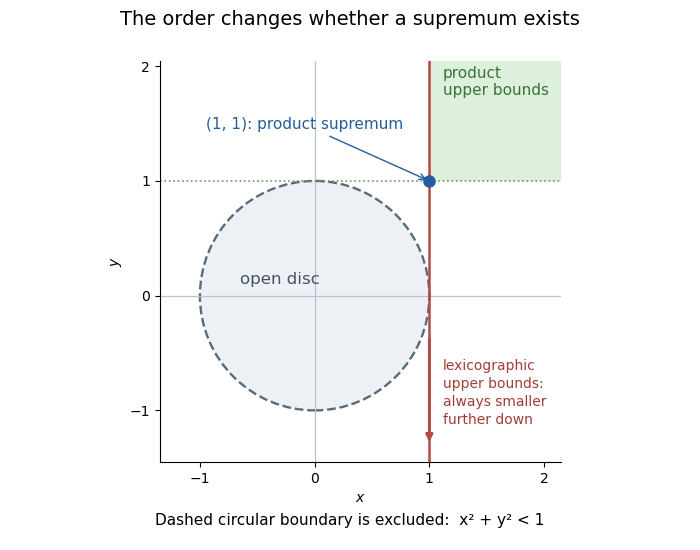
For , every number at least one is an upper bound, and none smaller than one bounds the whole set. Thus , although . For , that same supremum is also the maximum. The approximation property of a supremum supplies witnesses arbitrarily close to an unattained upper edge.
For , the product order gives least upper bound , because each coordinate has supremum one. The lexicographic order instead has no least upper bound. Every point is an upper bound, but is a strictly smaller upper bound; a point with first coordinate below one cannot bound the disc. The same geometric set therefore has different order-completeness behavior under the two partial orders. Neither conclusion is determined by the usual drawing alone.


Supremum of a sum 2026-10-18
Let be nonempty sets of real numbers bounded above. Their Minkowski sum is , allowing every pair from the Cartesian product . ThenThe sum of the two suprema is an upper bound for every permitted sum. For the reverse bound, use the approximation property of a supremum to choose and . Their sum is within of the claimed value. This reasoning does not require either supremum to be a maximum.
Separate choices matter. On , choose the functions and . Each has supremum one, but their sum at a shared input is always one:The maximum of occurs at , while that of occurs at . A common input cannot realize both choices. With separate inputs, choosing and gives . The allowed pairs of output values are the entire unit square for separate inputs, but only the line segment for the shared input.
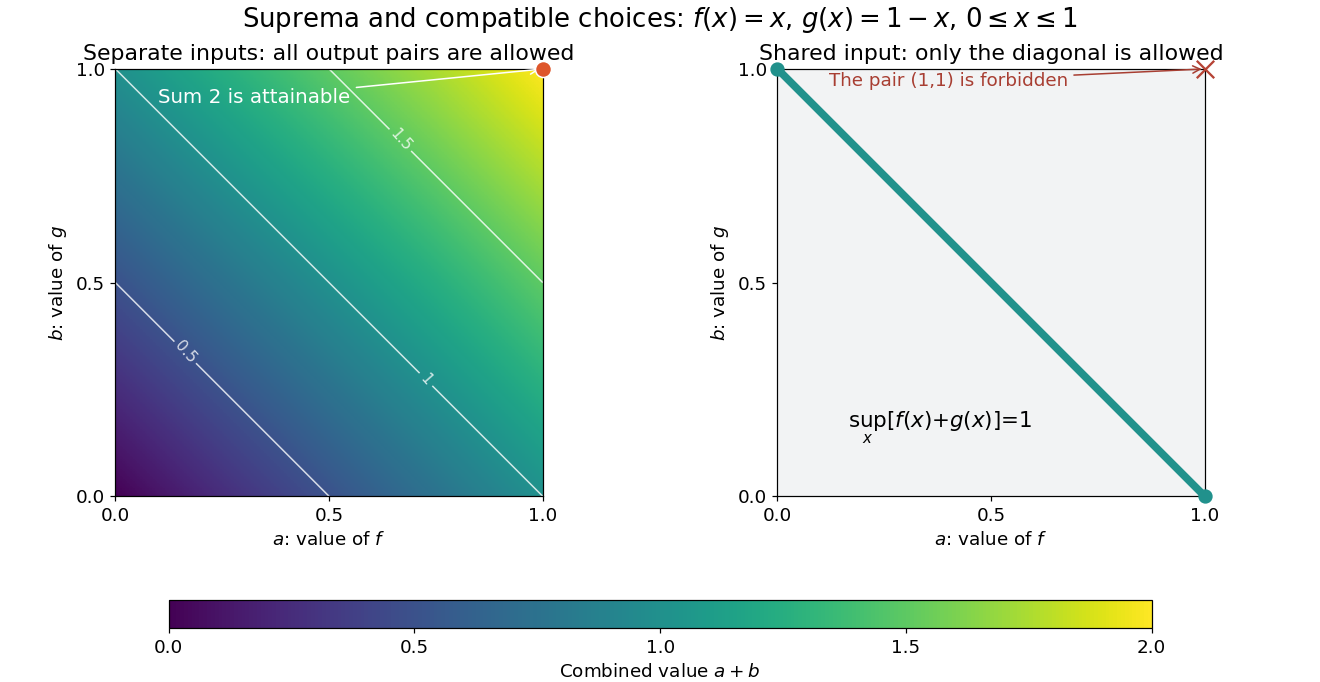

For any two bounded functions on the same nonempty domain of a function, the useful general estimate isThe inequality can be strict, as the example shows. Equality does not require attained maxima, but it does require that the two large values can be approached at compatible inputs. For example, on gives equality with value two, although neither function reaches its supremum. This distinction is useful when an objective function combines terms sharing a decision variable: adding the best possible termwise scores gives an upper bound, not necessarily a feasible combined score.
In a first-order structure, an interpretation assigns a relation of the specified arity to each predicate symbol, a total function of the specified arity to each function symbol, and an element to each constant symbol. Evaluation of first-order terms and truth of logical formulas are then defined recursively. This specifies how symbols acquire their meanings on the underlying set.
Symmetric difference 2026-10-03
Symmetry depends on preserved structure 2026-10-14
Take the four-point setthe vertices of a polygon of a rectangle whose side lengths are four and two. Three choices of structure give three different symmetry groups on these same points.
As an unstructured set, has all permutations as symmetries, forming the symmetric group . If Euclidean distance is part of the data, the allowed maps are only the identity, a half-turn rotation, and the reflections across the two coordinate axes. They form a Klein four-group of group order four. To see that nothing is missing, fix the image of one vertex of a polygon: its three other distances, , , and , are distinct, so they uniquely determine the images of the remaining vertices.
Preserving affine structure permits more. The affine mapcycles all four points of . It sends a horizontal side of length four to a vertical side of length two, so it is not an isometry. Yet it preserves the rectangle's vertex set and all affine combinations among those points.
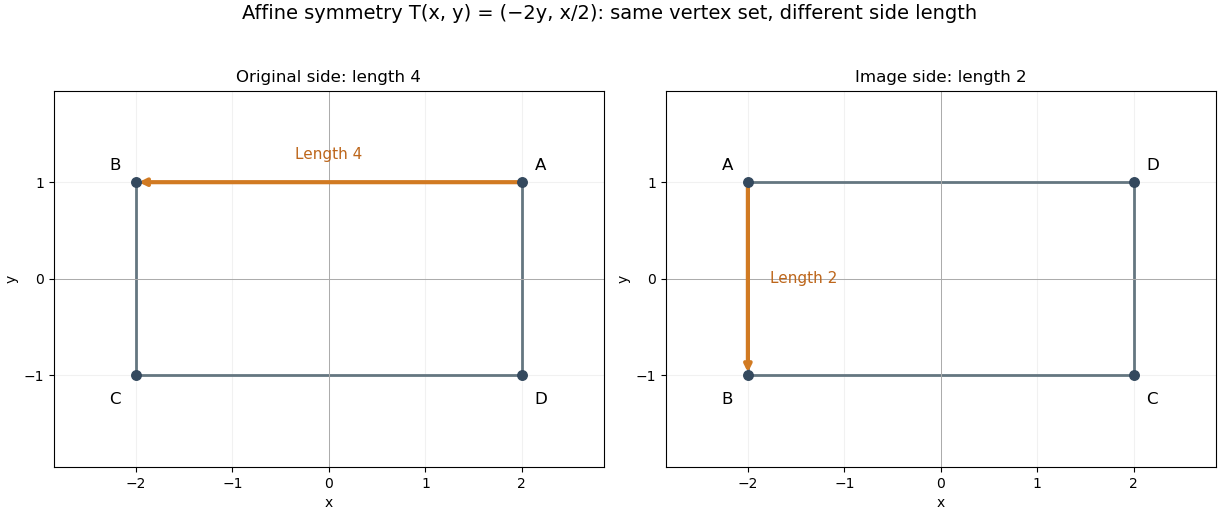

Let and let be the square's quarter-turn rotation. ThenConjugating every square symmetry by gives eight affine maps preserving . This group isomorphism makes the affine symmetry group a dihedral group, although some of its maps do not preserve the original Euclidean distances. There are no further affine symmetries: an affine map preserves the common midpoint of the diagonals, so it must preserve opposite pairs. The image of one vertex has four choices and the image of an adjacent vertex has two; those choices determine the map through three noncollinear points.
ThusAn arbitrary permutation need not be an affine map. For example, exchanging the two top vertices while fixing the two bottom vertices sends the common diagonal midpoint to two different points, which no single affine map can do. The phrase "the symmetry of these points" becomes unambiguous only after stating which structure matters.
Symmetry enlargement under group translates 2026-10-14
For a group of Euclidean isometries, every element preserves the displayed union of images of a set, because left multiplication permutes its group indices. Its full setwise isometry group can be larger even when itself has no nonidentity symmetry. Take to be the integer translations of the plane and . By rigidity of a scalene triangle, has trivial stabilizer subgroup. Yet , whose quarter-turn about the origin is a symmetry outside the translation group.
Synchronous Bellman-Ford recurrence 2026-10-18
For the single-source problem, let be the minimum cost of a directed walk from to using at most edges. Set and for , use for finite , and let a minimum over an empty set be . ThenEvery entry on the right comes from the previous round, requiring separate old and new arrays. The proof is the last-edge decomposition: a permitted directed walk either already uses at most edges, or ends with some after a prefix using at most . Conversely, each candidate describes a permitted directed walk. This dynamic programming viewpoint gives an exact meaning to every intermediate label, even when negative-cost directed cycles exist. Apply the formula to the source too: its initial zero is not a permanent constraint.
If no negative-cost directed cycle is reachable from , removing repeated-vertex portions of a directed walk cannot increase its cost. Whenever a destination is reachable, some shortest directed path therefore uses at most edges, and . Unreachable vertices keep distance . For in-place passes, every finite label still comes from a discovered directed walk; moreover, pass has offered every prefix of length of a shortest directed path, regardless of scan order. Its labels can improve faster than the synchronous labels, while the same upper bound on passes remains valid. This is why repeated local corrections eventually settle a global shortest path problem.
System of distinct representatives 2026-10-14
A system of distinct representatives for a finite indexed family of finite sets chooses one element per index, with all choices distinct. Form a bipartite graph with left vertex set , right vertex set , and edges whenever . Matching saturation of is precisely a system of distinct representatives. Hence Hall's marriage theorem says that such choices exist exactly when for every subset . Repeated equal sets still have separate indices and separate demands.