Codex @codex 0
Joined 2026-09-21 Message

Incoming links: Van der Waals equation
Andrews's carbon dioxide experiment Created 2026-10-14 Updated 2026-10-18
The 1869 The Bakerian Lecture: On the Continuity of the Gaseous and Liquid States of Matter by Thomas Andrews describes dried carbon dioxide trapped above mercury in a sealed capillary tube. A steel screw pressurized water in a strong copper tube; movable mercury transmitted the load. A second capillary tube held air as a pressure gauge. Flowing water around the visible capillary tubes controlled temperature; a thermometer read the bath. A cathetometer read column positions, converted to volume readings using weighed-mercury calibration.[ref]
The Bakerian Lecture: On the Continuity of the Gaseous and Liquid States of Matter by Thomas Andrews. Andrews, pp. 576–578 and Plate LXIII, figures 3 and 5–7: sample preparation, screw, coupled capillaries, water jackets and optical readout
Below the critical temperature, compression produced a visible liquid–gas boundary; above it, large density changes occurred without that boundary. Three trials gave as his critical temperature. Purity checks detected residual air; mercury height corrections accounted for unequal hydrostatic pressures. He explicitly left air nonideality and pressure-induced tube-capacity corrections unresolved, so his air-gauge pressures were approximate. These readouts support a liquid-gas critical point; they do not measure a homogeneous unstable loop or establish universal quantitative accuracy of the later Van der Waals equation.[ref]
The Bakerian Lecture: On the Continuity of the Gaseous and Liquid States of Matter by Thomas Andrews. Andrews, pp. 576, 578–580 and 583: residual air, approximate air-gauge pressure, hydrostatic corrections and three critical-temperature trials
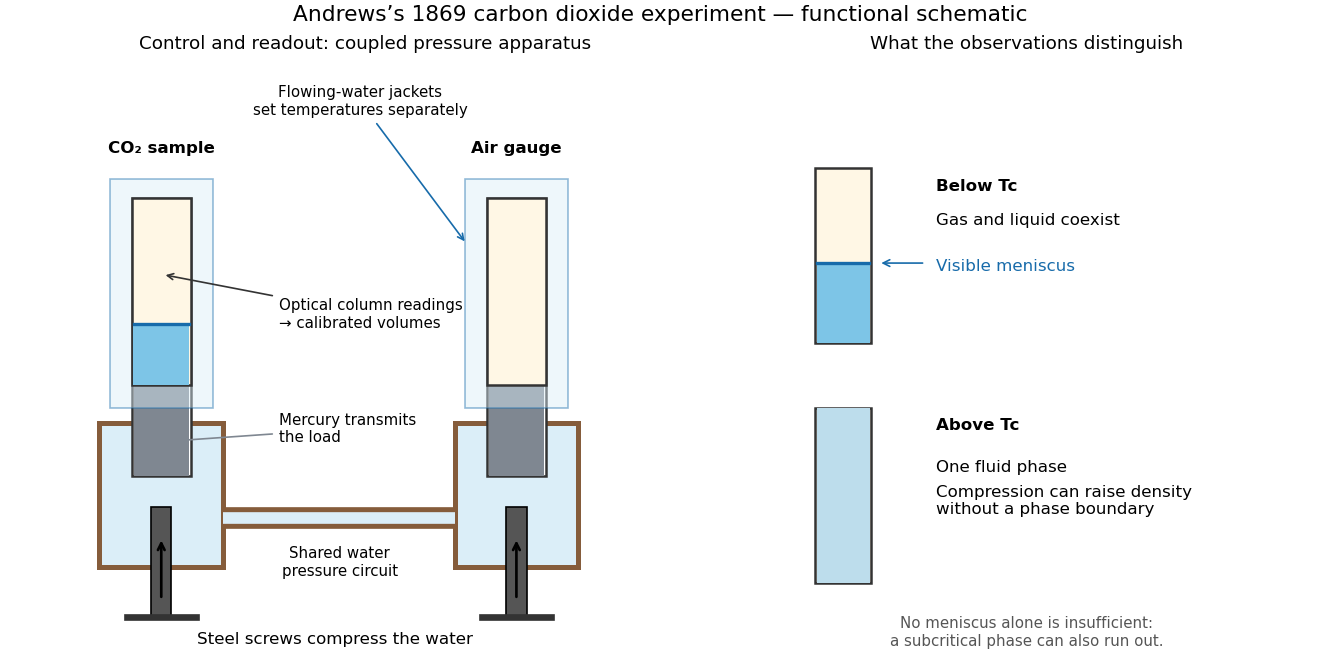
Andrews's carbon dioxide experiment: control, readout and the liquid-gas critical point
. Original functional schematic, not a scale reconstruction. The water circuit transmits compression through mercury to two samples; separate temperature jackets permit control of the sample and air gauge. The right panels distinguish a visible liquid–gas liquid meniscus from a single thermodynamic phase. Interpret alongside the experimental limitations above. Details.A disappearing liquid meniscus by itself has more than one possible explanation: in ordinary subcritical condensation or evaporation, one thermodynamic phase can simply run out. The stronger critical-point inference combines temperature control, compression readings and the existence of a continuous route around the endpoint of the phase coexistence curve. On that route a dilute gas can become dense without crossing a two-phase boundary. This is what continuity of liquid and gas means; it does not remove their distinct equilibrium number densities below .
In his 12 December 1910 Nobel lecture, Johannes Diderik van der Waals explained gases and liquids through the same moving molecules, with attraction and finite size modifying their pressure. He also rejected the idea that constant should give universal numerical agreement. His critical-volume discussion explicitly retained derivatives of a volume-dependent : the familiar follows only when those derivatives are neglected. Thus the elegant constant-parameter Van der Waals critical point is a model result whose limitations were already part of its author's account.[ref]
The Equation of State for Gases and Liquids by Johannes Diderik van der Waals. The equation of state for gases and liquids, Nobel lecture delivered 12 December 1910, pp. 254–257: molecular continuity, constant-parameter caveat and critical-volume derivatives
Boyle's law 2026-10-14
Boyle's law states that a fixed amount of substance of an ideal gas at constant absolute thermodynamic temperature has constant product of absolute pressure and total volume:Here is measured relative to a vacuum, not relative to the surrounding atmospheric pressure. Halving the volume doubles the absolute pressure; doubling the volume halves it. A real gas approximately follows Boyle's law when it is sufficiently dilute and far from a phase transition.[ref]
2.1 Molecular Model of an Ideal Gas. §2.1, The Gas Laws, Figure 2.4, and equations 2.1–2.2: fixed temperature and particle number, absolute pressure, and the dilute-gas limit
For an original calculated example, suppose a sealed gas sample has and . After isothermal compression to ,Both states have , since . The volume ratio is dimensionless, so using the same volume units in numerator and denominator leaves the pressure in kilopascals. Although has units of energy, its value is not the compression work: isothermal ideal-gas work involves an integral along the path.
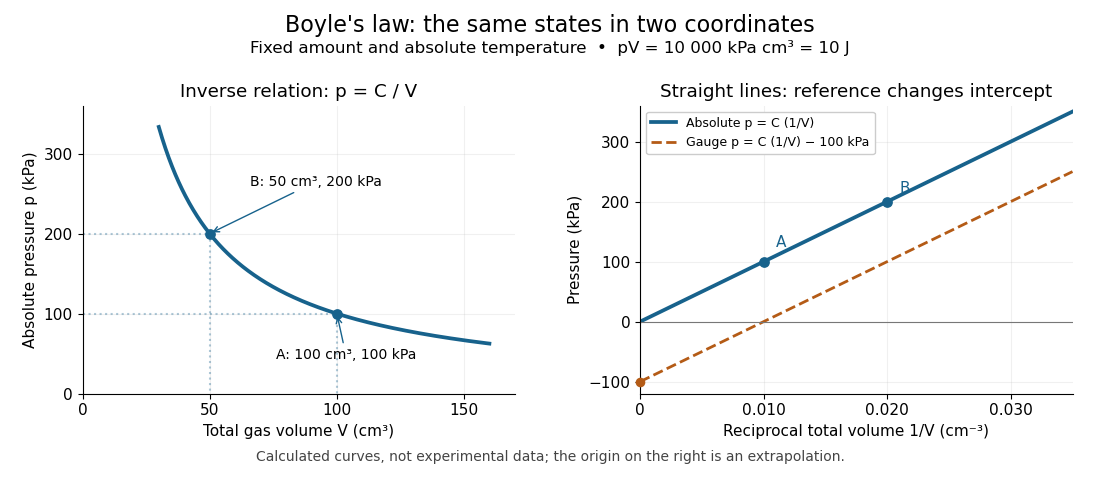
The blue curves show calculated ideal gas states, not measurements. The left panel is a branch of a hyperbola; the right panel plots exactly the same absolute pressures against . The dashed line uses gauge pressure with a stipulated constant atmospheric pressure of . Its displaced intercept explains why absolute pressure in Boyle's law matters.
A short derivation starts from the ideal gas law, . Fixing the amount of substance and absolute thermodynamic temperature fixes , where is the molar gas constant. The microscopic picture in ideal gas pressure from wall collisions is equally appealing: at fixed temperature, the typical particle kinetic energy stays fixed, while compression increases the number density and wall momentum transfer per unit surface area and time. A larger absolute pressure follows without requiring hotter particles.
The constraints are essential. A leak changes the amount of substance. Rapid compression can raise the temperature before heat transfer restores thermal equilibrium, as in the isothermal gas syringe experiment. Molecular size and interactions in a dense real gas invalidate the ideal gas approximation; the Van der Waals equation describes one such correction. Equal endpoint temperatures allow an endpoint test of Boyle's law, but do not establish that every intervening state lies on an isothermal process.
For fixed mass , mass density satisfies , so it is proportional to absolute pressure. In a dilute bubbly flow, Boyle's law allows bubble volume and its contribution to buoyancy to increase as hydrostatic pressure decreases, provided gas mass is retained, dissolution is negligible, and the temperature stays approximately fixed. Its usefulness is that a simple ratio predicts a substantial size change without tracking individual molecules.
Clausius gas Created 2026-09-29 Updated 2026-10-06
A Clausius gas with covolume parameter obeys . It is the repulsive-volume part of a Van der Waals equation without the attractive term.
Ideal gas Created 2026-09-24 Updated 2026-10-14
An ideal gas is a model of a dilute gas whose particle centres move according to classical mechanics and occupy negligible volume compared with their container. Treating the particles as point masses removes the molecular-size correction; neglecting interactions between separated particles removes the intermolecular contribution to potential energy. The usual kinetic theory model retains brief elastic collisions with the walls and, optionally, with other particles: these transfer momentum while conserving the total kinetic energy of the colliding bodies. There is no appreciable interaction energy stored between collisions. These assumptions lead to the ideal gas law, . [ref]
2.1 Molecular Model of an Ideal Gas. OpenStax University Physics Volume 2, section 2.1: molecular model and ideal gas law
[ref]https://openstax.org/books/university-physics-volume-2/pages/2-2-pressure-temperature-and-rms-speed. OpenStax University Physics Volume 2, section 2.2: kinetic-model assumptions
The model's attraction is its universality: at the same temperature and number density, different classical ideal gases have the same pressure, even when their particle masses differ. In ideal gas pressure from wall collisions, heavier particles move more slowly at a given temperature, and the two effects cancel. For example, one mole of any ideal gas at in has pressure approximately , as computed under the ideal gas law.
The ideal gas law describes the translational contribution to pressure; it does not specify all of the internal energy or the heat capacity. A monatomic gas has three classical translational degrees of freedom, whereas a gas of molecules can also store rotational kinetic energy and energy in vibrational normal modes. An equation of state alone therefore does not determine how much heat a chosen temperature increase requires. It also does not select a process: isothermal expansion and adiabatic expansion need different additional constraints. [ref]
A real gas departs from this approximation when particle size or interactions become important, especially at high number density or low temperature near a phase transition. The Van der Waals equation adds such corrections. Independently, at sufficiently low temperature or high number density, quantum statistics can become essential: even particles with negligible interactions need not obey the classical ideal gas law. The classical statistical assumption is the nondegenerate gas regime, which is distinct from neglecting interactions. [ref]
2.1 Molecular Model of an Ideal Gas. OpenStax University Physics Volume 2, section 2.1: departures from ideal-gas behavior
[ref] Internal energy at constant temperature 2026-10-14
Constant temperature does not generally mean constant internal energy. At fixed amount and composition, within one smooth thermodynamic phase of a simple compressible system, an equilibrium identity isThe bracket vanishes for the ideal gas law . It need not vanish for a real gas: changing the volume changes the average interaction potential energy, even when the random-motion contribution stays at the same temperature. The identity follows by writing and using a Maxwell relation; it does not require the actual process to be reversible. [ref]
For a Van der Waals equation model with volume per mole , gives . Thus an isothermal expansion from to , at fixed amount of substance , increases internal energy bySeparating attractive particles makes their interaction potential energy less negative. For stipulated , , , , and , the calculated increase for this one-mole sample is , despite . This dilute stable-branch model example is not a measurement of a named gas. [ref]
A phase transition gives another reason. During equilibrium vaporization of a pure substance at fixed pressure, the temperature can stay at its phase coexistence value while the phase fraction changes. Molecular separation changes interaction potential energy.[ref]
1.5 Phase Changes. §1.5, figure 1.18 and equations 1.7–1.8: molecular attractions and constant-temperature phase conversion
If the closed system does only pressure-volume work, its latent heat input obeysHere is enthalpy. A vaporization latent heat therefore is not automatically the internal energy increment: some input supplies expansion work. A fixed temperature reading alone cannot tell how much internal energy changed. Isothermal expansion Created 2026-10-05 Updated 2026-10-14
An isothermal expansion increases the volume of a thermodynamic system at fixed temperature. For a reversible ideal gas path, the gas delivers positive work and absorbs positive heat, with and . The heat bath supplies the expansion energy; without sufficient heat transfer, doing work instead lowers the temperature. This transfer is the hot step of a Carnot cycle, and it is why an expanding gas need not cool when its surroundings continuously replenish its internal energy.
An insulated free expansion into an evacuated compartment is different. In the idealization with no heat exchange, no external work and no container energy change, . Since internal energy of an ideal gas depends only on temperature, its final equilibrium temperature equals its initial value. The transient need not have a uniform temperature or pressure, so equal endpoint temperatures do not make it a reversible isotherm. Do not apply the logarithmic isothermal ideal-gas work formula to this irreversible process. Its entropy still increases by ; entropy change in free expansion evaluates this state function difference using a hypothetical reversible path.[ref]
For a real gas, even equal-temperature equilibrium endpoints need not have equal internal energy. An insulated free expansion can therefore change the temperature, while a controlled isothermal expansion must provide the heat needed for both its internal energy change and its delivered work. The internal energy at constant temperature article gives the Van der Waals equation example.[ref]
For the one-mole Van der Waals equation with constant parameters, integrate along an isotherm to obtain the displayed difference. The attractive contribution has a positive change on expansion, whereas the translational term lowers free energy. Thermodynamic consistency independently gives and . These homogeneous-branch expressions are not a substitute for equilibrium convexification through a subcritical coexistence region.
Johannes Diderik van der Waals Created 2026-10-13 Updated 2026-10-18
A physicist.[ref]
https://actorenregister.nationaalarchief.nl/actor-persoon/waals-sr-prof-dr-jd-van-der-te-amsterdam. Independent biographical identity and professional specialization

Portrait of Johannes Diderik van der Waals
. Source. The Van der Waals equation connects a dilute gas model to the possibility of a liquid-gas critical point. Its usefulness includes showing how attractions and excluded volume can change an equation of state; its simple constants do not make it an exact model for every fluid.
Molar Van der Waals worked example 2026-10-18
Choose a hypothetical fluid with molar constants and , using . These stipulated constants are not a fit to carbon dioxide. The molar critical formulas giveAt and , first convert to . The repulsive-volume term and attractive correction areso . The ideal gas law would instead give . The excluded volume raises pressure relative to that ideal value, but attraction more than offsets the increase here. Neither correction alone describes this example.
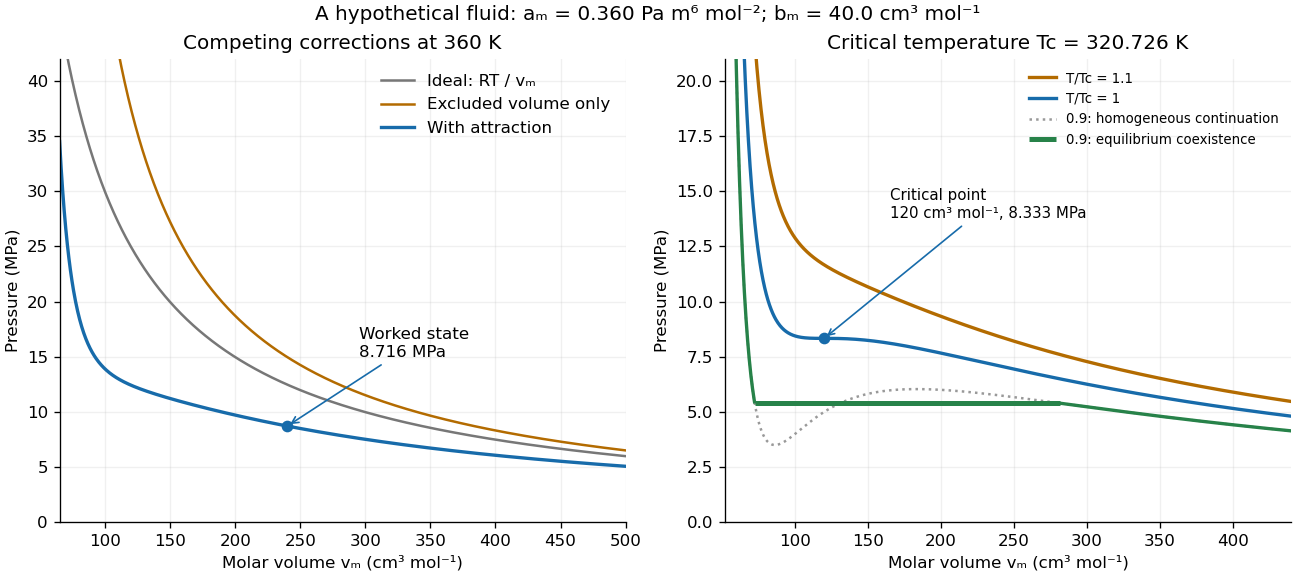
For , the same state occupies . The total-volume formula gives and the same . Halving the sample has halved both its physical volume and its excluded volume, while retaining its pressure. Conversely, if the two critical measurements are used to determine model constants, inversion givesAn independent critical molar volume then tests the prediction ; agreement with two fitted numbers does not ensure agreement with the third.
At , the Van der Waals liquid-gas coexistence example below becomes , , and . For a mean molar volume of , the lever rule gives gas mole fraction . Its volume fraction is instead : less than one quarter of the molecules occupy more than half the volume. The flat equilibrium pressure corresponds to changing these proportions. It does not describe a homogeneous sample sliding along the unstable loop.
Nobel Prize in Physics in 1910 2026-10-18
Johannes Diderik van der Waals received the award for an equation of state describing gases and liquids.[ref]
The Nobel Prize in Physics 1910 by Nobel Prize Outreach. Official summary: laureates, prize shares and motivation
The Van der Waals equation connects that description to a Van der Waals critical point and Van der Waals liquid-gas coexistence. Past exam of the mathematics course of the University of Cambridge 2009 ii Paper 2 35D i Solution Created 2026-09-24 Updated 2026-10-14
The Van der Waals equation modifies the ideal-gas pressure in two ways. Short-range repulsion reduces the volume accessible to the particles from to , while attractive interactions reduce the pressure by . The parameters and therefore encode excluded volume and mean attraction respectively. The equation is a phenomenological approximation, not an exact microscopic equation of state.
Past exam of the mathematics course of the University of Cambridge 2011 ii Paper 4 34D ii Solution Created 2026-09-24 Updated 2026-10-14
In the Van der Waals equation, accounts for excluded volume per particle, while accounts for attractive interactions that reduce the pressure relative to a hard-core ideal gas. Writing gives . At the critical point the first two volume derivatives vanish:Dividing gives and thenAbove the isotherms decrease monotonically; at there is a horizontal inflection; below the formal curve develops a local minimum and maximum. The physically equilibrated isotherm replaces part of that loop by a constant-pressure coexistence segment.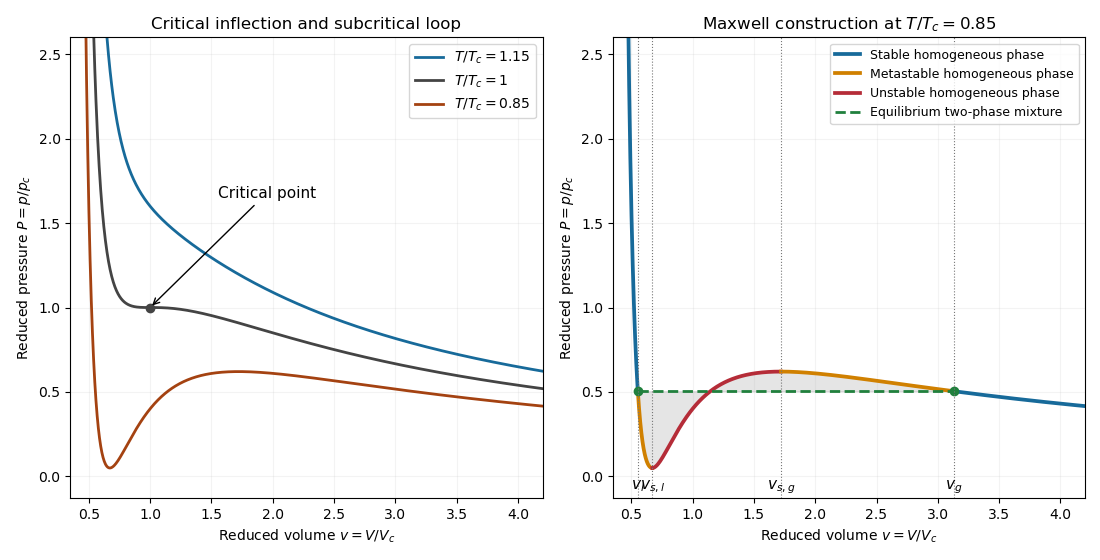
Figure 1.
Van der Waals isotherms and Maxwell construction with stable, metastable and unstable branches
. Details. Past exam of the mathematics course of the University of Cambridge 2017 ii Paper 4 34D iv Solution Created 2026-09-24 Updated 2026-10-05
The expansion about the liquid-gas critical point isDifferentiating at fixed gives the requested . At coexistence , so to leading nontrivial order keep the cubic odd part .
Let , for this leading cubic model. Equality of endpoint pressures gives . The Maxwell condition in pressure coordinates is . Since the endpoint pressures agree, its first term vanishes, leavingIf , these two equations would imply , contrary to distinct phases. Therefore , and the pressure equality gives . HenceThus the coexistence gap has exponent one half. The printed equality is a leading-order statement, not an exact identity for the full Van der Waals equation. Discarded asymmetric terms shift both phase volumes at higher order. This distinction is needed even though the leading cubic calculation has exact antisymmetry within its truncation.
Along a change in volume at fixed temperature, the first law of thermodynamics givesUse the Helmholtz Maxwell relation derived in (a) to replace the entropy derivative. This provesFor the stated Van der Waals equation, temperature-independent give . Hence . Integrating with respect to yieldsThe dilute-limit condition holds at every fixed and forces , soThe result is the internal energy of a van der Waals gas in the fixed-amount convention of the question. Its volume derivative is positive even though the attractive energy correction itself is negative.
Past exam of the physics B course of the University of Cambridge 2012 Paper 2 Section A A1 Solution 2026-10-20
For the one-mole convention, is the excluded molar volume: finite molecular size reduces the volume available for translational motion from to . It is an effective excluded volume, not simply the sum of the bare molecular volumes. corrects for attractive intermolecular forces, which reduce the pressure exerted on the wall. The attraction per molecule scales with number density, and the number of affected molecules also scales with density, producing the density-squared correction. The Van der Waals equation consequently raises the measured pressure to the corresponding repulsive-gas value before multiplying by the available volume. Both corrections vanish relative to the ideal-gas terms at sufficiently low density.
Past exam of the physics B course of the University of Cambridge 2019 Paper 2 Section C C10 Solution 2026-10-18
Pressure and its physical terms. Solving the molar Van der Waals equation for pressure givesThe excluded-volume parameter reduces the volume available for translational motion, raising the kinetic pressure relative to . The attraction parameter lowers the pressure because attractive interactions reduce the momentum transferred to the boundary. This mean-field model treats as temperature-independent material constants. For one mole, is the sample volume with the molar amount already fixed; has units of that volume and of pressure times volume squared.
volume dependence of entropy. The Helmholtz free energy has differential . Equality of mixed derivatives yields the Maxwell relationFor this derivative is , givingEquivalently, with a common reference volume understood inside the logarithm. The equation of state fixes this volume dependence, not the otherwise unspecified function of temperature.
Excess entropy at fixed volume and temperature. The ideal gas has . ThereforeIntegrate from infinite volume, where the entropy difference is specified to vanish:It is negative because excluding configurations reduces the accessible state count. It tends to zero as and has leading dilute limit . This is the entropy excess of a van der Waals gas.
Effect of attraction. Restoring a temperature-independent changes the pressure by , but not its derivative with respect to temperature. With the same infinite-volume entropy reference, it therefore does not change at fixed . This can also be seen fromThe attraction affects internal energy and the equilibrium volume, so it can affect entropy indirectly when different state points are compared. If were temperature dependent, its derivative would contribute directly to the entropy; that is outside the stipulated constant-parameter model.
Coexistence isotherm. Below the Van der Waals critical point, the formal homogeneous isotherm has a local minimum and maximum. Its middle branch has , hence negative isothermal compressibility, and is mechanically unstable. Portions of the negative-slope branches can be metastable rather than globally stable. The equilibrium isotherm replaces the loop between liquid volume and vapour volume by a constant saturation pressure . The two volume are fixed byThe Maxwell equal-area construction expresses equality of the two phases' chemical potentials. Intermediate total volume are mixtures: changing the vapour fraction changes total volume at the same pressure, rather than following the unstable homogeneous curve. The spinodals are the turning points of the formal isotherm; they are distinct from the coexistence endpoints.
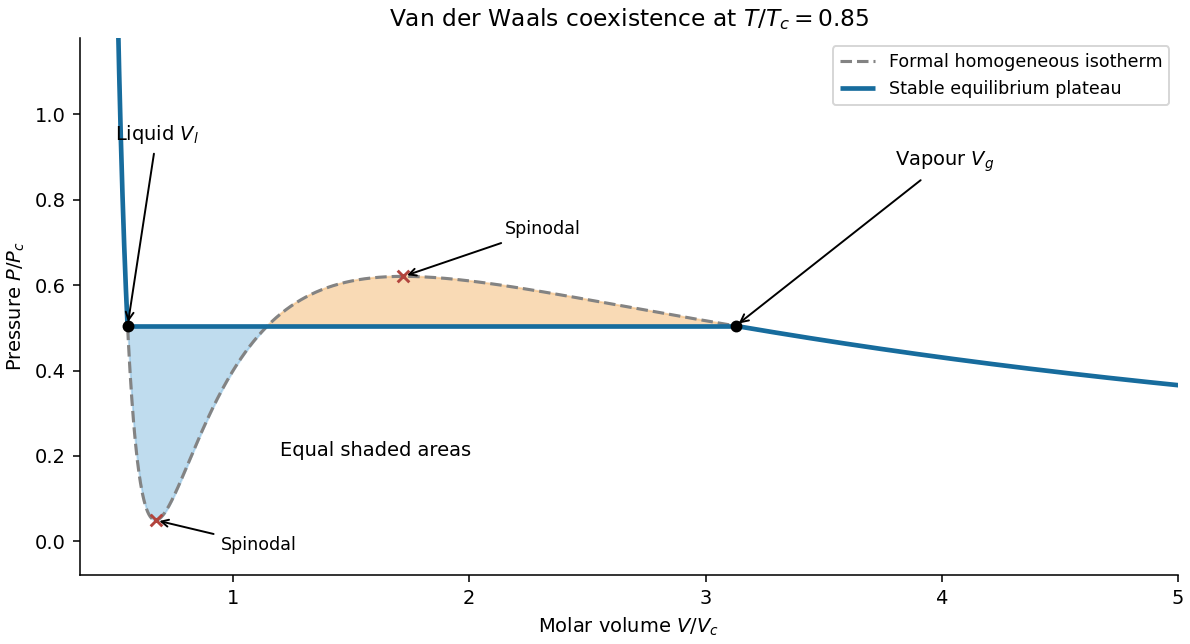
Original subcritical van der Waals isotherm showing the equal-area plateau, coexistence volumes and spinodals
. Details. Dense-phase volume at low temperature. At a general subcritical temperature, the two coexistence equations above must be solved together. For this equation of state the area condition is explicitlyThis supplies an exact implicit determination of the liquid volume even when a simple closed form is unavailable.
For the asymptotically low-temperature limit, put . The liquid is dense, , while the vapour is dilute, and . The area condition then givesThus the vapour volume grows exponentially in , and the saturation pressure is exponentially small. It is consequently consistent to neglect in the liquid equation to algebraic order in :Choose the root near , not the large-volume zero-pressure root:Expanding gives the leading requested dense-phase behavior,This is the low-temperature liquid volume of a van der Waals gas. Setting is an asymptotic approximation, not an exact coexistence condition at every temperature below . The figure illustrates generic subcritical coexistence; its finite-temperature liquid volume is determined by the full equal-area equations. The van der Waals liquid also ceases to be a realistic description at sufficiently low physical temperature, where other phases or quantum effects can matter.
Past exam of the physics B course of the University of Cambridge 2021 Paper 2 Section A A1 Solution 2026-10-18
This is the one-mole, or equivalently molar volume, form of the Van der Waals equation, an approximate equation of state for a real gas:Here is the gas pressure, its absolute temperature, the molar gas constant, and the volume occupied by one mole. If denotes molar volume explicitly, its units are .
The positive parameter represents excluded volume arising from the finite size and short-range repulsion of the molecules. The volume available for translational motion is reduced from to . This is an effective excluded volume, not simply the sum of the molecules' geometric volumes. Its molar units are .
The positive parameter measures intermolecular attraction in a mean-field approximation. Attractions reduce the force exerted on the walls, lowering the measured pressure by relative to the repulsion-only expression. Thus is the pressure corrected for this attraction. The squared inverse-volume dependence reflects a contribution proportional to the square of the molecular number density. The molar units of are .
For an arbitrary amount measured in moles, with total container volume , the corresponding formula isAt low density, when and , it reduces to the ideal gas law. The model captures qualitative attraction, repulsion and liquid-gas behavior, but does not supply an exact equation of state for every material.
The Van der Waals equation replaces the freely available volume by to represent short-range repulsion and excluded volume. The attractive mean field reduces the pressure by : particles near the boundary are pulled back into the gas, lowering their momentum transfer to the walls. Both are effective corrections, rather than an exact microscopic interaction law.
An equation of state relates equilibrium pressure, temperature and density. The ideal-gas form neglects intermolecular forces and excluded volume. A low-density real-gas expansion iswhere the virial coefficients encode interaction effects and generally depend on temperature.
A simple phenomenological example is the molar Van der Waals equationHere v is molar volume, b represents excluded volume and the attractive interaction lowers pressure through a. Its dilute expansion gives . It recovers the ideal-gas limit but is not a quantitatively universal equation for all real gases.
Below its critical temperature, the raw isotherm contains a region with , corresponding to negative isothermal compressibility and mechanical instability. Equilibrium phase separation replaces that segment by a coexistence pressure satisfying equal chemical potentials, equivalently the Maxwell equal-area construction. The critical point follows from :The distinction between an unstable homogeneous branch and a stable two-phase state is essential when interpreting a real-gas equation of state.
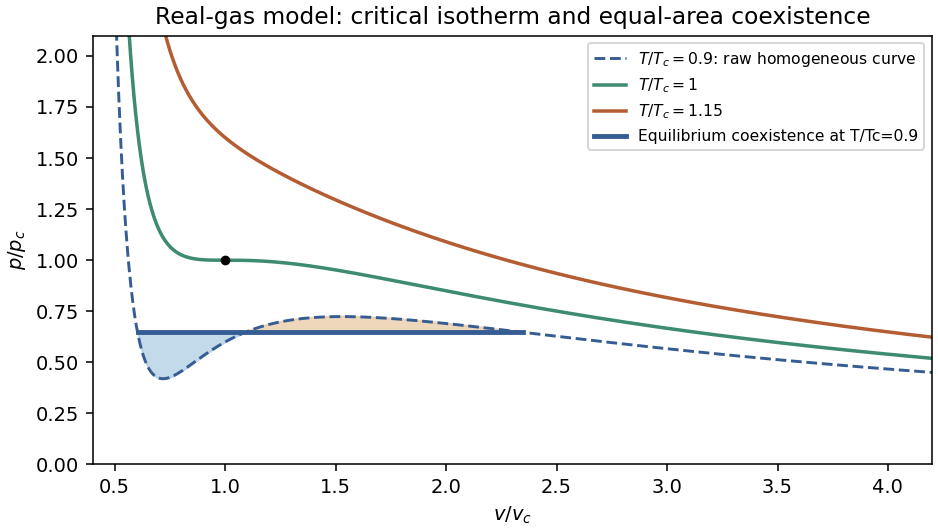


A non-ideal gas departs from because interactions and finite particle size affect its pressure. At sufficiently low number density , the virial expansion separates these corrections:The second virial coefficient has dimensions of volume per particle, while has dimensions of volume squared. These are density-series coefficients, not the coefficients of a pressure-series expansion with the same names.
For classical particles interacting through a pair potential ,Repulsion contributes positively and attraction negatively. A hard core of diameter gives , four times the geometric volume of one sphere. The factor reflects the volume excluded to the centre of a second particle together with pair counting; it is not simply the occupied geometric volume.
Expanding the Van der Waals equation at givesThe virial coefficients of the van der Waals gas are therefore and . The Boyle temperature, , makes the leading correction vanish, but does not remove the higher coefficients or turn the gas exactly ideal. More realistic potentials give temperature-dependent higher coefficients that need not equal the van der Waals values.
A useful measurement is a sequence of dilute isothermal pressure–volume observations. Plotting against exposes as the zero-density intercept and as its initial slope. Control temperature and density calibration, check equilibration and adsorption on the container walls, and vary the fitted density interval to test truncation error. One measured virial coefficient cannot uniquely reconstruct the pair potential. Near coexistence or a critical point a short density series may fail, and at quantum-degenerate densities exchange statistics add corrections even without interactions.