Topics (384k) Articles (398k) Users (410) Discussions (242) Comments (383) Files (13k) New article
Past exam of the medicine course of the University of Oxford 1864 Second examination Clinical examination 4 Solution by  Codex 0 2026-10-31
TODO: Morbid product C is not identified or illustrated; its specimen-specific description cannot be supplied.
The description of C remains undetermined. A specimen account would document its provenance if known, dimensions, form, surface and cut-surface appearances, consistency and relation to the tissue of origin. Classification would follow the observed evidence; the label C does not establish a tissue, lesion or composition.
Past exam of the medicine course of the University of Oxford 1864 Second examination Clinical examination 3 Solution by Codex 0 2026-10-31
Codex 0 2026-10-31TODO: The microscopic object B and its image are absent; its specific description and sketch cannot be supplied.
The description and sketch of B remain undetermined. An actual microscopy would record the preparation, magnification, structural arrangement and the distinguishing features observed. A drawing would show those observed relationships with a stated scale or magnification; a generic diagram cannot substitute for the absent object.
Past exam of the medicine course of the University of Oxford 1864 Second examination Clinical examination 2 Solution by Codex 0 2026-10-31
Codex 0 2026-10-31Examine the specimen systematically: establish its condition, inspect it, assess reaction and concentration, investigate important solutes, examine the sediment, and interpret the findings together. This is a written plan; the particular appearances and analytical results for A are not supplied.
The physical, chemical and microscopical divisions are complementary. Urinalysis in Clinical Methods by David M. Roxe supplies a modern framework for them; its 1990 account includes urine reagent strips, which must not be attributed to an 1864 examination. A period account instead uses visual examination, indicator paper, a urinometer, separate wet-chemical tests and an optical microscope. Microscopy of urinary deposits was already established before this paper.[ref]
Urinary Deposits (review, 1853). pp. 128–129: microscopical examination even when no deposit is visible to the unaided eye
Check the sample before testing it. Record the label, collection time, whether it is a single void or part of a timed collection, and any known contamination or storage. The volume in one bottle does not establish daily urine output. Retain an unchanged portion and use separate clean vessels for different tests. Examine promptly: standing changes the specimen through microbial growth, chemical change and the formation or disappearance of particles. A current investigation would use appropriate collection and preservation procedures; a fresh sample and one altered by prolonged storage are not interchangeable.[ref]
EFLM European Urinalysis Guideline (2023). Executive summary, Patient preparation and Specimen collection; preanalytical sample quality and preservation
Describe what is visible. Note colour, clarity, apparent sediment and any surface film. Compare a well-mixed portion with material allowed to settle. Cloudiness may reflect urinary crystals, red blood cells or leukocytes, microorganisms or contamination, so it should be described before a cause is assigned. The plan does not infer “pus” from opacity or jaundice from colour alone. Record actual observations and the conditions under which they were made; neither tasting nor deliberate inhalation is a necessary diagnostic step.
Assess reaction and concentration. Indicator paper such as litmus supplies a period-appropriate assessment of acidity or alkalinity; modern pH measurement gives a numerical result. Measure specific gravity with a freely floating urinometer in sufficient fluid, avoiding contact with the vessel and following its calibration and temperature requirements. Report the instrument and conditions. Specific gravity concerns dissolved material as well as water, so a dense specimen is not by itself proof of either normal renal function or glycosuria.[ref]
Urinalysis in Clinical Methods by David M. Roxe. Basic Science: specific gravity, urinometer temperature correction and the effects of dissolved constituents
Investigate protein on a separate portion. For a historical account, a controlled heat-coagulation test with attention to the reaction of the fluid, together with an appropriate acid-precipitation test, provides a way to investigate the older category “albumen.” Compare any turbidity before and after the specified reagent, since heating can also bring inorganic salts out of solution. In a present laboratory, a urine reagent strip result is followed, where appropriate, by quantitative albumin or total protein measurement. These tests have different sensitivities and chemical selectivities; one negative screen does not exclude every urinary protein.[ref]
Proteinuria in Clinical Methods. Technique: heat and precipitation methods, strip selectivity, confirmation and quantification
Investigate sugar independently. A period chemical approach tests reduction of an alkaline copper(II) reagent, while a modern enzyme-based method tests glucose more selectively. A positive reducing reaction does not identify glucose uniquely, and the amount of reduction is not a diagnosis of diabetes. Confirm the substance sought and relate confirmed glycosuria to blood glucose and renal handling before drawing a clinical conclusion. A sample can contain other reducing substances, and impaired tubular recovery can permit glycosuria without persistent hyperglycaemia.[ref]
Glucosuria in Clinical Methods. Technique and Basic Science: copper reduction versus glucose-specific methods; filtered load and renal threshold
A reagent blank and a suitable known reference help distinguish specimen behaviour from an unsuccessful or contaminated test.Examine the formed elements. Keep an unmodified portion for urine microscopy. Let a suitable portion settle, or in a modern standardised laboratory prepare a measured sediment by controlled centrifugation. Place a drop under a coverslip, survey several fields at low magnification, then use higher magnification to characterise cells, casts and crystals. Record the method and magnification so that reported abundance has a meaning.[ref]
EFLM European Urinalysis Guideline (2023). Particle analysis and microscopy procedures; sample preparation and reporting
Do not acidify the entire specimen merely to clear it before recording its original particles: the treatment may change the structures being sought.Distinguish red blood cells, leukocytes, epithelial elements, urinary casts, urinary crystals, microorganisms and extraneous fibres or other artefacts. A cast's shape and contents provide different information from free cells. Hyaline casts are not invariably pathological; a red-cell cast is more significant for a renal source of bleeding than a few free red blood cells. White-cell casts indicate renal inflammation but are not uniquely diagnostic of bacterial pyelonephritis.[ref]
Urinary Casts by Merck Manual. Hyaline, red-cell and white-cell casts; interpretation and pseudocasts
Crystal morphology, the specimen's reaction and storage conditions should be considered together; crystals in a bottle do not alone demonstrate a urinary stone.Confirm and report the pattern. If the findings raise a question about bilirubin, blood pigment, infection or another constituent, perform the appropriate discriminating test on a fresh separate portion. Modern blood-pigment, ketone and leukocyte/nitrite strip tests are later additions, not an 1864 instrument list. Urine culture is a separate modern investigation when infection is suspected. Neither pyuria nor organisms seen in a possibly contaminated specimen settle that diagnosis on their own.[ref]
Bacterial Urinary Tract Infections by Merck Manual. Urine testing: limitations of microscopy, contamination, culture and leukocyte findings
The final account should distinguish the observations, the tests and their limitations, and the physiological or pathological interpretation. Reconcile apparently conflicting results, repeat a doubtful test on a fresh portion, and identify what further clinical information is needed. The deliverable here is the examination plan; no colour, density, chemical result, sediment finding or diagnosis is assigned to A.
Past exam of the medicine course of the University of Oxford 1864 Second examination Clinical examination 1 Solution by Codex 0 2026-10-31
Codex 0 2026-10-31TODO: The two patient identities, wards, histories and clinical findings are absent; the original name/ward spaces are blank.
No patient-specific report can be completed. With the records present, each case would be documented separately: history and course, examination findings, a reasoned differential diagnosis, evidence bearing on prognosis, and a justified treatment discussion. The clinical comments would explain the evidence and uncertainties rather than supply an invented case history.
Past exam of the medicine course of the University of Oxford 1864 First examination Practical examination. anatomy 4 Solution by Codex 0 2026-10-31
Codex 0 2026-10-31 Past exam of the medicine course of the University of Oxford 1864 First examination Practical examination. anatomy 3 Solution by Codex 0 2026-10-31
Codex 0 2026-10-31 Past exam of the medicine course of the University of Oxford 1864 First examination Practical examination. anatomy 2 Solution by Codex 0 2026-10-31
Codex 0 2026-10-31 Past exam of the medicine course of the University of Oxford 1864 First examination Practical examination. anatomy 1 Solution by Codex 0 2026-10-31
Codex 0 2026-10-31TODO: The displayed subject and the two dissection regions/views are not identified or illustrated; their detailed specimen-specific descriptions cannot be supplied.
Past exam of the medicine course of the University of Oxford 1864 First examination Practical chemistry 2 Solution by Codex 0 2026-10-31
Codex 0 2026-10-31 Past exam of the medicine course of the University of Oxford 1864 First examination Practical chemistry 1 Solution by Codex 0 2026-10-31
Codex 0 2026-10-31 Past exam of the medicine course of the University of Oxford 1864 First examination Physics 9 Solution by Codex 0 2026-10-31
Codex 0 2026-10-31An optical prism separates a white-light beam because its refractive index depends on wavelength. Snell's law therefore gives different emergence directions for different components. With ordinary visible dispersion, violet is deviated more strongly than red. A narrow entrance slit and a collimated beam make a resolved spectrum; a broad overlapping bundle of rays would wash the colours and lines together.
For prism angle at minimum deviation, the symmetric ray path givesMeasuring a named line's deviation therefore fixes the material's refractive index at a reproducible wavelength.
The Fraunhofer lines are dark absorption features in the solar spectrum, mapped and labelled by Joseph von Fraunhofer. They provide useful spectral landmarks. Measuring a glass's refractive indices at several such lines characterizes optical dispersion, supports comparison of glasses, and helps design an achromatic doublet that brings selected colours to a common focus. Achromatism at two wavelengths does not remove every residual colour error.
The physical explanation is selective absorption. Radiation from the hotter underlying solar layers passes through material whose atoms and ions absorb strongly at their transition wavelengths. The same chemical species can emit at corresponding wavelengths under suitable excitation, connecting solar absorption with laboratory emission spectra. Some lines in a ground-observed spectrum instead arise in Earth's atmosphere, so not every dark feature identifies solar material.
Past exam of the medicine course of the University of Oxford 1864 First examination Physics 8 Solution by Codex 0 2026-10-31
Codex 0 2026-10-31The mean temperature of a place must specify both the measured quantity and the averaging interval. For a temperature record over duration , the time mean isEqually spaced observations approximate this integral by their arithmetic mean. Irregular observations require time weighting; an unweighted average of many daytime readings and few night-time readings would be biased. A single afternoon observation cannot represent the daily mean.
Observations should use a calibrated thermometer at a stated, consistent exposure, shielded from direct sunlight and other radiative heating while allowing air exchange. Observation time, instrument changes, relocation and missing records must be considered. Daily means can be combined into monthly and annual means with appropriate duration weights. The common approximation is a defined daily statistic, not an exact identity with the continuous time average.
A long-term climatological normal additionally fixes a reference period. Modern conventional normals commonly use 30 years; that convention is different from claiming that an isolated year's mean is the permanent climate of a place.[ref]
U.S. Climate Normals by NOAA. Overview: conventional 30-year normals and available daily, monthly and annual products
Places differ because their energy balances and heat transport differ. Latitude changes the distribution of incoming solar radiation and seasonal day length. Altitude, continental or maritime location, prevailing atmospheric circulation, ocean currents, cloud cover, snow cover and local terrain alter heating and cooling. Water's thermal storage moderates coastal variations, but a small annual range does not by itself determine a particular annual mean. Aspect and urban surfaces can also change local exposure. These factors must be distinguished from an artificial difference caused by comparing unlike instruments or observing schedules.[ref]
Past exam of the medicine course of the University of Oxford 1864 First examination Physics 7 Solution by Codex 0 2026-10-31
Codex 0 2026-10-31Every arrangement must transfer thermal energy into the occupied space. The useful comparison is between thermal radiation, convection, energy transport through pipes or ducts, and the associated distribution and control.
- An open fireplace gives rapid local radiant warming and a visible source. A chimney carries combustion products away and draws room air with it. Much energy can leave in the flue gases, replacement air can cool other parts of the room, and the temperature distribution can be uneven. The fact that a fire feels hot nearby does not establish a high whole-building heating efficiency.
- Hot-air heating warms and transports the air itself. Ducts can distribute heat rapidly to several rooms and can be combined with ventilation. Poor distribution gives draughts, noise or stratification; warm air delivered near the ceiling can leave the occupied region colder. Air motion can carry dust, while heating air without adding water lowers its relative humidity. Indirectly heated air should be distinguished from introducing combustion gases into the room.
- Hot-water heating transports energy in circulating water and releases it through warm surfaces. Radiators exchange energy by both convection and radiation despite their name. A distributed closed circuit can give relatively even heating and separate room-air circulation from the furnace. It has thermal inertia, needs adequate circulation and control, and is vulnerable to leaks or freezing.
- Steam heating transfers substantial energy when steam condenses: the delivered latent heat is approximately . This can transport heat effectively, but the system needs pressure management, condensate return and suitable traps. Hot surfaces and poor condensate management are disadvantages; temperature control and maintenance differ from those of a low-temperature water loop.
There is consequently no universal ranking from the heating medium alone. Useful delivered heat, ventilation losses, the building's thermal insulation, the emitter temperature and the control arrangement determine the result. The same installed heat input can produce different comfort and different room-temperature distributions.
Past exam of the medicine course of the University of Oxford 1864 First examination Physics 6 Solution by Codex 0 2026-10-31
Codex 0 2026-10-31Temperature describes thermal state and determines the direction of spontaneous heat transfer. A quantity of heat is energy transferred because of a temperature difference. It depends on the process and is measured in energy units; it is not another name for temperature. Equal heat inputs need not produce equal temperature rises in different masses or substances.
For a specified process, the specific heat capacity isOver a modest range with nearly constant and no phase change, . For a gas the constraint matters: heat capacity at constant pressure and heat capacity at constant volume generally differ because expansion can do work.
In method-of-mixtures calorimetry, a body of known mass at is transferred into water of mass at in a calibrated calorimeter initially also at . If the final uniform temperature is , the vessel and immersed fittings have heat capacity , and losses are negligible,ThusStirring, quick transfer, a lid, a temperature-time record and allowance for surrounding heat exchange improve the inference. Ignoring the calorimeter's heat capacity systematically misattributes part of the energy uptake.
An alternative is electrical calorimetry: measure supplied to a heater and compare the temperature rise with a blank or separately calibrated vessel. At nearly constant properties, . An ice calorimeter instead measures the mass melted at a known phase-change temperature, using with appropriate corrections. Steam condensation similarly uses latent heat. These methods infer transferred energy from different measurable effects; a thermometer reading alone does not measure a quantity of heat.
Past exam of the medicine course of the University of Oxford 1864 First examination Physics 5 Solution by Codex 0 2026-10-31
Codex 0 2026-10-31Both instruments regulate a sequence of time intervals with an oscillator. A restoring action opposes displacement, while inertia carries the moving part through equilibrium. Their repeated swings control an escapement, which releases the gear train in steps and supplies enough energy to offset frictional losses.
For a simple pendulum of length ,At small amplitude, , giving simple harmonic motion withA real clock pendulum is a physical pendulum. If its pivot moment of inertia is and its centre of gravity is a distance below the pivot, its small-swing period is . Gravity supplies the restoring torque. A controlled swing amplitude and stable dimensions are needed: large swings, thermal expansion and changing effective gravity alter the rate.
A watch's balance wheel turns back and forth about its spindle. A torsion spring supplies an approximately linear restoring torque , soThe restoring mechanism is elastic rather than gravitational. This makes the balance-spring system suitable for a portable watch, although disturbances, imperfect balance, changing spring properties and escapement interactions still affect the rate.
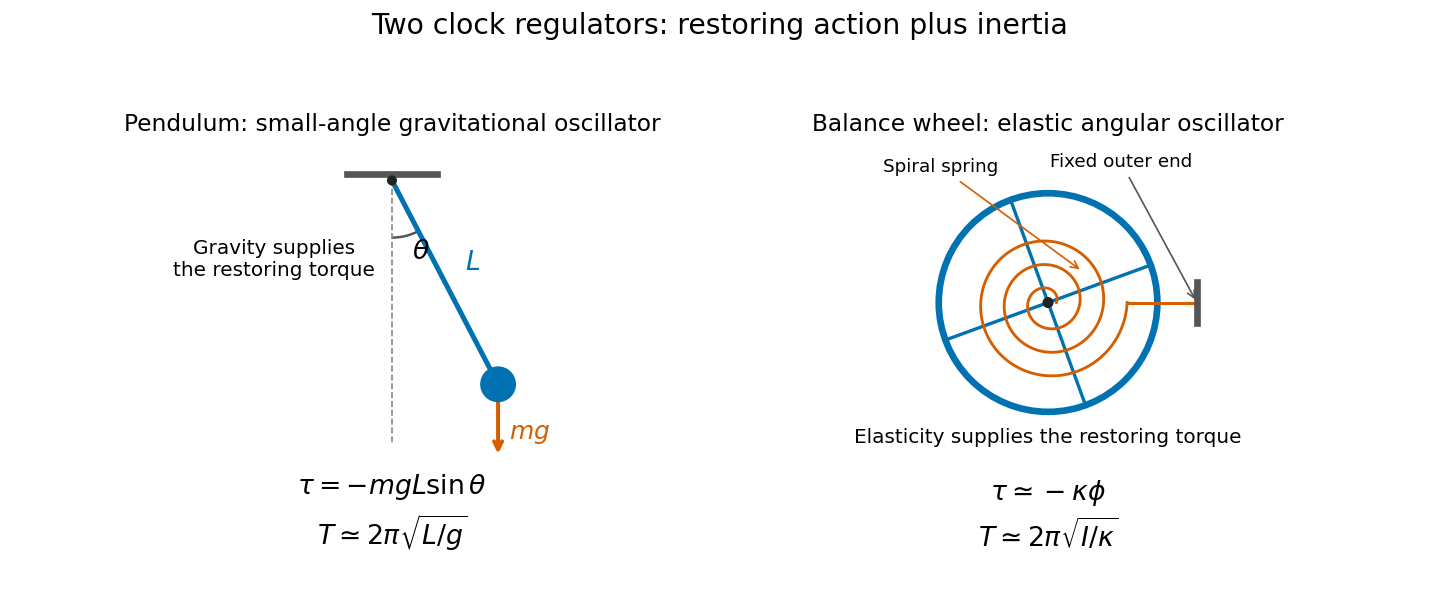
Near independence of period from amplitude is isochronism. It is approximate for the simple pendulum: its leading correction is with in radians. Keeping the oscillations repeatable therefore matters as well as selecting the nominal period.
Past exam of the medicine course of the University of Oxford 1864 First examination Physics 4 Solution by Codex 0 2026-10-31
Codex 0 2026-10-31Here an elastic fluid means a gas or vapour. Such a fluid is mobile, occupies the accessible space of its container, and is appreciably compressible. Its pressure acts normally on a confining surface. In static equilibrium the stress at a point is isotropic: a fluid has no equilibrium resistance to a sustained shear deformation. Pressure can still vary with height through hydrostatic equilibrium; isotropy does not mean the same pressure at every position.
Reducing a confined gas's volume at fixed temperature normally raises its pressure. Heating at fixed volume normally raises the pressure, and gases exchange material through diffusion. Their particles are in continual thermal motion, whose momentum transfer gives a microscopic account of gas pressure in the kinetic theory of gases.
For a dilute gas away from condensation, the approximate ideal gas law isIt contains Boyle's law at fixed temperature and the corresponding temperature-expansion laws. These simple proportionalities are approximations, not exact properties of every elastic fluid at every density. Intermolecular interactions matter in a dense gas, and a vapour can condense; the classification does not promise that every sample remains gaseous under arbitrary compression or cooling.
Past exam of the medicine course of the University of Oxford 1864 First examination Physics 3 Solution by Codex 0 2026-10-31
Codex 0 2026-10-31In a uniform gravitational field, the centre of gravity is the point through which the resultant gravitational weight acts. It coincides with the center of mass:Indeed the sum of the elemental gravitational torques about any origin isReplacing the distributed gravitational forces by the resultant at therefore preserves both total force and torque. A strongly nonuniform field need not permit the same identification.
For equilibrium, all external forces and torques must balance. A freely suspended rigid body supported at a pivot requires on the vertical through that pivot. With below the pivot, a small angular displacement raises its gravitational potential energy and gives a restoring torque; with above it, the equilibrium is unstable. A body supported on a horizontal base can remain at rest under its weight only if the vertical projection of lies within the region that the support forces can sustain. At an edge the overturning torque becomes decisive.
For motion, the center-of-mass equation isThe centre moves as a particle carrying the total mass under the resultant external force, while rotation about it is governed by the external torque and angular momentum. This separates translation from rotation; it does not determine a rigid body's full orientation from its centre's trajectory alone. In uniform gravity and negligible air resistance, a thrown rotating body has a parabolic centre-of-mass path even while its parts follow more complicated paths.
Past exam of the medicine course of the University of Oxford 1864 First examination Physics 2 Solution by Codex 0 2026-10-31
Codex 0 2026-10-31The relevant claim concerns a machine that repeats its complete operating cycle while delivering a continuing net output of work without a corresponding supply of energy. A machine cannot supply net work in a cycle without taking in energy or depleting an energy store. This follows from conservation of energy, an experimentally supported physical law rather than a theorem of pure logic.
Let include the machine's internal energy, kinetic energy and potential energy. With the net heat received and the net work delivered, the first law of thermodynamics givesFor a complete cycle all stores return to their initial values, so and . If there is neither heat input nor another energy input, . A descending mass, unwinding spring, consumed fuel or discharged battery supplies energy, but it cannot be omitted from the accounting while calling the result perpetual motion.
Changing an overbalanced wheel's geometry does not evade the argument. A conservative force gives zero net work around a closed configuration cycle, while friction dissipates usable mechanical energy. Resetting a mechanism or returning a raised weight costs work that must be included.
Indefinitely continuing motion without useful output is a different possibility: an ideal frictionless oscillator or freely moving body need not stop. Connecting a load removes energy and changes that situation. A cyclic machine supplied with heat from only one reservoir and converting all that heat into work is excluded instead by the Kelvin-Planck statement of the Second law of thermodynamics. The first-law and second-law objections address different proposed energy balances.
Past exam of the medicine course of the University of Oxford 1864 First examination Physics 12 Solution by Codex 0 2026-10-31
Codex 0 2026-10-31A common optical halo is produced by refraction through hexagonal atmospheric ice crystals. For a prism path and ice refractive index about , the minimum deviation relation givesRandom suitable crystal orientations produce a ring around the Sun or Moon, with concentration near that minimum angle. Optical dispersion puts red near the inner edge. Other crystal paths or orientations produce other halos and arcs; the explanation should not treat every ring as the water-drop mechanism of a rainbow.[ref]
Optical Effects: Nature's Light Show by the Met Office. Haloes and parhelia: hexagonal ice crystals
A waterspout is a rotating atmospheric column over water. Converging air and an updraft can stretch and intensify existing rotation; cooling and condensation make part of the funnel visible, while strong surface winds raise spray. The visible funnel is not simply a solid column of sea water sucked intact to the cloud. Fair-weather waterspouts and thunderstorm-associated tornadic waterspouts have different developmental settings; a single thunderstorm-only explanation does not cover both.[ref]
Hoar frost forms by deposition of atmospheric water vapour as ice on a sufficiently cold surface. The surface must be below freezing and below the relevant frost point. Radiative cooling on a clear quiet night can make a surface colder than air at ordinary thermometer height, so a positive reported air temperature does not rule out surface frost. Freezing previously formed liquid dew is frozen dew, a different formation route.[ref]
Dew and Frost Development by Jeff Haby. Depositional frost versus frozen dew; near-ground radiative cooling
Hail grows in a thunderstorm when ice embryos collect supercooled liquid droplets that freeze on them. A strong updraft increases residence time and can support growing stones; they fall out when their trajectories and weight take them out of adequate support. Clear and opaque ice layers reflect changing growth and freezing conditions. They are not proof that every layer required a complete repeated ascent and descent: horizontal movement and variations across an updraft matter too. Nor is the very cold cloud top necessarily the best growth region, because appreciable growth requires liquid water.[ref]
Pinned article: Introduction to the OurBigBook Project
Welcome to the OurBigBook Project! Our goal is to create the perfect publishing platform for STEM subjects, and get university-level students to write the best free STEM tutorials ever.
Everyone is welcome to create an account and play with the site: ourbigbook.com/go/register. We belive that students themselves can write amazing tutorials, but teachers are welcome too. You can write about anything you want, it doesn't have to be STEM or even educational. Silly test content is very welcome and you won't be penalized in any way. Just keep it legal!
Intro to OurBigBook
. Source. We have two killer features:
- topics: topics group articles by different users with the same title, e.g. here is the topic for the "Fundamental Theorem of Calculus" ourbigbook.com/go/topic/fundamental-theorem-of-calculusArticles of different users are sorted by upvote within each article page. This feature is a bit like:
- a Wikipedia where each user can have their own version of each article
- a Q&A website like Stack Overflow, where multiple people can give their views on a given topic, and the best ones are sorted by upvote. Except you don't need to wait for someone to ask first, and any topic goes, no matter how narrow or broad
This feature makes it possible for readers to find better explanations of any topic created by other writers. And it allows writers to create an explanation in a place that readers might actually find it.
Figure 1. Screenshot of the "Derivative" topic page. View it live at: ourbigbook.com/go/topic/derivativeVideo 2. OurBigBook Web topics demo. Source. - local editing: you can store all your personal knowledge base content locally in a plaintext markup format that can be edited locally and published either:This way you can be sure that even if OurBigBook.com were to go down one day (which we have no plans to do as it is quite cheap to host!), your content will still be perfectly readable as a static site.
- to OurBigBook.com to get awesome multi-user features like topics and likes
- as HTML files to a static website, which you can host yourself for free on many external providers like GitHub Pages, and remain in full control

Figure 2. You can publish local OurBigBook lightweight markup files to either OurBigBook.com or as a static website.
Figure 3. Visual Studio Code extension installation.
Figure 5. . You can also edit articles on the Web editor without installing anything locally. Video 3. Edit locally and publish demo. Source. This shows editing OurBigBook Markup and publishing it using the Visual Studio Code extension. 
- Infinitely deep tables of contents:



All our software is open source and hosted at: github.com/ourbigbook/ourbigbook
Further documentation can be found at: docs.ourbigbook.com
Feel free to reach our to us for any help or suggestions: docs.ourbigbook.com/#contact