Topics (384k) Articles (398k) Users (410) Discussions (242) Comments (383) Files (13k) New article

Brendan McKay is a researcher in computational graph theory and an emeritus professor at the Australian National University. His institutional homepage identifies nauty as software for graph isomorphism and graph automorphisms.[ref]
Brendan McKay homepage at Australian National University. Biographical heading and Software
A graph automorphism is a relabeling that preserves adjacency within a graph. For an original cycle on four vertices, choose the image of one vertex in4 ways and then choose which of its two neighbors receives the next vertex in2 ways. The remaining images are forced, givingThese relabelings form a group. Computing such symmetries can avoid repeating equivalent branches of a structural search.
Graph canonical labeling addresses a complementary problem: assign a representative encoding so that isomorphic graphs receive the same canonical result. This makes it possible to compare structures whose input vertex names differ or to remove duplicate generated graphs. McKay's work on nauty made these tasks practical for many graph classes.
With Adolfo Piperno, he described the mathematical basis of individualization-refinement graph search and the implementations in nauty and Traces graph isomorphism software. Their paper connects the validity of the search framework with performance comparisons, while distinguishing the practical algorithms from a general worst-case efficiency claim.[ref]
Practical graph isomorphism, II by Brendan D. McKay and Adolfo Piperno. Introduction, refinement-individualization framework and program comparisons
Adolfo Piperno is a computer scientist at Sapienza University of Rome whose work includes algorithms for graph isomorphism and graph canonical labeling. His institutional profile identifies him in the Department of Computer Science.[ref]
Adolfo Piperno profile at Sapienza University of Rome. Departmental profile and linked university research description
Piperno introduced the approach implemented in Traces graph isomorphism software, studying how to reduce the search needed for canonical labeling. His paper examines refinement of vertex classes, the choice of vertices to individualize, search order and the use of discovered graph automorphisms.[ref]
Search Space Contraction in Canonical Labeling of Graphs by Adolfo Piperno. Abstract and introduction, individualization/refinement and Traces
An original small example illustrates individualization-refinement graph search. For the four-vertex path , grouping vertices by their numbers of neighbors first gives classes and . Give vertex1 a unique marker. Neighbor counts relative to that singleton then distinguish vertex2 from vertex3, and further refinement separates the remaining vertices. Choosing vertex4 instead produces the reflected ordering. A canonical-labeling procedure must account for such equivalent choices rather than depend on the input vertex names.
This example explains the basic mechanism, not every heuristic in Traces. Piperno and Brendan McKay later described both nauty and Traces within a common framework and compared their behavior on graph families.[ref]
Practical graph isomorphism, II by Brendan D. McKay and Adolfo Piperno. Abstract; framework and implementations
Anant Agarwal is a computer scientist and electrical engineer whose work includes computer architecture, multicore processors and circuit education. MIT's departmental profile lists computer architecture among his research areas, while his CSAIL profile describes work involving multicore computing and authorship of a circuits textbook.[ref]
Anant Agarwal profile by MIT CSAIL. Biography and textbook paragraph; linked MIT EECS research-area listing
The MIT lecture State and Memory by Anant Agarwal and Jeffrey Lang, jointly credited with Jeffrey Lang, connects analog stored state to computer memory. A capacitor can summarize prior input by one state quantity, such as stored electric charge ; digital storage then adds a rule for distinguishing logical values. The slides explicitly introduce capacitor state, zero-input response, zero-state response and a one-bit memory abstraction.[ref]
State and Memory by Anant Agarwal and Jeffrey Lang. PDF pp.3–9, State, Why memory? and Memory Abstraction
For an original physical-memory example, let a capacitor initially hold and leak through a resistor. With no driving input,If a stipulated readout interprets values above as the stored high state, the ideal decay reaches that threshold afterThe initial stored electric charge is , but the logical interpretation also depends on leakage, the elapsed time and the decision threshold. This is a teaching model, not a specification for a particular memory chip.
The example exposes why merely retaining some electric charge is different from reliably retaining a bit. A practical memory circuit must preserve distinguishable states over the required interval and allow the state to be read. Agarwal and Lang's lecture uses the state concept to connect the circuit's dynamics with that information-storage task.
Robert D. Feltham coauthored Principles of structure, bonding, and reactivity for metal nitrosyl complexes by John H. Enemark and Robert D. Feltham.
The study concerns metal nitrosyl complexes, where assigning electrons separately to the metal and nitric-oxide ligand can be ambiguous. Counting the metal d electrons together with the nitric-oxide antibonding electrons provides a useful classification without pretending that every complex has one uniquely localized oxidation-state description.
Dmitri Mendeleev organized the chemical elements by recurring chemical properties and used the arrangement to predict missing entries. His account of the periodic law emphasized that gaps and uncertain atomic weights could be tested against similarities within chemical families.[ref]
The Periodic Law of the Chemical Elements by Dmitri Mendeleev. 1889 Faraday Lecture: development of the periodic system and predictions of missing elements
The method was predictive rather than merely a sorted list: a proposed missing element had to fit several properties at once, including the compositions of its compounds. Modern ordering uses atomic number, which distinguishes elemental identity from average isotopic atomic mass. Mendeleev's historical atomic-weight ordering and the modern organizing principle should therefore be kept distinct.
Raphaël Plasson analyzed autocatalysis with collaborators, distinguishing mechanisms that produce superficially similar self-accelerating behaviour. Their study compared chemical mechanisms, kinetic equations and dynamical patterns rather than defining every increasing reaction rate as autocatalytic.[ref]
Autocatalyses by Raphaël Plasson and others. Sections 2–3: definitions, competing pathways and simple models
For the idealized reaction , law of mass action gives ; with conserved , this becomes . The product promotes its own formation, but substrate depletion limits indefinite exponential growth. The kinetic assumptions and uncatalyzed background pathway matter when identifying an experimental autocatalytic effect.
J. P. Icenhower contributed to the joint PNNL programme quantifying waste-glass dissolution and its dependence on solution conditions.[ref]
Durability comparisons must normalize the exposed surface area and the constituent fraction being measured. Otherwise a change in particle size or bulk composition can masquerade as a different intrinsic corrosion rate.
P. F. Martin co-investigated the durability of low-activity waste glass in the FY2000 PNNL report, including flow-through corrosion tests.[ref]
A simple mass balance illustrates why volumetric flow rate matters: exported solute per unit time equals volumetric volumetric flow rate times the inlet-to-outlet concentration increase. Equal outlet concentrations at different flow rates therefore need not mean equal release rates.
D. R. Rector contributed to PNNL's FY2000 waste-glass durability investigation, combining dissolution measurements with reactive-transport modelling.[ref]
The distinction between reaction and transport is essential: a surface can release material rapidly while a restricted pathway exports it slowly. A predictive model must therefore combine chemical source terms with fluid transport, rather than treating an outlet concentration as an intrinsic material constant.
H. T. Schaef contributed to the joint PNNL investigation of waste-glass corrosion under controlled solution chemistry and temperature.[ref]
Low-Activity Waste Glass Studies: FY2000 Summary Report by B. P. McGrail and others. Byline and sections 2.1–2.2
In dissolution experiments, changing pH changes the chemical environment at the surface. Comparing such tests can probe reaction dependence, provided temperature, available surface area and transport are also controlled.
E. A. Rodriguez co-investigated aqueous waste-glass dissolution in PNNL's FY2000 study, which varied solution conditions while measuring constituent release.[ref]
Low-Activity Waste Glass Studies: FY2000 Summary Report by B. P. McGrail and others. Byline and sections 2.1–2.2
For the single-pass flow-through leach test, an inlet blank distinguishes material released by the glass from material already present in the feed. Without that subtraction, a small measured outlet concentration need not represent a small net corrosion flux.
J. L. Steele contributed to the PNNL study of waste-glass dissolution using controlled flow-through experiments. The joint report relates measured element release to glass durability.[ref]
Low-Activity Waste Glass Studies: FY2000 Summary Report by B. P. McGrail and others. Title-page byline and section 2
The single-pass flow-through leach test measures exported material, not simply a change in the specimen's apparent size. A comparison of released constituents also tests whether the dissolution follows the solid's bulk stoichiometry.
J. D. Kemp is a chemist credited with K. S. Pitzer on the 1937 paper The Entropy of Ethane and the Third Law of Thermodynamics. Hindered Rotation of Methyl Groups by J. D. Kemp and Kenneth S. Pitzer. The paper connects molecular internal rotation with entropy and the third law of thermodynamics; the originating record identifies Kemp by initials.[ref]
The Entropy of Ethane and the Third Law of Thermodynamics. Hindered Rotation of Methyl Groups by J. D. Kemp and Kenneth S. Pitzer. JACS 59(2),276–279, published 1 February 1937; byline and title.
The physical question is whether rotation around a carbon-carbon bond can be treated as free or whether angle-dependent potential energy must be included. For example, a model assigns the same energy to every orientation; a threefold model distinguishes staggered conformations from eclipsed conformations. Such models predict different populations of orientations and therefore different contributions to entropy. The example explains the thermodynamic relevance of the paper's question; it is not a reconstructed numerical result from the 1937 experiment.
Kemp's verified contribution here is coauthorship of that focused physical-chemistry study. The bibliographic evidence does not assign a separate apparatus design or calculation to each coauthor, and it does not establish a full name or a portrait.
L. L. Lucas authored a 2000 comparison of water standards containing tritium, using liquid scintillation counting to measure their massic activity ratios. Massic activity is radioactive activity divided by sample mass. The work compared these measured ratios with ratios obtained from recorded mass-based dilutions, finding agreement within the stated measurement uncertainties.[ref]
Massic Activity Ratios of the NBS/NIST Tritiated-Water Standards Issued Between 1954 and 1999 by L. L. Lucas. Abstract, Journal of Research of NIST 105 (2000), pp. 535–539; DOI 10.6028/jres.105.042.
The comparison illustrates an important measurement calibration principle: independently obtained ratios can test consistency without making every source of error disappear. Agreement between counting and dilution supports the relationship between the standards. It does not imply zero measurement uncertainty, nor does it by itself establish an absolute radioactive activity scale. The study's contribution was a quantitative connection between reference samples, rather than simply a count from one detector.[ref]
Massic Activity Ratios of the NBS/NIST Tritiated-Water Standards Issued Between 1954 and 1999 by L. L. Lucas. Abstract: measured ratios versus gravimetric-dilution ratios.
Lloyd A. Currie prepared the 1995 IUPAC recommendations on evaluating analytical methods, including detection and quantification capabilities. A central contribution was to separate an observed-result decision from the capability of a measurement process. A detection decision threshold controls the chance of a false positive, while a limit of detection also depends on the chance of missing a real signal.[ref]
Nomenclature in evaluation of analytical methods including detection and quantification capabilities by Lloyd A. Currie. IUPAC Recommendations1995, §§3.7.2–3.7.3, especially p.1709: critical values, detection capability and error probabilities.
An original idealized example makes the distinction visible. Suppose the blank-corrected measurement has a normal distribution with standard deviation one. A threshold near gives a 5% type I error under a zero-mean blank model. A true mean near places that same threshold about standard deviations below the mean, giving about 95% detection probability, or 5% type II error.
The two signal levels answer different questions: whether one observed result crosses a decision boundary, and how strong a true signal must be for reliable detection under the assumed process. These numbers belong to the stated model; they are not universal detection limits for instruments.
Ala Bazyleva works on chemical thermodynamics and the quality of thermophysical-property data. Her named profile at the National Institute of Standards and Technology describes research involving measurements, thermodynamic modeling and critical data assessment.[ref]
She is corresponding author and task-group chair of a 2021 technical report proposing seven reference binary systems for liquid-liquid equilibrium studies. The work evaluates existing measurements, recommends property values with measurement uncertainty, and provides equations for comparison within stated experimental ranges. Its contribution is a defensible reference for checking instruments and methods, rather than treating any previously published number as equally reliable.[ref]
Reference Materials for Phase Equilibrium Studies. 1. Liquid-Liquid Equilibria by Ala Bazyleva and others. Title-page byline and footnote; Abstract and Introduction
An original comparison illustrates the role of uncertainty. Suppose a reference mole fraction is 0.200 with standard uncertainty 0.002, and an independent measurement gives 0.206 with standard uncertainty 0.001. If those uncertainties describe independent contributions, the standard uncertainty of their difference isThe observed difference 0.006 is about 2.68 times that scale. Comparing only the central numbers would miss how strongly the result depends on the reference and measurement uncertainties. This stipulated diagnostic is not a universal acceptance threshold or a numerical result from Bazyleva's report.
A useful experimental check also matches temperature, pressure and composition conventions to the reference conditions. A precise instrument can disagree with a reference because it examined a different state, so agreement tests need both a defined measurand and a supported uncertainty statement.
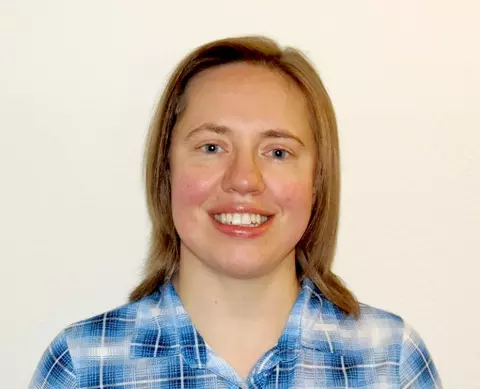
Ala Bazyleva, named portrait linked from her NIST staff profile
. Duncan Thorburn Burns is an analytical chemistry researcher named with Klaus Danzer and Alan Townshend as preparing the 2002 IUPAC recommendations on recovery terminology. The paper's full byline identifies Burns at Queen's University Belfast; its publisher record abbreviates him as D. T. Burns.[ref]
Use of the term "recovery" and "apparent recovery" in analytical procedures by D. T. Burns and others. printed p. 2201, full-name byline and affiliation; publisher landing-page byline
The recommendations distinguish extraction recovery, the yield of a separation or preconcentration step, from apparent recovery, the ratio of an analytically obtained value to a reference value after measurement calibration. These answer different scientific questions: how much analyte reaches the measurement stage, and how the final reported result compares with its reference.[ref]
Use of the term "recovery" and "apparent recovery" in analytical procedures by D. T. Burns and others. Abstract, distinction between extraction/preconcentration yield and observed/reference value
An original controlled-response example shows why even an apparent recovery of one can conceal a loss. Stipulate a preparation starting with of analyte, of which reaches a final solution. The extraction recovery is . Suppose a clean-solvent standard produces one arbitrary signal unit per , while the final sample matrix multiplies the response by . The extract then produces ten signal units. A clean-solvent measurement calibration converts that signal to , equal to the reference concentration for complete recovery:The stipulated signal enhancement exactly compensates for the extraction loss in this example. Agreement of the final result with the reference does not identify either mechanism separately.
A comparison measurement could introduce equal nominal quantities before extraction, after extraction into a matched blank extract, and into clean solvent, with matched final volumes and instrument settings. Comparing their responses separates preparation losses from a response change caused by the sample matrix, under the stated linear-response assumptions. The analytical matrix effect article explains the response distinction. Repeating the example with a matrix-matched calibration slope of gives : the apparent recovery then becomes . The number depends on the analytical procedure and its calibration, rather than on extraction yield alone.
Burns and his collaborators' terminology makes those experimental distinctions explicit. A reported recovery value therefore needs its definition, reference and calibration procedure; the percentage by itself leaves the measurement ambiguous.
Ahmed H. Zewail developed experiments for observing chemical dynamics on the femtosecond time scale and helped establish femtochemistry. His author-hosted Nobel Lecture describes the development of pump-probe spectroscopy and coherent molecular wave packets, connecting controlled optical delays with time-dependent chemical signals. Caltech's memorial records his 1946–2016 dates and the 1999 Nobel Prize in Chemistry.[ref]
Femtochemistry: Atomic-Scale Dynamics of the Chemical Bond Using Ultrafast Lasers by Ahmed H. Zewail. author Nobel Lecture, Prologue and Femtochemistry: Development of the Field
[ref]Ahmed Zewail memorial at Caltech. opening biographical account and Nobel recognition
The key experimental idea is to prepare a synchronized ensemble with a short pump pulse and measure a selected response with a later probe. Scanning their delay samples changing populations or configurations. It is not a sequence of conventional camera photographs of one molecule; the observation is a delay-dependent signal interpreted through a physical model.
His femtosecond sodium iodide photodissociation experiment supplies an illuminating example. The lecture's NaI account compares signals probing the evolving molecular complex with signals detecting free fragments. Oscillations in the complex signal and structured fragment production reveal motion between ionic and covalent regions, rather than merely one featureless exponential decay. The experiment connects a prepared wave packet, changing internuclear separation and the appearance of products.[ref]
An original apparatus calculation shows why optical delay is useful. Moving a retroreflecting mirror by changes the path by and the vacuum delay by . A translation changes the delay by about . Measuring a mechanical displacement can therefore control a time interval far shorter than a mechanical shutter could directly open and close.
The calculation is not a specification of a particular Zewail apparatus. Pump and probe durations, overlap and the selected detection channel determine its temporal response; an arbitrarily small delay step does not guarantee corresponding time resolution. The important contribution is the controlled link between preparation, delay and a chemically interpretable observation.

Ahmed H. Zewail, portrait identified in Caltech's named memorial
. Michel Vert chaired IUPAC's project on terminology for biorelated polymers and coauthored the resulting 2012 recommendations. The project explicitly addressed materials intended to function for a limited time in biomedical applications.[ref]
Terminology for biorelated polymers and applications project by IUPAC. chairman and project description
Its scientific motivation is to distinguish what happens to a material from what an application hopes it will do.For example, hydrolysis of susceptible backbone bonds, diffusion of water into a specimen and escape of soluble fragments need not occur on the same timescale. A decrease in molecular size is not identical to complete removal of a device or its products from the body.
An original scale estimate compares water diffusion over distance with a first-order cleavage model. The characteristic times areChoose , and . Then while . Water can penetrate this idealized length before extensive cleavage. Reducing by a factor of reverses that ordering. The model neglects swelling, changing transport and reaction products; it illustrates why specimen dimensions and transport can alter degradation patterns even at a fixed reaction rate.
Testing a temporary biomaterial therefore needs separately defined observations: changes in molecular structure, retained mass, mechanical function and the fate of released products. These model comparisons explain the project motivation and are not clinical predictions or experimental values attributed to Vert.
Yoshiharu Doi coauthored the 2012 IUPAC recommendations on terminology for biorelated polymers. This contribution connects polymer chemistry with precise descriptions of materials and their biological applications.[ref]
Terminology for biorelated polymers and applications (IUPAC Recommendations 2012) by Michel Vert and others. published full byline and scope
A useful scientific distinction is between a copolymer's overall composition and the arrangement of its monomers along a chain. Materials with the same mole fractions can be statistical copolymers or block copolymers, with different local chemical environments. Composition alone cannot specify those environments.
For an original independent-sequence model, let each position be monomer A with probability and B with probability . The adjacent-pair probabilities areThus of neighboring pairs are unlike in this ideal model. A long chain made of one A block followed by one B block can have the same overall 80:20 composition but only one unlike junction. With 100 total units that is one of 99 internal junctions, about .
An experiment can test sequence information through resolved nuclear magnetic resonance signals associated with different local environments, rather than treating bulk elemental composition as a sequence measurement. The pair probabilities above are a model example, not experimental data attributed to Doi. They show why material descriptions need architecture and characterization alongside a biological origin or intended use.
Pinned article: Introduction to the OurBigBook Project
Welcome to the OurBigBook Project! Our goal is to create the perfect publishing platform for STEM subjects, and get university-level students to write the best free STEM tutorials ever.
Everyone is welcome to create an account and play with the site: ourbigbook.com/go/register. We belive that students themselves can write amazing tutorials, but teachers are welcome too. You can write about anything you want, it doesn't have to be STEM or even educational. Silly test content is very welcome and you won't be penalized in any way. Just keep it legal!
Intro to OurBigBook
. Source. We have two killer features:
- topics: topics group articles by different users with the same title, e.g. here is the topic for the "Fundamental Theorem of Calculus" ourbigbook.com/go/topic/fundamental-theorem-of-calculusArticles of different users are sorted by upvote within each article page. This feature is a bit like:
- a Wikipedia where each user can have their own version of each article
- a Q&A website like Stack Overflow, where multiple people can give their views on a given topic, and the best ones are sorted by upvote. Except you don't need to wait for someone to ask first, and any topic goes, no matter how narrow or broad
This feature makes it possible for readers to find better explanations of any topic created by other writers. And it allows writers to create an explanation in a place that readers might actually find it.
Figure 1. Screenshot of the "Derivative" topic page. View it live at: ourbigbook.com/go/topic/derivativeVideo 2. OurBigBook Web topics demo. Source. - local editing: you can store all your personal knowledge base content locally in a plaintext markup format that can be edited locally and published either:This way you can be sure that even if OurBigBook.com were to go down one day (which we have no plans to do as it is quite cheap to host!), your content will still be perfectly readable as a static site.
- to OurBigBook.com to get awesome multi-user features like topics and likes
- as HTML files to a static website, which you can host yourself for free on many external providers like GitHub Pages, and remain in full control

Figure 2. You can publish local OurBigBook lightweight markup files to either OurBigBook.com or as a static website.
Figure 3. Visual Studio Code extension installation.
Figure 5. . You can also edit articles on the Web editor without installing anything locally. Video 3. Edit locally and publish demo. Source. This shows editing OurBigBook Markup and publishing it using the Visual Studio Code extension. 
- Infinitely deep tables of contents:



All our software is open source and hosted at: github.com/ourbigbook/ourbigbook
Further documentation can be found at: docs.ourbigbook.com
Feel free to reach our to us for any help or suggestions: docs.ourbigbook.com/#contact