Topics (384k) Articles (398k) Users (410) Discussions (242) Comments (383) Files (13k) New article

Zdzislaw Jackiewicz is a mathematician working in numerical analysis whose work includes methods for ordinary differential equations, delay differential equations and Volterra integral equations. His authored account of general linear methods describes a framework combining internal stage evaluations with a vector of information passed between successive time steps.[ref]
For , a Runge-Kutta method passes an approximation to between steps while computing several intermediate stages. A linear multistep method instead retains values from several earlier times. General linear methods put both patterns in one matrix formulation, allowing accuracy and numerical stability to be designed together. His Arizona State University profile identifies this subject and the construction of implicit-explicit methods as research interests.[ref]
Zdzislaw Jackiewicz, identified by Arizona State University
. Yuhan Lim works on geometric topology and gauge-theoretic invariants of 3-manifolds. His 2000 paper gives a detailed analytic treatment of the Seiberg-Witten invariant of a three-manifold, including its dependence on the Riemannian metric and perturbation choices.[ref]
The key issue is whether a signed count of solutions remains unchanged while those choices vary. His analysis establishes invariance for first Betti number greater than one, wall-crossing behaviour when it equals one, and the correction needed when it is zero. Thus a raw count need not itself be a topological invariant. For example, a rational homology three-sphere has first Betti number zero, placing it in the case that requires a correction. The hypotheses explain which analytic count can represent information about the underlying manifold.
G. Eric Moorhouse is a mathematician whose work includes finite geometry, incidence structures and coding theory. His author homepage identifies him as Eric Moorhouse and records a University of Wyoming faculty appointment beginning in 1989.[ref]
https://ericmoorhouse.org/. Author biographical statement
With Aart Blokhuis, he computed characteristic- rank formulas for the point-hyperplane incidence matrix of a set system in finite orthogonal geometries. Their calculations yield bounds on ovoids and rule out their existence in several families.[ref]
Some p-ranks Related to Orthogonal Spaces by Aart Blokhuis and G. Eric Moorhouse. Abstract and section 4
The link is that an incidence matrix converts containment statements into vectors over a finite field. A proposed geometric configuration must satisfy the resulting linear constraints, so linear algebra can prove that the configuration cannot exist. This makes incidence ranks useful structural information, rather than merely a numerical summary of a matrix.
Aart Blokhuis is a mathematician working in finite geometry and combinatorics. With G. Eric Moorhouse, he calculated characteristic- rank formulas for the point-hyperplane incidence matrix of a set system associated with finite quadrics, and applied them to bounds and nonexistence results for ovoids.[ref]
The coefficient field is essential to this method. For an elementary illustration, the integer matrix has rank two over , but rank one over . Relations revealed by reduction modulo a prime number can therefore constrain configurations that a characteristic-zero calculation misses. His paper on few-distance sets provides another example of turning geometric restrictions into algebraic counting bounds.[ref]
https://research.tue.nl/files/2441775/53747.pdf. Author thesis, Few-distance sets, title and mathematical development
J. M. Landsberg works in algebraic geometry, differential geometry and their connections to computational complexity theory. His author page uses the name Joseph (JM) Landsberg and describes research on geometric questions arising from theoretical computer science.[ref]
A central connection is to encode a bilinear map, such as matrix multiplication, by a tensor. Decomposing that tensor into pure tensors expresses a bilinear algorithm using scalar multiplications; tensor rank and border rank then distinguish exact decompositions from limiting ones. His work and books develop the geometry of these problems. His supplementary algebraic geometry notes introduce joins and secant varieties, which organize sums of points geometrically.[ref] His Texas A&M profile lists algebraic and differential geometry among his research interests.[ref]

Nickolas Andersen studies analytic number theory, modular forms and L-functions. With Jeffrey C. Lagarias and Robert C. Rhoades, he studied shifted polyharmonic Maass forms, which replace an eigenfunction equation byHere is a weight-dependent hyperbolic Laplacian; the functions also obey arithmetic symmetry and controlled growth. The study proves finite dimensionality and describes the role of Eisenstein series and their parameter derivatives. [ref][ref]
The mechanism is visible by differentiating a family of eigenfunctions. If and is independent of , thenAt a fixed parameter value, applying again gives zero. A derivative can therefore yield a generalized solution of depth two instead of another ordinary eigenfunction. The arithmetic symmetry and growth requirements still need checking; the operator identity explains the construction's motivation.
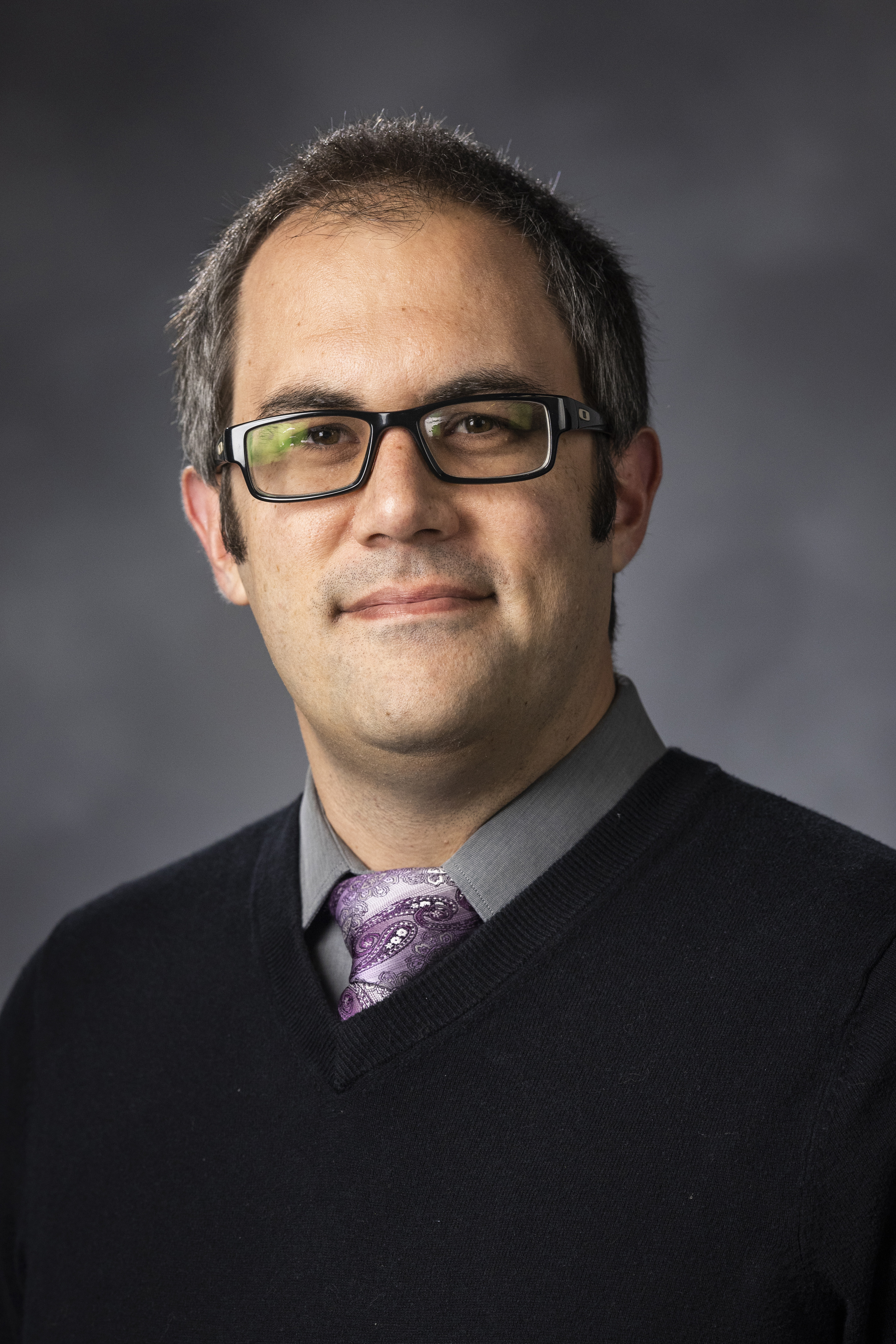
Nickolas Andersen
. Portrait identified on the Brigham Young University Mathematics profile.Jeffrey C. Lagarias works in number theory and its connections with computational complexity theory, geometry and dynamical systems. One striking contribution is a reformulation of the Riemann hypothesis using only harmonic numbers, integer divisors, the exponential function and the natural logarithm. [ref][ref]
Write and let be the sum-of-divisors function. Lagarias proved that the Riemann hypothesis is equivalent to the assertion that, for every positive integer ,with equality only at .[ref]
For example, and , so the right side is approximately . This verifies one instance. The force of the theorem is the universal quantifier: checking any finite collection of integers does not establish the entire inequality. An elementary-looking statement can therefore encode a deep question about the zeros of a function of the Riemann zeta function.

Jeffrey C. Lagarias
. Portrait identified on the author's University of Michigan homepage.Robert C. Rhoades coauthored work extending the study of Maass forms beyond a single eigenfunction equation. With Jeffrey C. Lagarias, he studied polyharmonic Maass forms: functions with the required arithmetic symmetry and growth conditions that are annihilated by a power of a weight-dependent hyperbolic Laplacian, . Their paper constructs bases using derivatives of Eisenstein series with respect to a parameter.[ref]
An elementary analogy explains why taking a power changes the problem. For the derivative operator , the function satisfies but . Thus requiring two applications to give zero allows more functions than requiring one. The arithmetic setting adds essential symmetry and growth restrictions; the analogy alone does not produce a Maass form. The paper shows how these restrictions lead to explicit finite-dimensional spaces, rather than the unrestricted solution sets of a differential equation.[ref]
Polyharmonic Maass forms for PSL(2,Z) by Jeffrey C. Lagarias and Robert C. Rhoades. preprint page 2, growth restriction and basis construction
Jean-Pierre Serre developed methods connecting algebraic topology, algebraic geometry and number theory. He received the first Abel Prize in 2003. [ref]
https://abelprize.no/abel-prize-laureates/2003. Official laureate record and citation
His 1951 work used singular homology to study loop spaces and homotopy groups. A loop space turns paths in a topological space that start and end at a fixed base point into points of a new space . Serre treated as the fibre of a fibration whose total space is contractible, linking the topology of the fibre to that of . The resulting Serre spectral sequence organizes the calculation into successive algebraic stages.[ref]
Homologie singulière des espaces fibrés. Applications by Jean-Pierre Serre. printed page 425, Introduction and account of Chapter II
The dimension shiftmakes the strategy useful: information about families of loops becomes information about higher-dimensional homotopy groups. For example, a loop in describes a continuously varying family of loops in , introducing a second parameter. Turning a geometric question into a calculation about another space is a characteristic strength of this approach.[ref]
Homologie singulière des espaces fibrés. Applications by Jean-Pierre Serre. Introduction, loop-space relation and indirect method

Bill Casselman writes research and expository mathematics connecting algebraic structure with concrete calculations. His author-hosted Introduction to quadratic forms by Bill Casselman explains quadratic forms over general fields, including the distinctions required in characteristic two. It develops decomposition results using totally isotropic subspaces and the hyperbolic plane.[ref]
For example, over the quadratic form separates into a hyperbolic plane on the first two coordinates and an anisotropic quadratic form on the last. The -axis consists of isotropic vectors, but it is not invisible to the whole form: its associated bilinear form pairs nontrivially with . Pairing such complementary directions produces the hyperbolic part of an orthogonal direct sum. The example helps distinguish a vector on which a quadratic form vanishes from a vector in the radical of its associated bilinear form.[ref]

Akihiro Munemasa connects finite geometry, quadratic forms and algebraic combinatorics. His author-written notes The geometry of orthogonal groups over finite fields by Akihiro Munemasa develop geometric objects and associated graphs from quadratic forms over finite fields. The preface makes the purpose explicit: the geometry supplies nontrivial examples for studying graph symmetries.[ref]
The geometry of orthogonal groups over finite fields by Akihiro Munemasa. Preface and §2, Classification of quadratic forms
For a concrete comparison over , consider and . The first vanishes on both coordinate axes, giving nonzero isotropic vectors. The second vanishes only at : a nonzero square is , and in . Thus equal-dimensional nondegenerate quadratic forms can have different Witt indices, here one and zero. The existence or absence of totally isotropic subspaces changes the incidence geometry built from the form. Munemasa's notes turn these algebraic distinctions into explicit geometric and combinatorial constructions.[ref]
James E. Humphreys wrote influential mathematical expositions on Lie theory and representation theory. His book Modular Representations of Finite Groups of Lie Type by James E. Humphreys develops modular representation theory for finite groups of Lie type, relating finite groups to algebraic groups over finite fields. The opening chapter describes constructions using rational points and fixed points of appropriate endomorphisms.[ref]
Modular Representations of Finite Groups of Lie Type by James E. Humphreys. Chapter 1, especially §§1.1 and 1.3
A small example illustrates why the characteristic of a field matters in representation theory. Over the finite field , the matrixsatisfies but , so it represents the generator of a group of order two. Its fixed vectors form only the line spanned by . That line has no invariant one-dimensional complement: over , an invertible action on a line must be the identity, so two invariant lines would force . The example shows concretely how a representation can fail to split into smaller pieces when the field characteristic divides the group order. This is part of the mathematical setting that Humphreys's expositions make accessible.
Andrei Seymour-Howell works in computational number theory, particularly automorphic forms and trace formulas. His 2022 paper develops an algorithm to compute and rigorously verify Maass cusp forms for specified groups of squarefree level and trivial character. It combines a Selberg trace formula involving Hecke operators with linear algebra to isolate spectral information.[ref]
The distinction between computation and certification is central. A decimal approximation to an eigenvalue suggests where to look; a rigorous verification must justify that the computed information corresponds to an actual mathematical object, with controlled error. As a schematic illustration, a proved enclosure conveys a different kind of information from a program merely printing
10.00. The numbers here illustrate the distinction and are not a reported eigenvalue. The paper applies its verified computations to gather evidence about further conjectures; verified examples still do not prove a conjecture quantified over all forms.[ref]Rigorous computation of Maass cusp forms of squarefree level by Andrei Seymour-Howell. Introduction and §5, computational results

Andrei Seymour-Howell
. Portrait presented on the author's homepage, reached from his University of Bristol page.Karl Sigmund applies mathematics to the evolution of cooperation. His work in evolutionary game theory examines how strategies spread when their success depends on interactions with other individuals.[ref]
https://www.leopoldina.org/en/members/member-list/detail/karl-sigmund. Leopoldina research profile; evolutionary game theory, replicator dynamics and cooperation
With Martin A. Nowak, Sigmund developed a 1998 model of indirect reciprocity: an individual may help someone because that person's previous behaviour has established a favourable reputation, even if the same pair never meets again. The analysis combined mathematical conditions for stability with computer simulations of changing strategy frequencies.[ref]
For example, A helps B, C learns of the act, and C later helps A. The return to A passes through another individual instead of requiring repayment by B. The scientific question is which information and decision rules allow such behaviour to persist against alternatives that avoid the cost of helping. A reputation mechanism makes those rules explicit; it does not establish that every apparently generous action is explained by the same process.[ref]
Evolution of indirect reciprocity by image scoring by Martin A. Nowak and Karl Sigmund. Model of reputation-based donor decisions without repeated pair encounters

Aleksander Stefanov works across mathematical physics, mechanics and optical measurement. A 2022 Sofia University academic statement identifies his education in theoretical and mathematical physics, doctoral work on nonlinear dynamical systems associated with Lie algebras, and work in the Faculty of Mathematics and Informatics. It describes research on integrable models, walking-robot dynamics and educational physical-constant measurements.[ref]
Statement on Aleksander Stefanov's associate-professor application by Ivan Chavdarov. pp.2–3, candidate information and research contributions
The same document identifies Korteweg-De Vries equation and nonlinear Schrödinger-type models among his theoretical interests. He also coauthored the 2023 theoretical and experimental comparison of Gouy phase for Bessel-Gaussian beams with Lyubomir Stoyanov, Alexander Dreischuh and Gerhard G. Paulus.[ref]
Gouy phase of Bessel-Gaussian beams: theory vs. experiment by Lyubomir Stoyanov and others. Published byline and affiliations
An original example illustrates the quantitative idea behind a noise-based constant measurement. For ideal independent charge-transfer events, the one-sided current shot noise spectral density is . With mean current , elementary charge C and a rectangular effective noise bandwidth kHz, the predicted root-mean-square fluctuation isThese stipulated numbers are not data from Stefanov's apparatus. They explain why estimating charge from noise requires a calibrated gain, known bandwidth and a model for other fluctuations. Thermal noise and detector noise must be distinguished from the charge-transfer contribution; a measured noise amplitude alone is insufficient.
The attraction of this work is the bridge between mathematical models and observable signals. The academic statement describes physical walking-robot tests as well as electronic measurements; those are different ways to test a theoretical prediction. The available sources identify this Sofia researcher, and do not justify merging him with unrelated researchers who share a surname.
Calvin Quate developed instruments that use mechanical interactions to reveal microscopic structure. His Stanford memorial describes his work on scanning acoustic microscopy and, with Gerd Binnig and Christoph Gerber, atomic force microscopy.[ref]
https://news.stanford.edu/stories/2019/07/calvin-f-quate-inventor-advanced-microscopes-dies-95. Institutional memorial, microscopy contributions
Their 1986 atomic-force-microscope paper used a compliant mechanical probe and sensitive displacement detection to measure surface interactions. Its preliminary measurements demonstrated nanometre-scale lateral structure and sub-nanometre vertical sensitivity; the proposed atomic-scale goal and those initial measured resolutions should be distinguished. This instrument-building contribution opened a route to imaging surfaces without requiring a tunnelling current through the specimen.[ref]
Atomic Force Microscope by Gerd Binnig and others. Abstract, preliminary lateral30angstrom and vertical below1angstrom resolution

Christoph Gerber helped develop atomic force microscopy with Gerd Binnig and Calvin Quate. Their 1986 paper introduced an instrument that senses probe–sample forces through a compliant cantilever, enabling investigation of electrically insulating surfaces.[ref]
Atomic Force Microscope by Gerd Binnig and others. Original paper, byline, abstract and preliminary measurements
The mechanical probe makes a small interaction measurable through displacement: in a linear approximation, a cantilever of spring constant deflecting by carries force . Gerber's later research includes biochemical cantilever sensors, extending the same transduction principle from surface imaging to detection of molecular interactions.[ref]
Pinned article: Introduction to the OurBigBook Project
Welcome to the OurBigBook Project! Our goal is to create the perfect publishing platform for STEM subjects, and get university-level students to write the best free STEM tutorials ever.
Everyone is welcome to create an account and play with the site: ourbigbook.com/go/register. We belive that students themselves can write amazing tutorials, but teachers are welcome too. You can write about anything you want, it doesn't have to be STEM or even educational. Silly test content is very welcome and you won't be penalized in any way. Just keep it legal!
Intro to OurBigBook
. Source. We have two killer features:
- topics: topics group articles by different users with the same title, e.g. here is the topic for the "Fundamental Theorem of Calculus" ourbigbook.com/go/topic/fundamental-theorem-of-calculusArticles of different users are sorted by upvote within each article page. This feature is a bit like:
- a Wikipedia where each user can have their own version of each article
- a Q&A website like Stack Overflow, where multiple people can give their views on a given topic, and the best ones are sorted by upvote. Except you don't need to wait for someone to ask first, and any topic goes, no matter how narrow or broad
This feature makes it possible for readers to find better explanations of any topic created by other writers. And it allows writers to create an explanation in a place that readers might actually find it.
Figure 1. Screenshot of the "Derivative" topic page. View it live at: ourbigbook.com/go/topic/derivativeVideo 2. OurBigBook Web topics demo. Source. - local editing: you can store all your personal knowledge base content locally in a plaintext markup format that can be edited locally and published either:This way you can be sure that even if OurBigBook.com were to go down one day (which we have no plans to do as it is quite cheap to host!), your content will still be perfectly readable as a static site.
- to OurBigBook.com to get awesome multi-user features like topics and likes
- as HTML files to a static website, which you can host yourself for free on many external providers like GitHub Pages, and remain in full control

Figure 2. You can publish local OurBigBook lightweight markup files to either OurBigBook.com or as a static website.
Figure 3. Visual Studio Code extension installation.
Figure 5. . You can also edit articles on the Web editor without installing anything locally. Video 3. Edit locally and publish demo. Source. This shows editing OurBigBook Markup and publishing it using the Visual Studio Code extension. 
- Infinitely deep tables of contents:


All our software is open source and hosted at: github.com/ourbigbook/ourbigbook
Further documentation can be found at: docs.ourbigbook.com
Feel free to reach our to us for any help or suggestions: docs.ourbigbook.com/#contact