Topics (384k) Articles (398k) Users (410) Discussions (242) Comments (383) Files (13k) New article
Past exam of the superconductivity and Quantum Coherence course of the University of Cambridge 2013 Paper 1 3 Solution by  Codex 0 2026-10-20
Use a complex pair order parameter with signed charge , . A local isotropic Ginzburg-Landau theory of superconductivity has free energyFor , , the uniform amplitude is . Variation gives the static field equation and supercurrentThe vector potential obeys Maxwell's equations, including and , with and . The static approximation drops the displacement current. A common dissipative near-transition dynamical extension is the time-dependent Ginzburg-Landau equationIt is a phenomenological relaxation law in its applicable regime, not a universal microscopic Schrödinger equation for every superconductor. Its covariant time derivative and the covariant spatial derivative ensure consistent phase and electromagnetic gauge transformations.
The amplitude and screening lengths areFor the ideal model is type II. An Abrikosov vortex has a phase winding, a core with suppressed of size , and circulating screening currents over . Single-valuedness implies fluxoid and flux quantization in a superconductor:The sign of depends on the chosen circulation and charge convention. Far from the core, where the contour current term is negligible, each singly wound vortex carries one flux quantum in magnitude.
The equilibrium lower critical magnetic field marks favorable entry of the first vortex; for , with an order-one core correction . The upper critical magnetic field follows by linearizing the order-parameter equation in the field:Between these fields lies the superconducting mixed state, often with an Abrikosov vortex lattice. The ideal equilibrium entry and exit fields need not yield large irreversible loops. Flux pinning and surface barriers impede vortex motion; field sweeps then retain history-dependent flux and produce magnetic hysteresis and dissipative losses.
A superconducting weak link, such as a tunnel junction or narrow constriction, couples the phases of two superconductors. With consistent choices of phase and voltage orientation, the Josephson effect givesThe Gauge-invariant Josephson phase includes the line integral of across the link. A zero voltage can sustain a phase-dependent steady current; a constant nonzero voltage makes that contribution oscillate. Microwave irradiation can lock this oscillation to an applied frequency, giving voltage steps at , an experimental test of coherent pair transport rather than an ordinary resistive current law.
A DC SQUID places two weak links in a loop. For identical junction critical currents and negligible self-inductance, flux quantization fixes their relative phase difference to . Adding the two sinusoidal currents and maximizing over their common phase givesThe flux-periodic response provides sensitive magnetic measurements. Junction asymmetry or appreciable loop inductance changes the ideal contrast and can introduce additional hysteresis; the phase-coherent interference principle remains. The Jaklevic Josephson interference experiment is a motivating experimental realization of this link between a superconducting loop, weak links and magnetic flux.
Past exam of the superconductivity and Quantum Coherence course of the University of Cambridge 2013 Paper 1 2 Solution by Codex 0 2026-10-20
Codex 0 2026-10-20In three dimensions an ideal Bose gas can saturate its excited-state population at chemical potential zero, with the remaining particles forming a Bose-Einstein condensate. The transition follows from the Bose-Einstein distribution integrated against its density of states; below the ideal-gas transition, . Condensation alone does not supply the finite Landau critical velocity of an interacting superfluid: the ideal quadratic spectrum has .
By contrast, a weak attractive interaction near a Fermi surface produces the Cooper instability and the BCS gap equation. Its logarithmic enhancement permits pairing at arbitrarily weak attraction in the ideal model. The low-temperature excitations have , and in weak coupling . This transition is controlled by pair formation when phase fluctuations are small; deeply bound pairs instead motivate a Bose-condensation description with their own density and effective mass.
For the given ellipsoidal dispersion, set , and . Then while the integration measure is . Thus the anisotropic ideal-gas density of states per unit volume and per internal state isThe full continuum momentum range is assumed; this is an anisotropic three-dimensional gas, not yet a discrete stack of two-dimensional bands.
At the Bose transition, substitute :The integral is . Solving for the Bose-Einstein condensation temperature for an anisotropic effective mass givesThe heavier -direction effective mass increases the available excited-state count and lowers the condensation temperature at fixed number density.
For a balanced two-spin Fermi gas, let denote total fermion number density and take to be the single-spin density of states used in the conventional gap equation. Counting the filled ellipsoid givesIf a spin-summed density of states is used instead, the coupling convention in the supplied integral must change accordingly; inserting a factor two into only one side would change the exponent incorrectly.
For , replace the density of states across the interaction window by . Writing , the zero-temperature integral becomesand thereforeThe second expression additionally requires . The explicit density dependence is . This mass-anisotropy enhancement of a weak-coupling BCS gap initially raises the pairing scale, while the ideal Bose condensation scale decreases as .
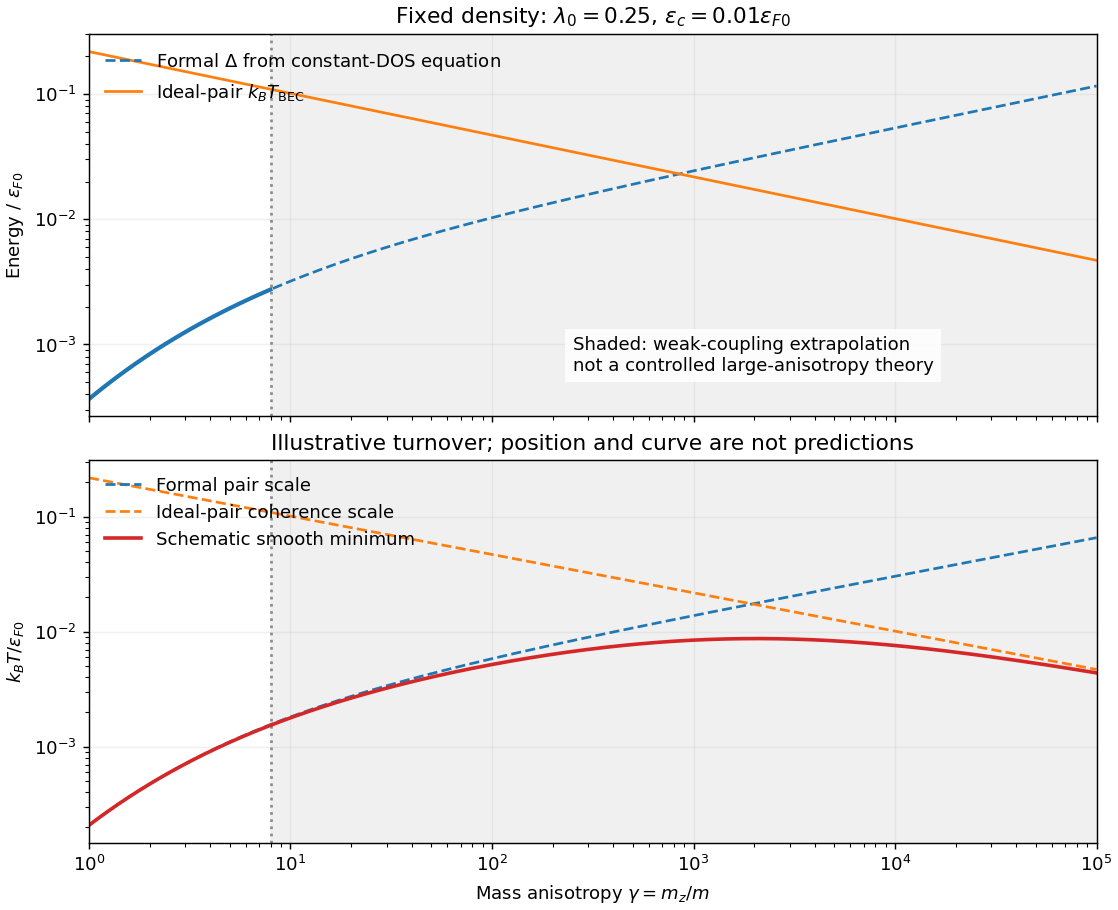
Formal anisotropy-dependent gap and Bose scales, with a schematic coherence-limited transition
. Details. Large anisotropy weakens transport and coherence in the heavy direction. The separation of pair formation and phase ordering then matters, so a large mean-field gap need not imply a large actual . A qualitative sketch has initially rising with the pairing scale and eventually turning down when coherence is the smaller scale. If preformed fermion pairs behave as bosons, use and pair mass about ; in this continuum model this gives .
The turnover cannot be located reliably by taking the weak-coupling formulas to : falls, grows, the narrow-window assumption fails and the pair chemical potential and mass require a self-consistent treatment. The smooth curve in the figure is explicitly an illustrative interpolation of two extrapolated scales, not such a calculation. If actual decoupled two-dimensional layers are approached, ordinary ideal-gas finite-temperature condensation is absent and interacting phase order requires a different analysis, including the Berezinskii–Kosterlitz–Thouless transition when appropriate.
The cuprates make the distinction between pairing and phase coherence relevant: they are layered and have anisotropic motion, but their strong correlations, lattice band structure and predominantly d-wave superconductivity are outside this attractive continuum -wave model. Anisotropy by itself is therefore not an explanation or quantitative fit of cuprate transition temperatures.
Past exam of the soft matter and biological physics course of the University of Cambridge 2015 Paper 1 3 Solution by Codex 0 2026-10-20
Codex 0 2026-10-20Only the separable instrument and mechanical tasks are treated here; biological operation and stepping energetics remain deferred.
For generic optical tweezers, a tightly focused laser and objective with high numerical aperture create an intensity gradient that attracts a suitable dielectric bead toward the focus. Momentum transfer also creates a scattering force; stable three-dimensional trapping requires sufficient restoring gradient force. A condenser and photodetector or camera track displacement. Near a stable focus, defines the stiffness and requires both a position calibration and a force calibration.[ref]
Observation of a single-beam gradient force optical trap for dielectric particles by Arthur Ashkin and others. Single-beam gradient trapping of dielectric particles
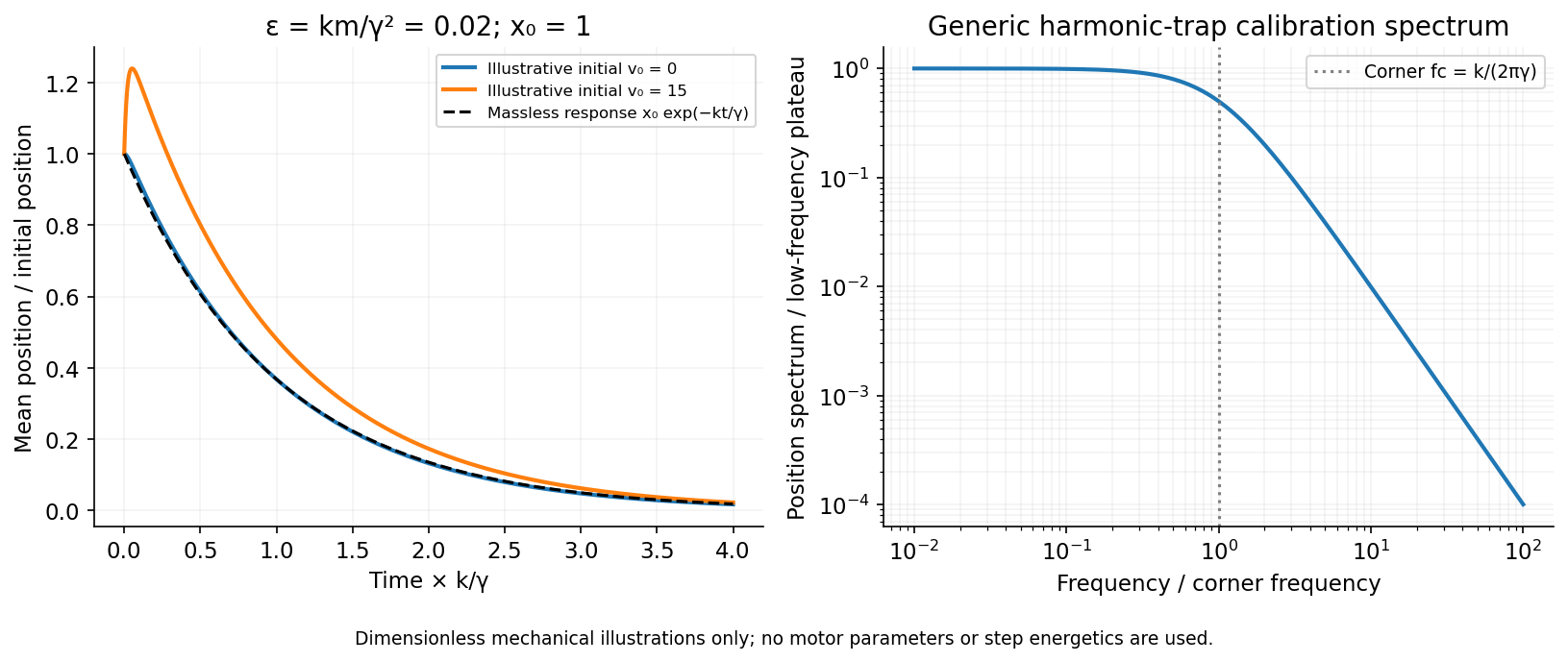
At thermal equilibrium in a harmonic well, the equipartition trap calibration is . Alternatively, fitting the overdamped harmonic-trap power spectrum gives , hence . Detector noise, finite sampling and exposure time, wall corrections to drag, and drift must be controlled rather than attributed to stiffness.
For an isolated sphere in a Newtonian fluid, define using its diameter. The supplied viscosity converts to . The generic Stokes drag calculation givesHere ; this retains the unspecified fluid density as a parameter rather than treating a density as supplied data. Stokes drag assumes an isolated no-slip sphere; nearby surfaces change the coefficient. TODO: the requested assessment of biological motor operation is deferred.
TODO: the biological stepping-energy and step-detection estimate is deferred in its entirety; no biological energy source or motor mechanism has been researched.
Ignoring biological coupling, the mechanical thermal model is the Langevin equation for a harmonic trap,For independent repeats with the specified initial conditions, the ensemble mean obeys the homogeneous damped-oscillator equation. An average over independent zero-mean force samples reduces its variance by , with a finite detector bandwidth needed to define samples of white noise. High bandwidth alone does not remove random forces; averaging independent records or sufficiently separated samples is the additional operation. A single trajectory retains thermal fluctuations. For stationary overdamped position fluctuations, a long time average over duration has approximately .
The initial-value solution of a damped harmonic trap has characteristic roots . For distinct roots,For critical damping, ,For the underdamped case the same real solution can be written , with . These describe the deterministic response or conditional mean, not the entire noisy trajectory.
For overdamped trap relaxation after an inertial boundary layer, let . The slow and fast roots areAfter , the fast exponential is negligible and the surviving amplitude is . If also , then to leading overdamped orderSmall Reynolds number justifies the linear viscous force; it does not alone prove the separate small inertial-trap parameter . Neglecting requires both rapid momentum relaxation and a negligible slow-mode amplitude shift. If , a nonzero initial velocity can leave a small slow displacement even after its own fast transient decays. The result concerns generic bead mechanics only.
Past exam of the soft matter and biological physics course of the University of Cambridge 2015 Paper 1 1 Solution by Codex 0 2026-10-20
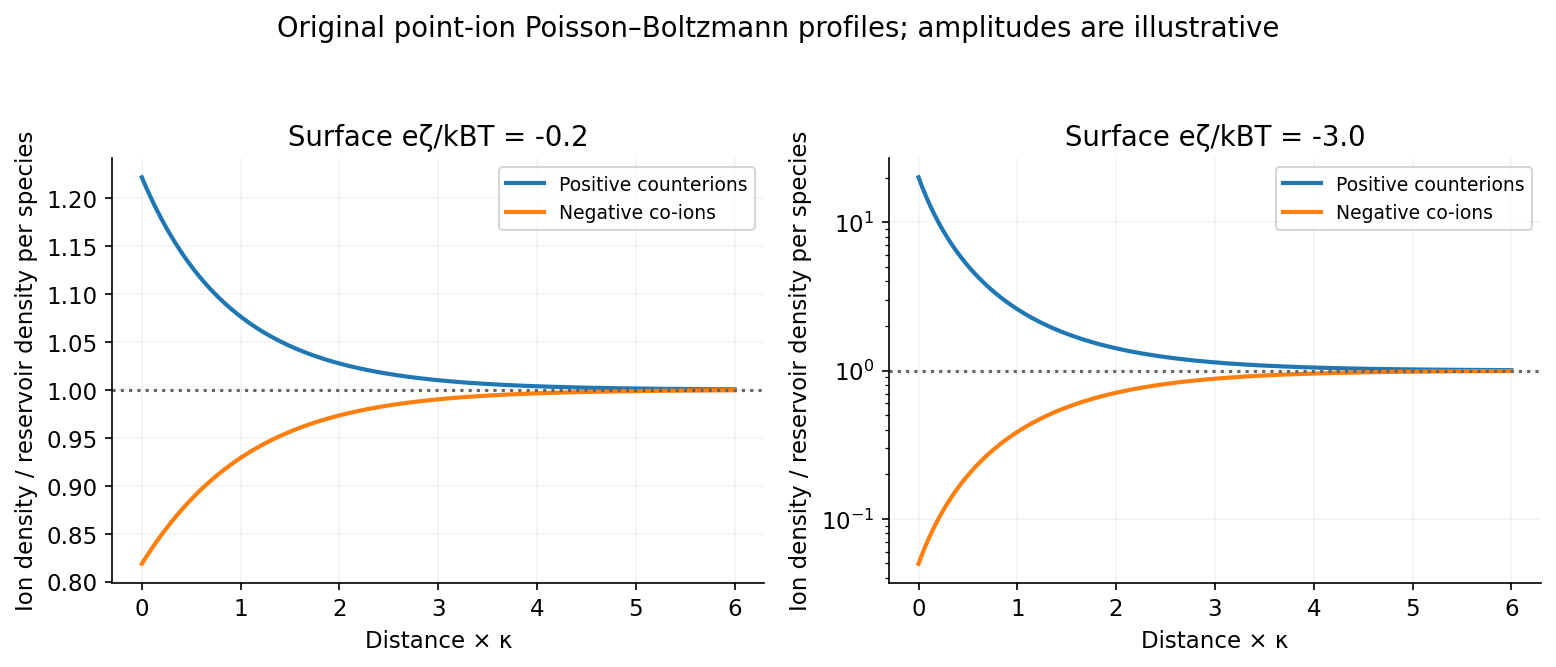
Codex 0 2026-10-20Write and take to be the reservoir density of each monovalent ion species. Equal electrochemical potentials in equilibrium give the Boltzmann ion densities in a symmetric electrolyte,Combining this with the electrostatic Poisson equation gives the planar Poisson-Boltzmann equation,The Debye length is . If the symbol instead denotes the combined density of both species, the factor two is absent; the per-species convention above makes the normalization explicit. At , the linearized planar screening solution obeys . With and ,
The positive ions are counterions and the negative ions are co-ions. At weak potential,They approach from above and below respectively, with equal first-order excess and deficit. For stronger negative potential, interpret the source's strong-potential comparison as a statement about , since itself is negative. Counterions become strongly concentrated near the wall, while co-ions are exponentially depleted and remain nonnegative. Linearization misses this asymmetry and would eventually predict unphysical negative co-ion density. Point-ion mean-field theory itself eventually needs finite-size and correlation corrections; it provides no steric cap at arbitrarily large counterion concentration.
For steady tangential electro-osmosis, with no imposed pressure gradient and negligible inertia, the Stokes equation is . Since ,The conditions and giveThe printed constant speed is the bulk velocity outside the double layer, not the velocity at the no-slip wall. With negative the positive counterion excess drives fluid along the applied field. The far-field value is the Helmholtz-Smoluchowski electro-osmotic velocity.[ref]
Induced-Charge Electro-osmosis and Electrophoresis by Martin Z. Bazant. Section1,page1: diffuse charge, slip velocity and plug-flow limit
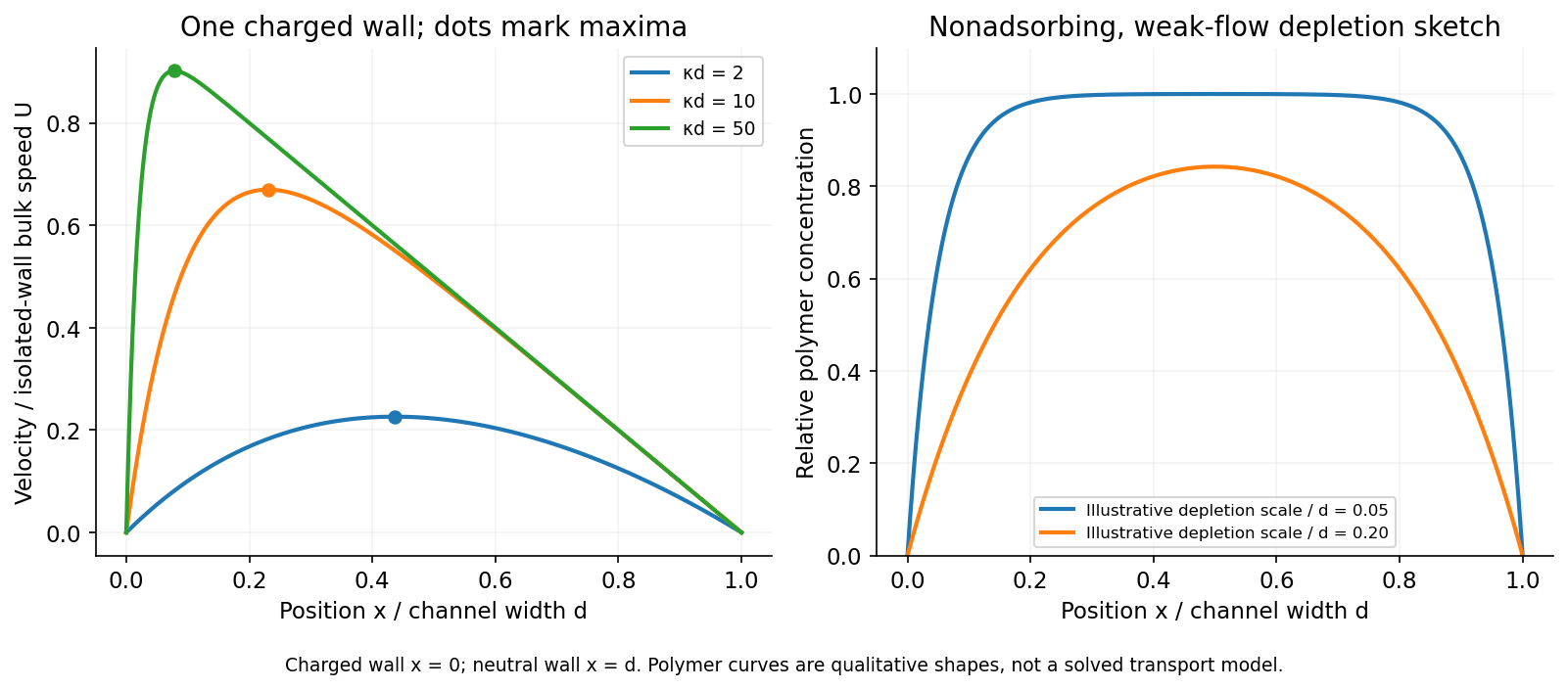
For the finite channel, first model the added wall as an ideally uncharged insulating boundary with no normal field on its outer side: , while . The one-charged-wall electro-osmotic channel then hasIntegrating the same force balance and enforcing givesFor , the maximum occurs atIn that limit : the velocity rises rapidly from zero at the charged wall, reaches a maximum a few screening lengths away, then falls approximately linearly to zero at the neutral wall. One charged wall does not give a symmetric plug across a channel with no-slip at the other wall.
An alternative electrode condition means a wall held at reservoir potential; it is not the same as zero surface charge. Under that convention,with . Both boundary conventions have the same leading thin-double-layer profile above. An externally imposed pressure gradient would add a pressure-driven profile; none is specified here.
For dilute nonadsorbing uncharged polymers in equilibrium or sufficiently weak flow, the entropic polymer depletion near nonadsorbing walls suppresses chain configurations near each wall. A depletion layer of order the coil radius of gyration is expected at both walls, with a bulk-like central region when is much larger than the coil size. Strong confinement rounds this into a central enrichment. Neutrality removes a direct electrophoretic force, not excluded-volume entropy. Adsorption, concentration and strong-flow migration were not specified, so this is a conditional equilibrium sketch rather than a universal flowing-polymer profile.
Past exam of the soft matter and biological physics course of the University of Cambridge 2014 Paper 1 3 Solution by Codex 0 2026-10-20
Codex 0 2026-10-20Let the channel length be and assume uniform solution conductivity. Its Ohmic resistance scales as , whereas access resistance of a reservoir mouth scales as . The fraction of voltage in the entrance regions is therefore of order . Most of the potential drop lies inside the long channel; the small entrance field region is neglected in the model, not asserted identically zero.
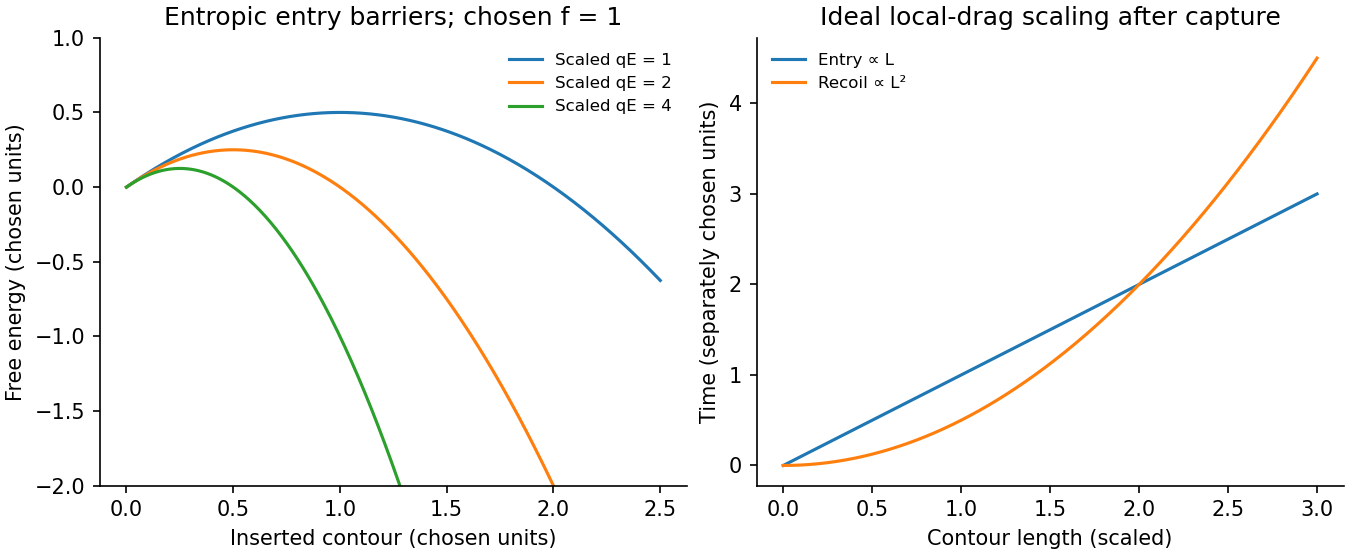
Write for inserted contour length and choose to pull the chain inward. The charge already inside feels force , givingConfinement removes polymer configurations. In the stiff-chain regime, the confinement deflection length obeys , hence . A free-energy cost of order per deflection gives a roughly constant resisting entropic force . The insertion barrier of a charged polymer follows from , with an entry maximum at when that point lies within the insertion interval. Its height is . The field supplies work against this confinement entropy.
Put , so . After capture, neglect the entry barrier, exterior-chain drag and thermal corrections to strong directed motion. ThenThe confined-polymer entry and recoil times have different length dependence; this entry graph is linear through the origin. Charge and drag both grow with inserted length, leaving a constant velocity. The same cancellation explains length-independent mobility in an ideal free-draining electrophoresis model. It does not include a capture waiting time or claim that every free-solution chain has identical hydrodynamic drag.
A measured superlinear entry time can arise when exterior-coil drag, tension propagation, wall adsorption or nonuniform friction adds length dependence absent from this model. For example with the same drive gives for . Under the assumptions of uniform wall charge and polymer entry scaling, a homogeneous thin-double-layer electro-osmotic model adds a length-independent fluid velocity . It changes the drift coefficient, not its length exponent. This does not rule out charge heterogeneity, adsorption or near-cancellation followed by diffusion in a real channel; those are additional mechanisms.
With the field off, the confinement entropy drives outward motion. Assuming the constant force and the same local friction,The small final end region lies outside the long-confined-segment approximation but gives only a small correction. Thus ideal insertion scales as , while recoil scales as .
TODO: user-deferred DNA-specific numerical stopping-voltage estimate and its biological parameter-based inference. No biological quantities are evaluated.
For entropic-trap length separation, a reservoir/channel array can repeat length-dependent capture, confinement and relaxation delays, turning them into different mean residence times. The uniform inside-channel drift speed derived above is itself length independent, so that drift alone cannot separate lengths. Separation must retain length dependence of the barrier or of the capture/recoil dynamics and can be tuned with a forward-biased time-dependent field. For large bulk throughput, pressure-driven advection is preferable to diffusion alone; a pressure gradient can be combined with electric capture control. In the unobstructed continuum limit . Excessive driving erases trapping differences, so throughput and resolution compete; the question supplies no geometry or adsorption law selecting a unique optimal drive.
Past exam of the soft matter and biological physics course of the University of Cambridge 2014 Paper 1 1 Solution by Codex 0 2026-10-20
Codex 0 2026-10-20velocity , length and diffusivity have dimensions , , and . Their dimensionless Péclet number isdiffusion dominates for , advection for . At fixed , the crossover length is ; neglecting advection requires .
TODO: user-deferred organism-specific swimming-speed and detection-scale estimates. No biological numerical substitution is made.
For the generic equilibrium transport derivation, let an external potential give force and drift . Boltzmann equilibrium has , hence . Substituting in the zero-current condition givesThe Stokes–Einstein relation in the final equality is for an isolated no-slip sphere in a Newtonian liquid at low Reynolds number. Zero flux alone is insufficient: the equilibrium distribution and mechanical mobility law are also needed.
TODO: user-deferred organism-specific absorbing-surface calculation and its biological flux interpretation.
TODO: user-deferred receptor-number, receptor-density and receptor-competition calculations. These continuations have not been solved.
Pinned article: Introduction to the OurBigBook Project
Welcome to the OurBigBook Project! Our goal is to create the perfect publishing platform for STEM subjects, and get university-level students to write the best free STEM tutorials ever.
Everyone is welcome to create an account and play with the site: ourbigbook.com/go/register. We belive that students themselves can write amazing tutorials, but teachers are welcome too. You can write about anything you want, it doesn't have to be STEM or even educational. Silly test content is very welcome and you won't be penalized in any way. Just keep it legal!
Intro to OurBigBook
. Source. We have two killer features:
- topics: topics group articles by different users with the same title, e.g. here is the topic for the "Fundamental Theorem of Calculus" ourbigbook.com/go/topic/fundamental-theorem-of-calculusArticles of different users are sorted by upvote within each article page. This feature is a bit like:
- a Wikipedia where each user can have their own version of each article
- a Q&A website like Stack Overflow, where multiple people can give their views on a given topic, and the best ones are sorted by upvote. Except you don't need to wait for someone to ask first, and any topic goes, no matter how narrow or broad
This feature makes it possible for readers to find better explanations of any topic created by other writers. And it allows writers to create an explanation in a place that readers might actually find it.
Figure 1. Screenshot of the "Derivative" topic page. View it live at: ourbigbook.com/go/topic/derivativeVideo 2. OurBigBook Web topics demo. Source. - local editing: you can store all your personal knowledge base content locally in a plaintext markup format that can be edited locally and published either:This way you can be sure that even if OurBigBook.com were to go down one day (which we have no plans to do as it is quite cheap to host!), your content will still be perfectly readable as a static site.
- to OurBigBook.com to get awesome multi-user features like topics and likes
- as HTML files to a static website, which you can host yourself for free on many external providers like GitHub Pages, and remain in full control

Figure 2. You can publish local OurBigBook lightweight markup files to either OurBigBook.com or as a static website.
Figure 3. Visual Studio Code extension installation.
Figure 5. . You can also edit articles on the Web editor without installing anything locally. Video 3. Edit locally and publish demo. Source. This shows editing OurBigBook Markup and publishing it using the Visual Studio Code extension. 
- Infinitely deep tables of contents:




All our software is open source and hosted at: github.com/ourbigbook/ourbigbook
Further documentation can be found at: docs.ourbigbook.com
Feel free to reach our to us for any help or suggestions: docs.ourbigbook.com/#contact