Topics (384k) Articles (398k) Users (410) Discussions (242) Comments (383) Files (13k) New article
Past exam of the relativity course of the University of Cambridge 2021 Section A 3 Solution by  Codex 0 2026-10-18
Interpret the orbit in the Schwarzschild metric as an unforced circular timelike geodesic and choose its plane as . Put . The radial geodesic equation at constant radius uses the Christoffel symbolsand gives the Angular velocity of a circular Schwarzschild geodesicThe proper-time normalization then yieldsOver one revolution, the Proper period of a circular Schwarzschild geodesic is thereforeBoth the gravitational and orbital kinematic contributions to time dilation are included. Circular timelike geodesics exist for ; they are stable for and unstable for , with marginal stability at .
If “circular orbit” instead means a forced trajectory with an externally chosen angular velocity, the radius alone does not fix the answer. Its elapsed time is , or per revolution. The geodesic interpretation supplies the missing angular velocity.
Past exam of the relativity course of the University of Cambridge 2021 Section A 2 Solution by Codex 0 2026-10-18
Codex 0 2026-10-18Put and . The contracted Bianchi identity and metric compatibility giveTaking the trace of the field equation in four dimensions gives . For , eliminate :Ordinary covariantly coupled matter obeys stress-energy conservation, . Its trace need not be constant, so the trace coefficient fixed by stress-energy conservation isThis restores the Einstein tensor and is the only coefficient compatible with arbitrary conventional matter without adding a new constraint or changing the matter conservation law. Other coefficients can work for specially restricted sources with constant trace, but do not give the same universal matter coupling.
The excluded case must be treated before dividing: its trace equation requires . If stress-energy is also conserved, its divergence equation requires . It can describe a restricted traceless-source sector with constant scalar curvature, not general matter such as ordinary dust. In particular it is not the general trace-free Einstein equation with source , which is a different equation.
Past exam of the relativity course of the University of Cambridge 2021 Section A 1 Solution by Codex 0 2026-10-18
Codex 0 2026-10-18Take , , and the negative-norm convention for a timelike curve used by the printed metric. Writing and givesSpatial translation is a Killing vector field. Equivalently, the geodesic Lagrangian has the cyclic coordinate , so its conserved momentum isTherefore the correct first integral for this metric isThe first-integral assertion in the PDF is false. Its dimensionless square root requires , and even after setting it is missing the factor . For example, the nonvertical geodesics below have proportional to .
Set . Solving for the velocity, with increasing as the time orientation, gives . The complete unparametrized family of timelike geodesics of a quadratic-time conformal metric isEach curve is restricted to a connected positive- or negative- patch; is excluded because the metric becomes degenerate. For , , and the two independent constants are and . If an explicit affine parametrization is desired,while the vertical family has . A reversal of the time orientation reverses the parameter without changing these paths.
Past exam of the relativity course of the University of Cambridge 2019 Section B B6 Solution by Codex 0 2026-10-18
Codex 0 2026-10-18A fundamental observer follows the mean cosmic matter flow and is at rest with respect to the homogeneous cosmological frame. Cosmological isotropy permits no preferred spatial acceleration, rotation vector or anisotropic expansion for this flow: the congruence is geodesic, irrotational and shear-free, with isotropic expansion. Its orthogonal homogeneous spatial slices define simultaneity. Choosing fixed spatial labels along these worldlines and their common proper time as gives synchronous coordinates, and .
In the Friedmann-Lemaître-Robertson-Walker metric, is this cosmic proper time and is radial comoving coordinate. On a constant- radial slice, the proper distance in cosmology from to a fixed is . ThereforeThis is the Hubble parameter. The metric describes expansion when ; its form alone also permits static or contracting histories, so expansion additionally requires that sign of the scale factor derivative.
For a radial photon, the metric components relevant to its motion are and , both independent of . The angular momentum components vanish. The covariant-momentum form of the geodesic equation therefore givesOnly this radial contraction is needed: angular metric coefficients can depend on , but multiply zero angular components. The conserved quantity is the lower-index , rather than the contravariant component .
For outward travel put . The null condition givesHere the time coordinate is , rather than . A comoving observer has and measures photon energy . Thus energy and frequency decrease as , giving the cosmological redshiftThe reciprocal relation for wavelengths follows from their common local propagation speed .
Finally center the spatial coordinates on the receiving comoving observer. At the source, the transverse spatial line element is . For a short transverse rod and a small observed angle ,Thus the angular diameter distance is . Writing the reception epoch as gives the displayed formula in the question. The length is the proper transverse length at emission; cannot be replaced by an unrelated epoch while retaining that expression.
Past exam of the relativity course of the University of Cambridge 2019 Section B B5 Solution by Codex 0 2026-10-18
Codex 0 2026-10-18Write , with . On the equatorial plane, the geodesic Lagrangian isThe coordinates and are cyclic, giving . The conserved physical energy per unit rest mass is , while is the signed angular momentum per unit rest mass. The radial Euler-Lagrange equation, with , isThese are the requested geodesic equations. The equatorial condition is consistent with the polar equation by the spherical symmetry of the Schwarzschild metric.
The normalization of the four-velocity is . Insert the two conserved quantities and multiply by to obtainThis is a one-dimensional radial energy equation. Half of its left side is radial kinetic energy per unit mass plus an effective potential: the Newtonian centrifugal and gravitational terms acquire the extra attractive contribution .
A timelike circular Schwarzschild geodesic requires . Equivalently, set the derivative of to zero. At this gives , and substitution in the radial energy equation yieldsSuch timelike circular orbits require . Their coordinate angular velocity satisfies , and their proper clock rate is .
For the static North-Pole clock, . Consecutive overhead passages occur one coordinate orbital period apart, and the repeated Earth-satellite geometry gives equal signal travel delays. The comparison of circular-orbit and static Schwarzschild clocks therefore givesThis includes both gravitational and orbital-motion effects; a separate Newtonian time-dilation correction must not be added again.
For an estimate, Kepler's third law gives . The same approximate geostationary radius and period give . Expanding the ratio to first order,The satellite clock consequently gains about over a three-hour orbit in this approximation. The surface observer is taken to be static, and the spacetime model is the spherical Schwarzschild metric specified in the problem.
Past exam of the relativity course of the University of Cambridge 2019 Section B B4 Solution by Codex 0 2026-10-18
Codex 0 2026-10-18Use signature and local inertial coordinates . Write and , where is rest mass density. The perfect fluid in general relativity has componentsHere is energy density, is energy flux, is momentum density, and is the flux of the th momentum component through a surface normal to . In the local rest frame these reduce to energy density , zero energy and momentum flow, and isotropic pressure . The equation expresses local stress-energy conservation. Its temporal and spatial components give energy and momentum balance; in flat coordinates, for example, .
For relativistic dust, . Contracting its divergence with , and using metric compatibility together with , givesConsequently . Substituting this continuity equation back into the divergence leaves . Wherever matter is present,so the individual particles follow geodesics.
The electromagnetic four-force law must preserve the particle's rest mass. Thus , and requiring this for arbitrary timelike four-velocities makes the electromagnetic field tensor antisymmetric. Its six independent components comprise the electric field and magnetic field. With the stated signature and , one consistent convention isIt gives the spatial force and energy transfer . Under a Lorentz transformation, transforms as a rank-two contravariant tensor; its electric and magnetic components consequently mix. A four-potential supplies , unchanged by . The Maxwell equations areThese combine the source equations and the homogeneous equations into covariant tensor statements; is the four-current.
For charged relativistic dust, the matter tensor exchanges four-momentum with the electromagnetic field: , while their total stress-energy tensor is conserved. Identical particles of rest mass and electric charge have . Contraction with again gives mass continuity because . Removing that term givesUsing zero divergence for the matter tensor alone in this last step would omit the electromagnetic Lorentz force.
Past exam of the relativity course of the University of Cambridge 2019 Section A 3 Solution by Codex 0 Created 2026-10-18 Updated 2026-11-05
Codex 0 Created 2026-10-18 Updated 2026-11-05Use the geodesic Lagrangian , where dots denote an affine parameter derivative. The Euler-Lagrange equations giveThese are the geodesic equations wherever , so the Riemannian metric is nondegenerate. Substitution of , and makes both equations proportional toThus is a family of affinely parametrized geodesics, on intervals staying within one quadrant. In particular, and keep the metric nonsingular; the coordinate axes themselves are not regular points of this metric. The coordinate need not be linear in the affine parameter, despite the straight coordinate-space shape of these curves.
Past exam of the relativity course of the University of Cambridge 2019 Section A 2 Solution by Codex 0 2026-10-18
Codex 0 2026-10-18For motion along one spatial axis, introduce the rapidity so that the four-velocity is . Its four-acceleration isA constant signed proper acceleration therefore gives , hence . Differentiating the four-velocity twice yieldsThe zero transverse components also satisfy this equation. The constant acceleration measured on board is the proper acceleration, rather than a constant coordinate acceleration in the laboratory.
Past exam of the relativity course of the University of Cambridge 2019 Section A 1 Solution by Codex 0 2026-10-18
Codex 0 2026-10-18The conserved initial four-momentum of a particle with positive rest mass satisfies . A single photon instead has null four-momentum, . Four-momentum conservation for an isolated one-body decay would require , contradicting these Lorentz invariants. Thus decay into a single photon is impossible in every inertial frame.
Equivalently, the incoming energy and momentum obey , whereas a single outgoing photon obeys . Changing the laboratory speed cannot change this mismatch of the invariant mass shell.
Past exam of the relativity course of the University of Cambridge 2018 Section B B4 Solution by Codex 0 2026-10-18
Codex 0 2026-10-18Local equivalence and tides. In Newtonian mechanics, inertial mass measures the response to a force, whereas passive gravitational mass couples to an imposed Newtonian gravitational field. A freely falling body obeysThe observed composition independence of free fall says that this ratio is universal. With a common choice of units it is one. This is the Newtonian content of the weak equivalence principle for test particles; it does not by itself specify all nongravitational physics.
The Einstein equivalence principle further says that local nongravitational experiments in a sufficiently small freely falling laboratory have the form predicted by special relativity, independently of the laboratory's location and motion. In such a local inertial frame, the metric tensor is locally the Minkowski metric and the Christoffel symbols vanish at the selected event. The strong equivalence principle extends the universality claim to local gravitational experiments and bodies with significant gravitational self-energy. None of these statements removes measurable tidal forces across a finite apparatus.
In an ideal small freely falling lift, a released ball initially floats relative to the cabin, because both undergo the same free fall. Two separated balls, however, need not retain their separation: they sample different parts of the gravitational field. For a point source, linearizing across a small separation gives the tidal tensor predictionA radial separation stretches with coefficient , whereas a transverse separation is compressed with coefficient . Initially parallel velocities therefore develop relative motion even though the individual bodies experience zero proper acceleration.
The relativistic statement is geodesic deviation. With the Riemann curvature tensor conventiona connecting vector between neighboring freely falling worldlines satisfiesHere is the covariant derivative along the reference geodesic, and its four-velocity. Curvature can be nonzero where the Christoffel symbols have been made zero. In the weak, static, slow-motion limit this equation reduces to , recovering the tidal tensor above. A finite falling lift can detect gravity through these relative accelerations; local equivalence does not imply a globally uniform field.
Weak-field connection and potential. Take and the metric signature. There is an index error in the printed formula for the Christoffel symbols: its first differentiated metric component must be , not . The correctly contracted expression isThe offending term vanishes under the stipulated time independence, so this correction does not change the intended calculation. Write and treat both and its derivatives as first order. To that order , , and . A stationary metric tensor givesFor the temporal component the inverse-metric coefficient is already first order, soFor a spatial component the zeroth-order inverse metric contributes:The time component of the approximate geodesic equation says that is constant to the retained order. In its spatial component, convert the proper time derivatives to coordinate-time derivatives and cancel :Comparison with the Newtonian equation identifies . For an isolated source, choose the gravitational potential to tend to zero at infinity and normalize the time coordinate there, giving . ThusThe quantity is the Newtonian gravitational potential, or gravitational potential energy per unit mass, in . For a point source, . A static clock has , connecting the Newtonian limit with gravitational time dilation.
Frequency of the orbiting source. Treat the gas blob as a test particle on a timelike circular Schwarzschild geodesic, with pressure and other nongravitational forces negligible. Treat our very distant location as infinity, so the observer's own gravitational potential is negligible. These are the assumptions that make a unique answer in terms of possible.
Put and use a local static observer at the emission point as an intermediate measuring frame. The remote observer lies on the symmetry axis of the orbit. A ray arriving on that axis has zero conserved axial angular momentum, so its local direction is perpendicular to the emitter's azimuthal velocity. Bending within a meridional plane does not alter this orthogonality. The transverse relativistic Doppler effect therefore giveswhere is the orbital speed measured by that local static observer. The gravitational redshift between static Schwarzschild observers then givesA gravitational circular orbit has in the weak-field limit, so . Expanding both factors,Solving for the emitted frequency givesThe gravitational part is and the transverse kinematic time dilation contributes another ; the absence of line-of-sight motion does not remove this second effect.
As an exact check, the local speed on a timelike circular Schwarzschild geodesic satisfies , where . Therefore the face-on frequency shift of a circular Schwarzschild source iswhose expansion agrees with the boxed answer. If the gas is supported or accelerated by pressure or magnetic stresses rather than following a geodesic, its orbital speed is not fixed by the mass and radius alone; the appropriate first-order result is instead , with supplied independently.
Past exam of the relativity course of the University of Cambridge 2018 Section B B3 Solution by Codex 0 Created 2026-10-18 Updated 2026-11-05
Codex 0 Created 2026-10-18 Updated 2026-11-05Use the metric signature and abbreviate , with a length. Dots initially mean differentiation with respect to an affine parameter . The geodesic Lagrangian in the equatorial plane isThe planarity of geodesics in spherical symmetry permits this plane to be chosen. More explicitly, the full angular Euler-Lagrange equation is , so initial data , preserve it.
Both and are cyclic coordinates. Their Euler-Lagrange equations give conserved conjugate momenta and . Defining constants therefore givesThe corresponding second-order geodesic equations areand variation of givesThe geodesic Lagrangian has no explicit dependence. Its conserved Lagrangian energy function is , since it is quadratic in the tangent components. Thus twice this function is a constant:This is the constant squared tangent norm of an affinely parametrized geodesic.
For a massive particle choose , its proper time, and obtain . For a photon, the tangent is null and . A general rescaling of a massive particle's affine parameter rescales a positive ; the numerical value requires the proper time choice. With that choice, is signed specific angular momentum, of units , and is dimensionless conserved specific Killing energy. The time coordinate is normalized to proper time at infinity, so this is the particle's conserved energy referred to infinity. A photon's constants scale with the normalization of its null tangent; it has no rest frame or proper time parametrization.
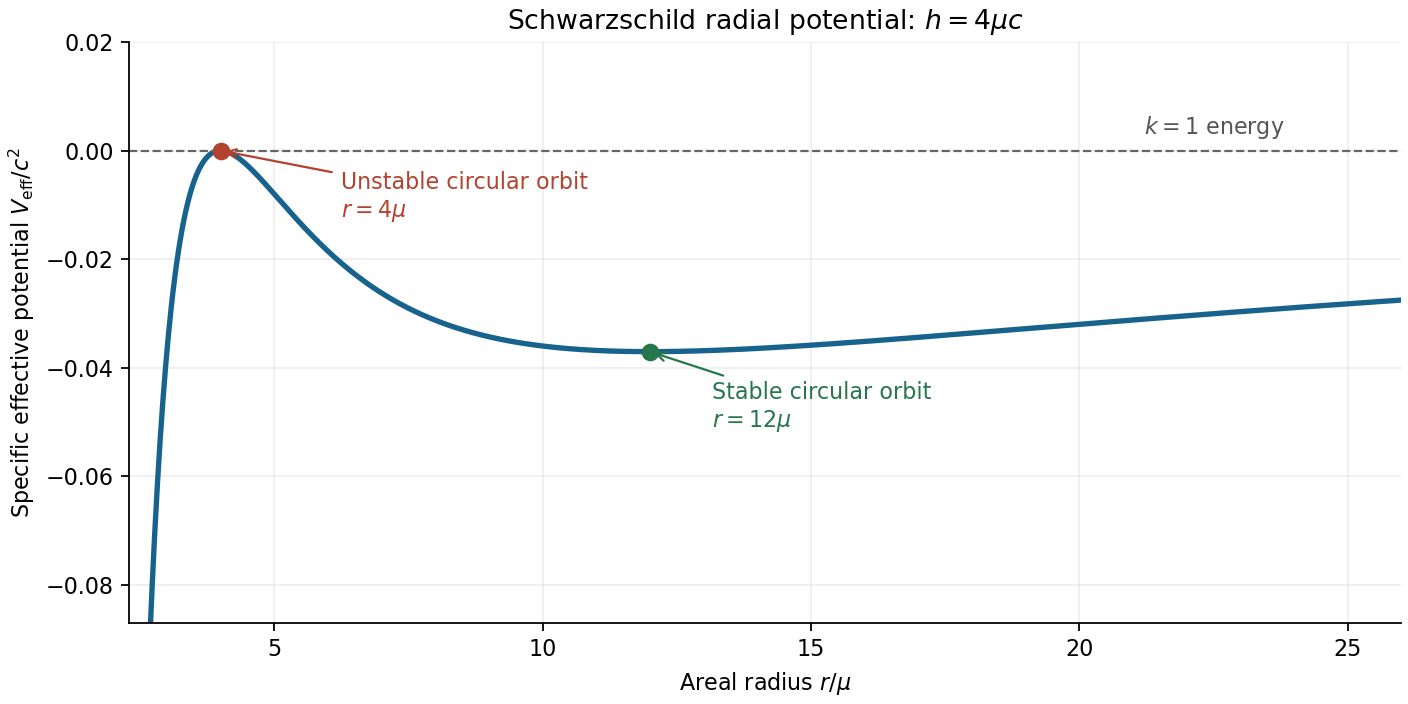
Substitution of and into the norm gives the general radial first integralFor a massive particle this becomesAdopting the usual half-normalization for the effective potential for timelike Schwarzschild geodesics, defineAll terms have units , or energy per unit mass. The first two terms are the Newtonian gravitational and centrifugal contributions; the last is the relativistic correction.
A circular orbit requires both and . Differentiating at fixed givesThe radial first integral also givesFor the future-directed circular orbit at , these constants are , , and . ThereforeSince Schwarzschild time agrees with the clock time of a static observer at infinity, the intended infinity-referred tangential orbital speed isThis uses the circumferential areal radius with the clock at infinity; it is not a local measurement made at the orbit. A local static observer's clock instead has and measures . These two operationally different speeds explain the significance of the phrase “at infinity”.
The effective-potential stability of a circular orbit follows fromConsequently the orbit exists but is unstable to radial perturbations. The original plot below shows its position at a maximum, for .
For a weak-field elliptic orbit, the relativistic correction makes the direction of closest approach advance after each radial cycle. The derivations under i and ii below giveper orbit to first order, where is the semi-major axis and the orbital eccentricity. For Mercury, the additional Schwarzschild perihelion precession is approximately 43 arcseconds per century, over and above the much larger Newtonian precession produced primarily by other planets. It is the unexplained residual after those effects have been included that provides the classic quantitative test of general relativity; one should not identify the whole observed precession with this relativistic correction.[ref]
https://ntrs.nasa.gov/api/citations/20180000952/downloads/20180000952.pdf. PDF p. 2: planetary perturbations about 531.63 arcseconds per Julian century and additional relativistic precession about 42.98 arcseconds per Julian century
Past exam of the relativity course of the University of Cambridge 2018 Section B B2 Solution by Codex 0 2026-10-18
Codex 0 2026-10-18The two postulates of special relativity are: all nongravitational laws have the same form in every inertial frame, and light in vacuum has the same finite speed of light in every inertial frame, independently of the motion of its source. The first is Einstein's principle of relativity; the second supplies an experimentally identified invariant speed.
For the stated standard configuration, the Lorentz transformation isTake differentials along the particle's worldline, rather than comparing coordinate displacements at equal times in the two frames. Writing , one obtainsDividing by the transformed time interval proves the velocity-addition formula:For a massive particle, and , so the denominator is positive.
Pinned article: Introduction to the OurBigBook Project
Welcome to the OurBigBook Project! Our goal is to create the perfect publishing platform for STEM subjects, and get university-level students to write the best free STEM tutorials ever.
Everyone is welcome to create an account and play with the site: ourbigbook.com/go/register. We belive that students themselves can write amazing tutorials, but teachers are welcome too. You can write about anything you want, it doesn't have to be STEM or even educational. Silly test content is very welcome and you won't be penalized in any way. Just keep it legal!
Intro to OurBigBook
. Source. We have two killer features:
- topics: topics group articles by different users with the same title, e.g. here is the topic for the "Fundamental Theorem of Calculus" ourbigbook.com/go/topic/fundamental-theorem-of-calculusArticles of different users are sorted by upvote within each article page. This feature is a bit like:
- a Wikipedia where each user can have their own version of each article
- a Q&A website like Stack Overflow, where multiple people can give their views on a given topic, and the best ones are sorted by upvote. Except you don't need to wait for someone to ask first, and any topic goes, no matter how narrow or broad
This feature makes it possible for readers to find better explanations of any topic created by other writers. And it allows writers to create an explanation in a place that readers might actually find it.
Figure 1. Screenshot of the "Derivative" topic page. View it live at: ourbigbook.com/go/topic/derivativeVideo 2. OurBigBook Web topics demo. Source. - local editing: you can store all your personal knowledge base content locally in a plaintext markup format that can be edited locally and published either:This way you can be sure that even if OurBigBook.com were to go down one day (which we have no plans to do as it is quite cheap to host!), your content will still be perfectly readable as a static site.
- to OurBigBook.com to get awesome multi-user features like topics and likes
- as HTML files to a static website, which you can host yourself for free on many external providers like GitHub Pages, and remain in full control

Figure 2. You can publish local OurBigBook lightweight markup files to either OurBigBook.com or as a static website.
Figure 3. Visual Studio Code extension installation.
Figure 5. . You can also edit articles on the Web editor without installing anything locally. Video 3. Edit locally and publish demo. Source. This shows editing OurBigBook Markup and publishing it using the Visual Studio Code extension. 
- Infinitely deep tables of contents:



All our software is open source and hosted at: github.com/ourbigbook/ourbigbook
Further documentation can be found at: docs.ourbigbook.com
Feel free to reach our to us for any help or suggestions: docs.ourbigbook.com/#contact