Topics (384k) Articles (398k) Users (410) Discussions (242) Comments (383) Files (13k) New article
For an isotropic harmonic oscillator with mass , restoring constant and linear drag coefficient , put and . Choose initial position and tangential velocity , which would give anticlockwise circular motion without damping. For underdamping, givesTaking the squared norm and multiplying by gives the exact potential energyOnly to leading order in does this reduce to . The exact expression has , consistent with the initially tangential velocity, while the leading approximation does not reproduce this short-time derivative. Angular momentum obeys by angular momentum decay under uniform linear drag.
For , an initial velocity at zero displacement givesAll three cases begin with slope . Only underdamping produces repeated crossings through equilibrium; critical damping and overdamping remain on the initial side of equilibrium for this particular initial condition. The overdamped long-time tail decays at rate , which becomes slow for strong damping.
Causal Green function of an overdamped oscillator by  Codex 0 Created 2026-10-18 Updated 2026-10-20
For with , denotes the Heaviside step function. This Green function vanishes at negative time and satisfies . Its positive-time part solves the homogeneous ordinary differential equation, is zero at the origin, and has right derivative one. Thus it is continuous with a unit derivative jump, which gives precisely the Dirac delta function in its second distributional derivative.
With the negative-exponential Fourier transform convention,Both poles lie in the upper half-plane. Contour integration closes above for positive time and below for negative time, giving the title expression. When the integral converges, convolution supplies the response with no freely added homogeneous transient growing toward negative infinity. The continuous limit is .
Double Dalitz decay converts both virtual photons from a two-photon hadronic transition into charged-lepton pairs. The neutral-pion four-electron final state avoids the specific two-lepton helicity suppression of , despite its more restricted phase space.
A closed circular cylinder of radius and length has volume and total surface area , including both end disks. At fixed area , Lagrange multipliers for maximizing the volume give , henceEquivalently, eliminate and maximize on . The derivative changes from positive to negative at the displayed radius, and the volume tends to zero at both ends.
For a cylinder inscribed in a sphere of radius , the constraint is . Maximizing by Lagrange multipliers gives , so the positive aspect ratio is . It is independent of . With , the area is ; differentiating this expression confirms the unique maximum on .
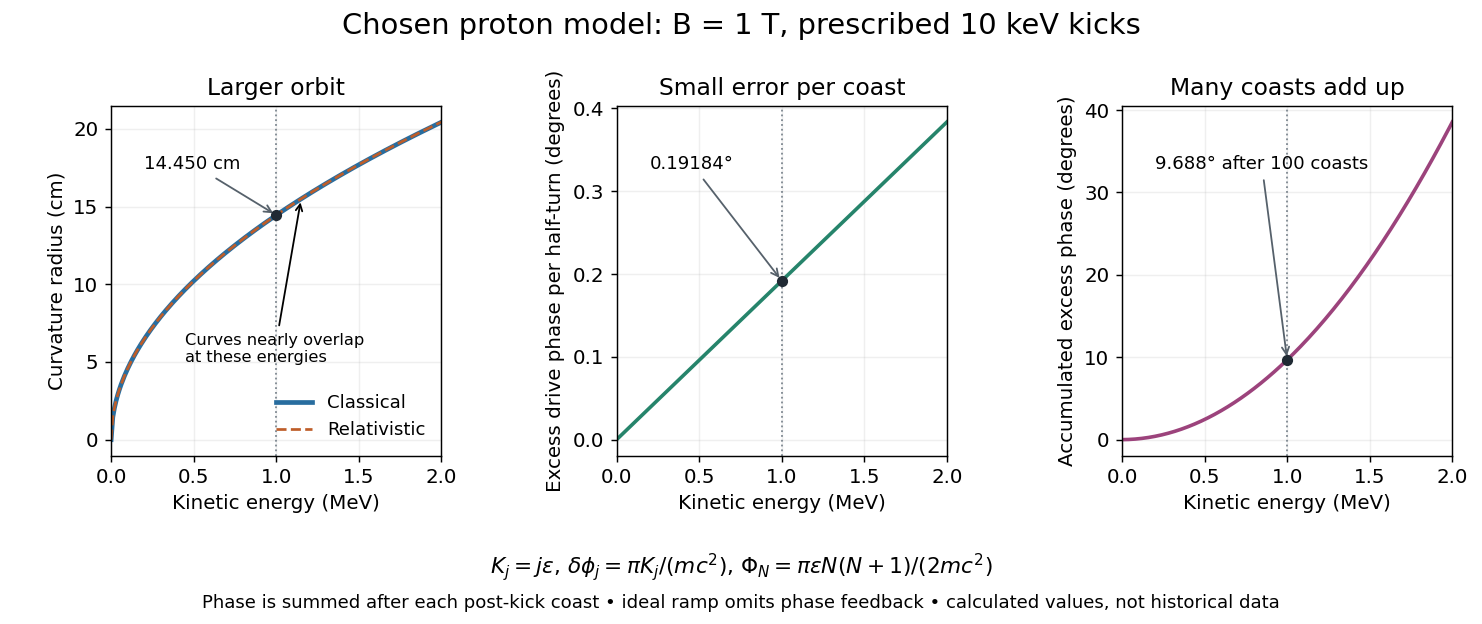
At larger kinetic energy, special relativity changes the relation between momentum and velocity. With the invariant mass, the Lorentz factor is , and a relativistic cyclotron orbit in a fixed uniform magnetic field satisfiesThe cyclotron frequency decreases as the kinetic energy increases. If the drive stays at the classical value , the half-turn time is . During it the drive advances through rather than radians. Its excess phase per half-turn is thereforeEven a small fractional frequency mismatch accumulates across many turns. A particle eventually reaches a weak or decelerating gap phase, so the classical fixed-field, fixed-frequency design has a practical kinetic energy limit. The limit depends on the kick size and acceptable accumulated phase error, rather than one universal cutoff energy. Changing drive frequency or shaping the magnetic field can restore synchronism; the argument does not forbid relativistic circular accelerators.
For the illustrative proton at , : the frequency is lower by about , and the next half-turn adds about of drive phase excess. To see cumulative sensitivity, prescribe an ideal ramp with and sum the errors of the first coasts after kicks:This gives after the coast following kick ; the arrival at kick instead has . The prescribed ramp diagnoses detuning but does not feed the resulting phase error back into the kicks. A self-consistent thin-gap model uses the cyclotron gap energy gain with , then advances the phase with the new kinetic energy during the following coast.
Ernest Orlando Lawrence and Milton Stanley Livingston reported repeated ion acceleration in 1932. Their evacuated brass chamber used one driven hollow cyclotron dee; the grounded box and slotted divider supplied the other electrode. Filament electrons ionized hydrogen near the gap. A perpendicular magnetic field bent the ions; a high-frequency oscillator drove the gap. Deflecting plates and slits selected particles for a Faraday cup, read by an electrometer.[ref]
The Production of High Speed Light Ions Without the Use of High Voltages by Ernest Orlando Lawrence and Milton Stanley Livingston. Lawrence and Livingston, 1932, pp. 25–28, Figs. 2–4: actual accelerating electrode, source, collector and oscillator
Scanning the magnetic field produced narrow resonance peaks. The optimum deflecting voltage tracked the kinetic energy predicted from field and orbit radius, supporting the reported protons. Source width and slit geometry limited this check; it was not a direct energy measurement of every particle.[ref]
The Production of High Speed Light Ions Without the Use of High Voltages by Ernest Orlando Lawrence and Milton Stanley Livingston. pp. 31–33, Figs. 7–9: resonance scans, field and wavelength measurements, deflection-voltage energy check and geometric uncertainty; p. 19: maximum reported proton energy
This combination distinguishes producing a circulating electric current from establishing its kinetic energy. The electrometer measures collected electric charge per unit time; it cannot by itself tell whether the collected particles are fast. The separate deflection selection supplies a speed-dependent test. Agreement of two consequences of the model, the cyclotron resonance condition and the cyclotron energy and orbit radius relation, makes the inference stronger than either a current signal or a predicted orbit alone.
Milton Stanley Livingston built the early cyclotrons with Ernest Orlando Lawrence; the 1939 Nobel Prize in Physics went to Ernest Orlando Lawrence. His lecture, The evolution of the cyclotron, was delivered on 11 December 1951.[ref]
More Timelines by Lawrence Livermore National Laboratory. Ernest Lawrence entry: 1939 prize and delayed lecture on 11 December 1951
[ref]M. Stanley Livingston by Fermilab. M. Stanley Livingston: co-inventor of the cyclotron and early Berkeley work
Combining with the classical kinetic energy givesHere denotes kinetic energy, not relativistic total energy. At fixed magnetic field, twice the final radius allows four times the classical kinetic energy. At fixed final kinetic energy, a larger accelerating gap voltage reduces the number of crossings needed, but does not change the required orbit radius.
For an illustrative proton with and peak gap voltage , take negligible injection kinetic energy, on-crest kicks, a zero-width gap, and no losses. Each crossing adds , so crossings give , using electronvolts. With and ,The th kick arrives after intervening half-turns, about after the first kick in this idealization. The final two curvature radii differ by . That difference is a curvature-radius increment, not a general formula for separation of real extracted turns: successive arc centers shift, and extraction also depends on focusing and the gap geometry. These chosen settings are a calculation, not historical measurements.
Take an ion of mass and electric charge , with velocity perpendicular to a uniform magnetic field of magnitude . In the classical mechanics limit, the Lorentz force provides the centripetal acceleration:Here is the local radius of curvature and is the cyclotron frequency, expressed as an angular frequency. A half-turn takesIncreasing speed increases the path length in exactly the same proportion. Drive the gap at angular frequency , or ordinary frequency . In each half-turn the gap electric field reverses once, just as the particle reverses its direction of passage through the gap. The particle therefore receives two accelerating kicks per complete turn, using one oscillation per complete turn. This is the fundamental resonance; transit time through the gap and departures from a uniform magnetic field have been neglected.
A hollow D-shaped electrode that shields a circulating ion from the accelerating electric field during one half-turn. Two opposed cyclotron dees provide two shielded regions separated by a gap; their electric potential difference alternates. The vacuum reduces collisions with residual gas. An ion source supplies particles near the center, and an extraction system directs an outer orbit toward a particle detector or target. Useful electric current depends on retaining particles near the median plane and delivering them to the outlet, as well as on increasing their kinetic energy.
X-ray crystallographic structure inference is an inverse problem: infer a crystal structure from measured X-ray diffraction. A proposed unit cell and atomic basis of a crystal predict a pattern; structure determination asks which proposals survive comparison with that pattern. The useful separation is between directions and strengths. Peak positions constrain the reciprocal lattice and hence interplanar spacings; relative wave intensities constrain the motif through the crystal basis structure factor. Knowing a repeat distance does not locate all the chemical atoms within that repeat.
The lattice constant from two indexed reflections example isolates the geometric inference. Basis intensities and phase ambiguity then holds the translations fixed while changing the motif. Even complete, noiseless wave intensity data need not determine all wave phases: this is the phase problem. Chemical composition, symmetry, and additional measurements can supply constraints beyond the original pattern.[ref]
Phase problem. Online Dictionary of Crystallography by International Union of Crystallography; Definition and Methods of solution: intensities determine structure-factor magnitudes but not phases; additional structural information enters phase estimation
X-ray crystallography infers a crystal structure from measured X-ray diffraction. Peak positions constrain the lattice geometry, while intensities constrain the atomic basis of a crystal; the inference also needs an experimental model and does not directly observe every atomic position.
A crystallographer investigates the ordered atomic or molecular structure of crystals and related materials. Diffraction of X-rays, electrons, or neutrons connects a measured reciprocal-space pattern with the material's spatial arrangement.
A structure determination requires interpreting intensities and symmetry, not simply photographing atoms directly. Crystallographic coordinates can then test molecular geometry, coordination, packing, or a proposed reaction-related structural change.
Pinned article: Introduction to the OurBigBook Project
Welcome to the OurBigBook Project! Our goal is to create the perfect publishing platform for STEM subjects, and get university-level students to write the best free STEM tutorials ever.
Everyone is welcome to create an account and play with the site: ourbigbook.com/go/register. We belive that students themselves can write amazing tutorials, but teachers are welcome too. You can write about anything you want, it doesn't have to be STEM or even educational. Silly test content is very welcome and you won't be penalized in any way. Just keep it legal!
Intro to OurBigBook
. Source. We have two killer features:
- topics: topics group articles by different users with the same title, e.g. here is the topic for the "Fundamental Theorem of Calculus" ourbigbook.com/go/topic/fundamental-theorem-of-calculusArticles of different users are sorted by upvote within each article page. This feature is a bit like:
- a Wikipedia where each user can have their own version of each article
- a Q&A website like Stack Overflow, where multiple people can give their views on a given topic, and the best ones are sorted by upvote. Except you don't need to wait for someone to ask first, and any topic goes, no matter how narrow or broad
This feature makes it possible for readers to find better explanations of any topic created by other writers. And it allows writers to create an explanation in a place that readers might actually find it.
Figure 1. Screenshot of the "Derivative" topic page. View it live at: ourbigbook.com/go/topic/derivativeVideo 2. OurBigBook Web topics demo. Source. - local editing: you can store all your personal knowledge base content locally in a plaintext markup format that can be edited locally and published either:This way you can be sure that even if OurBigBook.com were to go down one day (which we have no plans to do as it is quite cheap to host!), your content will still be perfectly readable as a static site.
- to OurBigBook.com to get awesome multi-user features like topics and likes
- as HTML files to a static website, which you can host yourself for free on many external providers like GitHub Pages, and remain in full control

Figure 2. You can publish local OurBigBook lightweight markup files to either OurBigBook.com or as a static website.
Figure 3. Visual Studio Code extension installation.
Figure 5. . You can also edit articles on the Web editor without installing anything locally. Video 3. Edit locally and publish demo. Source. This shows editing OurBigBook Markup and publishing it using the Visual Studio Code extension. 
- Infinitely deep tables of contents:



All our software is open source and hosted at: github.com/ourbigbook/ourbigbook
Further documentation can be found at: docs.ourbigbook.com
Feel free to reach our to us for any help or suggestions: docs.ourbigbook.com/#contact