Topics (384k) Articles (398k) Users (410) Discussions (242) Comments (383) Files (13k) New article

Represent one polymer by two beads joined by an ideal linear entropic spring, and stipulate a dimensionless conformation tensor with equilibrium value . The displayed model uses velocity gradient and positive polymer relaxation time . It omits finite chain extensibility, interactions with other chains, and feedback from the polymer onto the flow. It is a teaching model, not a fitted description of Keller's apparatus.
Define the Weissenberg number for this model as and dimensionless time . With an initially isotropic , the diagonal entries obeyBelow , both transverse and longitudinal responses approach positive finite steady values:For a chosen , and : the longitudinal mean-square separation is five times its quiescent value, while the transverse separation contracts. A root-mean-square length grows as the square root of a variance, so the longitudinal length factor is , not five. The anisotropy is an orientational indicator; converting it to measured birefringence requires an additional calibrated optical relation.
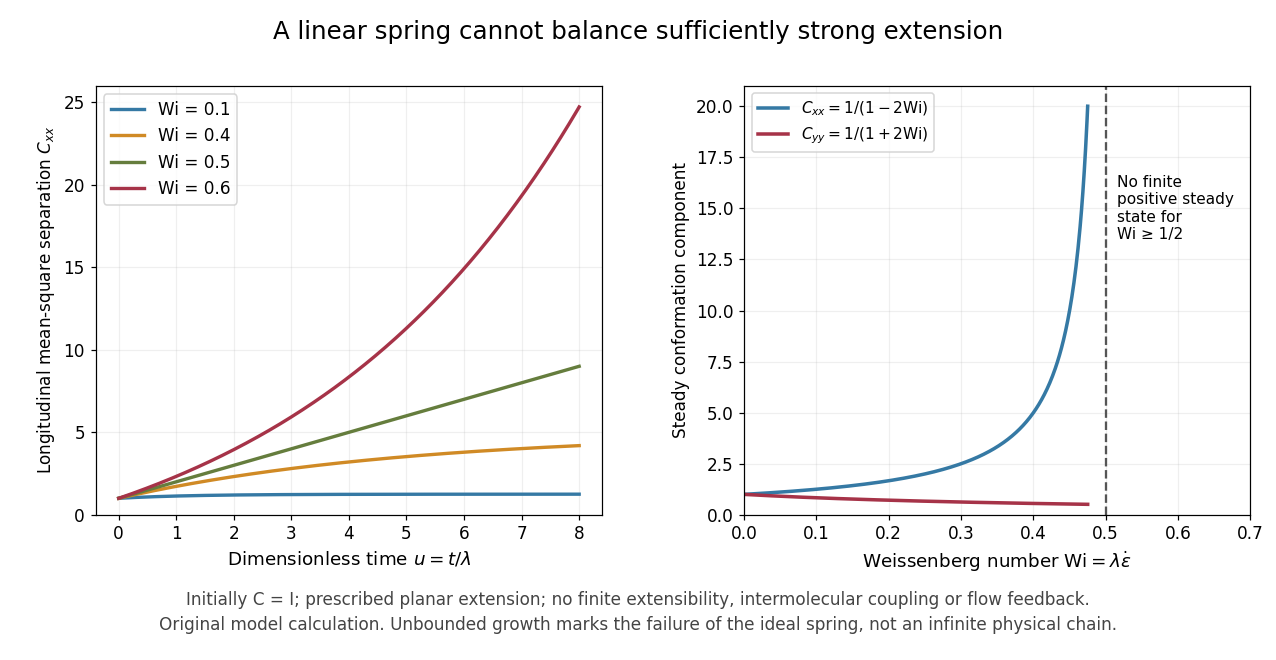
At , . Above that value, the growing homogeneous solution prevents a positive finite steady state. For instance, gives . Real chains have finite contour lengths, so this growth identifies the failure of the linear spring model. It does not establish a universal threshold for arbitrary flow histories, finite chains or other definitions of polymer relaxation time. Combining the growth equation with residence time in planar extension also explains why a large instantaneous Weissenberg number alone does not guarantee a strongly stretched exiting chain.
Pierre-Gilles de Gennes's 1991 lecture describes Andrew Keller and collaborators using four rollers to deform a dilute polymer solution. A well-chosen exit trajectory kept coils under sustained extension. Above a threshold flow rate the solution became birefringent, revealing a change in chain orientation and conformation. The experiment connected an optical readout to a mechanically driven molecular response.[ref]
Soft Matter by Pierre-Gilles de Gennes. Printed p. 9: four-roller experiment and coil-stretch interpretation; text inspected in the Columbia reproduction
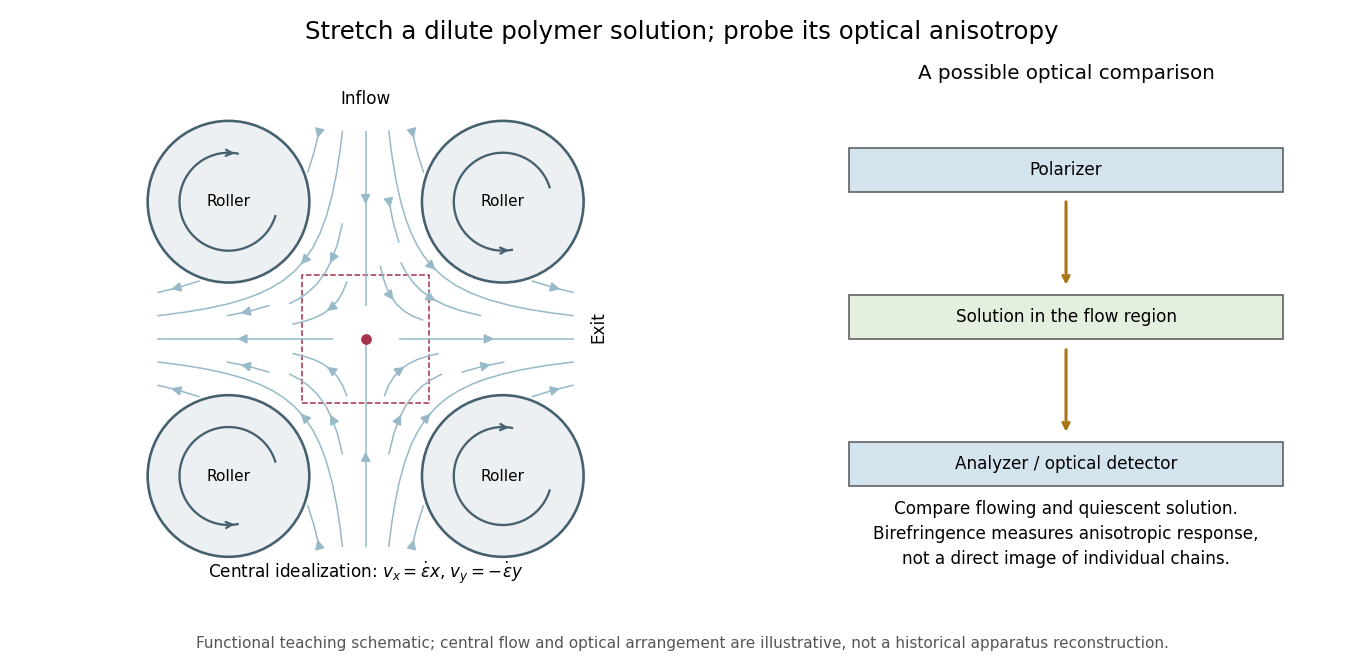
This original functional diagram shows a central flow idealization, rather than historical dimensions or a photograph. A probe of birefringence detects different optical responses along different directions; it does not directly photograph a chain or establish its extension without an optical model. Comparing a flowing solution with its quiescent state and controlling temperature and concentration are useful proposed checks, not an assertion that this is the complete historical protocol.
A normalized oscillator coherent state obeys , so its mean occupation number is . Under the quantum harmonic oscillator Hamiltonian operator , its evolution is . Inserting and givesThese mean values obey the classical harmonic oscillator equations. The displacement amplitude is , whose classical orbit has energy . The full quantum mean energy has the additional zero-point energy . Indeed the variances are and , and their kinetic and potential contributions sum to .
Suddenly shifting a quantum harmonic oscillator equilibrium from zero to a signed position leaves the old ground state unchanged at the instant of the quantum quench. The new annihilation operator is , with , so . In the translated energy eigenstates , the expansion isThe sign follows by translating the old vacuum by before expanding it in the old Fock states. A Baker--Campbell--Hausdorff formula with central commutator separates the resulting exponential into creation and annihilation parts. Evolution with the shifted Hamiltonian preserves this coherent state, with . Its mean occupation is and its mean energy above the new potential minimum is . Omitting in favour of changes the state when .
The displacement operator translates oscillator phase space. It is unitary and obeys and , a coherent state. The Baker--Campbell--Hausdorff formula with a scalar commutator givesThe conjugation on ensures that the exponent is anti-Hermitian for arbitrary complex displacement. For real , this becomes the spatial translation .
Cobalt-60 is a radioactive cobalt isotope with twenty-seven protons and thirty-three neutrons. It beta-decays to excited states of nickel-60, followed by characteristic gamma emission.
That reproducible emission makes it useful as a radiation source in measurement and irradiation applications. Its decay concerns nuclear transitions; changing cobalt's chemical oxidation state does not turn one cobalt isotope into another.
A diffusion cloud chamber continuously supplies vapor from a warmer reservoir toward a colder base. A temperature gradient permits supersaturated vapor in a layer near the base, where new ionization trails can continually form drops. There is no repeated bulk piston expansion cycle. The two instruments share ion-assisted condensation, but their sensitive regions and timing differ.
CERN's modern teaching apparatus uses alcohol-soaked felt, a sealed transparent container, a dark metal base cooled with dry solid carbon dioxide, and a side light. The view is a thin sensitive region near the cold base, rather than a chamber-wide expansion photograph.[ref][ref]
Bringing Particle Physics to Life: Build Your Own Cloud Chamber by Francisco Barradas-Solas and Paloma Alameda-Meléndez. Barradas-Solas and Alameda-Meléndez, Bringing particle physics to life: build your own cloud chamber (29 April 2010), “The continuously sensitive diffusion cloud chamber” and “Method”, steps 5–6
The central mechanism is a competition between two falling pressures: expansion reduces the actual water partial pressure, but cooling can reduce the equilibrium vapor pressure still faster. The ratio can therefore rise above one even though the gas becomes more dilute. The cloud-chamber expansion model below makes that comparison explicit.
A climate model is a mathematical description of the mechanisms and statistics of a planet's climate change and variability. A useful hierarchy starts with conservation of energy in a zero-dimensional planetary energy balance, adds vertical radiative transfer and convection in a radiative-convective climate column, and can resolve three-dimensional fluid mechanics and ocean circulation. Each level answers different questions. A column can explain why changing an absorber changes surface temperature; it cannot locate tomorrow's storm.
Three questions should be kept distinct: what sets an average temperature, how fast does it respond to radiative forcing, and how large are its unforced fluctuations? Climate sensitivity concerns the first, heat capacity controls response times, and the Hasselmann stochastic climate model illustrates the third. An observational test must compare a predicted observable with an instrument's actual readout, as in the satellite test of greenhouse spectral change.
Hans Adolf Krebs described the experimental reasoning in his 1953 Nobel lecture. Pigeon breast skeletal muscle retained strong oxidative activity after preparation in a Latapie mincing mill and suspension in aqueous medium. Small fumarate additions increased oxygen uptake by more than complete oxidation of the added fumarate could explain; added four-carbon acids could still be detected afterward. His Table 1 compares the increase in uptake with that calculated from complete consumption of the addition. These comparisons challenge the interpretation that the addition merely supplied extra fuel.[ref]
The citric acid cycle by Hans Adolf Krebs. The citric acid cycle, Nobel Lecture, 11 December 1953, printed pp. 400–401 and Table 1: minced-muscle preparation, uptake comparison and retained acid; authored transcript also available at studyres.com/doc/1333386/hans-a.-krebs---nobel-lecture
The lecture identifies the preparation apparatus but does not describe the gas-measuring instrument behind Table 1. The result supports regeneration, not a unique complete reaction mechanism. Its later discussion combines citrate formation from oxaloacetate with breakdown back toward the four-carbon intermediates to close the cycle. Competitive inhibition supplies another comparison: malonate inhibits succinate dehydrogenase, and succinate accumulates. Such evidence links a blocked step to the surrounding metabolic pathway; damaged tissue and restricted inhibitor access can complicate interpretation.[ref]
The citric acid cycle by Hans Adolf Krebs. The citric acid cycle, printed pp. 401–404, Figures 1–2 and malonate discussion: cyclic interpretation and inhibitor-access limitation; p. 399, preparation damage
An increase above the added fuel's own oxygen demand is a particularly revealing control on the explanation: it compares the proposed cause with the largest effect that simple consumption could produce. The modern mitochondrial oxygen electrode assay asks a different question about a prepared mitochondrion, testing respiratory control through ADP additions. Neither an oxygen uptake signal nor an accumulating intermediate is by itself a direct measurement of ATP production.
Net stoichiometry does not identify individual chemical atoms. In the ordinary forward citric acid cycle, neither entering acetyl group carbon is released in that same first turn: both released carbon dioxide carbon chemical atoms came from the starting oxaloacetate. The entering carbon remains in regenerated intermediates.[ref]
The Citric Acid Cycle (Boston University lecture slides). The Citric Acid Cycle, slide numbered 4, Origin of C-Atoms in CO2: entering acetyl carbons retained and released carbons from starting oxaloacetate
Consider a chosen ideal first-turn experiment, with negligible natural carbon-13 abundance and no exchange, side pathways, repeated turns or isotope effects. Supply of initially unlabelled oxaloacetate and of acetyl-CoA, of which has both acetyl group carbon positions labelled with carbon-13. The other has neither position labelled. The label refers only to the acetyl group, not to coenzyme A.
The input contains of labelled carbon chemical atoms. The of citrate initially formed contains of carbon chemical atoms, so its labelled-carbon fraction is . After exactly one forward traversal per starting oxaloacetate, the of released carbon dioxide has zero label, while the regenerated of oxaloacetate contains all of labelled carbon chemical atoms among total: .
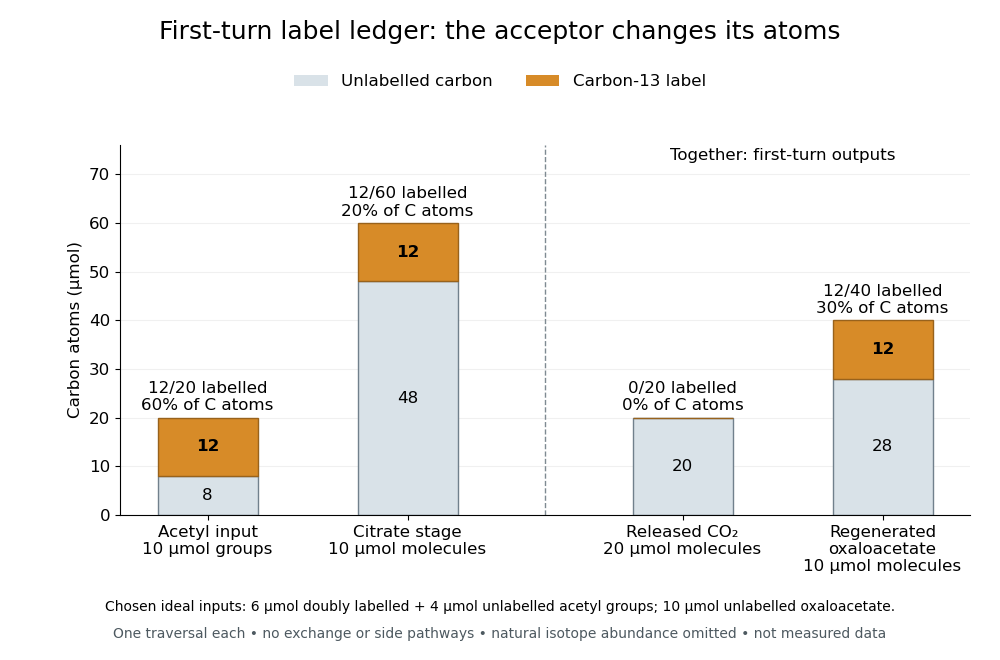
The conservation check is for total carbon and for label. In this model, of regenerated oxaloacetate molecules carry label, distinct from the labelled-carbon fraction. The regenerated oxaloacetate is the same chemical species and the same amount of substance as the initial acceptor pool, but its chemical atom identities have changed. Saying that the cycle oxidizes an acetyl group to two carbon dioxide is a net ledger, not a claim that those exact two incoming chemical atoms immediately leave. Later-turn label release requires positional tracking and mixing assumptions; the first-turn balance alone does not determine it.
The carbon sequence is oxaloacetate plus an acetyl group to citrate , then isocitrate , alpha-ketoglutarate , succinyl-CoA , succinate , fumarate , malate and back to oxaloacetate . The numbers count the cycling carbon skeleton, excluding coenzyme A. Two carbon dioxide releases accompany the changes .[ref]
Biology 2e by Mary Ann Clark and others. §7.3, Steps in the Citric Acid Cycle, steps 1–8 and Figure 7.11
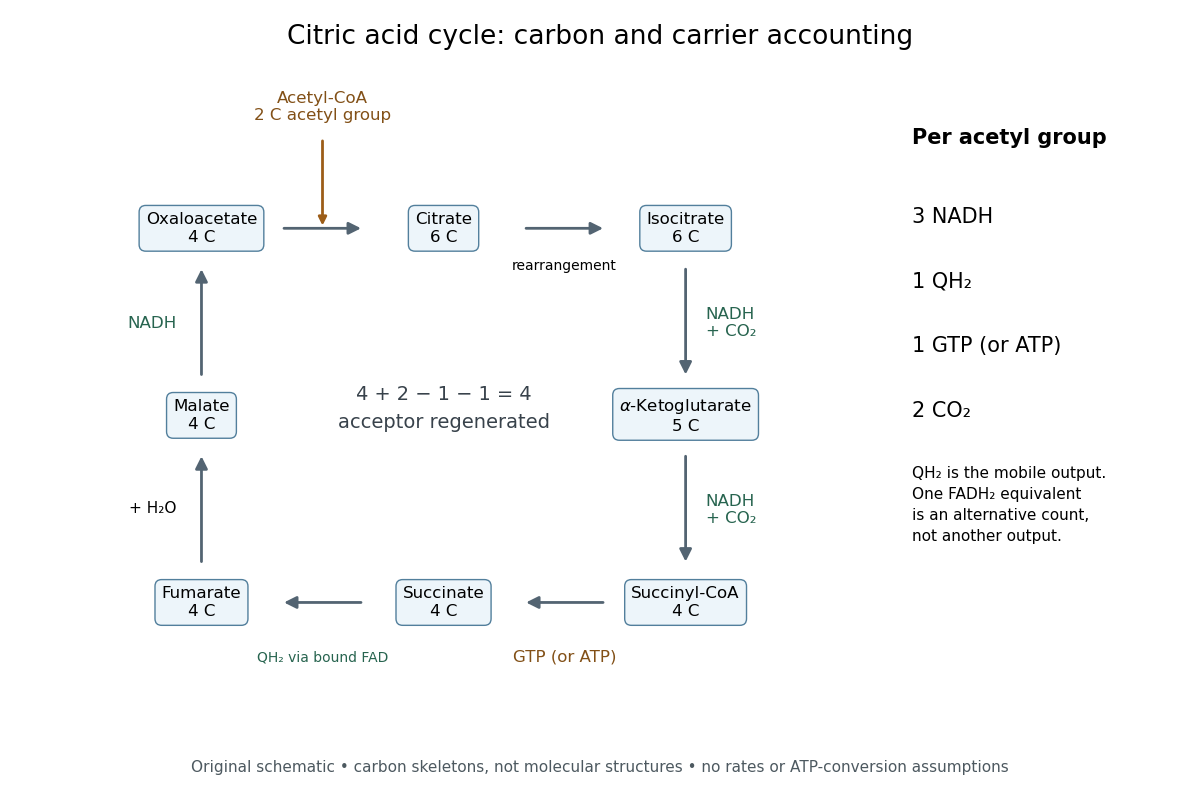
Per acetyl group: three NADH, one FADH2 equivalent, one GTP or ATP by substrate-level phosphorylation, and two carbon dioxide. Succinate dehydrogenase retains FADH2 and transfers its electrons to ubiquinone, forming ubiquinol. The FADH2 equivalent and ubiquinol count the same electron pair.[ref]
Biology 2e by Mary Ann Clark and others. §7.3, Citric Acid Cycle and Steps in the Citric Acid Cycle, steps 3–8, especially step 6, enzyme-bound reduced carrier; §7.4, Q and Complex II: ubiquinone reduction to QH2
A useful check adds the stepwise changes. The carbon count is ; the NADH count is . Each NADH carries two electrons, and the succinate dehydrogenase route supplies another pair, so one turn exports electrons. This arithmetic is an accounting identity, not an ATP yield calculation. Converting it to ATP requires the separate energy coupling and transport assumptions discussed under oxidative phosphorylation.
For a chosen ideal conversion of of acetyl groups, multiplication gives of NADH, of ubiquinol, of GTP and of carbon dioxide. The electron output is . If all these electrons subsequently reach oxygen with no competing sinks, four electrons per oxygen molecule require of oxygen. That is consumption by the connected electron transport chain; it is not an oxygen term in the cycle's own substrate ledger.
No cycle step directly consumes molecular oxygen. In ordinary aerobic mitochondrial operation, however, the mitochondrial respiratory chain must reoxidize NADH and ubiquinol to restore the oxidized electron carriers. Without that outlet, a finite oxidized-carrier pool cannot sustain continued turnover. Other electron acceptors and other forms of metabolism require their own analysis.[ref]
How Cells Obtain Energy from Food. Molecular Biology of the Cell, 4th edition by Bruce Alberts and others; Chapter 2, How Cells Obtain Energy from Food, The Citric Acid Cycle Generates NADH by Oxidizing Acetyl Groups to CO2: lack of direct O2 consumption and need to regenerate NAD+
The pyruvate dehydrogenase complex acts upstream: one three-carbon pyruvate gives one two-carbon acetyl group, one carbon dioxide and one NADH. These are additional to the cycle ledger.[ref] Consequently, processing one pyruvate through both stages gives three carbon dioxide and four NADH, while the succinate dehydrogenase contribution and the substrate-level phosphorylation contribution each remain one. Counting the upstream step inside the cycle would obscure where the extra carbon dioxide and NADH arise.
The signed accumulated rotation about a specified fixed axis. Unlike an angle specified only modulo , angular displacement counts complete revolutions as well as the final orientation. Its derivative with respect to time is angular velocity. The displayed formula therefore follows from the fundamental theorem of calculus.
An arithmetic circuit is a directed acyclic graph whose input nodes are variables or constants in a field, and whose internal gates perform addition, subtraction, or multiplication. Gates may reuse earlier outputs, so the circuit can represent a polynomial without listing all its monomials.
Pinned article: Introduction to the OurBigBook Project
Welcome to the OurBigBook Project! Our goal is to create the perfect publishing platform for STEM subjects, and get university-level students to write the best free STEM tutorials ever.
Everyone is welcome to create an account and play with the site: ourbigbook.com/go/register. We belive that students themselves can write amazing tutorials, but teachers are welcome too. You can write about anything you want, it doesn't have to be STEM or even educational. Silly test content is very welcome and you won't be penalized in any way. Just keep it legal!
Intro to OurBigBook
. Source. We have two killer features:
- topics: topics group articles by different users with the same title, e.g. here is the topic for the "Fundamental Theorem of Calculus" ourbigbook.com/go/topic/fundamental-theorem-of-calculusArticles of different users are sorted by upvote within each article page. This feature is a bit like:
- a Wikipedia where each user can have their own version of each article
- a Q&A website like Stack Overflow, where multiple people can give their views on a given topic, and the best ones are sorted by upvote. Except you don't need to wait for someone to ask first, and any topic goes, no matter how narrow or broad
This feature makes it possible for readers to find better explanations of any topic created by other writers. And it allows writers to create an explanation in a place that readers might actually find it.
Figure 1. Screenshot of the "Derivative" topic page. View it live at: ourbigbook.com/go/topic/derivativeVideo 2. OurBigBook Web topics demo. Source. - local editing: you can store all your personal knowledge base content locally in a plaintext markup format that can be edited locally and published either:This way you can be sure that even if OurBigBook.com were to go down one day (which we have no plans to do as it is quite cheap to host!), your content will still be perfectly readable as a static site.
- to OurBigBook.com to get awesome multi-user features like topics and likes
- as HTML files to a static website, which you can host yourself for free on many external providers like GitHub Pages, and remain in full control

Figure 2. You can publish local OurBigBook lightweight markup files to either OurBigBook.com or as a static website.
Figure 3. Visual Studio Code extension installation.
Figure 5. . You can also edit articles on the Web editor without installing anything locally. Video 3. Edit locally and publish demo. Source. This shows editing OurBigBook Markup and publishing it using the Visual Studio Code extension. 
- Infinitely deep tables of contents:




All our software is open source and hosted at: github.com/ourbigbook/ourbigbook
Further documentation can be found at: docs.ourbigbook.com
Feel free to reach our to us for any help or suggestions: docs.ourbigbook.com/#contact