Topics (384k) Articles (398k) Users (410) Discussions (242) Comments (383) Files (13k) New article

For radiative, gas-pressure-supported homologous stars with constant opacity, write , and . The radiative diffusion in a star equation contains the dimensionless coefficient . A common fixed profile fixes , so and the luminosity of a fixed-mass member is constant. Gravitational energy generation in a homologously contracting ideal-gas star gives for a positive profile constant . Thus . For CNO cycle heating , the stellar nuclear fusion luminosity scales as . Equating this with gives . Neglecting , the arrival time is , hence a coeval cluster's newly arriving mass scales as . All comparisons hold stellar composition, opacity normalization and dimensionless profiles fixed.
A mass-preserving stellar homology with scale has mass density proportional to . For an adiabatic process with constant adiabatic index , its internal energy scales as and its Newtonian gravitational potential energy as . Writing , stationarity at requires , and the second scale derivative is . Thus this particular displacement is restoring for , destabilizing for , and marginal at . This is a test of homologous radial stability; it does not by itself test every stellar displacement.
For a monatomic ideal gas fully convective star, and . Matching its adiabat to a photosphere with and gives , and hence surface luminosity . Specific heating gives . Equality yields the displayed laws and , so the theoretical HR slope is . Fixed composition, efficient convection and the surface matching approximation are essential.
For flux and effective dust opacity , radiative acceleration is . Comparing it with the gravitational acceleration gives an Eddington luminosity condition appropriate to dusty gas. In an optically thick starburst galaxy, feedback can limit the star formation rate per area and drive a galactic outflow, while the gas supply limits the duration. A surface-density limit is not a universal ceiling on total star formation rate: the star-forming area matters. Radiation-supported starburst disk calculations give characteristic optically thick infrared fluxes near .
A spherical mass density gives projected surface density . On the positive half of the line of sight, substitute to obtain the displayed Abel transform. Spherical symmetry is essential: a general three-dimensional density cannot be reconstructed uniquely from one projection.
A collisional self-gravitating stellar core can lose heat to its halo, contract and become hotter because it has negative heat capacity of a virialized gravitational system. The increased temperature contrast drives further outward heat flow and further contraction. The classical gravothermal catastrophe is the loss of a finite-density thermodynamic equilibrium at a finite total energy along the confined three-dimensional Newtonian isothermal sequence. It concerns slow two-body relaxation, not simply a collisionless instability. The dimensional form of the gravitational interaction and the thermodynamic ensemble matter: a two-dimensional logarithmic gravitational gas need not have the same finite-energy instability.
A spherical stellar model with total mass , scale radius , inner density proportional to and outer density proportional to . Integrating its mass density gives , hence Newtonian gravitational potential , normalized to zero at infinity. Its circular speed satisfies : it tends to a constant inside the scale radius and becomes Keplerian outside. The central density cusp has vanishing enclosed mass as and does not imply a central point mass.
A stellar orbit with sensitive dependence on its initial phase-space point, often diagnosed by a positive Lyapunov exponent. It need not explore the whole energy hypersurface: regular islands and disconnected chaotic regions can coexist. If an orbit is dense in a connected energy-shell region, every continuous integral of motion is constant on its closure; that stronger condition excludes further independent continuous constraints within that region.
A loss cone consists of low-angular momentum stellar trajectories whose next pericentre enters a central absorbing region. For capture radius in a black hole-dominated potential, the Newtonian near-parabolic estimate is . At radius and speed , its angular half-width is . Two-body relaxation can refill this depleted part of phase space.
In a thin ideal-gas grey atmosphere with , constant enclosed mass and luminosity , and , divide the stellar hydrostatic equation by radiative diffusion in a star. This gives . Integrating from , , yieldsLogarithmic derivative gives . For a monatomic gas gas, the Schwarzschild criterion reaches equality at , hence . The purely radiative profile cannot be continued past this point as a convectively stable model.
The abundance of chemical elements heavier than helium in astronomical material. A metal mass fraction measures their combined mass; spectroscopic abundance ratios are other measures of metallicity and need not be numerically identical to that fraction.
For a stationary axisymmetric tracer with isotropic velocity dispersion, vanishing tilted stress, density , and , the radial Jeans equation gives the displayed expression. More generally its right side is . It requires a nonnegative streaming-speed square; the density and dispersion laws must describe the same tracer and the chosen height or consistent vertical average.
Reflection symmetry makes odd in height, so its value at the midplane vanishes while its derivative need not vanish. The radial Jeans equation includes this derivative in the stellar asymmetric drift. For a velocity ellipsoid locally aligned with spherical coordinates, , and its midplane contribution is . Dropping a mixed moment at the symmetry plane does not justify dropping its derivative.
For a small, uniform surface at temperature , enclosed by much larger black walls all at temperature , the outward net heat transfer by thermal radiation isAssume an opaque grey body that is a diffuse thermal emitter, with the same emissivity and radiometric absorptance at the surface's current temperature. Its emitting area sees only the enclosure: the view factor to the walls is one, with no self-viewing surface, opening or intervening obstruction. The intervening medium must neither absorb nor emit appreciable thermal radiation; a vacuum supplies a useful idealization. The enclosure is maintained at uniform . The small-body assumption makes that reservoir description physically reasonable; genuinely black isothermal walls supply the incoming irradiance even without an infinite area ratio. Positive means net loss by the surface; negative means net gain. This expression counts thermal radiation alone, not all heat transfer.[ref]
Thermodynamics and Propulsion. §19.1, cavity irradiance; §19.2, grey-body absorptance/emittance; §19.4, enclosed-body view factor one
The reasoning is a two-way energy balance. Black walls supply irradiance , so the surface absorbs and emits . Subtract these to obtain . For an opaque surface the remaining fraction of incoming radiant flux is reflected; counting emitted plus reflected outgoing radiant flux minus total incoming radiant flux gives the same result. Kirchhoff's law of thermal radiation justifies equal spectral absorption and emission factors; the grey body assumption lets one factor be taken outside both spectral integrals.
Choose , , and . These are stipulated model inputs, not measured material properties. Using givesThe incoming irradiance is , corresponding to incident on the surface; only is absorbed. At , emitted and absorbed powers are both , so radiative equilibrium has zero net exchange despite continuing emission. Changing only emissivity to reduces both one-way powers and the net loss by a factor of four, giving net. A low-emissivity coating therefore suppresses both radiative cooling to colder walls and radiative heating from hotter walls.
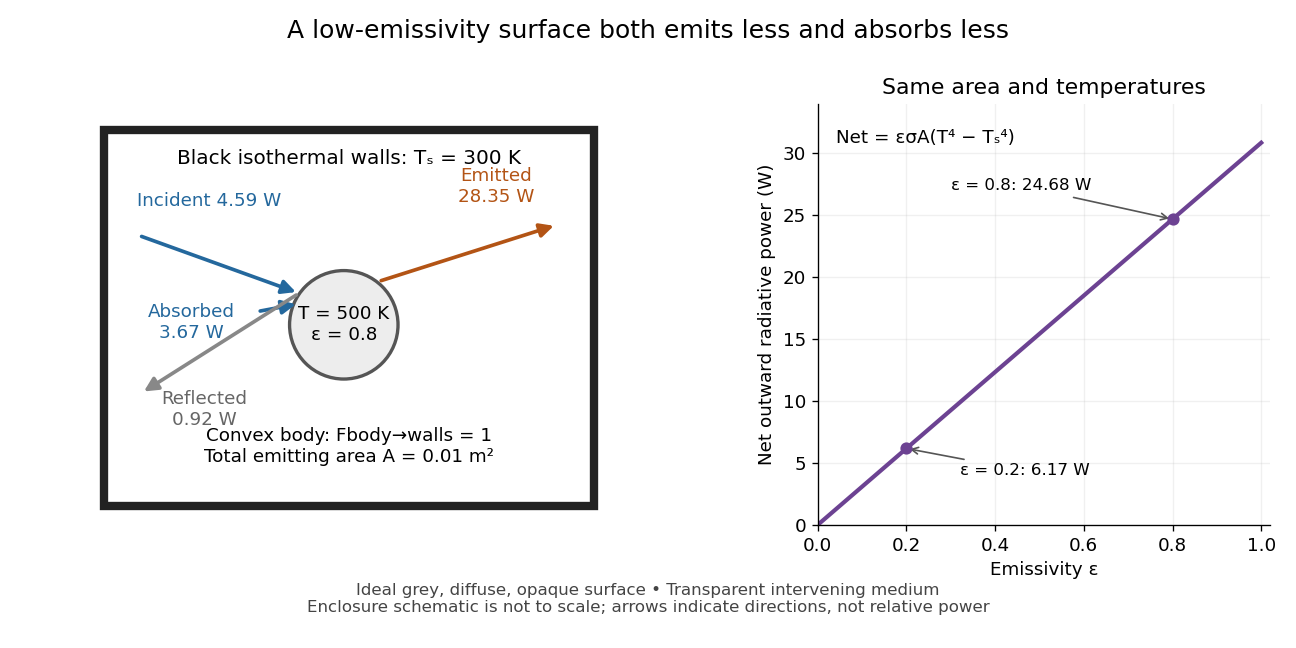
Two-way exchange in a black enclosure and the effect of emissivity
. Original schematic, not an experimental apparatus. The central convex body has total emitting area , temperature and view factor one to black walls at . Arrows show gross emission, absorbed enclosure radiation and reflected enclosure radiation for emissivity ; widths are illustrative. The graph compares stipulated emissivities under the same geometry and temperatures. Details.Near equal temperatures, write . Taylor's theorem givesFor constant emissivity, the radiative heat transfer coefficient is approximately at and . This local linear approximation is useful for small temperature differences; the difference in the worked example needs the full fourth-power expression.
A cooling experiment requires a wider first law of thermodynamics balance. In a uniform-temperature model without a heater,where is the sample's heat capacity and the last two terms are signed outward convection and thermal conduction losses. A vacuum suppresses convection but does not eliminate thermal conduction through supports or sensor leads. A cooling slope therefore cannot establish emissivity unless these paths and heat capacity are independently constrained. Multiple wall temperatures, incomplete view factors, wavelength-selective materials or appreciable intervening absorption require a more complete radiative transfer calculation.
Write the Steane code basis as uniform quantum superpositions over a binary linear code and a disjoint coset , where is the even-weight part of the length-seven Hamming code. For , diagonal Pauli Z gates cannot connect the two cosets. Within coset , the overlap isIf , translation by a word with negates this sum, so it vanishes. Since the dual code is the length-seven Hamming code of minimum Hamming distance three, every nonzero of Hamming weight one or two has vanishing overlap. Taking from proves the displayed identity. The eight two-dimensional error images are orthogonal, so their projective measurement determines the error syndrome without revealing the logical state; applying the identified phase flip again recovers every code state. This proves nondegenerate quantum error-correcting code behaviour for the identity and all single-site phase flips, including their coherent linear span.
Cluster analysis groups observations using similarities or dissimilarities without supplied class labels. A distance choice specifies which features and scales matter. Agglomerative hierarchical clustering merges groups recursively, producing partitions at different resolutions rather than one intrinsically determined number of groups.
Learning structure from data without supplied target labels. Examples include extracting principal components, clustering and learning representations that efficiently reconstruct inputs.
Generalization is the ability of a fitted prediction rule to perform well on new observations under a specified target probability distribution. It is assessed through prediction error rather than training error. The target distribution and use of data are part of the question: dataset shift can change performance, and data leakage can make an apparent assessment misleading.
Supervised learning fits a prediction rule from training data containing both inputs and associated target responses. Regression analysis predicts numerical responses; classification in statistical learning predicts class labels. A loss function specifies which prediction errors matter, and generalization concerns performance beyond the observations used to fit the rule.
Pinned article: Introduction to the OurBigBook Project
Welcome to the OurBigBook Project! Our goal is to create the perfect publishing platform for STEM subjects, and get university-level students to write the best free STEM tutorials ever.
Everyone is welcome to create an account and play with the site: ourbigbook.com/go/register. We belive that students themselves can write amazing tutorials, but teachers are welcome too. You can write about anything you want, it doesn't have to be STEM or even educational. Silly test content is very welcome and you won't be penalized in any way. Just keep it legal!
Intro to OurBigBook
. Source. We have two killer features:
- topics: topics group articles by different users with the same title, e.g. here is the topic for the "Fundamental Theorem of Calculus" ourbigbook.com/go/topic/fundamental-theorem-of-calculusArticles of different users are sorted by upvote within each article page. This feature is a bit like:
- a Wikipedia where each user can have their own version of each article
- a Q&A website like Stack Overflow, where multiple people can give their views on a given topic, and the best ones are sorted by upvote. Except you don't need to wait for someone to ask first, and any topic goes, no matter how narrow or broad
This feature makes it possible for readers to find better explanations of any topic created by other writers. And it allows writers to create an explanation in a place that readers might actually find it.
Figure 1. Screenshot of the "Derivative" topic page. View it live at: ourbigbook.com/go/topic/derivativeVideo 2. OurBigBook Web topics demo. Source. - local editing: you can store all your personal knowledge base content locally in a plaintext markup format that can be edited locally and published either:This way you can be sure that even if OurBigBook.com were to go down one day (which we have no plans to do as it is quite cheap to host!), your content will still be perfectly readable as a static site.
- to OurBigBook.com to get awesome multi-user features like topics and likes
- as HTML files to a static website, which you can host yourself for free on many external providers like GitHub Pages, and remain in full control

Figure 2. You can publish local OurBigBook lightweight markup files to either OurBigBook.com or as a static website.
Figure 3. Visual Studio Code extension installation.
Figure 5. . You can also edit articles on the Web editor without installing anything locally. Video 3. Edit locally and publish demo. Source. This shows editing OurBigBook Markup and publishing it using the Visual Studio Code extension. 
- Infinitely deep tables of contents:



All our software is open source and hosted at: github.com/ourbigbook/ourbigbook
Further documentation can be found at: docs.ourbigbook.com
Feel free to reach our to us for any help or suggestions: docs.ourbigbook.com/#contact