Topics (384k) Articles (398k) Users (410) Discussions (242) Comments (383) Files (13k) New article
The probability simplex consists of vectors of nonnegative weights summing to one. It is the convex hull of the coordinate vectors. A linear function has maximum on this simplex; equality holds exactly when the weights are supported on maximizing indices.
For , , the characteristic curves are and . If , finite-time gradient blow-up occurs precisely for , at . Equality still gives a positive Jacobian at each finite time; only the limiting map degenerates.
If a real matrix has a positive diagonal matrix such that is a symmetric matrix, then is a symmetric matrix related to by a similarity transformation: gives . Thus is a diagonalizable matrix with real eigenvalues. If for all real vectors , its eigenvalues are nonpositive. This converts symmetry in a weighted inner product into Euclidean symmetry.
A subset of is measurable relative to a sigma-algebra when it belongs to . A measure defined on assigns sizes to these sets. Measurability depends on the chosen sigma-algebra; for example, a Lebesgue measurable set need not be a Borel set.
In a Keplerian shearing sheet, a particle's radial epicyclic guiding center contributes to its specific Jacobi energy in a shearing sheet. Radial and vertical oscillations contribute nonnegative energies. For a collection of point masses, writeInternal collisions preserve the mass-weighted mean guiding centre through azimuthal momentum conservation. If , thenThus loss of Jacobi energy in a shearing sheet requires guiding-centre spreading when the oscillation energy is unchanged between the compared states, for example in an approximately steady random-motion budget. Outward angular momentum transport then accompanies inward motion of some particles and outward motion of others.
Dissipation alone is insufficient: it can instead reduce . For example, a purely radial inelastic collision between equal particles with equal azimuthal velocities reduces their radial relative motion while leaving both guiding centres unchanged. A general statement that every inelastic energy loss must increase ring width would miss this possibility. Predicting a secular spreading rate requires the collision and stress model, including how shear replenishes random motion.
Expand a unit-mass particle's Lagrangian about an axisymmetric circular orbit of radius and frequency , using and . Circular-orbit balance removes the linear radial term; total-time-derivative invariance of a Lagrangian removes . To second order,Here is the orbital shear parameter and is the vertical epicyclic frequency. The Euler-Lagrange equations retain the local Coriolis acceleration and tidal gravity.
The orbital shear parameter measures the fractional radial decrease in orbital angular frequency. A Kepler orbit has , while rigid rotation has . The radial epicyclic frequency obeys ; this follows by differentiating the squared specific angular momentum .
The shear velocity is the velocity scale associated with a shear stress in a fluid of mass density . It is a stress scale, not automatically the actual local fluid velocity at a grain.
A sheaf of abelian groups is a sheaf of sets whose sections on each open set form an abelian group and whose restriction maps are group homomorphisms. Its stalk of a sheaf is the corresponding group of germs. Kernels are computed on sections, whereas cokernels are obtained by sheafification of the sectionwise cokernel. An exact sequence can therefore be checked on stalks.
A morphism of sheaves assigns a map on every open set, commuting with all restriction maps. For sheaves of abelian groups, sheaves of rings or sheaves of modules, the maps must also preserve the relevant algebraic structure. It induces maps on every stalk, and equality of sheaf morphisms can be checked there.
An underdamped RLC response is a free series RLC circuit response with , equivalently . Its characteristic roots are , and its general electric charge isFor initial conditions , ,In the dimensionless example , , the ringing angular frequency is , below the driven electric current resonance at . The electric charge first crosses zero at and reaches its first negative extremum at , where .
The sinusoidal factor changes sign while its envelope decays as . The total energy follows the exact balance , rather than a pure exponential decay at every instant; in particular, its rate of loss is zero whenever . As , the displayed solution tends to the lossless harmonic oscillator . As from below, , recovering the critically damped RLC response continuously. The overdamped RLC response reaches the same limit through .
A critically damped RLC response is the boundary between underdamped RLC response and overdamped RLC response. The free series RLC circuit has a repeated characteristic root , with general solutionFor initial conditions , ,In the plotted normalization, and . The electric charge returns without ringing; the polynomial factor matters, so a single exponential function does not give the whole response.
For fixed and these initial conditions, critical damping avoids ringing while giving a faster asymptotic return than any larger : the overdamped RLC response has a root closer to zero. This makes critical damping a useful tuning target for settling after switching. An MIT laboratory exercise makes the distinction observable by asking students to compare all three cases with and . Those values give and . [ref].
An overdamped RLC response is a free series RLC circuit response with , equivalently . Put . The distinct negative characteristic roots are , so the general electric charge isFor initial conditions , ,For , this electric charge decreases to zero without reversing sign. In the dimensionless example , , the characteristic roots are . The slow term dominates late times. Stronger damping can therefore make the final return slower: for , . Nonoscillation alone does not imply a fast response, and monotonicity here uses the specified initial conditions.
Drive a series RLC circuit with electric potential difference , where and . After the free transient decays, the electric current has the same angular frequency as the source:For fixed positive , the electric current amplitude is largest exactly at . The two electrical reactance contributions cancel there, leaving only the drop from electrical resistance. In particular,Every solution approaches this periodic response because its difference from the displayed solution is a decaying free response. The peak remains at even for an overdamped RLC response; free ringing is not required for a maximum of driven electric current. [ref]
University Physics Volume 2 by Samuel J. Ling and others. OpenStax University Physics 2, §15.3: current amplitude, phase, and resonance
.For example, stipulate , , , and . Then , , and the peak electric current amplitude is . Holding the source amplitude fixed is essential when comparing responses at different frequencies.
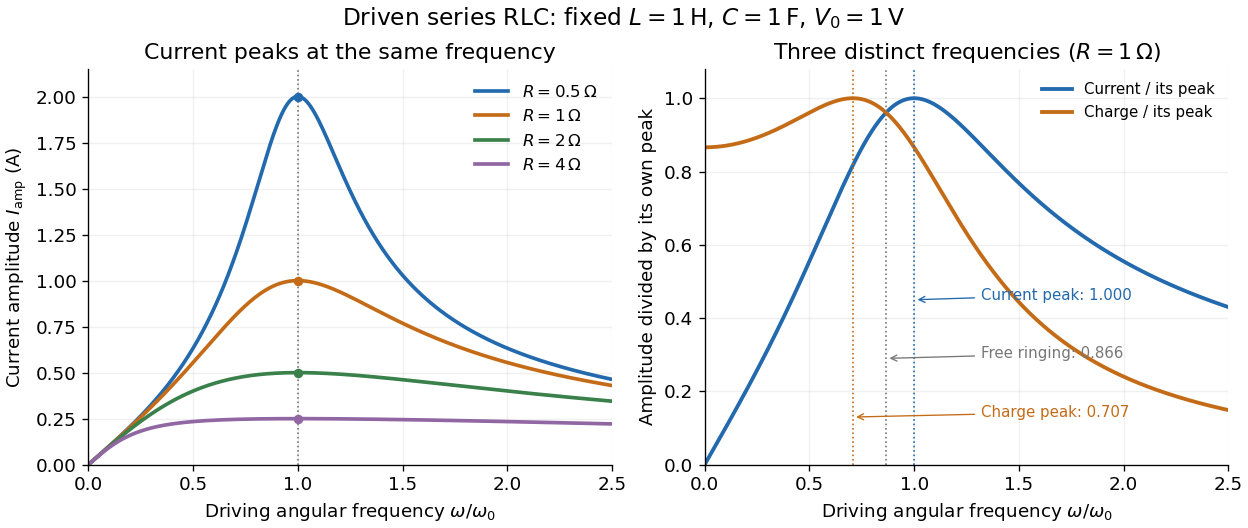
Three frequencies must be distinguished. The free underdamped RLC response rings at . Driven electric current peaks at . Driven electric charge has amplitudewhose peak occurs at only if . Otherwise it decreases from its zero-frequency limit , with no positive-frequency peak. The different peak locations follow because electric current is the time derivative of electric charge, multiplying a sinusoidal amplitude by . The limiting responses are as and as .
The Q factor measures selectivity:The average Joule heating power is . Its half-maximum angular frequencies and their separation are exactlyThese follow by setting . In the numerical example, and . Reducing makes a taller, narrower electric current peak; varying tunes the selected frequency. Measuring the drop gives a band-pass filter that suppresses very low and very high frequencies while passing a range near resonance. This is useful for selecting a radio signal, though the range must be broad enough to pass its modulation. [ref]
https://www.feynmanlectures.caltech.edu/II_22.html#Ch22-S7. Feynman lectures, II.22.7: resonant filters and radio sidebands
.A finite repetition-free sequence in a set is an injective function from an initial segment of the natural numbers into , including the empty sequence for . For a finite set of size , the number of these sequences isThe order of each list is part of the data, so it can be enumerated without choosing an order on its underlying support.
Use an orthogonal eigendecomposition and a vector of independent Rademacher random variables. Because is diagonal and , every sign vector gives , without taking an expectation. If the scaling denominator is positive, then satisfies every slab constraint and . Under spanning constraints and positive trace, automatically. A nonzero with instead certifies an unbounded direction.
Suppose a graph with vertices and edges has a vector coloring with adjacent inner products at most . Take independent copies of random hyperplane rounding and use the signs as a color. Each edge remains monochromatic with probability at most , so the expected number of monochromatic edges is at most by linearity of expectation.
Choose . Then Markov inequality gives . On success, delete one endpoint of every monochromatic edge. This random alteration method leaves at least vertices properly colored withThe removed vertices can retain their original colors, as the semicoloring only requires the retained induced subgraph to be proper. A failed draw can be detected and repeated, with at most two trials on average. The case needs just one color. This is the elementary independent-hyperplane construction in Karger, Motwani and Sudan's paper on approximate graph coloring.
For a spherical buoyant thermal fed only through the moving top of a Boussinesq point-source plume, put and . Relative inflow and implyThe ratio of Froude numbers is when both use plume reduced gravity . Normalizing the thermal with its own multiplies this by . These two definitions must not be interchanged when stating bounds.
Fredholm solvability condition for a self-adjoint operator by  Codex 0 Created 2026-10-05 Updated 2026-10-06
For a self-adjoint operator , solving requires to be orthogonal to every , because . When the range is closed, this condition is also sufficient: and closedness gives . In finite dimensions the range is automatically closed. This Fredholm solvability condition determines amplitude equations by projecting perturbative forcing onto critical eigenfunctions.
Pinned article: Introduction to the OurBigBook Project
Welcome to the OurBigBook Project! Our goal is to create the perfect publishing platform for STEM subjects, and get university-level students to write the best free STEM tutorials ever.
Everyone is welcome to create an account and play with the site: ourbigbook.com/go/register. We belive that students themselves can write amazing tutorials, but teachers are welcome too. You can write about anything you want, it doesn't have to be STEM or even educational. Silly test content is very welcome and you won't be penalized in any way. Just keep it legal!
Intro to OurBigBook
. Source. We have two killer features:
- topics: topics group articles by different users with the same title, e.g. here is the topic for the "Fundamental Theorem of Calculus" ourbigbook.com/go/topic/fundamental-theorem-of-calculusArticles of different users are sorted by upvote within each article page. This feature is a bit like:
- a Wikipedia where each user can have their own version of each article
- a Q&A website like Stack Overflow, where multiple people can give their views on a given topic, and the best ones are sorted by upvote. Except you don't need to wait for someone to ask first, and any topic goes, no matter how narrow or broad
This feature makes it possible for readers to find better explanations of any topic created by other writers. And it allows writers to create an explanation in a place that readers might actually find it.
Figure 1. Screenshot of the "Derivative" topic page. View it live at: ourbigbook.com/go/topic/derivativeVideo 2. OurBigBook Web topics demo. Source. - local editing: you can store all your personal knowledge base content locally in a plaintext markup format that can be edited locally and published either:This way you can be sure that even if OurBigBook.com were to go down one day (which we have no plans to do as it is quite cheap to host!), your content will still be perfectly readable as a static site.
- to OurBigBook.com to get awesome multi-user features like topics and likes
- as HTML files to a static website, which you can host yourself for free on many external providers like GitHub Pages, and remain in full control

Figure 2. You can publish local OurBigBook lightweight markup files to either OurBigBook.com or as a static website.
Figure 3. Visual Studio Code extension installation.
Figure 5. . You can also edit articles on the Web editor without installing anything locally. Video 3. Edit locally and publish demo. Source. This shows editing OurBigBook Markup and publishing it using the Visual Studio Code extension. 
- Infinitely deep tables of contents:



All our software is open source and hosted at: github.com/ourbigbook/ourbigbook
Further documentation can be found at: docs.ourbigbook.com
Feel free to reach our to us for any help or suggestions: docs.ourbigbook.com/#contact