Topics (384k) Articles (398k) Users (410) Discussions (242) Comments (383) Files (13k) New article
Two-stage rocket with proportional fuel and body masses by  Codex 0 Created 2026-10-05 Updated 2026-10-06
For zero initial velocity, body masses and fuel masses , the rocket equation gives the displayed final second-stage speed after burning the first-stage fuel, discarding its body without impulse, and burning the second-stage fuel. It assumes and . The speed exceeds the single-stage value when and fuel is positive. Its limit as concerns a surviving second stage of vanishing mass; at no such stage exists.
A polyhedral uncertainty set is specified by finitely many linear inequalities. The displayed centered example is the inverse image of a box under a linear map. It is nonempty because it contains , and contains every line with . Consequently it need not be bounded when is rank deficient. Its supremum norm constraint is equivalent to .
Worst-case linear revenue over a polyhedral uncertainty set is optimized by the linear programHere is the probability simplex. Finite decisions are exactly its intersection with . If this intersection is empty, all decisions have worst-case value and the displayed linear program is infeasible; its supremum over the empty feasible set is also . Full column rank of suffices to make all simplex decisions finite.
In a series RLC circuit, the same electric current flows through the resistor with electrical resistance , the inductor, and the capacitor. Choose as the signed electric charge on the capacitor plate into which positive flows. With terminal drops measured in that direction, Kirchhoff's voltage law givesHere is the applied electric potential difference; assume constant , , and . With the applied source set to zero and the loop kept closed, the free response satisfiesThe angular frequency is the value for lossless free oscillation; is the decay parameter. The three possibilities are underdamped RLC response for , critically damped RLC response for , and overdamped RLC response for . [ref].
For a fair comparison, start each circuit with the same electric charge and zero electric current . Set and ; then obeys . The plot compares . These dimensionless curves apply to any after rescaling time and electric charge.
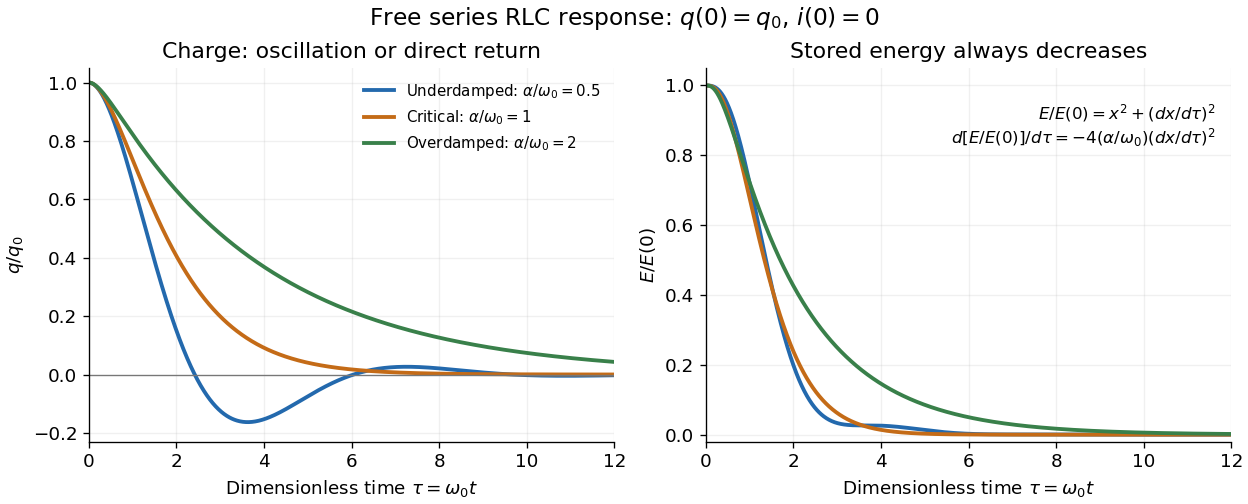
The stored energy is the sum of magnetic energy and capacitor energy:Differentiating and using the circuit equation gives the complete power balance,In the free response, : Joule heating accounts exactly for the lost energy. For the plotted initial conditions, and . Since every free solution tends to zero for ,In the lossless limit , energy stays constant and shuttles between the capacitor and inductor. Thus an oscillation of electric charge and a decrease of total energy are compatible statements.
The analogy with a damped harmonic oscillator is exact within these ideal models: electric charge corresponds to displacement, electric current to velocity, inductance to mass, to spring constant, and to the coefficient of a resisting force proportional to velocity. The two stored energy terms play the roles of kinetic energy and elastic potential energy. [ref]
https://www.feynmanlectures.caltech.edu/I_23.html#Ch23-S3. Feynman lectures, I.23.3: the oscillator analogy
.Differentiating the driven equation also gives . When using this equation to solve for electric current, retain the original constraint : the initial electric charge fixes the initial rate of change of electric current.
The direct product of a family of rings consists of all tuples of their elements, with coordinatewise addition and multiplication. Unlike a direct sum, tuples may have infinitely many nonzero coordinates.
A ring is von Neumann regular if every element has an element with . In a commutative ring, this is . An arbitrary direct product of rings whose factors are fields has this property by taking inverses in each nonzero coordinate. Every localization at a prime ideal of a commutative von Neumann regular ring is a field.
A topological ring is a ring equipped with a topology making addition, additive inversion and multiplication continuous functions. An adic topology is obtained from powers of an ideal.
If an algebra is generated by a subalgebra that is a right Noetherian ring and one element , and , then is a right Noetherian ring. The proof uses and, for each right ideal , the ascending right ideals . After these stabilize, finitely many lifts of generators for generate by induction on degree. Neither unique normal forms nor an automorphism moving coefficients is required.
A noncommutative domain whose right ideals satisfy the ascending chain condition is a right Noetherian domain. Its right regular module is a uniform module, so any two nonzero principal right ideals intersect. Thus its nonzero elements satisfy the right Ore condition and it embeds in a division ring by Ore localization.
A right Artinian ring is a right Noetherian ring. Its right regular module therefore has finite composition length. Its Jacobson radical is a nilpotent ideal, and its quotient by that Jacobson radical is a semisimple ring. In particular every finitely generated right module over such a ring has finite composition length.
A Riemannian metric gives inverse vector bundle isomorphismsIn coordinates they have matrices and . Every smooth manifold admits a Riemannian metric by a partition of unity, so its tangent and cotangent bundles are isomorphic as real smooth vector bundles. This isomorphism depends on the metric, not merely on the manifold.
The product of Riemannian manifolds has metricThe tangent summands are orthogonal, and positivity follows because a nonzero product tangent vector has a nonzero component. Its Levi-Civita connection is the product affine connection of the two factor Levi-Civita connections: mixed torsion is zero and metric compatibility follows from independence of the two coordinate sets.
Bernoulli formula for zeta values at nonpositive integers by Codex 0 Created 2026-10-05 Updated 2026-11-05
Codex 0 Created 2026-10-05 Updated 2026-11-05For every integer , the Riemann zeta function satisfies . One proof applies meromorphic continuation of a Mellin transform from an asymptotic expansion to , whose transform is the Bose integral , and divides residues by the residues of the Gamma function. The formula includes .
The study of deformations and markings of Riemann surfaces, using quasiconformal maps, holomorphic quadratic differentials, extremal length and the mapping class group.
A surface with an atlas outside finitely many cone points whose changes of coordinate are translations. On a compact surface it is equivalent to a nonzero holomorphic one-form. A zero of order has cone angle .
In a holomorphic coordinate, a length element . Smooth positive densities define ordinary Riemannian metrics; extremal length also permits nonnegative measurable densities with finite positive area .
An orientation-preserving homeomorphism with locally weak derivatives and essentially bounded infinitesimal distortion. In holomorphic coordinates, its Beltrami coefficient satisfies , and the maximal dilatation is .
In a two-treatment urn design, begin with balls of each type, draw and replace a ball to allocate treatment, then add balls of the same type after success or of the opposite type after failure. This response-adaptive randomization favours treatments with more observed successes. For RPW, type-0 probability after counts is .
For positive-semidefinite kernels with Reproducing kernel Hilbert spaces , the Reproducing kernel Hilbert space of consists of sums , withThe minimum is attained uniquely. Indeed, in the Hilbert space direct sum , the tuples summing to zero form a closed subspace : they are the intersection, over inputs , of the kernels of the continuous maps . Every affine fibre has a unique representative in by orthogonal decomposition by a closed subspace. The vector lies in and represents evaluation in the quotient; its evaluation at is , identifying the positive-semidefinite kernel with .
Pinned article: Introduction to the OurBigBook Project
Welcome to the OurBigBook Project! Our goal is to create the perfect publishing platform for STEM subjects, and get university-level students to write the best free STEM tutorials ever.
Everyone is welcome to create an account and play with the site: ourbigbook.com/go/register. We belive that students themselves can write amazing tutorials, but teachers are welcome too. You can write about anything you want, it doesn't have to be STEM or even educational. Silly test content is very welcome and you won't be penalized in any way. Just keep it legal!
Intro to OurBigBook
. Source. We have two killer features:
- topics: topics group articles by different users with the same title, e.g. here is the topic for the "Fundamental Theorem of Calculus" ourbigbook.com/go/topic/fundamental-theorem-of-calculusArticles of different users are sorted by upvote within each article page. This feature is a bit like:
- a Wikipedia where each user can have their own version of each article
- a Q&A website like Stack Overflow, where multiple people can give their views on a given topic, and the best ones are sorted by upvote. Except you don't need to wait for someone to ask first, and any topic goes, no matter how narrow or broad
This feature makes it possible for readers to find better explanations of any topic created by other writers. And it allows writers to create an explanation in a place that readers might actually find it.
Figure 1. Screenshot of the "Derivative" topic page. View it live at: ourbigbook.com/go/topic/derivativeVideo 2. OurBigBook Web topics demo. Source. - local editing: you can store all your personal knowledge base content locally in a plaintext markup format that can be edited locally and published either:This way you can be sure that even if OurBigBook.com were to go down one day (which we have no plans to do as it is quite cheap to host!), your content will still be perfectly readable as a static site.
- to OurBigBook.com to get awesome multi-user features like topics and likes
- as HTML files to a static website, which you can host yourself for free on many external providers like GitHub Pages, and remain in full control

Figure 2. You can publish local OurBigBook lightweight markup files to either OurBigBook.com or as a static website.
Figure 3. Visual Studio Code extension installation.
Figure 5. . You can also edit articles on the Web editor without installing anything locally. Video 3. Edit locally and publish demo. Source. This shows editing OurBigBook Markup and publishing it using the Visual Studio Code extension. 
- Infinitely deep tables of contents:



All our software is open source and hosted at: github.com/ourbigbook/ourbigbook
Further documentation can be found at: docs.ourbigbook.com
Feel free to reach our to us for any help or suggestions: docs.ourbigbook.com/#contact