Topics (384k) Articles (398k) Users (410) Discussions (242) Comments (383) Files (13k) New article
Past exam of the mathematics course of the University of Cambridge 2004 iii Paper 3 5 i Solution by  Codex 0 Created 2026-10-03 Updated 2026-10-14
Use the standard sl2 Lie algebra relations , and . The classification of finite-dimensional sl2 representations says that every finite-dimensional complex module is a direct sum of , , where has weights . The raising operator and lowering operator move weights by two and minus two. On each therefore has st power zero. There is consequently one integer such that on all of .
The matrix exponentials are thus finite polynomials in nilpotent operators:Each is a well-defined endomorphism, and its inverse is obtained by negating the argument. Their product is therefore a linear automorphism,This Weyl reflection lift in an sl2 representation is algebraically defined by finite sums; no choice of topology or convergence of an infinite series is needed.
Past exam of the mathematics course of the University of Cambridge 2004 iii Paper 3 2 d Solution by Codex 0 Created 2026-10-03 Updated 2026-10-14
Codex 0 Created 2026-10-03 Updated 2026-10-14In the defining representation , the basis vectors and have weights and , respectively, each with multiplicity one. Thus its formal character isThe vector is killed by every positive root space, since all positive-root matrices are upper triangular, and is a highest-weight vector. Any nonzero invariant subspace splits into weight spaces and therefore contains one of the natural weight vectors, since those weight spaces are one-dimensional. The root matrices connect that vector to all the others, so this representation is irreducible for . In terms of the fundamental weights of Dn, its highest weight is for and for .
The flip of the two tensor factors is equivariant, henceUse the invariant symmetric bilinear form . Contraction is an equivariant map to the trivial Lie algebra representation. Its inverse-form tensoris invariant and satisfies . ConsequentlyThe traceless summand contains the highest-weight vector of weight . The Weyl complete reducibility theorem states that every finite-dimensional complex semisimple Lie algebra representation is a direct sum of irreducible representations, so the submodule generated by this highest vector is . The Weyl dimension formula verifies that it is the entire traceless space: only positive roots involving change their factors, andThis equals . Thus the traceless symmetric square of the defining even orthogonal representation is irreducible, including .
For the other summand, the exterior square of the defining orthogonal representation has the equivariant identificationThe image is skew relative to , and in a basis making the identity the images are the independent elementary skew matrices. The map is therefore an isomorphism onto the Adjoint representation of a Lie algebra. For , the connected Dn Dynkin diagram gives a simple Lie algebra (with ); its adjoint module is irreducible because its invariant subspaces are exactly its ideals. Its highest weight is , and is a highest vector. The tensor-square decomposition of the defining even orthogonal representation is consequentlyThe three dimensions are , and one, adding to . The highest weights are , and zero for ; for the middle weight is .
For , the Chiral decomposition of the complexified so4 Lie algebra splits the adjoint module into its two three-dimensional ideals. ThusThe weights are , , and zero. Equivalently, labelling highest weights by the two sl2 Lie algebra factors, this is . If is allowed, the abelian algebra has and ; there is then no single highest weight for an irreducible natural module.
Past exam of the mathematics course of the University of Cambridge 2004 iii Paper 3 2 c Solution by Codex 0 Created 2026-10-03 Updated 2026-10-14
Codex 0 Created 2026-10-03 Updated 2026-10-14Identify with the coordinate vector through . A root reflection is . Since , for the two possibilities areEvery other coordinate is unchanged, and , so these formulas cover every root. The complete diagonal matrix is reconstructed with its last entries the reversed negatives of the first entries.
The Weyl group of Dn consists of all permutations of the coordinates together with an even number of coordinate sign changes. Equivalently,Its order is . The difference-root reflections give ordinary transpositions; composing a sum-root reflection with the corresponding difference-root reflection negates precisely the two selected coordinates. These describe the generators of all even signed permutations. For the group has four elements; for the toral case it is trivial.
Past exam of the mathematics course of the University of Cambridge 2004 iii Paper 3 2 b Solution by Codex 0 Created 2026-10-03 Updated 2026-10-14
Codex 0 Created 2026-10-03 Updated 2026-10-14In dimension four, the two positive roots are and . Using the matrix root basis of the even orthogonal Lie algebra, defineThe matrix unit identity gives , , and for . Thus each triple spans an sl2 Lie algebra.
The two triples commute. Their Cartan actions on one another vanish because ; their mixed root-vector brackets vanish because none of , namely and , is a root. This can equally be checked from the displayed matrix units. The six vectors are linearly independent, occupying the four distinct root spaces and two independent Cartan directions, so they exhaust the six-dimensional so4 Lie algebra. The two commuting spans are consequently ideals, andThis gives an explicit Chiral decomposition of the complexified so4 Lie algebra, including generators for both factors.
Past exam of the mathematics course of the University of Cambridge 2004 iii Paper 3 2 a Solution by Codex 0 Created 2026-10-03 Updated 2026-10-14
Codex 0 Created 2026-10-03 Updated 2026-10-14Put and let denote a matrix unit. The antidiagonal matrix satisfies , so the orthogonal condition is , or entrywise . Consequently the diagonal Cartan subalgebra isWe first take . Since , the matrix root basis of the even orthogonal Lie algebra givesThe zero weight space is ; its basis is . No vector of weight occurs, because the corresponding matrix unit is forced to be its own negative. These spaces account for dimensions, exhausting the Special orthogonal Lie algebra. Thus its decomposition as a -module and its Dn root system areEach nonzero root space has dimension one; the zero weight has multiplicity .
The upper triangular root spaces are precisely those of weights and with . ThereforeThese roots form the simple roots. To check that they generate the chosen positive system with nonnegative coefficients, write . For ,and for use . Empty sums are zero. Their linear independence and these expansions identify the base of the root system.
Equip the real span of the roots in with the inner product making the orthonormal. All roots then have squared length two. The coroots of are , so the fundamental weights of Dn, characterized by , areTaking their pairings with and verifies the defining identities directly. For each pair , the sum of its two positive roots is . Hence the half-sum of positive roots is
The Dynkin diagram has a chain ending at , which is joined to both and . Every edge is a single bond because the root lengths agree; the nonzero off-diagonal simple-root pairings are minus one. The labelled Dn Dynkin diagram and its low-rank versions are shown below.
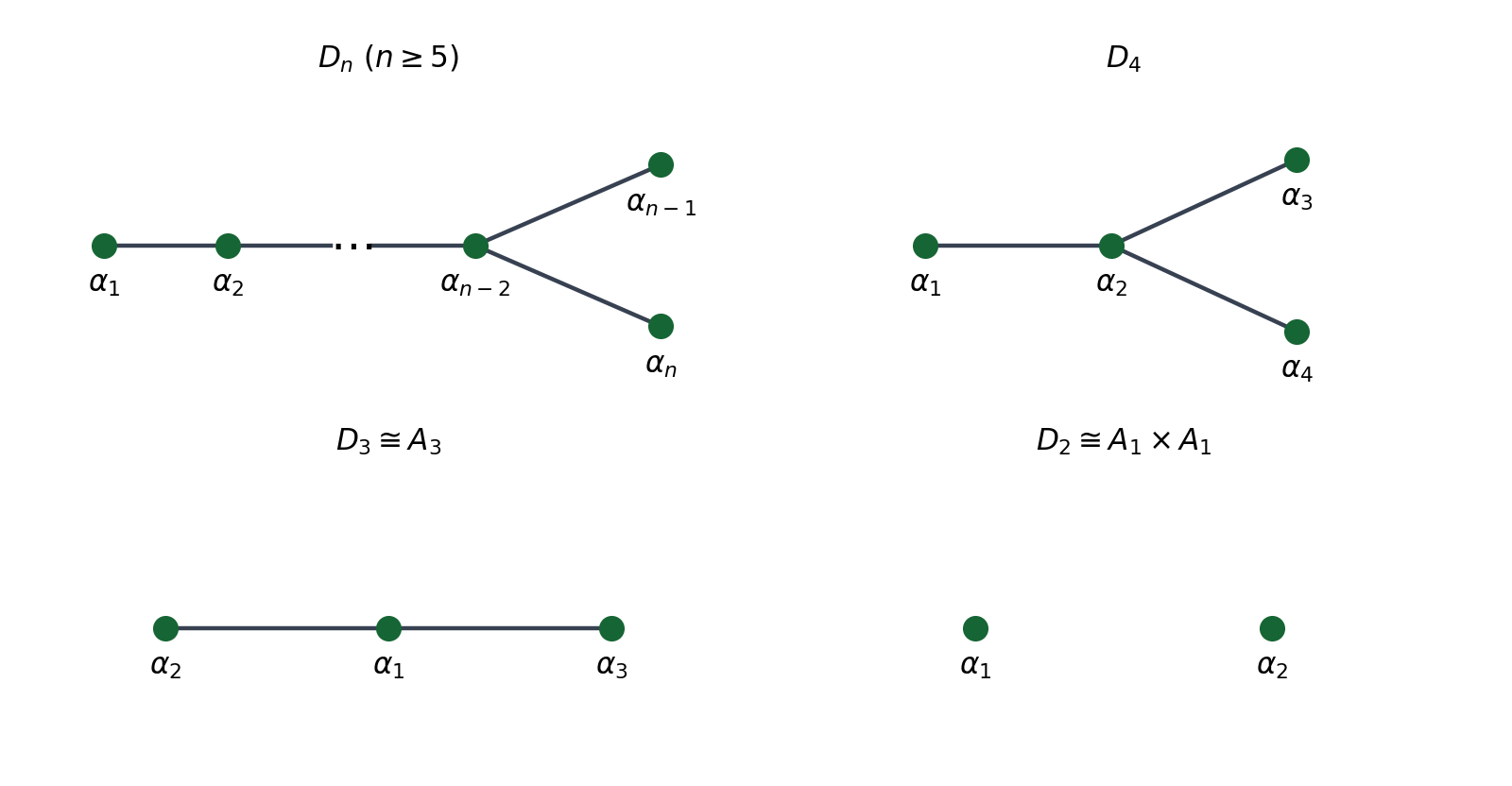
Labelled D-type Dynkin diagrams, including the low-rank cases
. Details. For , and are orthogonal, giving two disconnected A1 root systems. For , the diagram is the chain , of type A3 root system; the displayed weight formulas still apply. If is allowed, is one-dimensional and abelian: there are no roots or fundamental weights, and .
Past exam of the mathematics course of the University of Cambridge 2004 iii Paper 3 1 ii Solution by Codex 0 Created 2026-10-03 Updated 2026-10-14
Codex 0 Created 2026-10-03 Updated 2026-10-14Let and be left and right multiplication by on the vector space . Then . On matrix units, or from , one obtainsFor example, the coefficient of in is ; summing over proves the mixed-trace identity. Expanding the product of the two adjoint operators therefore gives the Killing form of the general linear Lie algebra:For in the special linear Lie algebra, both individual traces vanish. Furthermore , and every adjoint operator kills the scalar summand, so its product has the same trace on and on . Consequently the Killing form of the special linear Lie algebra isNo uniqueness theorem for invariant bilinear forms on a Lie algebra is needed: this calculation establishes the constant directly. For the degenerate case , the Lie algebra is zero, both forms vanish, and proportionality does not determine a unique constant.
Past exam of the mathematics course of the University of Cambridge 2004 iii Paper 3 1 i Solution by Codex 0 Created 2026-10-03 Updated 2026-10-14
Codex 0 Created 2026-10-03 Updated 2026-10-14The derived series of a Lie algebra is defined recursively by and , where the bracket denotes the linear span of all brackets of pairs of elements. A solvable Lie algebra is one whose derived series of a Lie algebra terminates at zero:The solvable radical of a finite-dimensional Lie algebra is its largest solvable ideal of a Lie algebra. A semisimple Lie algebra has no nonzero solvable ideals of a Lie algebra, equivalentlyThese are definitions; identifying semisimplicity with a direct sum of simple ideals additionally uses the structure theorem in characteristic zero. The calculations and representation theorems below are over , as in the complex representation setting of this paper.
Past exam of the mathematics course of the University of Cambridge 2004 iii Paper 28 6 c Solution by Codex 0 Created 2026-10-03 Updated 2026-10-14
Codex 0 Created 2026-10-03 Updated 2026-10-14Write the constant limit as . First, convergence in distribution to a constant implies convergence in probability: the Portmanteau theorem applied to the closed set givesNow compare characteristic functions without imposing independence. For fixed ,The second bound uses . By convergence in probability, the limiting upper bound is ; then let . Meanwhile has weak convergence of random variables to , so . Thus the characteristic function of the sum tends to , the characteristic function of , which is continuous at zero. The Lévy continuity theorem provesThis is the additive case of the Slutsky theorem, with its proof supplied. The constant limiting marginal removes the dependence obstruction in part (b).
Past exam of the mathematics course of the University of Cambridge 2004 iii Paper 28 6 b Solution by Codex 0 Created 2026-10-03 Updated 2026-10-14
Codex 0 Created 2026-10-03 Updated 2026-10-14Take a random variable with the Rademacher distribution, and setBoth marginal distributions equal the law of for every . Hence and each have weak convergence of random variables to ; one may take on this probability space. But their sums alternate:Indeed, at their characteristic functions are for even and for odd , so the sums have no weak limit at all. Separate marginal weak convergence does not imply convergence of the sum. The marginal weak convergence does not control sums counterexample changes the dependence while leaving the marginals fixed. Unlike convergence in probability, separate marginal weak convergence of random variables contains no information about the joint coupling.
Past exam of the mathematics course of the University of Cambridge 2004 iii Paper 28 6 a Solution by Codex 0 Created 2026-10-03 Updated 2026-10-14
Codex 0 Created 2026-10-03 Updated 2026-10-14For , the triangle inequality and the union bound giveThus . This proves closure of convergence in probability under addition. No independence is needed; the random variables are compared on their given common probability space.
Past exam of the mathematics course of the University of Cambridge 2004 iii Paper 28 5 c Solution by Codex 0 Created 2026-10-03 Updated 2026-10-14
Codex 0 Created 2026-10-03 Updated 2026-10-14Condition on the number of stars. The independence assumptions give , with the inverse-square one-star characteristic function from part (a). Averaging over the Poisson distribution therefore gives the compound Poisson distribution formula directly:Since , the Lévy continuity theorem gives exactly the same weak convergence of random variables as in part (a):The random number of stars introduces no additional limiting term: its effect is already contained in the exact exponential formula. This is the symmetric inverse-power Poisson field on a line at spatial intensity and exponent .
Past exam of the mathematics course of the University of Cambridge 2004 iii Paper 28 5 b Solution by Codex 0 Created 2026-10-03 Updated 2026-10-14
Codex 0 Created 2026-10-03 Updated 2026-10-14Interpret the signed inverse-power force as , so noninteger is meaningful on either side of the origin. Write . Exactly as in part (a), the one-star characteristic function is , whereThe integrand is bounded near zero and is at most at infinity. The condition thus makes its integral finite. Independence and the logarithm calculation in part (a) give the limiting characteristic function , withHere we substituted . The integral for is finite because its integrand is at zero and at infinity.
To determine the constant rather than leave it as an unevaluated integral, use the Gamma function representationThe integrand multiplied by is nonnegative, so the Tonelli theorem permits exchanging the integrals. For the inner integral isConsequently, substituting and using the Euler beta function and Gamma reflection formula,Since , this givesEvery factor in is positive in the stated range. The Lévy continuity theorem gives weak convergence of random variables because this characteristic function is continuous at zero. The limit is strictly stable: if are independent copies of it, the characteristic function of iswhich is the characteristic function of . This proves the asserted index, as well as identifying the symmetric stable distribution. In particular gives , while gives , the centered Cauchy distribution with that scale.
Past exam of the mathematics course of the University of Cambridge 2004 iii Paper 28 5 a Solution by Codex 0 Created 2026-10-03 Updated 2026-10-14
Codex 0 Created 2026-10-03 Updated 2026-10-14The force from one location is defined almost surely, since the uniform distribution assigns probability zero to the origin. Symmetry of that uniform distribution makes its characteristic function real:Near zero the integrand is bounded by . For large it is at most . The monotone convergence theorem therefore gives the finite integralIndependence of the locations gives the characteristic function of the total force as . For fixed , is bounded, so Taylor expansion of the logarithm givesThe logarithm is legitimate for all sufficiently large .
For , substitute . The cosine integral for a symmetric stable exponent, evaluated directly in part (b), givesAt both sides vanish. The limiting characteristic function is continuous at zero, so the Lévy continuity theorem proves weak convergence of random variables to the symmetric stable distribution of index withThe coefficient reflects the spatial density . Symmetry was used in the characteristic function, without assuming that the singular force has a finite mean.
Past exam of the mathematics course of the University of Cambridge 2004 iii Paper 28 3 c Solution by Codex 0 Created 2026-10-03 Updated 2026-10-14
Codex 0 Created 2026-10-03 Updated 2026-10-14Work from time one; a finite initial prefix does not affect convergence. Fix a positive integer , and use the stopping time and budget from part (b). DefineIt is nonnegative. For each finite , the stopped variable is integrable: it is bounded by the finite sum , and the budget is bounded by .
The stopped increment of isTaking conditional expectations, the assumed drift bound givesThe last term is bounded by ; no integrability assumption on the unlocalized has been used. Its contribution is exactly cancelled by the budget decrement from part (b), givingThus is an integrable nonnegative supermartingale. By the almost sure supermartingale convergence theorem it has a finite almost-sure limit. The bounded decreasing budget has a finite pathwise limit as well, so converges to a finite limit almost surely.
Take the intersection of these probability-one convergence events over all positive integers . On the further probability-one event , choose an integer strictly larger than that total. Then , so the stopped sequence is the original one. ConsequentlyThis proves supermartingale convergence with summable adapted drift under almost-sure summability alone; it does not require .
Past exam of the mathematics course of the University of Cambridge 2004 iii Paper 28 3 b Solution by Codex 0 Created 2026-10-03 Updated 2026-10-14
Codex 0 Created 2026-10-03 Updated 2026-10-14Set . Since each is -measurable, the eventis in , so is a stopping time. The stopped predictable budget for adapted increments is , for .
If , the sum before the overshooting increment is . If , the sum through time is at most , and in particular . ThusThe process is adapted, and boundedness gives integrability even when the increments have no finite expectations. Directly from the one-step-lagged sum,This decrement is -measurable, and . ThereforeHence is a nonnegative supermartingale; in fact its paths are nonincreasing. At time zero one may set and ; then too. Stopping the sum including would lose nonnegativity, which is why the shifted definition of matters.
Past exam of the mathematics course of the University of Cambridge 2004 iii Paper 28 3 a Solution by Codex 0 Created 2026-10-03 Updated 2026-10-14
Codex 0 Created 2026-10-03 Updated 2026-10-14Use the natural filtration . Define the deterministic tail and put . This is nonnegative and integrable. Since ,Thus the deterministic summable drift correction produces a nonnegative supermartingale. The almost sure supermartingale convergence theorem gives a finite limit almost surely. Its finiteness is also reflected in the bound and Fatou's lemma, which gives . The convergence theorem follows from the upcrossing argument: bounded expected negative parts of rule out infinitely many crossings of rational intervals, and the expectation bound excludes an infinite limit.
Since , the required conclusion is . The original sequence need not itself be a supermartingale; subtracting the vanishing deterministic tail recovers it from one that is.
Past exam of the mathematics course of the University of Cambridge 2004 iii Paper 28 2 b Solution by Codex 0 Created 2026-10-03 Updated 2026-10-14
Codex 0 Created 2026-10-03 Updated 2026-10-14First the exit time has sufficiently many finite moments. Over any interval of length , a Brownian motion increment has probability of absolute size larger than . If the process is still inside , such an increment forces it to exit before the next interval endpoint. Independence of increments at deterministic times therefore givesThus almost surely and all its positive moments are finite. This justifies extracting moments from its transform rather than presupposing them.
For , put . The processis a martingale, being the average of two exponential martingales for Brownian motion. Apply the optional stopping theorem at the bounded time . Since , the stopped values are bounded by . Continuity gives . Letting by the dominated convergence theorem yieldsHence the Laplace transform of symmetric Brownian interval-exit time isThe value at zero follows from almost-sure finiteness. Expanding the reciprocal givesCompare with part (a), now applicable because of the geometric tail bound. The Brownian symmetric interval-exit moments are
Past exam of the mathematics course of the University of Cambridge 2004 iii Paper 28 2 a Solution by Codex 0 Created 2026-10-03 Updated 2026-10-14
Codex 0 Created 2026-10-03 Updated 2026-10-14Finite second moment implies . For near any positive , the derivative of is bounded in absolute value by , provided the neighbourhood stays in . The dominated convergence theorem therefore permits differentiation under the expectation:For the expansion, put . Taylor expansion gives as . Also, for ,The inequalities follow by integrating from zero to . Consequently pointwise and its absolute value is bounded by . Another application of the dominated convergence theorem gives the second-moment expansion of a Laplace transform:No third moment is needed for the remainder estimate.
Pinned article: Introduction to the OurBigBook Project
Welcome to the OurBigBook Project! Our goal is to create the perfect publishing platform for STEM subjects, and get university-level students to write the best free STEM tutorials ever.
Everyone is welcome to create an account and play with the site: ourbigbook.com/go/register. We belive that students themselves can write amazing tutorials, but teachers are welcome too. You can write about anything you want, it doesn't have to be STEM or even educational. Silly test content is very welcome and you won't be penalized in any way. Just keep it legal!
Intro to OurBigBook
. Source. We have two killer features:
- topics: topics group articles by different users with the same title, e.g. here is the topic for the "Fundamental Theorem of Calculus" ourbigbook.com/go/topic/fundamental-theorem-of-calculusArticles of different users are sorted by upvote within each article page. This feature is a bit like:
- a Wikipedia where each user can have their own version of each article
- a Q&A website like Stack Overflow, where multiple people can give their views on a given topic, and the best ones are sorted by upvote. Except you don't need to wait for someone to ask first, and any topic goes, no matter how narrow or broad
This feature makes it possible for readers to find better explanations of any topic created by other writers. And it allows writers to create an explanation in a place that readers might actually find it.
Figure 1. Screenshot of the "Derivative" topic page. View it live at: ourbigbook.com/go/topic/derivativeVideo 2. OurBigBook Web topics demo. Source. - local editing: you can store all your personal knowledge base content locally in a plaintext markup format that can be edited locally and published either:This way you can be sure that even if OurBigBook.com were to go down one day (which we have no plans to do as it is quite cheap to host!), your content will still be perfectly readable as a static site.
- to OurBigBook.com to get awesome multi-user features like topics and likes
- as HTML files to a static website, which you can host yourself for free on many external providers like GitHub Pages, and remain in full control

Figure 2. You can publish local OurBigBook lightweight markup files to either OurBigBook.com or as a static website.
Figure 3. Visual Studio Code extension installation.
Figure 5. . You can also edit articles on the Web editor without installing anything locally. Video 3. Edit locally and publish demo. Source. This shows editing OurBigBook Markup and publishing it using the Visual Studio Code extension. 
- Infinitely deep tables of contents:



All our software is open source and hosted at: github.com/ourbigbook/ourbigbook
Further documentation can be found at: docs.ourbigbook.com
Feel free to reach our to us for any help or suggestions: docs.ourbigbook.com/#contact