Topics (384k) Articles (398k) Users (410) Discussions (242) Comments (383) Files (13k) New article
Past exam of the mathematics course of the University of Cambridge 2007 iii Paper 11 4 Solution by  Codex 0 Created 2026-10-03 Updated 2026-10-14
A representative of an element of is a determinant-one matrix over the Gaussian integers, considered up to its common sign. It acts by a Möbius transformation of the disk. Since and , we haveOnly finitely many Gaussian-integer pairs can have in a fixed compact subdisk. More generally, if carries some point of a compact set into , and lies in the hyperbolic ball of radius about zero, the triangle inequality gives . Thus there are only finitely many such . This proves the properly discontinuous group action, and in particular discreteness. The specified belong to , so their subgroup is discrete as well.
The fixed-point equations reduce to for and for . Thus their unique fixed points are respectively and on the ideal boundary. Neither transformation is the identity; their displayed determinant-one representatives have trace two. They are therefore parabolic Möbius transformations.
To find the Dirichlet domains, use the Möbius transformationIt takes the disk to the upper half-plane, and direct substitution givesFor and in the upper half-plane, the hyperbolic distance obeys . Since , the distance inequalities are equivalent toThese reduce to for all integers . The cases imply , which also suffices for every other . Therefore the cyclic Dirichlet domain becomes the strip .
The two vertical hyperbolic geodesics pull back to arcs joining to and to . In disk coordinates they are the circles and , restricted to the disk. ThusConjugating by gives , so its two hyperbolic geodesics join to and to , andThe requested drawing and their intersection are shown below.
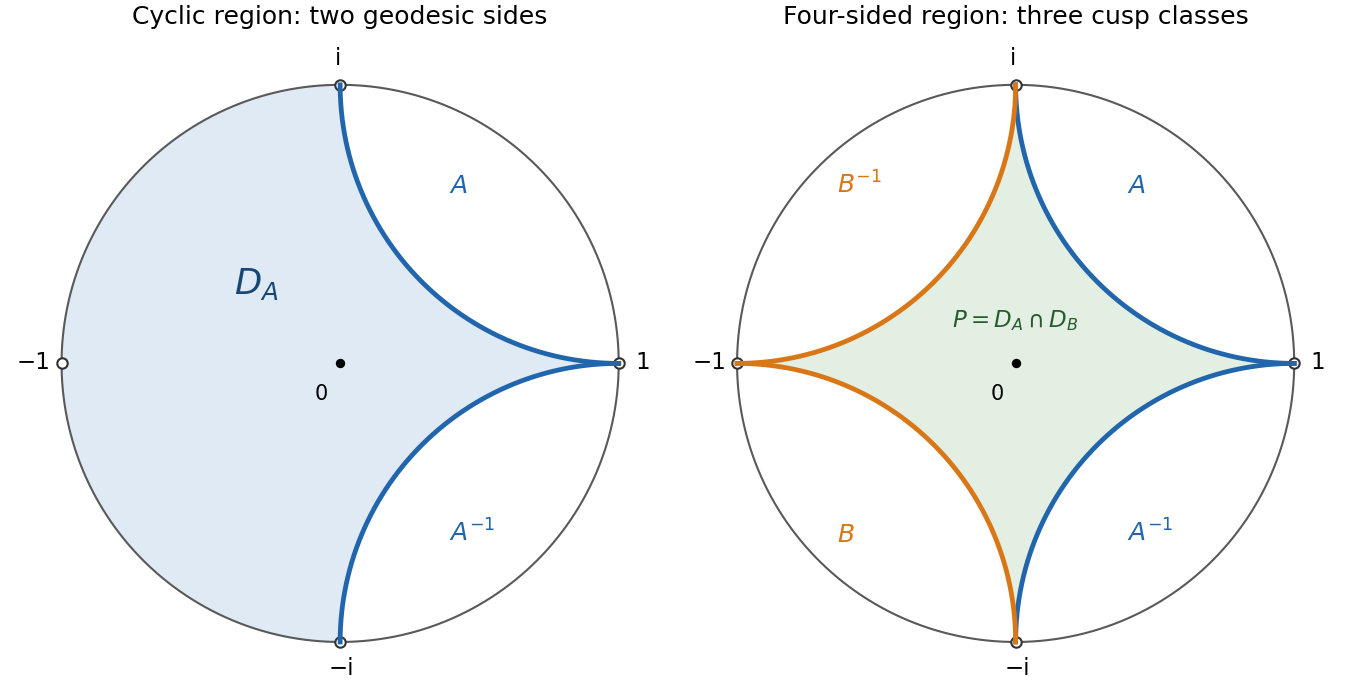
Cyclic parabolic Dirichlet region and the four-sided region for the two generators
. Details. For any , the orbit points satisfying form a nonempty finite set, by proper discontinuity and compactness of closed hyperbolic balls. Choose a closest one, . For every integer , its minimality givesand the same inequality with . Hence lies in the ideal hyperbolic quadrilateralIts ideal vertices are .
For the quotient identification, it remains to justify that this covering region is a fundamental polygon. The four open corner caps excluded by are pairwise disjoint inside the disk. The transformation carries the exterior of the lower-right cap into the upper-right cap; reverses the pairing. Similarly carries the exterior of the upper-left cap into the lower-left cap, and reverses this. These assertions follow either from the upper-half-plane formulas or by mapping their boundary circles and testing zero: and .
Apply a reduced word in from right to left to a point in the interior of . The first letter puts it into its target cap. Every subsequent letter can do the same, since its inverse cap is distinct from the preceding target cap unless the word cancels. Thus the final point lies in the target cap of the leftmost letter, never in the interior of . This ping-pong lemma argument proves freeness and disjointness of distinct translated interiors. Together with orbit coverage it makes a fundamental polygon. The corresponding argument on closed caps shows that boundary identifications are generated by the stated side pairings.
The generator pairs the side from to with the side from to , fixing the ideal endpoint and sending to . The generator pairs the side from to with the side from to , fixing and sending to . There are three ideal-vertex classes: , and . The first two give parabolic ends from ; the third does too, since is a nonidentity parabolic transformation fixing . Adding one point at each end produces an oriented closed surface with one face, two edges and three vertices. Its Euler characteristic is , so it is a sphere. Removing the three added points gives a thrice-punctured sphere, proving
Past exam of the mathematics course of the University of Cambridge 2007 iii Paper 11 2 Solution by Codex 0 Created 2026-10-03 Updated 2026-10-14
Codex 0 Created 2026-10-03 Updated 2026-10-14For a continuous boundary function , its Poisson integral on the unit disk isThe kernel is the real part of the holomorphic function , so differentiation under the integral on compact subsets shows that is harmonic. The kernel is positive and has integral : expand the holomorphic fraction as and integrate. As approaches a boundary point, the mass outside any fixed arc around that point tends to zero. Uniform continuity of therefore shows that extends continuously with boundary values .
Apply this with . The maximum principle for harmonic functions applied to the harmonic difference , which vanishes on the boundary, givesAt boundary points the formula is understood through its continuous interior limit.
Now suppose a continuous function has the mean value property and has a local maximum at . Shrink the neighborhood so that there and all sufficiently small centered circles satisfy the mean value property. On each such circle the average is . If one value were smaller than , continuity would make it smaller on an arc of positive length, contradicting this average. Thus every sufficiently small circle, and hence an entire neighborhood of , has value .
A harmonic function has the mean value property. Indeed, if is its average on a circle centered at , the divergence theorem givesAs , , giving the asserted equality.
Conversely, suppose is continuous and has the mean value property. On an arbitrary closed disk compactly contained in its domain, form the harmonic Poisson integral with boundary values . The difference is continuous, has the mean value property, and vanishes on the boundary. If its maximum were positive, it would be attained inside. The set attaining that maximum is relatively closed and, by the local argument already proved, relatively open. Connectedness of the disk makes constant, contradicting its boundary value. Thus . Applying the same argument to gives . Therefore on every such disk, proving
Past exam of the mathematics course of the University of Cambridge 2007 iii Paper 11 1 Solution by Codex 0 Created 2026-10-03 Updated 2026-10-14
Codex 0 Created 2026-10-03 Updated 2026-10-14The complement of is nonempty and closed. Take points in that complement with . This sequence is bounded, so a subsequence converges to a point . Continuity of distance gives .
Put . On the indicated exterior region , and lies in the right half-plane. Its principal holomorphic logarithm is therefore the power seriesOn each compact subset of that region, , so the series has locally uniform convergence by comparison with . It does not converge uniformly on the whole region: choose with . Then ; as , tends to minus infinity while each fixed partial sum stays bounded. In particular, the remainder after any fixed number of terms is unbounded.
The boundary-adapted holomorphic zero factor is holomorphic throughout , since its only possible denominator singularity is at . The exponential never vanishes, so its only zero is , andOn , cancellation of the first logarithmic terms gives a holomorphic logarithm of this zero-free restriction withChoose so that the final bound is smaller than the prescribed error. This logarithm is only asserted on the exterior region; a function with a zero cannot have a logarithm on all of .
For each , construct a boundary-adapted holomorphic zero factor whose logarithmic error is smaller than . If is compact, write . For all sufficiently large , for every . Hence converges absolutely and uniformly on after discarding finitely many terms. Consequentlyis a holomorphic function. Its tail is the exponential of a convergent logarithmic sum and is nonzero. The finite initial product has precisely its prescribed simple zeros. Since , only finitely many lie in any compact subset of , and this proves that has exactly the desired simple zeros.
For the final meromorphic function assertion, poles escaping to infinity need additional care: a locally finite pole sequence need not satisfy . Here is the required extension of the product argument. Split the distinct poles into two sets according asIn the first set, for each the poles with are in a bounded closed subset lying at least from the complement. Local finiteness makes this a finite set. Thus the boundary distances tend to zero. In the second set, poles in are at least from the complement, so there are finitely many of them. Thus their moduli tend to infinity.
Use the preceding factors for the first set. For the second set use the Weierstrass elementary factorsFor these have the same logarithmic-tail bound as above. If a pole has order , choose the factor's error smaller than and raise it to the power . A possible pole at zero is handled by a finite polynomial factor. On every compact subset the resulting logarithmic tails are uniformly summable, so their product is holomorphic with zeros of exactly the pole orders and no other zeros. If is the original meromorphic function, the product extends holomorphically across every pole. Writing that extension as gives the concise conclusion
Past exam of the mathematics course of the University of Cambridge 2007 iii Paper 10 8 Solution by Codex 0 Created 2026-10-03 Updated 2026-10-14
Codex 0 Created 2026-10-03 Updated 2026-10-14The loop group here is , with pointwise multiplication. Although it is abelian, its nontrivial positive-energy quantum representations are projective: implementers can commute only up to a phase. A positive energy representation of the loop group of U(1) has rotations whose self-adjoint generator is bounded below and which implement in the projective unitary group. The fermionic construction gives both that phase and an explicit bosonic description.
Choose the one-particle Hilbert space with modes , , and projection onto . Use the polarized fermionic Fock spacewhere the exterior powers are Hilbert-completed and the tensor product is graded. Its vacuum fills all modes and leaves empty; excitations are particles in the empty modes and holes in the filled modes. The fermionic annihilation operators and fermionic creation operators satisfy the canonical anticommutation relationsFinite particle-hole configurations form an orthonormal basis. As in the finite-dimensional exterior algebra construction, their creation and annihilation operators act irreducibly: an operator in the commutant sends the vacuum to a scalar vacuum, since the joint kernel of its vacuum annihilators is one-dimensional, and then acts by that scalar on the dense configuration basis.
Segal's quantization criterion for fermions says that a unitary one-particle operator has a unitary implementer on this Fock space, satisfying , exactly whenEquivalently is Hilbert-Schmidt. Implementers are unique up to phase, hence form a projective unitary representation of the restricted unitary group. This is the fermionic, polarized criterion; it is not a condition that the entire operator be Hilbert-Schmidt. The criterion and the corresponding continuity topology are stated in Theorem III.2.1.1 of the fermionic construction of loop-group representations. For the compact principal-angle part of a pair of polarizations, the threshold has a concrete interpretation. Its two-dimensional blocks are rotations through angles ; finitely many unmatched modes can be handled separately. Each angle rotates the vacuum into times its original component plus times a particle-hole pair. After discarding finitely many exceptional blocks, the successive tensor products are Cauchy precisely when converges to a nonzero value, equivalently . In this block model the sum is exactly half the squared Hilbert-Schmidt norm of the projection difference; finitely many unmatched modes account for a change of charge. Infinitely many unmatched modes already violate the criterion. This explains why infinitely many arbitrarily small mixings can fail to be implementable.
For , multiplication is a unitary one-particle operator. Its matrix entry from to is . ThereforeFor a fixed difference , exactly pairs cross the polarization boundary. Smoothness makes the sum finite, so Segal's quantization criterion for fermions constructs a continuous projective unitary representation of every smooth loop. Smooth convergence gives operator-norm convergence of and Hilbert-Schmidt convergence of its commutator, which is sufficient for the strong projective continuity of the implementers.
Normal ordering fixes the charge and rotation energy. On the dense finite-configuration domain putThe sums are finite on each configuration. A particle at adds charge one and energy ; a hole at adds charge minus one and energy . Consequently is a nonnegative self-adjoint diagonal operator with integer spectrum and finite-dimensional eigenspaces. The unitaries are strongly continuous, have period , and implement . Conjugating multiplication by this one-particle rotation gives , so their Fock implementers rotate the loop representation projectively. This is an actual positive-energy circle action.
The scalar anomaly is visible in the Heisenberg current algebra of a fermion on the circle. Define on finite-energy vectorsFor fixed the sum has only finitely many nonzero actions on any configuration. Direct use of the canonical anticommutation relations givesOn summing, the two noncentral sums cancel. If the central sum is : for the terms are precisely . ThusIn particular for . The coefficient one in the central term is the level of this basic representation.
Let be smooth and real. The normal-ordered infinitesimal implementer of multiplication by isThe sign of the current index matters: multiplication by raises the one-particle mode by , so it corresponds to . It follows either directly from the bilinear commutator or from the fermionic currents on the circle that . For trigonometric these are oscillator fields on the finite-energy domain; their self-adjoint closures exponentiate to the implementers of . For general smooth , their extensions are obtained by the oscillator-field construction below: guarantees the square-summable field coefficients, and Fourier truncation converges in the corresponding Weyl relations implementers. Thus no unjustified infinite operator product is required.
SetIt is real and antisymmetric for real . The Heisenberg current algebra of a fermion on the circle relations give . The Weyl relations, or the finite-mode Baker-Campbell-Hausdorff computation followed by the square-summable limit, yieldThis is an explicit two-cocycle on the identity component of the loop group. A different phase choice changes it by a group coboundary, but its antisymmetric commutator remains , and hence cannot be removed.
The winding components also matter. Every smooth loop is with , real periodic , and mean determined modulo . Let implement multiplication by . It moves the filled boundary one place upwards, so it raises charge by one; phases of charge ground states can be chosen so that . Conjugating the fermionic currents on the circle givesChoose . Since , one obtains the full loop group two-cocycle for U(1)The exponent is bilinear in the additive winding-logarithm coordinates, so expansion immediately gives . Replacing by changes by , whose exponential is identity since charges are integers; the scalar cocycle also stays unchanged since . Thus the expression is well-defined on loops, not just on chosen logarithms. It records both the derivative anomaly and the commutator of winding with constant loops.
For the fermion-boson correspondence on the circle, decompose into charge eigenspaces. The charge- ground state fills all integer modes . Its energy isFor , sum the energies of the added modes ; for , sum the hole energies of the removed modes . Every other charge- configuration is obtained by moving finitely many occupied levels upwards, so this is the lowest energy. Since preserves charge and lowers energy by , for .
Define bosonic annihilation operators and , . They obey . Their occupation vectorsare orthonormal by commuting positive fermionic currents on the circle through negative fermionic currents on the circle. Their energies are . It remains to prove that they span, rather than assume the boson correspondence. Count configurations by formal charge and energy . Empty modes can contain one extra particle, while filled modes , , can contain one hole. Therefore the fermionic character isThe charge form of the Jacobi triple product proved in Question 4 identifies this withThe reciprocal product counts bosonic occupations, or partitions of an integer. For fixed charge and energy, the finite-dimensional fermion space has exactly as many basis configurations as the independent fermionic current on the circle monomials already constructed. Hence those monomials exhaust every such space, proving their dense completeness. This establishes a unitary identification of every charge sector with a bosonic Fock space, and on that identificationThe usual half-integer fermion convention instead gives ground energy and requires the corresponding adjustment of rotations. Here integer modes were deliberately chosen to obtain a genuine circle action with integral nonnegative energies. The two ground states of energy zero, at charges zero and one, are therefore consistent, not a negative-energy defect.
This is also a constructive bosonic realization of the loop representation: the mean of acts by , nonzero modes of act as the square-summable oscillator field , and winding shifts the charge sectors. Taking tensor copies adds the fermionic current on the circle central terms and gives level . Positivity constrains their sign, since in a vacuum sector for . The level-one construction, its explicit loop cocycle, and its complete bosonic occupation basis show how an abelian classical loop group acquires noncommuting quantum currents while retaining positive rotation energy.
Past exam of the mathematics course of the University of Cambridge 2007 iii Paper 10 7 Solution by Codex 0 Created 2026-10-03 Updated 2026-10-14
Codex 0 Created 2026-10-03 Updated 2026-10-14Use the unitary normalization of the Fourier transform,The Schwartz space consists of smooth functions for which every Schwartz seminorm is finite. Such functions and all their derivatives are integrable. Differentiating under the integral and integrating by parts giveConsequentlyExpand the derivative by the product rule and insert the integrable weight ; the right side is bounded by finitely many Schwartz seminorms of . This proves continuity . The identical argument with the opposite sign proves continuity of .
For surjectivity and injectivity an inversion proof is needed. If , multiply by . Fubini's theorem and the elementary Gaussian integral giveThe Gaussian has total integral one and its mass outside any fixed ball tends to zero. The right side therefore tends to , by uniform continuity of . On the left, , so dominated convergence gives . This proves . Reversing the signs in the same calculation proves . ThusIts inverse is continuous by the seminorm estimate already proved. This establishes the requested bijection without assuming Fourier inversion as an unexplained theorem.
Inversion gives and the Parseval identity. Indeed, inserting the integral for into and using gives . Density of Schwartz functions in extends to a unitary operator on , the Plancherel theorem. Translation of becomes multiplication by a phase, modulation becomes frequency translation, andThese formulas explain why the Fourier transform diagonalizes constant-coefficient differential operators. By transpose it also defines a bijection of the tempered distributions: with the complex-linear distributional pairing, , since the Fourier kernel is symmetric in its variables.
The connection with creation and annihilation operators is especially transparent for the harmonic oscillator. On the common invariant dense domain , setIntegration by parts shows that these are formal Hilbert-space adjoints. They are closable unbounded operators; commutators below are computed on , avoiding undefined products on arbitrary vectors. The identity gives the canonical commutation relationsIt also givesThe normalized vacuum satisfies . Define the Hermite functionsMoving annihilation operators past creation operators with the commutation relations provesThese same relations show that the Hermite functions are orthonormal: unequal occupations are orthogonal eigenvectors of one of the commuting symmetric number operators , and the ladder relations recursively give norm one.
For completeness, let be orthogonal to every . The Hermite polynomials have nonzero leading monomials and triangular lower-degree terms, so these orthogonality relations say that all polynomial moments of vanish. Its Fourier integral extends to an entire function of :The Cauchy-Schwarz inequality, with the Gaussian absorbing every exponential linear weight and every polynomial, justifies differentiation uniformly on compact sets of . Every Taylor coefficient at zero is a vanishing moment, so the entire function is zero. Fourier uniqueness on follows here without circularity: if an function has zero Fourier transform, convolving it with gives zero by the Gaussian integral and Fubini, and the approximate-identity limit in gives the original function zero. Thus and . The Hermite functions form an orthonormal basis of .
Finally, the elementary Gaussian integral gives . The derivative and multiplication identities above implywhere the operators on the right act on the frequency variable. HenceThus creation and annihilation organize both the oscillator's spectral decomposition and the four possible Fourier eigenvalues. On Schwartz functions the oscillator powers control weighted derivatives, and Hermite coefficients decay faster than every power of ; conversely this rapid coefficient decay implies all Schwartz seminorms are finite. The Fourier phases preserve this decay, providing another explanation of the Fourier automorphism of Schwartz space.
Past exam of the mathematics course of the University of Cambridge 2007 iii Paper 10 6 Solution by Codex 0 Created 2026-10-03 Updated 2026-10-14
Codex 0 Created 2026-10-03 Updated 2026-10-14On the torus , choose normalized Haar measure, so that , , is an orthonormal basis of . A periodic Sobolev space is defined, for any real , byFor negative , the coefficients describe distributions rather than necessarily functions. For a nonnegative integer , the weight is comparable to , so this norm is equivalent to the sum of the squared norms of all weak derivatives through order . Fourier truncation proves that smooth trigonometric polynomials are dense. The pairing identifies the continuous dual of with , giving Sobolev duality.
Two Fourier estimates explain the usefulness of these spaces. If , the Cauchy-Schwarz inequality givesUniform convergence of the differentiated Fourier series proves the Sobolev embedding . If , a bounded subset of has uniformly small high-frequency tails in :Finite-dimensional Fourier truncation therefore proves the compact embedding , the periodic version of Rellich-Kondrachov compactness theorem. In addition, for multiplication is continuous , making it a Sobolev algebra. Indeed the weighted coefficient of a product is bounded by the sum of the convolutions of with and of with ; Cauchy-Schwarz puts unweighted coefficients in , and the case of Young's convolution inequality finishes the estimate.
For eigenfunction expansions, distinguish ellipticity from self-adjointness. An arbitrary non-self-adjoint elliptic operator need not have an orthonormal basis of eigenfunctions. A useful definite setting iswith smooth real periodic coefficients, , real , and uniform ellipticityTake the self-adjoint realization in with domain . Its construction and spectral properties can be seen from the associated form on ,For a sufficiently large constant , is a positive coercive form: , and . The Lax-Milgram theorem supplies the unique weak solution of for ; the form is Hermitian, which gives symmetry of its inverse on .
The regularity input is the periodic elliptic estimateHere is why an elliptic operator gains two derivatives. With coefficients frozen at a point, its principal symbol dominates , and the estimate follows by multiplying Fourier coefficients by that symbol. On a sufficiently small coordinate patch, the difference of the leading coefficients from these constants has arbitrarily small supremum norm. In the integer-order differentiated estimate, this absorbs the highest derivatives into the left side; derivatives falling on coefficients contribute only lower-order terms. A partition of unity reduces the variable-coefficient problem to such patches. Its commutators with have order one, controlled bywhich follows by splitting low and high Fourier modes. Absorbing these terms gives the displayed estimate. For a weak solution, the same localization with difference quotients first bounds its second weak derivatives for ; differentiating and repeating then gives for nonnegative integer . Interpolation and duality extend the scale to real orders. In particular is bounded.
Let . Compactness of makes a compact operator. Symmetry of the form makes self-adjoint, and positivity of makes positive and injective. Its range is dense because . The spectral theorem for compact self-adjoint operators consequently gives an orthonormal basis withElliptic regularity bootstraps every to a smooth function. Each eigenvalue has finite multiplicity. Thus a self-adjoint uniformly elliptic second-order operator on the torus has a complete smooth orthonormal eigenfunction expansion with discrete eigenvalues tending to infinity.
Writing , every has in , with . Iterating the elliptic estimate shows that the graph norm of is equivalent to the norm. Interpolation and duality give the more general spectral descriptionThe comparison constants depend on the operator and . In particular smooth functions have coefficients decaying faster than every power of , and their expansions converge in every Sobolev norm and hence in every norm.
This gives a practical way to solve elliptic equations. The equation is solvable if and only if whenever ; then one may take on the other eigenspaces and add an arbitrary vector in . The Sobolev description proves the two-derivative gain and the Fredholm alternative, rather than leaving them as formal series manipulations. Similarly the solution of the heat equation isFor every the exponential decay at high eigenvalues places this solution in every Sobolev space, hence it is smooth.
For the Laplacian the eigenfunctions are precisely with eigenvalues . The number with is the number of lattice points in a radius- ball, asymptotic to its volume by comparison with unit cubes. For the general self-adjoint operator above, bounds on its form above and below by positive multiples of plus constants, together with the Courant–Fischer min-max principle, imply . Thus the growth reflects dimension and the two-derivative order. Compactness of the torus is essential: on , translated bumps prevent the compact embedding, and the Laplacian instead has continuous spectrum described by the Fourier transform.
Past exam of the mathematics course of the University of Cambridge 2007 iii Paper 10 5 Solution by Codex 0 Created 2026-10-03 Updated 2026-10-14
Codex 0 Created 2026-10-03 Updated 2026-10-14The Fredholm index measures the finite-dimensional obstruction to inverting an operator. For a bounded operator between Hilbert spaces, the Fredholm conditions are that its range of a bounded linear operator is closed and its kernel and cokernel are finite-dimensional. The orthogonal complement of the range is , soAn invertible linear map has Fredholm index zero; the converse needs an additional finite-dimensional correction, since an operator can have equally large kernel and cokernel.
First construct an inverse up to finite-rank operators. On , the restriction of is a bounded bijection onto its closed range, with bounded inverse by the bounded inverse theorem. Extend that inverse by zero on , obtaining . ThenConversely, suppose and are compact operators. On , the first identity expresses the identity as a compact operator, so this kernel is finite-dimensional. If were not bounded below on , there would be unit vectors in that complement with . Write . Compactness of gives a subsequence for which converges, hence converges to a unit vector in with , a contradiction. This lower bound makes the range closed. Applying the analogous argument to , using , proves that its kernel is finite-dimensional. This proves the Atkinson theorem: a bounded operator is Fredholm exactly when it has an inverse modulo compact operators. For operators on one Hilbert space this says that its image in the Calkin algebra is invertible.
The Fredholm index is stable. Decompose the domain as , where , and the target as , where and . A sufficiently small norm perturbation has block matrixMultiplying by invertible triangular block matrices reduces this matrix to the direct sum of and the Schur complement . The latter's kernel dimension minus cokernel dimension is , whatever its rank. Therefore the Fredholm set is open and the index is locally constant. If is compact, the same parametrix works modulo compact operators for every , . Local constancy along this path gives
For Fredholm operators and , multiplication of parametrices shows that is Fredholm. Its index is additive. Here is a direct proof, rather than an assertion of additivity. There is an exact sequence of finite-dimensional spacesThe map from takes a vector to its class modulo ; the next takes the class of to that of ; the last is the quotient map. For example, a class lies in the kernel of the middle map exactly when for some , so . This verifies the only less immediate exactness assertion; the others follow directly from their definitions. Alternating the dimensions givesAlso , and indices add under direct sums. For with compact, the index is zero, so injectivity is equivalent to surjectivity. More generally is solvable exactly when is orthogonal to : these are the finitely many compatibility conditions in the Fredholm alternative.
Toeplitz operators exhibit how this analytic index detects a topological winding. Let be the Hardy space of the circle, spanned by , and let be its orthogonal projection. For a continuous symbol , define , where is multiplication by . Then . The product defect isFor trigonometric polynomials the crossing of negative and nonnegative Fourier modes has finite rank. Uniform approximation of continuous symbols by trigonometric polynomials, together with the displayed norm estimate, therefore makes this defect a compact operator for all continuous . If is nowhere zero, is continuous and is a two-sided parametrix modulo compact operators. Thus is Fredholm.
The converse is instructive. If at , consider the normalized Hardy kernelsTheir norms are one, their individual Fourier coefficients tend to zero as , and hence they converge weakly to zero. Their squared moduli are the Poisson kernel, so continuity of givesA Fredholm operator is bounded below off its finite-dimensional kernel. The projection of these weakly vanishing vectors onto that kernel tends to zero, contradicting this lower bound. Thus a continuous-symbol Toeplitz operator is Fredholm exactly when its symbol never vanishes. Applying the same argument to gives its essential spectrum as , with essential spectrum defined by failure of the Fredholm property.
For nonvanishing , let . Lifting a continuous argument of on gives an argument change . After division by , its argument has matching endpoints, so there is a continuous function with . The nonvanishing-symbol homotopy reduces the index to that of . For this is the th power of the unilateral shift operator, whose kernel is zero and whose range has codimension . For it is the th power of the adjoint shift, whose kernel has dimension and whose range is all of . ConsequentlyThe minus sign comes from counting missing nonnegative Fourier modes. This is a concrete bridge between the Fredholm index, stability under compact perturbations, and the winding number of a loop.
Pinned article: Introduction to the OurBigBook Project
Welcome to the OurBigBook Project! Our goal is to create the perfect publishing platform for STEM subjects, and get university-level students to write the best free STEM tutorials ever.
Everyone is welcome to create an account and play with the site: ourbigbook.com/go/register. We belive that students themselves can write amazing tutorials, but teachers are welcome too. You can write about anything you want, it doesn't have to be STEM or even educational. Silly test content is very welcome and you won't be penalized in any way. Just keep it legal!
Intro to OurBigBook
. Source. We have two killer features:
- topics: topics group articles by different users with the same title, e.g. here is the topic for the "Fundamental Theorem of Calculus" ourbigbook.com/go/topic/fundamental-theorem-of-calculusArticles of different users are sorted by upvote within each article page. This feature is a bit like:
- a Wikipedia where each user can have their own version of each article
- a Q&A website like Stack Overflow, where multiple people can give their views on a given topic, and the best ones are sorted by upvote. Except you don't need to wait for someone to ask first, and any topic goes, no matter how narrow or broad
This feature makes it possible for readers to find better explanations of any topic created by other writers. And it allows writers to create an explanation in a place that readers might actually find it.
Figure 1. Screenshot of the "Derivative" topic page. View it live at: ourbigbook.com/go/topic/derivativeVideo 2. OurBigBook Web topics demo. Source. - local editing: you can store all your personal knowledge base content locally in a plaintext markup format that can be edited locally and published either:This way you can be sure that even if OurBigBook.com were to go down one day (which we have no plans to do as it is quite cheap to host!), your content will still be perfectly readable as a static site.
- to OurBigBook.com to get awesome multi-user features like topics and likes
- as HTML files to a static website, which you can host yourself for free on many external providers like GitHub Pages, and remain in full control

Figure 2. You can publish local OurBigBook lightweight markup files to either OurBigBook.com or as a static website.
Figure 3. Visual Studio Code extension installation.
Figure 5. . You can also edit articles on the Web editor without installing anything locally. Video 3. Edit locally and publish demo. Source. This shows editing OurBigBook Markup and publishing it using the Visual Studio Code extension. 
- Infinitely deep tables of contents:



All our software is open source and hosted at: github.com/ourbigbook/ourbigbook
Further documentation can be found at: docs.ourbigbook.com
Feel free to reach our to us for any help or suggestions: docs.ourbigbook.com/#contact