
Quantum tunnelling is transmission through a finite classically forbidden region, where . The stationary Schrödinger equation permits an evanescent wavefunction inside such a barrier rather than forcing it to vanish at its entrance. Matching to propagating states beyond a barrier of finite width gives a nonzero transmitted probability current.
For a rectangular barrier of height and width , with equal exterior potentials and , write . The exact rectangular-barrier tunnelling probability isFor an opaque barrier its dominant dependence is . For a slowly varying barrier, the WKB approximation generalizes this to , apart from matching prefactors. Barrier width, particle mass and energy therefore have a strong influence. Energy is conserved in a static barrier: tunnelling does not require the particle to borrow energy or acquire a classical path with negative kinetic energy.
In alpha decay, a nuclear alpha-particle configuration is confined by the short-range nuclear interaction but separated from the exterior by a Coulomb barrier. Its energy can be positive relative to infinity while still lying below the barrier maximum. Escape by tunnelling produces alpha particles at that conserved energy, with an exponentially small decay probability per nuclear encounter. The pronounced dependence of half-life on alpha energy is a characteristic consequence of the barrier exponent, unlike a simple classical escape threshold.
In scanning tunneling microscopy, a conducting tip is brought within a nanometer-scale vacuum gap of a conducting surface and biased weakly. Electron tunnelling gives a current that depends approximately exponentially on separation, in a simple low-bias model. Feedback adjusts the tip height to keep current fixed while scanning, producing a surface map sensitive to both geometry and electronic states. Finite current through the non-contact gap, and its steep dependence on separation, are the direct tunnelling signatures; current is not a direct measurement of topographic height alone.
A Josephson junction provides a collective superconducting example. Two superconductors separated by a thin barrier can carry a coherent pair current even at zero voltage. At constant voltage the AC Josephson effect gives and oscillation frequency . The coupled condensate quantum phases and pair transfer distinguish this from independent normal-electron transmission. These examples involve different microscopic barriers, but all require quantum coupling across a region that suppresses classical passage. Comparing weak-temperature tunnelling behavior with thermally activated escape helps distinguish the mechanisms experimentally.
A diatomic molecule has one internal bond-stretching vibrational coordinate. Near its equilibrium separation, approximate the bond by a spring of stiffness and use the reduced mass . Its frequency is and its quantum harmonic oscillator levels are .
For independent molecules in thermal equilibrium, set . The single-molecule canonical partition function is a geometric series:Using , where , givesPer mole replace by . The zero-point energy is present in but is temperature-independent and contributes nothing to the heat capacity.
For , occupation of the first excited vibrational state is exponentially suppressed: . The vibrational degree of freedom is frozen out. For , . This recovers classical equipartition: the quadratic kinetic term and quadratic elastic term each contribute per molecule.
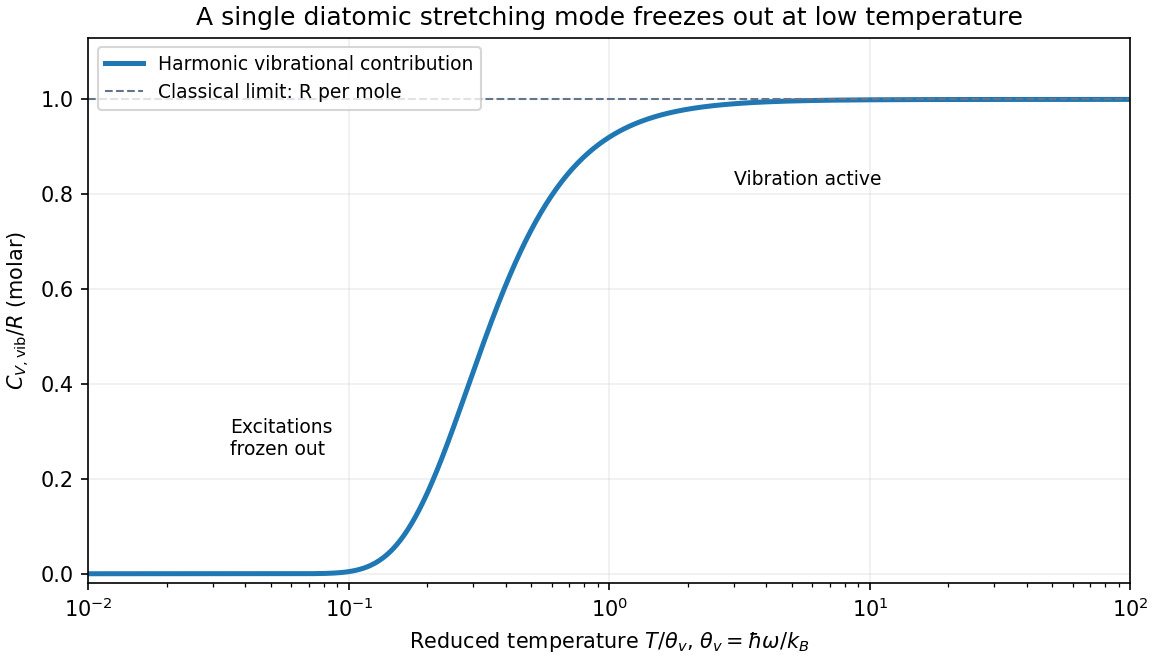
The vibrational heat capacity of a diatomic gas must be distinguished from the total heat capacity. In a dilute gas with rotations already active and vibration still frozen, translation contributes and rotation , so molar . Once vibration is active it adds , giving . For an ideal gas of a fixed number of intact molecules, , so the corresponding values are and . Very low temperatures also freeze rotations, while sufficiently high temperatures bring anharmonicity, dissociation or electronic excitations; the harmonic plateau is restricted to the range where those effects are negligible.
Indistinguishable particles have the same intrinsic properties and cannot be assigned physically observable permanent labels. Exchanging their mathematical coordinates leaves all physical predictions unchanged. In ordinary three-dimensional quantum mechanics the total state, including spin, obeysThe Spin-statistics theorem associates integer spin with bosons and half-integer spin with fermions. Exchange does not mean physically transporting two particles along some prescribed trajectories; it is the symmetry of the many-particle state under permutation of its arguments.
For orthonormal one-particle states , normalized two-particle spatial combinations are . They illustrate coherent exchange amplitudes. If both fermions have the same complete one-particle state, the antisymmetric combination vanishes. This is the Pauli exclusion principle: a fermionic mode has occupation zero or one. Bosonic modes can have arbitrarily large occupation. A many-fermion product basis is antisymmetrized by a Slater determinant.
It is the full spin-spatial state that must have the appropriate symmetry. For two electrons, an antisymmetric spin singlet state can accompany a symmetric spatial orbital, so opposite-spin electrons can occupy the same spatial orbital. A symmetric spin triplet instead needs an antisymmetric spatial state. Thus exclusion concerns identical complete states, not an unconditional prohibition on sharing a position or spatial orbital.
Counting allowed occupations gives Bose-Einstein statistics and Fermi-Dirac statistics. For an ideal gas in thermal equilibrium,Bosonic accumulation permits Bose-Einstein condensation; exclusion gives a filled Fermi sea and degeneracy pressure even at zero temperature. In the dilute classical limit the occupations are small and both expressions approach the Maxwell-Boltzmann distribution. Exchange effects become important when wavepackets overlap appreciably, often characterized by number density times the cube of the thermal wavelength.
Composite particles follow their total exchange statistics while remaining intact. The composite statistics of neutral atoms depend on electrons as well as nucleons, as in the two lithium isotopes above. Symmetrization can produce bunching or antibunching in joint detection probabilities even in the absence of an interaction potential; it is not an additional classical force.
The Hamiltonian operator isSince multiplication by commutes with multiplication by , part (b) gives . Similarly . Substituting into part (c) gives Ehrenfest theorem:Thus the mean momentum changes according to the mean force, and the derivative of mean position is mean velocity. These exact quantum equations resemble Hamilton's classical equations, but generally differs from . The classical point-particle equation for the center is exact for potentials at most quadratic and is an approximation for a localized packet when the force varies little across it. A spatially broad packet in a nonlinear potential need not follow a classical trajectory. Even where its center follows classical motion, its width and measurement uncertainties remain quantum properties.
For a normalized state, the expectation value isFor a time-independent operator, differentiation givesThe Schrödinger equation says . The self-adjointness of gives , soIn the integral derivation, the same self-adjointness step is integration by parts with vanishing boundary terms. An explicitly time-dependent observable would also contribute . These are the expectation-value equations underlying the Heisenberg equation of motion.
Expand the proposed product rule without interchanging any operator factors:Applying this commutator identity with and givesFor a differentiable multiplication potential, apply the other commutator to a test function:ThereforeThese operator equalities are understood on a common domain where the indicated products and derivatives are defined, with the boundary conditions appropriate to the state.
The commutator is . To evaluate it for differential operators, apply it to a smooth test wavefunction :Thus the canonical commutation relation is . The associated Heisenberg uncertainty relation is . Position and momentum cannot both have arbitrarily sharp outcome distributions in the same prepared state, even with ideal measuring apparatus. This concerns quantum-state preparation, not merely a calibration error in a particular instrument.
Taking the modulus squared gives the three-mode revival of a planar quantum rotor:The angular density has period , while both the state and its density revive after . Its integral over is one because and .
At , the density is , with maxima at and zeros at . At it becomes , interchanging those maxima and zeros. At and , it is , with four equal maxima along the coordinate axes and positive minima halfway between them. At the original profile returns.
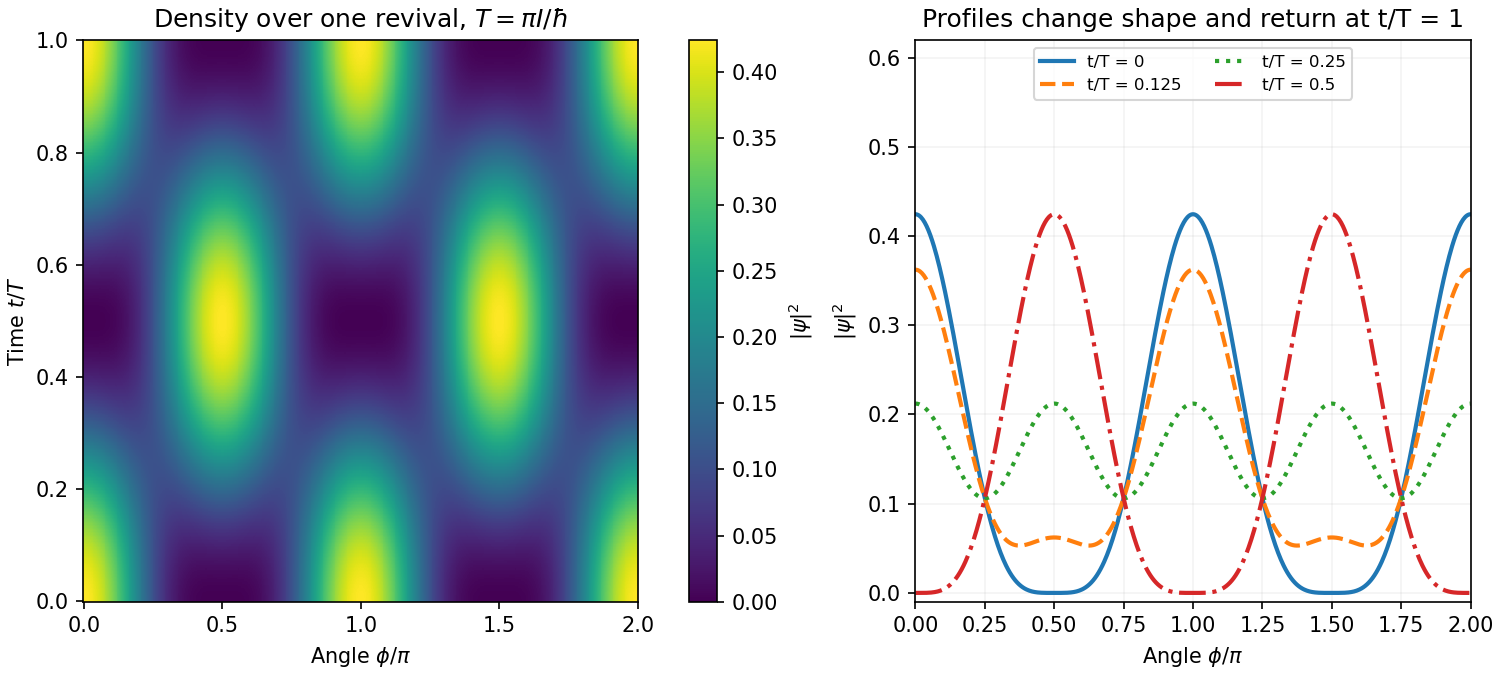
The changing profile is interference between the stationary mode and the degenerate counter-rotating modes. It does not translate rigidly around the circle; the standing-wave weights alternate between two orientations.
Each energy eigenstate evolves by its own quantum phase . The two components have the same energy, while the quantum phase stays one. ThusIn angle representation this isAt , recovers the initial state. The fixed coefficient magnitudes keep the angular momentum and energy probabilities constant even though the density in angle changes.
Expand the initial wavefunction in the angular momentum eigenbasis using . With the normalized from part (a), this givesThe coefficient squares sum to one, also verifying the stated normalization. The Born rule therefore gives angular momentum outcomesFor an energy measurement the two distinct states belong to the same energy eigenspace. Sum their probabilities, rather than adding their amplitudes, to obtainTheir relative probabilities are for the angular momenta and for the energies. In particular, zero mean angular momentum does not imply zero rotational energy.
The quantum rotor has orientation angle of period , so physical wavefunctions satisfy . The exponential solutions of are thereforeThey are normalized and orthogonal on . The corresponding angular momentum operator is , with eigenvalue . The ground level is nondegenerate, and every energy level has the twofold degeneracy . This uses ordinary periodic boundary conditions, with no flux or twisted quantum phase.
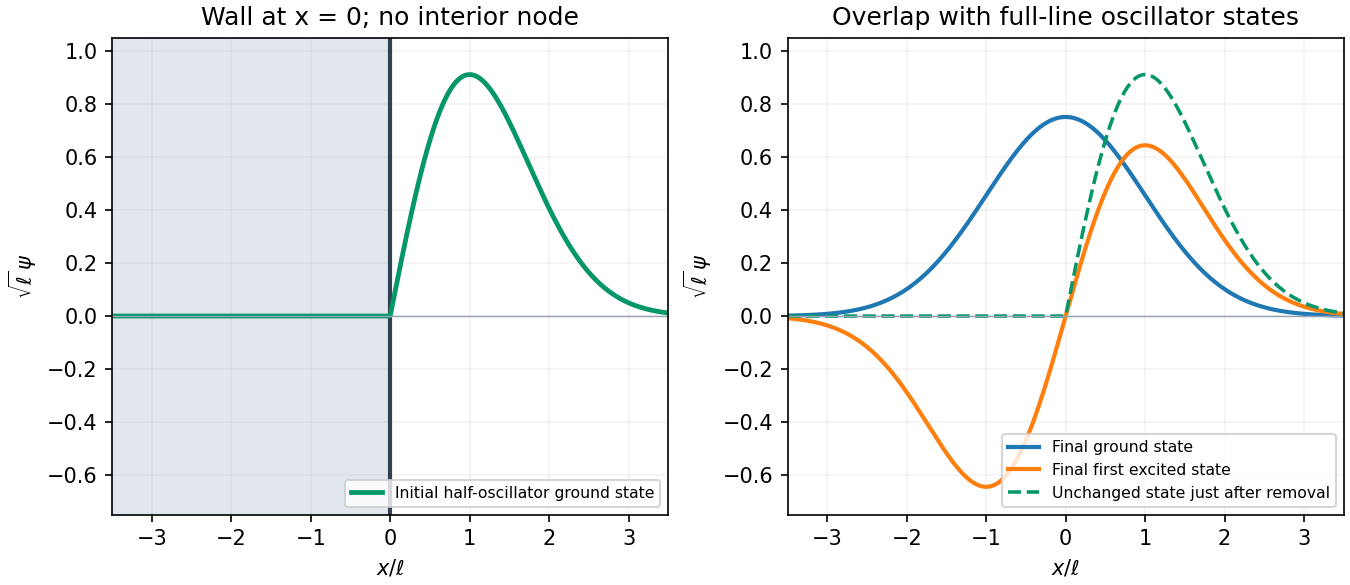
For removal of a half-oscillator wall, the sudden approximation keeps the state unchanged during the change of potential. Its probability in the new full-oscillator ground state is the squared overlap:where . ThereforeThe integral runs only over the initially occupied half-line. The initial state is not the odd full-line eigenstate: it is zero, rather than negative, on the left. Indeed its overlap with that final first excited state is , giving probability , and the remaining probability lies in higher states. Subsequent evolution under the new fixed Hamiltonian operator changes the quantum phases of its energy components without changing these energy-measurement probabilities.
The infinite wall imposes , and the wavefunction vanishes for . The even full-oscillator ground state fails this boundary condition; the lowest admissible state is the positive-half restriction of the odd first excited state. Multiplying by restores normalization because half its probability originally lay on either side.
With , the half-harmonic oscillator ground state isIt rises from zero at the wall, reaches its wave-amplitude maximum at , and decays to zero as . It is positive throughout the interior of the allowed region, with no interior node, as required for its ground state. The wall need not make the derivative continuous with the forbidden half-line.
Assume and define so that the potential is that of a quantum harmonic oscillator. The two trial forms have derivativesSubstitution into the stationary Schrödinger equation cancels the terms precisely when . Normalizability selects the positive root,The remaining constants giveFor later overlaps choose positive normalization constants. The Gaussian integral gives , while its second-moment integral gives . Thus both wavefunctions have unit norm and are orthogonal by their opposite parity.
The real Gaussian is positive everywhere and has no nodes; the odd state has exactly one node at . The Sturm oscillation theorem orders one-dimensional bound states by their node count. Consequently these are the ground state and first excited state, respectively, also agreeing with the oscillator spectrum .
The one-dimensional time-independent Schrödinger equation isHere is the particle mass, its potential energy, the stationary energy eigenvalue, and the reduced Planck constant. The spatial wavefunction is ; the full stationary state is . Physical bound states satisfy the boundary conditions and wavefunction normalization . The operator on the left is the Hamiltonian operator, the sum of kinetic and potential energies.
From the second-edge amplitude in part (c),This uses . If the transmitted wave is instead written , its coefficient is ; the extra factor only changes the quantum phase convention.
Using the probability current of a plane wave,Thus the flux transmission probability is one. The larger transmitted density compensates for the smaller transmitted velocity ; equal currents need not have equal wave amplitudes.
Zero reflection means . Matching the first interface then givesThe specified layer quantum phase is , so and . The second-interface conditions becomeSince , compatibility requires . This is a quantum quarter-wave matching layer: the intermediate wavenumber is the geometric mean, and the two interface reflections cancel after their round trip through the layer.
SetAll are real and . Suppressing a common time quantum phase , chooseThe rightmost region has no left-moving term because no wave is incident from the right. The shifted quantum phase convention makes the transmitted amplitude at the second interface.
For finite potential steps and equal mass, wavefunction matching at a finite potential step requires continuity of both and . Explicitly,A discontinuous wavefunction would introduce an inadmissible singular kinetic term, while integrating the stationary Schrödinger equation across a finite step shows that the derivative cannot jump. These conditions also keep the probability current continuous, so a finite interface neither creates nor destroys probability. The derivative rule would need modification for a delta-function potential or a different effective mass; neither occurs here.
Let be the probability density. For a real potential energy , the Schrödinger equation and its complex conjugate areDifferentiate and substitute both equations. The potential terms cancel, leavingComparison with the probability continuity equation identifiesFor a plane wave of amplitude and positive wavenumber , , the density times the velocity. Integrating the continuity equation over an interval makes its probability change equal to the incoming current minus the outgoing current.
For a Bravais lattice with primitive translation vectors , define the reciprocal lattice by vectors satisfying for every direct-lattice translation . A convenient basis iswith cyclic formulas for . Then and for integers . The reciprocal primitive volume is .
These vectors are the spatial Fourier series frequencies of a periodic lattice potential or density. Elastic coherent crystal diffraction occurs when the scattering wavevector transfer equals a reciprocal lattice vector, with intensities additionally controlled by the basis crystal lattice structure factor. This is the reciprocal-space version of Bragg's law. A lattice of points and its basis should not be confused: a basis can make allowed reciprocal-lattice diffraction intensities vanish.
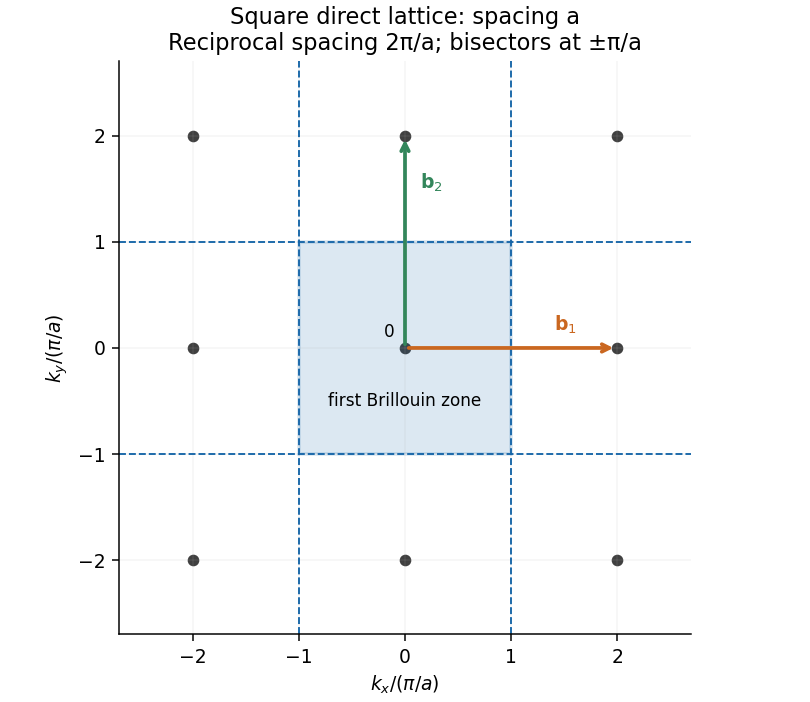
The first Brillouin zone is the Wigner-Seitz cell around the reciprocal origin: it consists of points closer to than to any other reciprocal point. Its faces lie on the perpendicular bisectorsTo see the condition, equate and . These are also free-electron Bragg-degeneracy planes, where a periodic potential can open a band gap. Higher zones classify regions beyond successive Bragg planes; the reduced-zone description folds them into the first zone while retaining a band label.
In one dimension with spacing , reciprocal points occur at , and the first zone is . A square lattice of spacing has reciprocal basis , and a square first zone with edges at .


The reciprocal of a face-centered cubic lattice is a body-centered cubic lattice and vice versa, with the scale fixed by the primitive-vector definition. In a Bloch state, wavevectors differing by describe equivalent crystal momenta modulo the lattice periodicity. A crystal with primitive cells has allowed wavevectors in one Brillouin zone, hence states in each band per spin. This state count links reciprocal geometry to band filling, metallic conduction and band insulating behaviour. Reciprocal space also labels phonons and makes conservation of crystal momentum modulo transparent.
There are unlisted articles, also show them or only show them.