
Past exam of the physics B course of the University of Cambridge 2018 Paper 2 Section A A2 Solution 2026-10-18
Use absolute temperatures and . Let be the heat extracted from the ground, the heat delivered indoors, and the electrical input power. For a reversible heat pump, the entropy transferred per unit time balances:Consequently the coefficient of performance isThe requested heat delivery is a rate, since the duration is unspecified:Of this, comes from the ground and from the electricity. A coefficient of performance greater than one is consistent with conservation of energy because the heat pump transports heat as well as converting electrical energy.
Past exam of the physics B course of the University of Cambridge 2018 Paper 2 Section A A1 Solution 2026-10-18
For the usual hollow rectangular electromagnetic waveguide, let the propagation axis be and the interior be , . A transverse magnetic polarization has and . At a perfect conductor wall the tangential electric field vanishes. Since is tangential to all four side walls, it satisfies a homogeneous Dirichlet boundary condition around the rectangle.
Separating the transverse Helmholtz equation therefore gives the transverse magnetic mode of a rectangular waveguideA zero value of either index makes identically zero, rather than producing a nonzero field uniform along that direction. The transverse electric and magnetic fields of this TM family are obtained from transverse derivatives of , so they also vanish. Thus both TM indices must be nonzero: neither nor exists in this rectangular hollow-guide model. In contrast, transverse electric modes obey a Neumann boundary condition on and may have one zero index. The claim is about this waveguide geometry, not all possible guides.
Past exam of the physics B course of the University of Cambridge 2018 Paper 1 Section C C13 Solution 2026-10-18
Meaning and microscopic origin. For a Newtonian fluid, the dynamic viscosity measures tangential momentum transfer between fluid layers moving at different speeds. For the Newtonian shear considered here, , with units for . Molecular motion and collisions transport momentum across layers in a gas; intermolecular interactions contribute strongly in liquids. The resulting viscous forces oppose relative shear motion and convert organized kinetic energy to heat. The constitutive law is Newtonian and isotropic; incompressibility alone does not establish it.
Vertical force balance. Choose downward, as in the original diagram, and outward normal to the plate. In a uniform steady film, has zero advective acceleration and no along-plate pressure gradient. On a slice of thickness , the net shear force per unit face area is , while its weight per unit area is . ThereforeHere denotes the downward traction on a face with positive normal. The opposite face has the opposite traction orientation, accounting for the sign in the force difference.
Boundary conditions. At the fixed solid wall, the no-slip boundary condition is , with no normal penetration. At the free surface , neglect air shear, so and hence . The flat free surface has normal pressure , neglecting surface-curvature effects. These are a velocity condition at the wall and a stress condition at the free surface, not zero velocity at both boundaries.
The parabolic speed profile. Integrating from the shear-free surface gives . Thusand the wall condition yieldsIt is zero at the wall and largest at the free surface, where its gradient vanishes. The wall shear supports the downslope weight of the film per unit plate area.
Volume flux per unit width. Integrate through the depth:This is volume flow per unit length in , with units .
Inclining the plate. Keep normal outward from the plate and use downslope. The gravitational components are downslope and normal to the plate. For a uniform film of normal thickness , the steady slice equations areThe free-surface pressure condition givesUniform makes . The same no-slip and zero-surface-shear conditions then give the uniform gravity-driven Newtonian film,The component normal to the plate changes the hydrostatic pressure, while the tangential component drives the flow. The thickness is measured normal to the tilted plate.
The inclined-film volume flux. Integrating the new profile givesIt recovers the vertical result at and vanishes on a horizontal plate at fixed uniform depth. A varying depth, imposed pressure gradient or significant air shear would require additional terms; the solution here uses the uniform film specified by the simple draining-plate model.
Past exam of the physics B course of the University of Cambridge 2018 Paper 1 Section C C12 Solution 2026-10-18
Compression and stretch viewed on rotated faces. To isolate shear, take equal small principal strains , . A square with sides at to these directions becomes a rhombus: adjacent side lengths are unchanged to first order, but their right angle changes by . In axes rotated through , the same strain tensor has zero diagonal entries and off-diagonal entries of magnitude .
The pure shear from opposite principal strains therefore has engineering shear strain , not . Equal opposite principal stresses give purely tangential traction of magnitude on those rotated faces. HenceIf the compression and stretch are not equal and opposite, an additional dilatational strain remains; their deviatoric part still supplies shear.
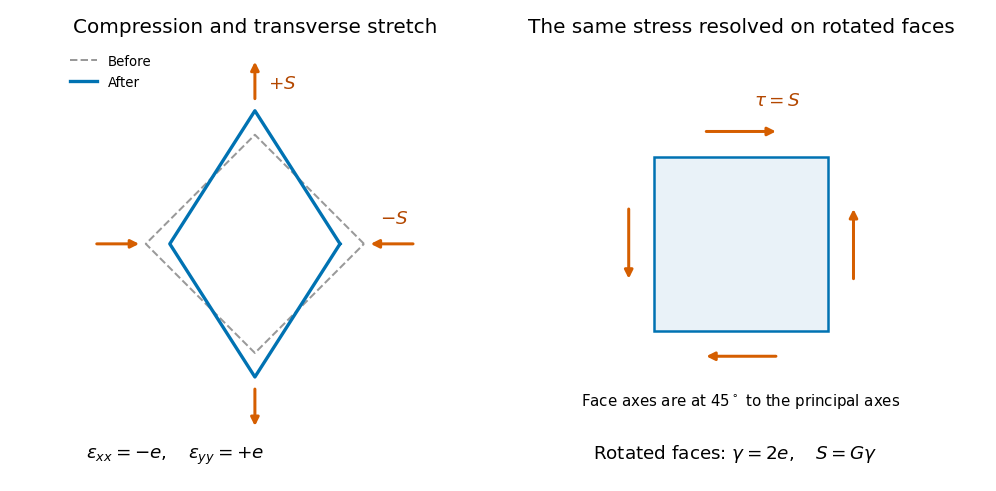
Original comparison of compression and transverse extension with the same stress resolved as shear on faces rotated through 45 degrees; deformation is exaggerated
. Details. 
The shaft's torsional stiffness. At radius , an end twist over length gives tangential displacement and shear angle . The local shear stress is . An annular area contributes torque , soThus torsion of a solid circular shaft givesHere is the polar second moment of area, in , not a mass moment of inertia. This is the transmitted torque magnitude; the shaft's restoring couple opposes the twist. The formula assumes small elastic shear and a circular uniform section.
Past exam of the physics B course of the University of Cambridge 2018 Paper 1 Section C C11 Solution 2026-10-18
The differential gravitational acceleration responsible for a tidal force is the difference between accelerations at separated points of a body. Relative to a freely falling reference point , a small offset experiencesThe tidal tensor has units ; the vector called in the source is the resulting differential acceleration, in . An actual differential force is this vector multiplied by the test mass. Measurable effects include relative motion of separated freely falling masses, radial stretching, transverse squeezing, deformation and, when self-gravity or strength is insufficient, disruption. A spatially uniform acceleration alone produces no tidal deformation.
Past exam of the physics B course of the University of Cambridge 2018 Paper 1 Section C C10 Solution 2026-10-18
Inertia and principal directions. About the centre of mass, the inertia tensor isIt relates angular momentum and angular velocity by and gives rotational kinetic energy . The principal axes are orthogonal eigenvector directions of this real symmetric tensor; in that basis it is diagonal, with entries the principal moments of inertia .
Derivatives in a rotating frame. Write in a body-fixed orthonormal basis. Each basis vector rotates according to . Differentiating the components and basis separately proves the rotating-frame derivative formula,The body derivative differentiates the scalar components in that basis. A fixed pivot can replace the centre of mass when the corresponding angular-momentum balance is valid.
Euler equations. The inertial angular-momentum equation is . Since the principal moments are constant in the body frame, substitute :These are Euler's equations in the principal body frame.
Linear perturbation of free rotation. After the impulse, . Let to leading order and be small. The third Euler equation changes only at quadratic order, so the linear transverse equations areFor and , eliminate fromThis givesIts units are inverse square seconds. Positive gives a growing real exponential; negative gives bounded oscillatory perturbations.
Past exam of the physics B course of the University of Cambridge 2018 Paper 1 Section B B9 Solution 2026-10-18
Distributed line parameters. The geometry is the wide parallel-plate transmission line described in the question, with absolute permittivity . A length has charge and field , givingThe opposed plate currents have sheet density and confine the leading magnetic field between the plates. The magnetic energy per unit length is , soHere and are per unit length, in and , not lumped component values. Internal conductor fields and edge corrections are neglected.
Voltage and current evolution. The current entering a short length minus that leaving it is the rate of increase of its plate charge:The voltage drop across that length is its inductive drop, . Dividing by gives the lossless Telegrapher's equations,
Propagation speed. Differentiate these equations once more and eliminate the other variable:The wave equation speed is
Travelling-wave impedance. For a forward wave , take . Substitution into gives , hence the characteristic impedanceThe backward-wave current has the opposite sign relative to its voltage; the fixed ratio above applies to one travelling direction.
Matching the antenna. The voltage reflection coefficient is . No reflection requires . With , , and ,The resulting is consistent with the wide-plate approximation.
Both transverse forces. The matched transverse electromagnetic mode has electric attraction and magnetic repulsion. For time-averaged power ,The force on one plate excludes its own field. Thus the average electric attraction and magnetic repulsion per unit length are respectivelyThe electric and magnetic pressure cancellation in a matched TEM line follows directly from :The equality also holds instantaneously for a single travelling wave. Quoting either alone would omit the opposing contribution. This is the ideal electromagnetic force in the stated lossless uniform-dielectric model; a standing wave would not generally have the same cancellation.
Past exam of the physics B course of the University of Cambridge 2018 Paper 1 Section B B8 Solution 2026-10-18
Effective permittivity. Use peak phasors with time dependence . The Ampere-Maxwell law isThe conductive contribution to complex permittivity is thereforeHere is the source's effective relative permittivity, not just the real part of a complex response. The positive imaginary term is the loss sign appropriate to this time convention.
The penetrating electric wave. Combine this equation with Faraday's law of induction. In a uniform source-free medium the transverse phasor satisfiesFor a good conductor of electrical conductivity , , so . The root which decays into isChoose the surface phasor amplitude real. Taking the real part of givesThe skin depth is an amplitude-decay distance in metres.
The magnetic wave and phase. The curl of an -polarized field varying in is in the direction. Since ,ThusThe phase sign follows the specified convention. Equivalently the surface impedance of a good conductor is .
How the fields differ from those in vacuum. The two metal fields have the same exponential envelope and spatial period , but their phase arguments differ by .
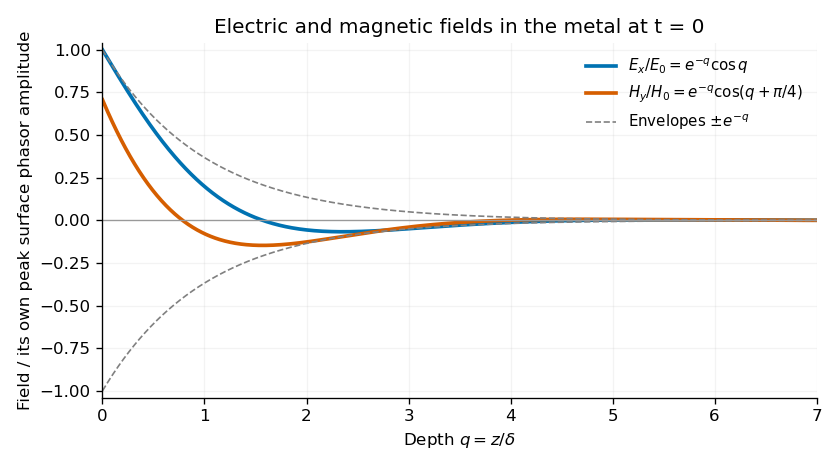
Original normalized electric and magnetic field profiles inside a good conductor at one instant, showing their common decay envelope and quarter-of-a-right-angle phase difference
. Details. 
An individual travelling wave in the lossless exterior has no attenuation, real wave impedance and in-phase electric and magnetic fields. The exterior total field also includes the reflected wave and may show interference, so it need not share that simple phase relation everywhere. At the interface the tangential fields match; is the field just inside the metal, not necessarily the incident amplitude. A good conductor reflects strongly and its wave impedance is much smaller than the vacuum impedance.
Average inward energy flux. For peak phasors, the Poynting vector averaged over a cycle is . The fields giveConsequently the constant in the question isThe flux is in the direction and has units .
Local energy conservation. The Poynting flux and local heating in a skin layer satisfyThe decrease becomes Joule heating in each layer. The Poynting theorem includes this transfer from field energy to the metal; averaged electromagnetic energy storage has zero time derivative in the periodic state, so no energy is lost from the complete balance.
There are unlisted articles, also show them or only show them.