
Use the leading lepton-orbital classification of a beta decay transition. For lepton-pair orbital angular momentum , Fermi transitions have pair spin and total lepton angular momentum ; Gamow-Teller transitions have and . Addition of angular momentum requireswhile the nuclear parity change requires . The least allowed gives the order: means an allowed beta decay, and an th-forbidden beta decay. Fermi-type and Gamow-Teller-type below refer to these spin-independent and spin-dependent contributions, including their higher-orbital generalizations.
- For , the nuclear spin changes by and parity is unchanged. An lepton pair cannot carry ; would have the wrong parity. At , Fermi transitions can carry , and Gamow-Teller transitions can carry , including the permitted transfers and . Therefore this is a second-forbidden, nonunique transition, with both Fermi-type and Gamow-Teller-type contributions permitted. The quantum numbers do not determine their actual relative matrix elements.
- For , and parity is unchanged. Already carries . The operator for a Fermi transition has rank zero and cannot connect these unequal nuclear spins. This is an allowed Gamow-Teller transition. The decrease of atomic number makes the nuclear conversion proton-to-neutron; the angular momentum classification applies to either the energetically available beta-plus decay or electron capture branch.
- For , requires transfer and a parity change. The lowest possible orbital order is . The pair for a Fermi transition then has only , whereas the pair for a Gamow-Teller transition can attain . Thus this is a first-forbidden unique Gamow-Teller-type transition. Here unique means the maximal transfer at the leading orbital order, as in a unique forbidden beta decay.
- For , permits the scalar operator for a Fermi transition with . The allowed Gamow-Teller transition operator has rank one, and the triangle rule excludes . Interpreting the printed logarithm in the usual comparative half-life convention gives
In the order listed, the concise classification is
Past exam of the particle and nuclear physics course of the University of Cambridge 2019 Section A 2 Solution Created 2026-10-18 Updated 2026-10-20
In both semileptonic decays, an active quark emits a virtual W boson, which produces an electron and an electron antineutrino:The unchanged spectator quarks combine with the produced into the final proton. The relevant Cabibbo-Kobayashi-Maskawa matrix elements are and .
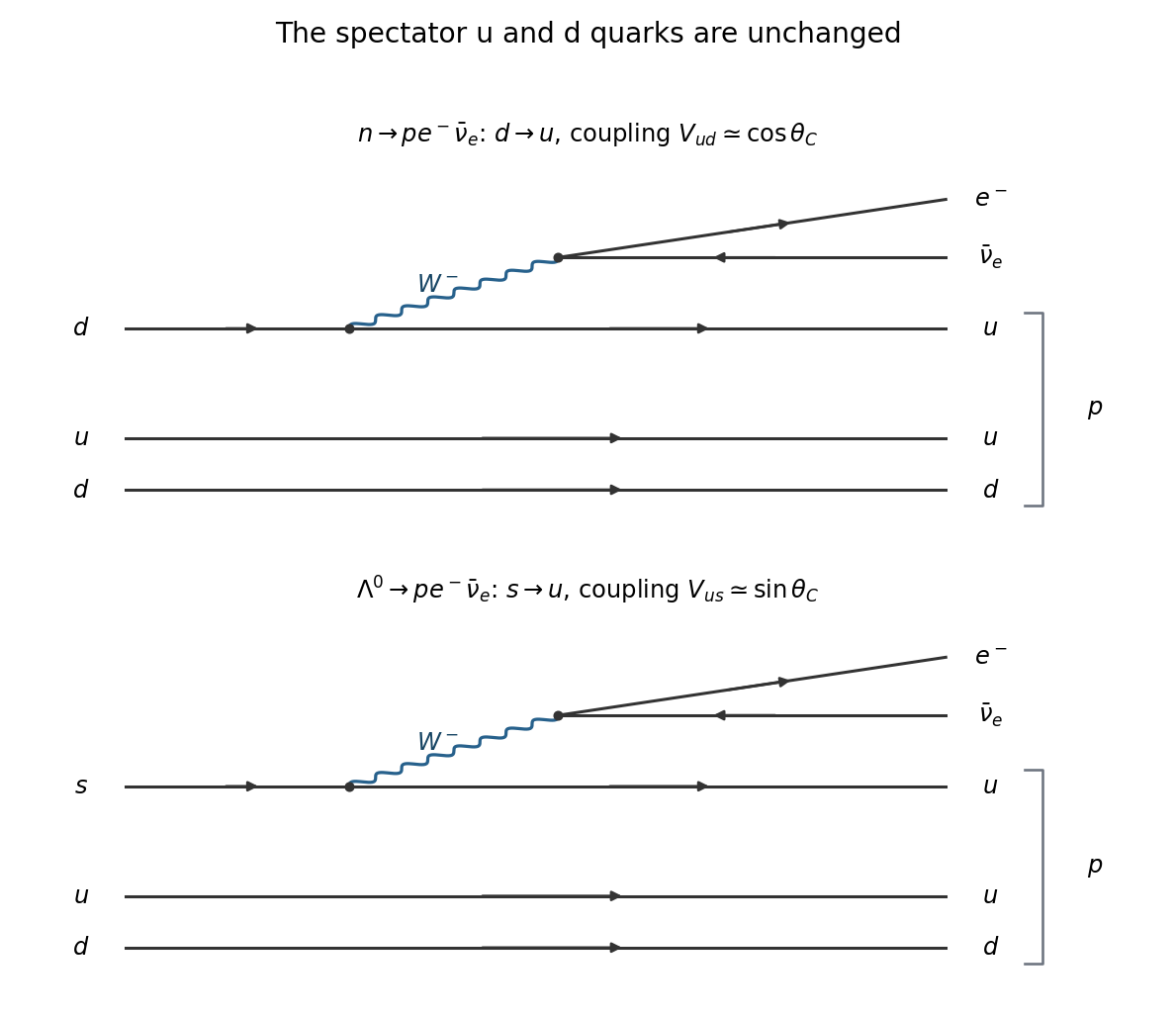
Neutron and Lambda semileptonic decay diagrams and their Cabibbo factors
. Details. Use the quoted masses in energy units, equivalently natural units , and define the energy releases before subtracting the electron rest energy asThe prescribed density of states ansatz uses precisely these differences to the fifth power. A Cabibbo-angle extraction from semileptonic decay rates also needs a common reduced hadronic strength. In that approximation the partial decay rates, measured in , areThe supplied mean lifetimes describe all decays, so multiply their inverses by the relevant branching fractions:Taking their ratio cancels and givesChoose the conventional first-quadrant Cabibbo angle:The Lambda baryon partial rate is much larger despite its smaller weak flavour coupling because the fifth-power phase space factor is enormous.
There is an assumption beyond the stated density of states ansatz: the neutron and Lambda reduced hadronic strengths have been set equal. If their ratio is , the same data instead imply . Without specifying , the angle is not uniquely determined. Unequal hadronic form factors, finite electron mass and recoil make the displayed common-strength result an exercise-level estimate, rather than a precision measurement.
Count strangeness before drawing a weak interaction diagram. An Omega baryon has , a Lambda baryon has , a negatively charged kaon has , and a pion has . Thus the two nonleptonic baryon decays requireThe strong interaction cannot supply either net change of strangeness.
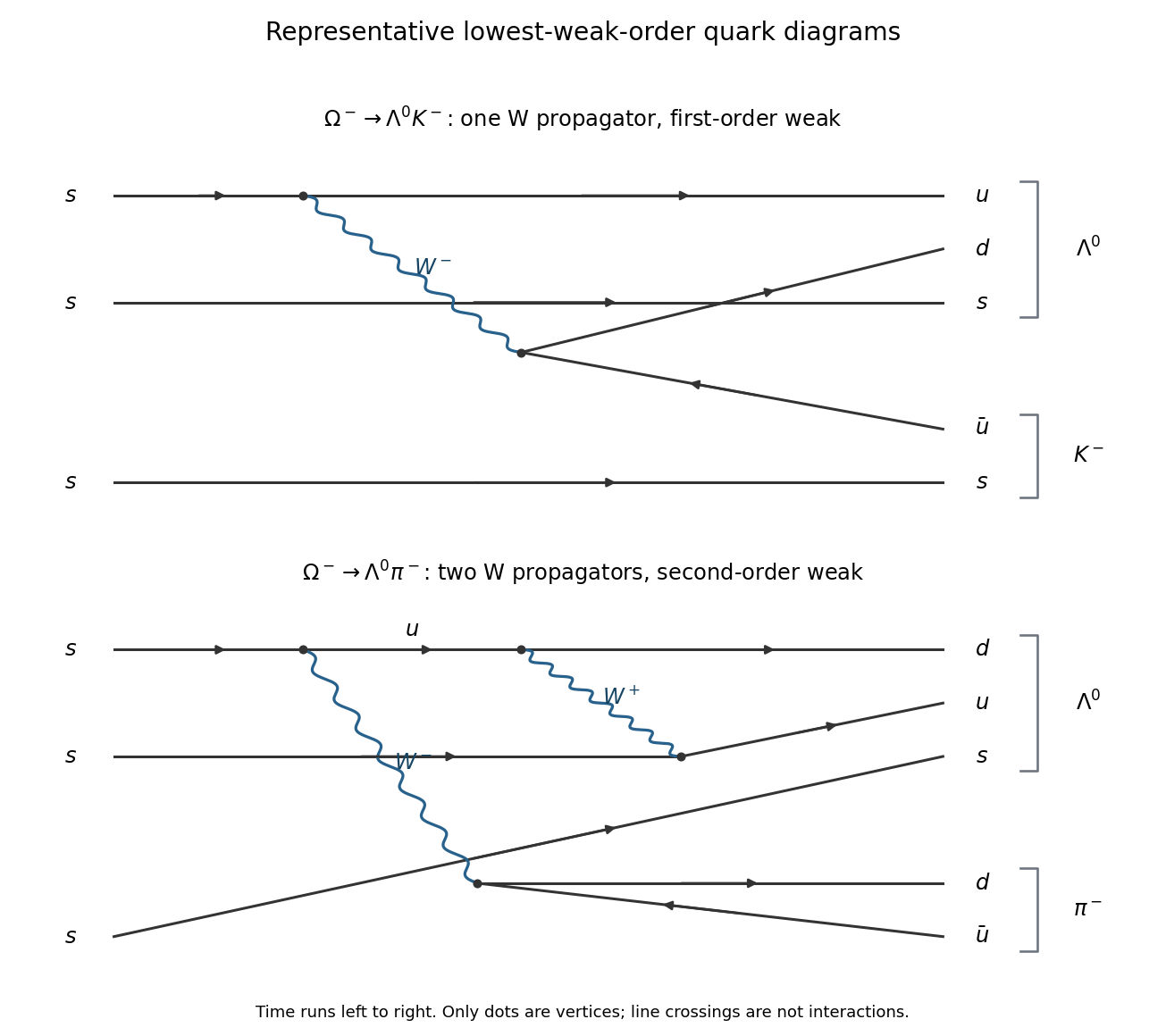
In the upper Feynman diagram, one initial strange quark undergoes the weak charged current transitionThe remaining two strange quarks are spectator quarks. Combine the outgoing and one spectator into the Lambda baryon, and the remaining with into the kaon. This uses one W boson propagator and two weak interaction vertices. Its Cabibbo-Kobayashi-Maskawa matrix factor has magnitude .
For the lower Feynman diagram, let the upper initial first emit a and become a virtual , then emit a and become a . The is absorbed by a second initial , turning it into a ; the third initial remains a spectator quark. The emitted produces . The complete quark flavour flow is thereforeThe final form the Lambda baryon and the other form the pion. Electric charge conservation holds at every vertex. Internal lines are virtual; this is a contribution to one decay amplitude, not a sequence of freely propagating on-shell constituent-quark decays.
This is a possible lowest-weak-order diagram for a second-order strangeness-changing weak decay: it has two W boson propagators and four weak interaction vertices. Its Cabibbo-Kobayashi-Maskawa matrix factor has magnitude in the displayed light-quark topology. Other contributions can exist, but a single charged-current insertion cannot turn two net strange quarks into nonstrange ones. No extra loop Feynman diagram is compulsory: the displayed two-W tree already realizes the required quark flavour change.
At low energies, one-W exchange produces one power of the Fermi constant in an effective decay amplitude; the second process requires an additional weak insertion. Hadronic matrix elements and propagators supply the accompanying dimensions, so a numerical ratio cannot be obtained by simply squaring a dimensionful constant. The robust comparison isThe dominant reason is the extra weak order, with additional Cabibbo suppression in this representative topology. It is not a comparison between a strong decay and a weak decay.
The nuclear determination of . A beta decay transition has no nuclear parity change and can proceed with zero lepton orbital angular momentum. The allowed scalar operator gives a Fermi transition; the rank-one Gamow-Teller transition operator cannot connect total nuclear spins zero to zero. The strong isobaric-analog transitions used for precision measurements are superallowed beta decays. A generic assignment alone would not guarantee superallowed strength if the states were nonanalog.
At the quark level the weak charged current converts and carries in the amplitude. The nuclear Fermi operator is an isospin ladder operator, givingHere denotes the known phase space dependence, with the dimensional factors included in the proportionality constant. In the isospin-symmetric limit, between analog states is fixed by isospin algebra, for example for the usual analog transitions. A measured partial half-life and the computed phase space factor give the comparative half-life; after radiative corrections and isospin breaking corrections, its inverse determines . The decay rate measures a magnitude squared, not the complex phase of .
Ds decay diagrams and CKM comparisons. The original PDF has , with . The local TeX drops that overbar; using instead would give a different flavour channel. Use the PDF's neutral antikaon throughout.
In the representative Ds nonleptonic tree amplitudes, the Ds meson spectator is . The elementary weak transitions are
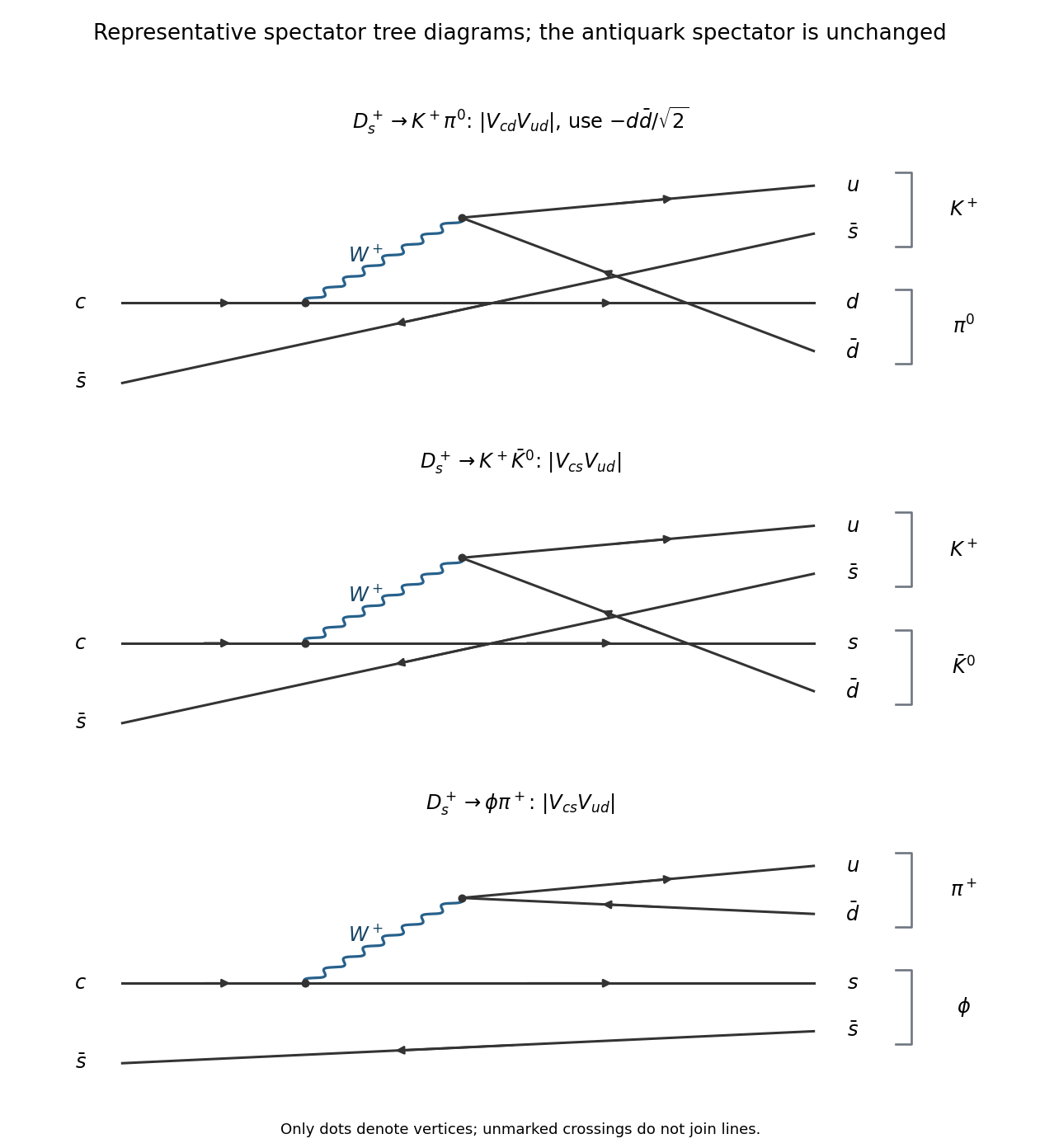
In the first two channels, the produced joins the spectator to form ; the other quark joins . For the first channel this uses the component of the neutral pion. In the third, forms the phi meson and forms . The two possible final pairings have different colour contractions and hadronic matrix elements even when their weak CKM factors coincide.
The purely CKM rate suppression of relative to isThus is singly Cabibbo suppressed, while and are Cabibbo-favored at this level. If reduced hadronic strengths and phase space effects were equal, including the neutral-pion component would giveThe supplied branching fractions instead giveThe first observed ratio is times the neutral-pion-corrected simple estimate, requiring only an order-one remaining hadronic and phase space factor. Relative to , that remaining factor is . The two Cabibbo-favored channels differ by a factor despite equal CKM magnitudes. The CKM hierarchy therefore explains why one channel is much rarer, but it does not calculate the three exclusive branching fractions; spin, phase space, color charge and strong interaction final-state effects also matter.
What spin and parity establish. In either pseudoscalar-pseudoscalar final state, the total intrinsic spin is zero. Conservation of angular momentum for a spin-zero parent forces , so the final parity isopposite to the parent Ds meson. ConsequentlyFor a vector meson plus a pion, the intrinsic final spin is one. Coupling to total requires , giving , equal to the parent parity. Thus spin and parity alone permit a parity-conserving transition. That is the limited sense in which it is not necessarily weak from this information alone. In reality it is also weak: the initial charm flavour disappears, which the strong interaction and electromagnetic interaction conserve.
W branching fractions. In the massless-daughter, tree-level estimate, each leptonic channel contributes one common unit of decay width. Each accessible quark pair contributes because of the three final colours. The charged-current W branching-fraction counting denominator isOnly and are accessible up-type quarks; the large is irrelevant because a W boson cannot decay into the heavier top quark. HenceA final bottom quark arises in or , soThis counts the primary decay channels; finite daughter masses and QCD corrections refine the approximation.
The requested top-lifetime estimate and its limitation. Under the instructed equal-coefficient Sargent's rule scaling, and the mean lifetime is inversely proportional to that fifth power. Converting both masses to GeV givesThis is the requested order-of-magnitude estimate, assuming the same effective coefficient for the two total decay rates. It corresponds to and is longer than the hadronization time, roughly a few . Taken literally, it would allow top-flavored hadrons to form; it does not establish the physical statement that the top decays before hadronizing.
The extrapolation fails because Sargent's rule uses a low-energy Fermi interaction approximation, whereas permits with an on-shell W boson. The physical leading decay width instead scales asUsing , the Fermi constant and gives about at the supplied top mass. Then , with , gives . This corrected regime explains top-quark decay before hadronization.[ref]
Past exam of the particle and nuclear physics course of the University of Cambridge 2018 Section B B3 Solution Created 2026-10-18 Updated 2026-11-05
Colour and identical-quark spin. A spatial ground-state baryon has a symmetric spatial wavefunction. For , or , the quark flavour state is also symmetric, and the total-spin state of three spin-one-half quarks is symmetric. Without another degree of freedom, the whole state would be symmetric under exchange of identical fermions, contrary to the Pauli exclusion principle.
A three-quark colour singlet supplies a completely antisymmetric factor,using the three color charge states. The remaining spatial-spin-flavour factor can then be symmetric. These baryons therefore provide evidence for an additional internal degree of freedom with at least three states, realized as colour in quantum chromodynamics.
For the pair in , the spatial and quark flavour factors are symmetric under exchange of the two up quarks, while the colour factor is antisymmetric. The pair's spin state must consequently be symmetric. The identical-quark pair spin in a ground-state baryon isa triplet state. This holds whether the complete baryon has total spin or .
Origin of the pair interaction. The terms in the baryon hyperfine mass formula are effective colour-magnetic spin-spin interactions, arising from gluon exchange between the quarks' colour-magnetic moments. Each magnetic moment brings an inverse constituent quark mass, explaining the factor . The constant absorbs the strong coupling constant, colour factors and the spatial overlap. A common is a constituent-model approximation.
Spin algebra and the two masses. Set , so each dimensionless spin angular momentum operator satisfies . Label the two up quarks 1 and 2 and the strange quark 3. Squaring givesNext square the total spin :Substituting these pair sums into the baryon hyperfine mass formula yieldsTheir difference is . Repeating the argument for the identical pair in givesThus the model predicts equal Sigma and Xi hyperfine splittings:For a like-flavour comparison using exactly the supplied masses, the splitting is and the splitting is , giving . Averaging within the supplied isospin multiplets instead gives . The predicted equality captures the common scale but misses the observed ratio by about in this table. Different spatial overlaps, and hence different effective values, can account for departures from the common-coefficient approximation.
Radiative decay and recoil. In a radiative Sigma-to-Lambda transition, both baryons retain valence content . A photon couples to an electrically charged constituent while the final quarks are projected onto the lower baryon's spin-flavour wavefunction. The leading up- and down-quark diagrams are shown below; their contributions must be combined coherently. In the simplest model, the strange-quark spin operator alone cannot change the pair from its Sigma triplet to the Lambda singlet. The transition is an multipole radiation transition, consistent with .
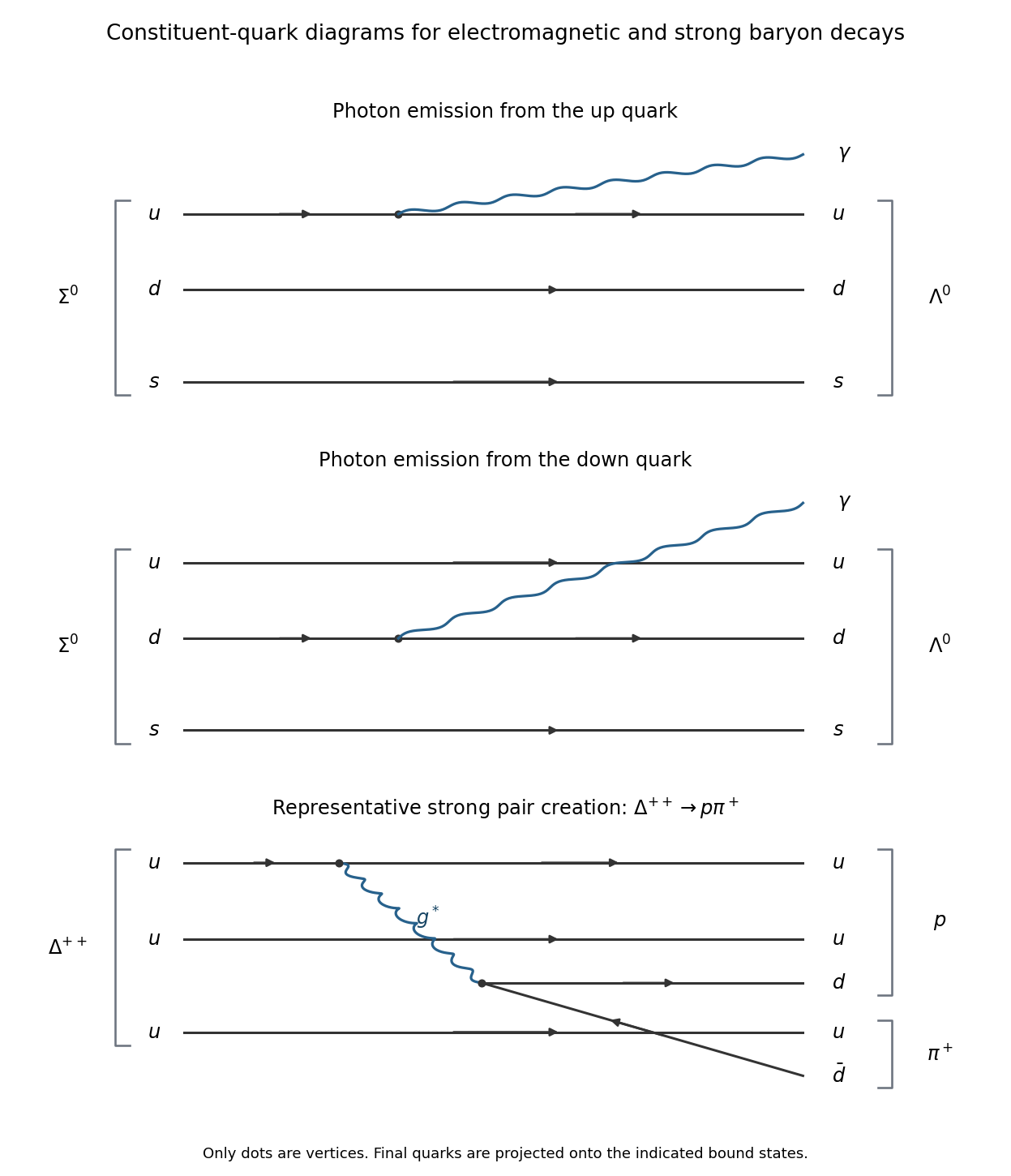
Quark diagrams for Sigma-to-Lambda photon emission and an example strong Delta decay
. Details. For the photon energy, let and in natural units. Four-momentum conservation gives equal opposite final momenta of magnitude , soThe recoil kinetic energy of the Lambda baryon is ; assigning the entire mass difference to the photon would miss it.
Which baryons decay strongly? The open strong-decay thresholds for baryons require both sufficient energy and conserved quark flavour, including strangeness. The dominant strong decayers in the supplied table areThe Delta baryon channels have threshold near , below . The excited Sigma baryons can decay as or , and the excited Xi baryons as , all with open thresholds and conserved strangeness. Their positive-parity baryon states can emit the negative-parity pion in an odd relative orbital angular momentum, with already allowing total .
The last diagram illustrates : a gluon creates a pair and the quarks regroup into the two hadrons. No quark changes flavour at the gluon vertices. This is a representative strong pair-creation topology; quantitative hadronic decay rates require bound-state dynamics.
The Omega baryon is an important exception among the spin- states. Its cannot become the of through the strong interaction. Its flavour-conserving threshold is at least , above its mass, so it decays weakly. The ground-state strange octet also has no open strong channel: for example needs at least , and or needs still more than the relevant initial mass. The neutral Sigma decays electromagnetically as above; the neutron and the other unstable octet members decay weakly, while the proton is stable within these processes.
Smooth-model fission energy. Use natural units , so the quoted nuclear masses are expressed as rest energies. Conservation of mass number and atomic number fixes the second fragment to . First omit nuclear pairing to compare a continuous range of . Pairing can subsequently add for integer fragments; it has no smooth parity assignment for arbitrary real .
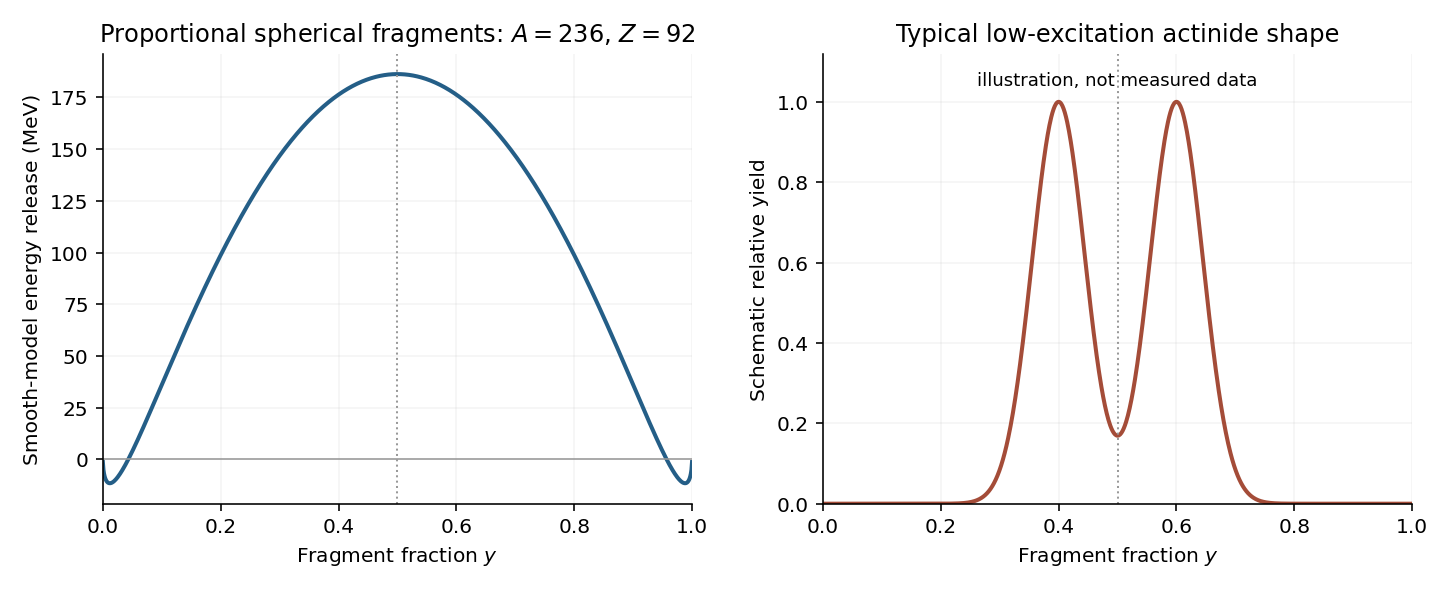
In the parent-minus-daughters mass difference, the nucleon rest energy and volume terms cancel. The nuclear symmetry energy also cancels because both fragments have the same :The remaining liquid-drop fission energy isSplitting increases the surface energy cost, but reduces nuclear Coulomb energy. Both contributions are symmetric under , so the symmetric split is stationary. Symmetry alone would not establish a maximum, since the two contributions compete.
For a full check, put , and . On , increases from to . Expressing the two fractional-power sums through givesThe derivative can change sign only from negative to positive, so any interior stationary point in is a minimum. The largest value is therefore either the no-split endpoint or the symmetric split. Thus symmetric fission maximizes the positive liquid-drop energy release: whenever this smooth model permits an exothermic split, its largest release occurs at .
There is a qualification to the paper's unqualified wording. For arbitrary low , the symmetric split need not maximize ; indeed it is a local minimum when . The symmetric-maximum conclusion is valid in the heavy, fission-favorable regime relevant here, rather than a universal property of the formula.
Barrier and fragment yields. Positive final-state Q value does not remove the fission barrier along a deformation path. Surface energy initially rises as the nucleus deforms; spontaneous fission then requires collective quantum tunnelling unless enough excitation is present. Its rate is exponentially sensitive to barrier height, width and collective inertia. Thus nuclei close to the exothermicity threshold can have immeasurably long spontaneous-fission mean lifetimes, while sufficiently heavier nuclei have smaller effective fission barriers or larger quantum tunnelling probabilities.
The fission-fragment mass distribution of low-excitation actinide fission is usually double peaked: complementary fragments have mass fractions roughly and rather than both exactly . Nuclear shell model effects and the fission dynamics help favor asymmetric fragments. Maximizing the final smooth-model energy release is not a calculation of the fragment yield. The following yield curve is schematic, with no measured counts implied:


Capture excitation energies. Capturing a negligible-energy neutron forms a compound nucleus with the rest energy of the target plus the free neutron. Relative to the compound ground state, the neutron-capture excitation energy is thereforewhere is positive nuclear binding energy and the compound nucleus's neutron separation energy. The free neutron rest energy cancels in the binding-energy difference. With the supplied semi-empirical mass formula,At , uranium-235 has odd , while uranium-236 is even-even. The pairing contribution is . By contrast uranium-238 is even-even and uranium-239 has odd , giving . The individual contributions areThus the model predictsOf the predicted difference, comes from the change in nuclear pairing. It is the primary reason the even-even capture product is more strongly excited; the smooth terms account for the remaining .
Thermal versus fast-neutron fission. The last comparison uses the supplied observed capture excitations, and , rather than replacing them by the preceding smooth-model estimates. Interpreting the quoted and activation energies as the barriers in the respective capture channels givesA simple neutron-induced fission threshold estimate for the second channel requires about additional centre-of-mass kinetic energy. Sub-barrier tunnelling is possible, but it does not give the large thermal-neutron fission probability of the first channel.
The barrier labels in the original PDF need care: it assigns them to and , whereas the states formed after capture are and . The comparison above uses the intended capture-channel interpretation. If the quoted numbers are literally barriers of the uncaptured target nuclei, the compound-nucleus barriers are missing and this numerical comparison does not follow from those data alone.
In a thermal reactor, neutron moderation slows fission neutrons so the large low-energy fission cross section of uranium-235 can support a nuclear chain reaction. Fuel composition, moderator choice and geometry must balance production against capture and leakage; capture resonances of uranium-238 during slowing are important losses from that neutron population. The reaction rate per target nucleus depends on the spectrum through , where is differential neutron flux per unit energy. A fast spectrum can access the uranium-238 fission channel and changes this balance. Also, uranium-238 is a fertile material: capture followed by two beta-minus decays can produce plutonium-239, a fissile material, so capture can contribute to breeding even when it causes no immediate fission.
Production and identification. At a hadron collider, initial partons carry fractions of the proton momenta; observable production rates combine parton-level amplitudes with parton distribution functions.
- Top quark pairs are produced through and . Single top production uses the weak charged current, for example through a virtual W boson. The dominant decay is , and similarly for the antiquark. The subsequent W boson decays produce dilepton, lepton-plus-jets and all-hadronic channels. Reconstructing the W and b systems constrains the top mass. The top decays before forming an ordinary long-lived top hadron.
- An on-shell W boson is produced by quark-antiquark annihilation, for example . Other sources include top decay and boson-pair production; at a lepton collider, provides a clean pair channel. The W boson decays to or to a kinematically accessible quark pair. Neglecting masses and strong corrections, the three lepton channels and two up-type quarks with three colors give approximately one-third leptonic and two-thirds hadronic branching. The leptonic modes combine a charged lepton with missing transverse momentum; the transverse-mass distribution constrains .
- Higgs boson production includes gluon fusion through a heavy-quark loop, vector-boson fusion , associated , and production. At a lepton collider, is another example. For a Higgs mass near , important decays include , , , and . The less frequent mode and mode give especially clean reconstructed mass peaks. The asterisk denotes an off-shell daughter boson; two on-shell W or Z bosons are inaccessible at that Higgs mass.
Why the three masses form a test. At tree level, electroweak symmetry breaking gives and . The Higgs mechanism relates masses to the vacuum field, but it does not by itself predict the top Yukawa coupling or the Higgs self-coupling, so the three masses are not fixed independently of measured parameters.
The stronger test comes from radiative corrections. With accurately measured , and , the electroweak precision test with the W, top and Higgs masses usesThe top-bottom loop contributes approximately , while the Higgs contribution has a characteristic logarithmic mass dependence. Hence direct measurements of and turn the precision calculation into a prediction for . Comparing that prediction with the direct W-mass measurement overconstrains the Standard Model; disagreement beyond experimental and theoretical uncertainties could indicate additional particles or interactions in the loops. The test concerns the relation among independently measured quantities, rather than merely the existence of the three particles.
Past exam of the particle and nuclear physics course of the University of Cambridge 2017 2 b Solution Created 2026-10-18 Updated 2026-11-05
Theory. Quantum chromodynamics is a local, non-Abelian gauge theory with gauge group SU(3) acting on color charge. Its matter fields are spin-half quarks of six flavours, each in three colors; its eight massless spin-one gluons are the gauge fields. Unlike the neutral photon, gluons themselves carry gauge charge. Consequently there are three-gluon and four-gluon vertices as well as the quark-gluon vertex. A compact Lagrangian density iswhere is the gauge covariant derivative and the field strength contains the nonlinear term .
The running coupling is weak at high momentum scales. At one loop, for active flavours,The positive coefficient produces asymptotic freedom: short-distance, large- processes admit perturbation theory. The gluon self-interaction is crucial to its sign. At low scales the coupling grows and isolated colored particles are not observed; the physical spectrum consists of color-singlet hadrons, the phenomenon of confinement. A hard-produced quark or gluon radiates and undergoes hadronization, giving a collimated jet. The one-loop formula is not valid at and is not, by itself, a mathematical proof of confinement.
- Deep inelastic scattering resolves approximately pointlike spin-half constituents. Approximate Bjorken scaling supplies the starting parton picture, while the measured logarithmic departures from scaling agree with QCD evolution of parton distribution functions.
- The hadronic R ratio in electron-positron annihilation counts squared quark charges multiplied by three colors, with calculable strong corrections. It tests color multiplicity as well as the quark charge assignments.
- Two-jet events identify a quark-antiquark hard topology. Three-jet events test hard gluon radiation, ; their angular correlations support a spin-one gluon. Four-jet correlations and radiation patterns further probe the non-Abelian color factors and gluon self-interactions.
- Determinations of from processes at widely separated scales follow the same running coupling, rather than independent interaction strengths. Jet rates, event shapes, hadronic weak-boson decays and high-energy hadron collisions provide complementary tests.
- Lattice QCD calculations reproduce many hadronic masses and other low-energy quantities from the same underlying theory, connecting its strongly coupled regime to the observed spectrum.
Past exam of the particle and nuclear physics course of the University of Cambridge 2017 2 a Solution Created 2026-10-18 Updated 2026-10-20
What is measured. A monoenergetic electron beam is directed at a thin target. A movable magnetic spectrometer selects the scattering angle and outgoing momentum, separating elastic scattering from nuclear excitation and other backgrounds. Incident beam current and target thickness supply the normalization of the differential scattering cross-section. The Hofstadter nuclear electron scattering experiment is a classic implementation of this electromagnetic probe.
For a heavy, approximately spin-zero atomic nucleus, neglecting recoil and treating the electron in the Born approximation, the point-charge result is multiplied by the nuclear charge form factor:Here is the magnitude of the spatial momentum transfer in natural units. The cosine factor includes the electron spin. Dividing the elastic data by the point-charge factor isolates within these approximations. Recoil, magnetic terms for targets with spin, radiative corrections and particularly Coulomb distortion in electron scattering must be included when significant.
From scattering to size and shape. For a spherical nuclear charge distribution,Thus the nuclear charge form factor is a normalized Fourier transform. Its low- expansion,measures the nuclear charge radius . Larger momentum transfers resolve the density profile through diffraction maxima and minima. For a uniform sphere of sharp radius , the uniform-sphere nuclear charge form factor is ; its first zero is at , while .
A practical extraction fits a family of densities to all measured cross sections, rather than treating a few measured values of as a complete density reconstruction. Finite angular coverage, resolution and the missing sign information make this an inverse problem.
Observed pattern. Apart from the lightest nuclei, the central density is approximately constant; the size grows approximately as and there is a diffuse surface. The coefficient describes an equivalent sharp nuclear radius, rather than the root-mean-square radius itself. Heavy nuclear charge distributions are often described by the two-parameter Fermi nuclear charge distribution, , with half-density radius scaling roughly as and diffuseness around . The surface thickness is then about . Shell effects, deformation and the lightest systems give departures from this smooth pattern. These qualitative features are established by the electron scattering density measurements.[ref]
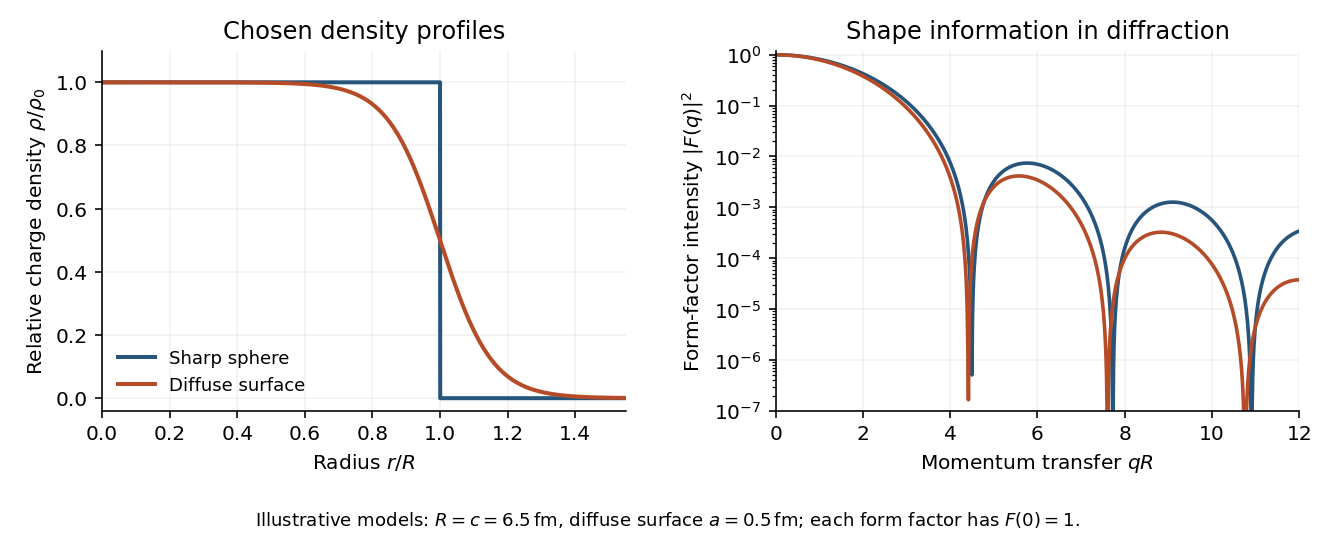
Original sharp-edge and diffuse nuclear charge models, showing how a surface profile changes the nuclear charge form factor
. Details. 
Complementary probes. Transition energies in a muonic atom are especially sensitive to nuclear size because the heavy negative muon orbits close to the charge. Electronic isotope shifts, after separating nuclear-mass and finite-size contributions, measure changes in . Both require atomic-structure calculations. Electromagnetic excitation and transition strengths constrain deformation and charge multipoles. Hadronic scattering can also constrain nuclear dimensions, but carries uncertainties from the strong interaction and probes matter rather than purely electric charge.
Past exam of the particle and nuclear physics course of the University of Cambridge 2017 1 c Solution Created 2026-10-18 Updated 2026-10-20
For negligible final fermion masses, the chiral Z-boson partial width is proportional to . Both channels have one color state. An electron has , and , givingFor one active neutrino species, , and there is no coupled right-handed neutrino field, so , . The common coupling normalization and phase space cancel in the ratio:The same total decay width appears in the two branching fractions, soThere is no factor of three for a single specified flavour. Summing three active neutrino flavours would give an invisible branching fraction of approximately in this approximation.
The separate proton and neutron shell capacities are . Filled shells and paired particles have zero net spin and magnetic dipole moment. The single-particle nuclear magnetic moment is , with orbital factors , and .
For nitrogen, the eight neutrons form a closed shell. The seventh proton occupies , so , and the Landé g-factor givesHence the nuclear shell model predictsIts single-particle spin and parity is . The negative moment results from the proton spin being predominantly opposed to the total angular momentum in this level.
For oxygen, eight protons and the first eight neutrons are paired. The ninth neutron occupies , with , . Since its orbital factor is zero, . ThereforeThese are ideal single-particle predictions in units of the nuclear magneton, not fits incorporating nuclear configuration mixing.
Use the inverse beta decay threshold, with the charged-lepton mass generalized to . For a stationary proton and a massless incident antineutrino, the Mandelstam invariant is . At threshold the final particles have no relative momentum in their centre-of-momentum frame, so . ThereforeUsing the supplied, rounded masses givesThe second term is the recoil correction; setting the threshold equal just to the final rest-mass excess would miss it.
Reactor electron antineutrinos have energies of a few million electronvolts. They can produce a Positron through inverse beta decay above the first threshold, but cannot produce a muon. Thus reactor neutrino oscillations are measured primarily as electron-antineutrino disappearance, through the event rate and energy spectrum relative to the unoscillated prediction. An oscillated muon antineutrino cannot be identified by the proposed muon-production channel at reactor energies; disappearance alone does not distinguish all possible final flavours.
There are unlisted articles, also show them or only show them.