
Particle decay cascade 2026-10-18
A particle decay cascade follows successive unstable daughters to longer-lived or stable particles. Probabilities of specified independent decay paths multiply their branching fractions. Waiting times are governed by each particle's mean lifetime, with time dilation relating proper and laboratory times. A particle which appears stable on one observation timescale can be an intermediate on another.
Leptonic decay 2026-10-18
Nonleptonic meson decay 2026-10-18
A nonleptonic meson decay contains final hadrons and no final leptons. Weak quark transitions set flavour factors, but strong hadronization and additional hadronic matrix elements are needed to determine exclusive rates.
Nonleptonic baryon decay 2026-10-18
A weak interaction decay of a baryon into final hadrons without final leptons. A weak charged current changes quark flavour, while spectator quarks and the produced quarks undergo hadronization. A quark-flow Feynman diagram specifies a possible weak topology; it does not calculate the full hadronic decay amplitude.
Relativistic three-body decay Created 2026-10-18 Updated 2026-10-20
A particle decay into three daughter particles subject to four-momentum conservation and the relativistic energy-momentum relation. The daughter energies generally vary continuously even in the parent's rest frame. Grouping two daughters into a recoil system of variable invariant mass turns the remaining kinematics into a relativistic two-body decay.
Anode ray 2026-10-18
A stream of positive ions in a gas discharge. Historical canal rays pass through holes in the cathode; collisions can also produce moving neutral chemical atoms.
Ion source Created 2026-10-18 Updated 2026-11-05
An ion source produces ions for a beam or another experiment. Ionization changes the charge state of an atom or molecule; an applied electric field can then extract charged particles into a transport region. The resulting particle beam depends on the ionization mechanism, extraction geometry and the distribution of initial positions and velocities.
One arrangement uses an electron beam to ionize a gas and an electrode voltage to extract the products. Surface ionization is another mechanism: suitable atoms can leave a hot surface as ions, as in the surface ionization detector. Producing an ion and identifying its species are separate operations, so a source may need downstream mass spectrometry or other selection when several charged species are present.
Particle flux 2026-10-18
Here particle flux means the number of particles crossing a surface per unit area and unit time, with the area taken perpendicular to the incident particle beam. Multiplying by the target interaction cross section gives an event rate per target particle in the ideal independent-target model.
Neutrino beam Created 2026-10-18 Updated 2026-11-05
A particle beam dominated by neutrinos. Accelerator beams can use particle decay of focused charged pions and kaons, followed by shielding that suppresses other beam components.
Beam cooling 2026-10-18
Beam cooling reduces random deviations around a beam's reference motion, such as its momentum spread and transverse spread. A highly energetic beam can be cool in this sense: its large common directed kinetic energy is distinct from the spread. Concentrating the occupied phase space helps accumulated particles fit the next machine's acceptance. Stochastic cooling achieves this through measured beam fluctuations and feedback control.
Super Proton-Antiproton Synchrotron 2026-10-18
The Super Proton-Antiproton Synchrotron used the converted SPS ring for counterrotating proton and antiproton beams. In the discovery running, two beams provided , unlike a stationary-target collision at the same incident energy. Antiproton production, accumulation and stochastic cooling supplied the collisions used in the W and Z discovery experiments.[ref]
Experimental Observation of the Intermediate Vector Bosons W+, W− and Z0 by Carlo Rubbia. Section 3, printed p.247 and Fig.5: counterrotating beams, accumulation and SPS conversion
Why can opposite electric charges share the bending magnets? Reversing both and velocity leaves the Lorentz force unchanged at a given point. Both circulating species can therefore bend toward the same ring center in the same magnetic field, with equal magnetic rigidity magnitudes. This argument explains the bending geometry; actual injection, focusing, timed acceleration and collisions still require a complete particle accelerator system.
Accelerator technician Created 2026-10-18 Updated 2026-11-05
An accelerator technician supports the construction, alignment, operation and maintenance of a particle accelerator and its subsystems. Vacuum equipment, magnets, electrical power, radio-frequency systems and diagnostics must work together to maintain a specified beam.
A beam-loss observation can have several causes, so troubleshooting compares instrument signals with the expected transport and timing. Reliable measurements and documented subsystem behavior are part of making accelerator experiments reproducible.
Electrostatic accelerator 2026-10-18
An electrostatic accelerator gives a charged particle kinetic energy by taking it through a sustained electric potential difference. Its ion source, accelerating tube and target form a particularly direct chain: prepare a charge, let an electric field do work, and measure what arrives or what the target emits. A vacuum reduces collisions with gas before the beam reaches its target. The Cockcroft-Walton generator supplies the potential by accumulating electric charge on capacitors.
Cyclotron 2026-10-18
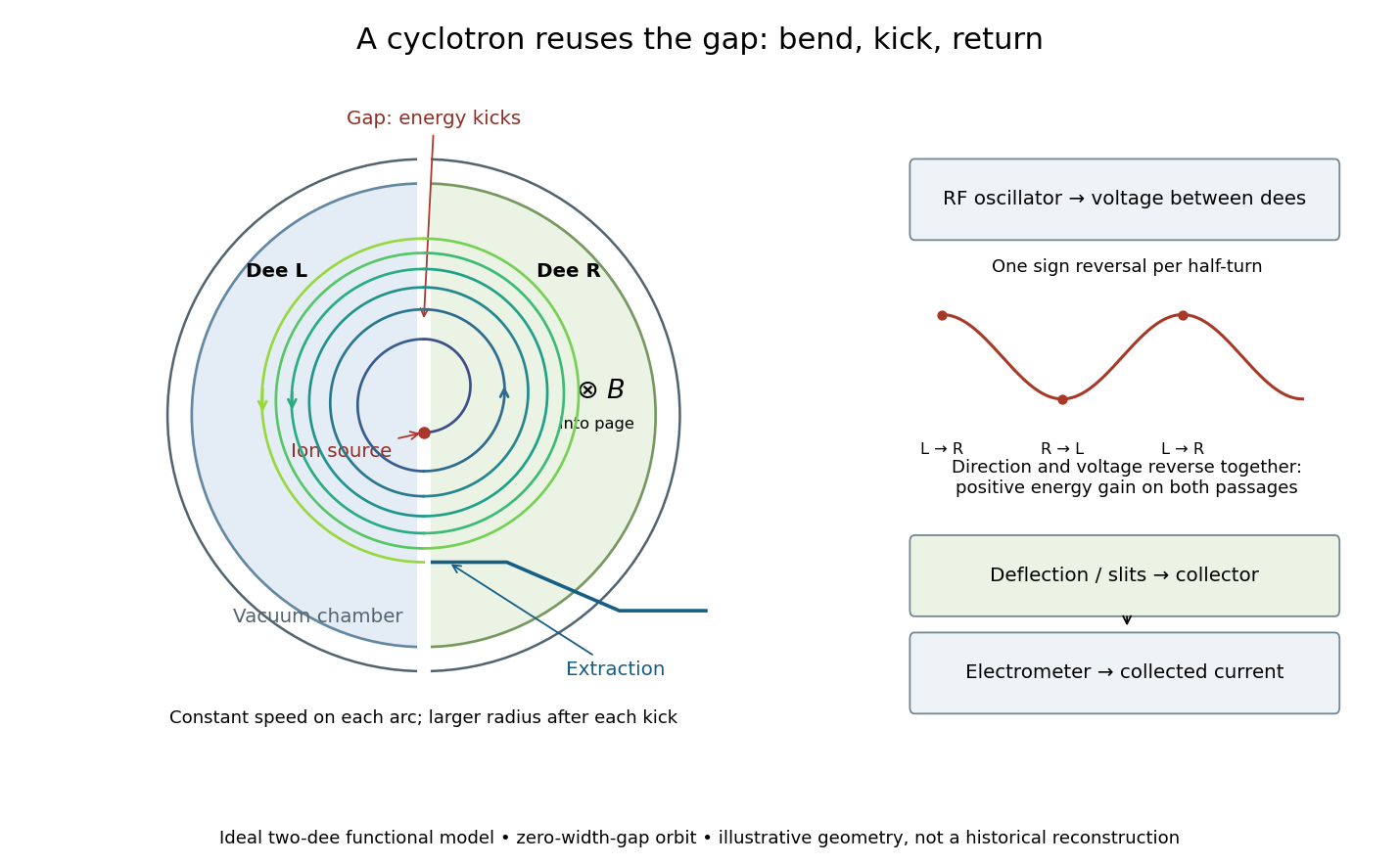
A cyclotron repeatedly passes ions through an alternating electric field between two hollow electrodes called cyclotron dees. A nearly uniform magnetic field perpendicular to their plane bends the charged particles back toward the gap. Inside each cyclotron dee, ideal shielding suppresses the accelerating electric field, so each segment is a constant-speed circular motion. The next gap crossing increases the speed and the radius of curvature. The complete path consists of connected, progressively larger arcs, rather than one circle or a smooth spiral with continuous acceleration everywhere.
The striking feature is a timing cancellation: the longer arc traveled by a faster particle takes the same time. This cyclotron resonance condition lets one fixed radio frequency accelerate many successive gap crossings. The following construction and cyclotron energy and orbit radius example describe an ideal model; the Lawrence-Livingston cyclotron experiment explains what the builders actually measured.

Linear particle accelerator 2026-10-18
A particle accelerator in which a beam gains kinetic energy along a substantially straight sequence of accelerating structures.
Bevatron Created 2026-10-18 Updated 2026-11-05
The Bevatron was a proton synchrotron at Berkeley. Its circulating beams supplied high-energy protons to fixed targets, producing secondary particles that could be selected and measured downstream. It played a central role in the 1955 discovery of the antiproton. [ref]
https://newscenter.lbl.gov/2005/10/27/the-golden-anniversary-of-the-antiproton/. Berkeley Lab, The Golden Anniversary of the Antiproton: Bevatron proton beam and secondary-particle experiment
A fixed target makes the production threshold more demanding than simply supplying the new particle's rest energy: conservation of momentum requires outgoing motion, and conserved quantum numbers require accompanying particles. This is why accelerator beam energy, collision center-of-mass energy and produced-particle kinetic energy are different quantities.
Synchrotron 2026-10-18
Large Hadron Collider Created 2026-10-18 Updated 2026-11-05
The Large Hadron Collider is a particle accelerator at CERN using two counter-circulating beams in a roughly 27-kilometre underground ring. It collides protons and can also operate with heavy ions. Superconducting magnets steer and focus the beams, while radiofrequency electric fields add energy along their direction of motion.[ref]
Large Hadron Collider by CERN. Accelerator description: ring, beam types, magnets and accelerating structures
The functional division matters: an ideal static magnetic field bends a particle's momentum without doing work, while the accelerating electric field changes its kinetic energy. ATLAS experiment and Compact Muon Solenoid surround collision points and reconstruct outgoing products; the accelerator itself supplies the incoming beams rather than measuring every final particle.
Work by Paloma Alameda-Meléndez 2026-10-18
Depletion region 2026-10-18
An illustrative abrupt-junction depletion approximation assumes uniform, fully ionized donor impurities and acceptor impurities, negligible mobile space charge in the depleted layer, and permittivity . For area , doping number densities and built-in electric potential difference , it givesHere is the elementary charge and is positive for forward bias. Increasing both doping densities reduces in this estimate. That explains the preparation strategy for a tunnel diode; it does not make this sharp-depletion approximation a precise microscopic model of a degenerate semiconductor.
There are unlisted articles, also show them or only show them.