
Quartz Created 2026-10-14 Updated 2026-11-05
Quartz is a crystalline form of silicon dioxide, . Its ordered structure distinguishes it from amorphous silica glass.
It is piezoelectric material: suitable mechanical deformation changes electric polarization. Quartz resonators exploit the reproducible mechanical resonance of a shaped crystal to stabilize an oscillator, linking crystal symmetry with time and frequency measurement.
Semipermeable membrane Created 2026-10-14 Updated 2026-10-20
A semipermeable membrane ideally passes the solvent while excluding the specified solutes. In the aqueous osmosis model below, water can cross but the counted dissolved particles cannot. Real selective permeability is often a matter of different rates, so this idealization needs checking over the measurement interval. Neither an impermeable sheet nor a freely mixing opening realizes this model.[ref]
Sodium carbonate Created 2026-10-14 Updated 2026-11-05
Sodium carbonate is , a sodium salt of carbonate. In water its carbonate ion accepts protons, producing a basic solution.
Calcium carbonate Created 2026-10-14 Updated 2026-11-05
Calcium carbonate is , occurring in crystal forms including calcite and aragonite. It is a major constituent of many rocks and biological hard structures.
Reaction with acid releases carbon dioxide. The balance between dissolved carbonate species and solid calcium carbonate depends on pH and carbon-dioxide conditions, connecting mineral dissolution with aqueous equilibrium chemistry.
Potassium cyanide Created 2026-10-14 Updated 2026-11-05
Potassium cyanide is the salt , containing potassium and cyanide ions. The cyanide carbon-nitrogen unit is distinct from a covalently attached nitrile group in an organic molecule.
Cyanide can act as a nucleophile and a ligand, while protonation changes it into hydrogen cyanide. Its reactions therefore depend on both coordination chemistry and acid-base speciation.
Zinc sulfate Created 2026-10-14 Updated 2026-11-05
Zinc sulfate is , commonly occurring as hydrated crystals. Zinc is predominantly in oxidation state , balancing sulfate.
On dissolution, the ions are solvated and may participate in complexation or hydrolysis equilibria. Specifying the hydrate is necessary for chemical-amount calculations based on a weighed sample.
Work by Sabrina Maniscalco Created 2026-10-14 Updated 2026-10-31
Rotational Raman spectroscopy 2026-10-14
Rotational Raman spectroscopy observes a frequency change of scattered light associated with molecular rotation. The coupling uses the induced electric dipole moment, , where is the electric polarizability tensor. For a linear molecule, the useful anisotropy is : the response differs for an electric field parallel or perpendicular to the molecular axis. A permanent electric dipole moment is not required.[ref]
Absorption lineshapes by Andrei Tokmakoff. Andrei Tokmakoff, §6.2, printed pp. 6-7–6-8, equations (6.40)–(6.44): induced dipole, polarizability tensor and rotational Raman response
For the spin-free linear rigid rotor in one internal quantum state, the anisotropic tensor depends quadratically on the molecular direction. Its angular part has even parity and degree two in spherical harmonics. The triangle inequality for coupled angular momenta permits , and even parity removes odd , leaving . The contribution is unshifted light; shifted rotational lines have . Consequently the rigid-model Stokes shifts, in ordinary frequency units, areSuccessive allowed shifts are separated by , rather than the absorption spacing of pure rotational electric-dipole selection rules. In spectroscopic wavenumber units replace by and by , using the speed of light in for .
A homonuclear diatomic molecule such as molecular hydrogen has no permanent electric dipole moment in its symmetric internal state, so it lacks the ordinary electric-dipole microwave ladder. Its anisotropic electric polarizability can nevertheless give rotational Raman spectroscopy lines. Nuclear-spin symmetry can change the populations of even and odd levels, so the spin-free population example above must not be reused unchanged for molecular hydrogen. The method of coupling, as well as the energy eigenvalues, determines what the experiment can see.
Recovering molecular geometry from rotational constants is an inverse problem. In the synthetic assignment, gives . For a diatomic molecule with known masses, rotational constant explains how to infer an effective bond length. For a longer linear molecule, one cannot determine every bond length: several different arrangements can have the same moment of inertia.
For a fixed three-atom linear model with positions and positive masses , subtracting the centre of mass givesThis is one equation for two unknown bond lengths. Even fixing the order of the chemical atoms leaves a family of solutions. Additional isotope substitutions change known masses and supply independent equations, provided the effective molecular geometry can be treated as shared. For nonlinear molecules, three principal moments of inertia give frequency-valued constants , , and ; a single evenly spaced comb is generally insufficient.
Vibrational averaging, unresolved hyperfine structure, internal motion, and centrifugal distortion limit structural inference. A ground-vibrational fitted rotational constant is not automatically the equilibrium constant. Ordinary field-free rotational spectroscopy also gives identical spectra for opposite enantiomers under the usual parity-symmetric molecular Hamiltonian; assigning composition and conformation does not by itself determine handedness. Molecular identification from a rich fingerprint can therefore succeed even when a unique full molecular geometry cannot be reconstructed.
Rotational state populations 2026-10-14
For the spin-free linear rigid rotor in thermal equilibrium at temperature , assume all integer are allowed and ignore nuclear-spin restrictions. Each level has quantum states sharing one energy eigenvalue, an instance of degenerate energy levels, so the Boltzmann distribution givesHere is a rotational partition function, the Planck constant, the Boltzmann constant, and a frequency in . Thus is dimensionless. The factor counts magnetic quantum numbers; it does not mean that a whole level is one quantum state. For the stipulated , the most populated levels are at and at .
Population alone is insufficient to predict intensity. In weak, unsaturated absorption, the integrated absorption coefficient includes the transition frequency, the squared electric dipole moment matrix element, and the difference of lower and upper substate populations because stimulated emission returns energy to the field. A pulsed FTMW spectroscopy signal additionally depends on excitation, quantum coherence, cavity tuning, and receiver response.[ref]
Absorption lineshapes by Andrei Tokmakoff. Andrei Tokmakoff, §§6.1–6.2, printed pp. 6-2–6-6, equations (6.8)–(6.10), (6.27)–(6.29): population difference and rotational dipole matrix elements
For an isotropic sample with polarization of an electromagnetic wave along , write . Normalized spherical harmonics giveThe last equality follows from . Combining this sum with the per-substate Boltzmann distribution and subtracting stimulated emission gives relative integrated absorption areasThe common factor includes and cancels upon normalization. This formula describes integrated weak absorption in a thermal, spin-free linear rigid rotor, not arbitrary peak heights. The example's strongest integrated lines originate at and for and , respectively: they differ from the most populated levels. A missing line can reflect population, coupling, coverage, or sensitivity; it does not prove that the corresponding quantum state is absent.
Rotational spectral line assignment Created 2026-10-14 Updated 2026-10-20
A rotational spectral line assignment associates a measured spectral line with a molecule, an internal quantum state, and an initial and final set of quantum numbers. For the spin-free linear rigid rotor, absorption is labelled . A regularly spaced group suggests a candidate rotational constant, but the lowest line inside a scanned band need not be . Several molecules can contribute to the same spectrum, and an apparent missing member can lie outside the band or below the detection threshold.
First determine line centers and their uncertainties from the instrument's readout, accounting for resolved Doppler shifts or hyperfine structure rather than treating every peak as a separate rotational transition. Then propose integer assignments, fit a rotational Hamiltonian, and predict additional spectral lines. For a weakly distorted linear molecule within one vibrational quantum state, the centrifugal distortion model gives the useful diagnosticHere are all frequencies in . Correct assignments make the second expression a straight line against , with intercept and slope . This follows by division of the transition formula; no additional model of molecular geometry is required. A direct weighted least squares fit of to uses the measured uncertainties. If instead the transformed values are fitted, their uncertainties must also be divided by .[ref]
For an original example, stipulate and , and suppose a scan covers –. The model places four consecutive transitions at , , , and . Their assignments are , hence . An extra stipulated line at is unrelated to this series. All these frequencies are calculated example inputs, not measured OCS data.
At and , the transformed values are and . Their straight line has slope , recovering and . Both intermediate transitions satisfy the same line exactly. Merely relabelling the first visible transition fails this diagnostic. The model predicts a withheld transition at : an additional measurement there would test the assignment rather than merely refit the original four lines.
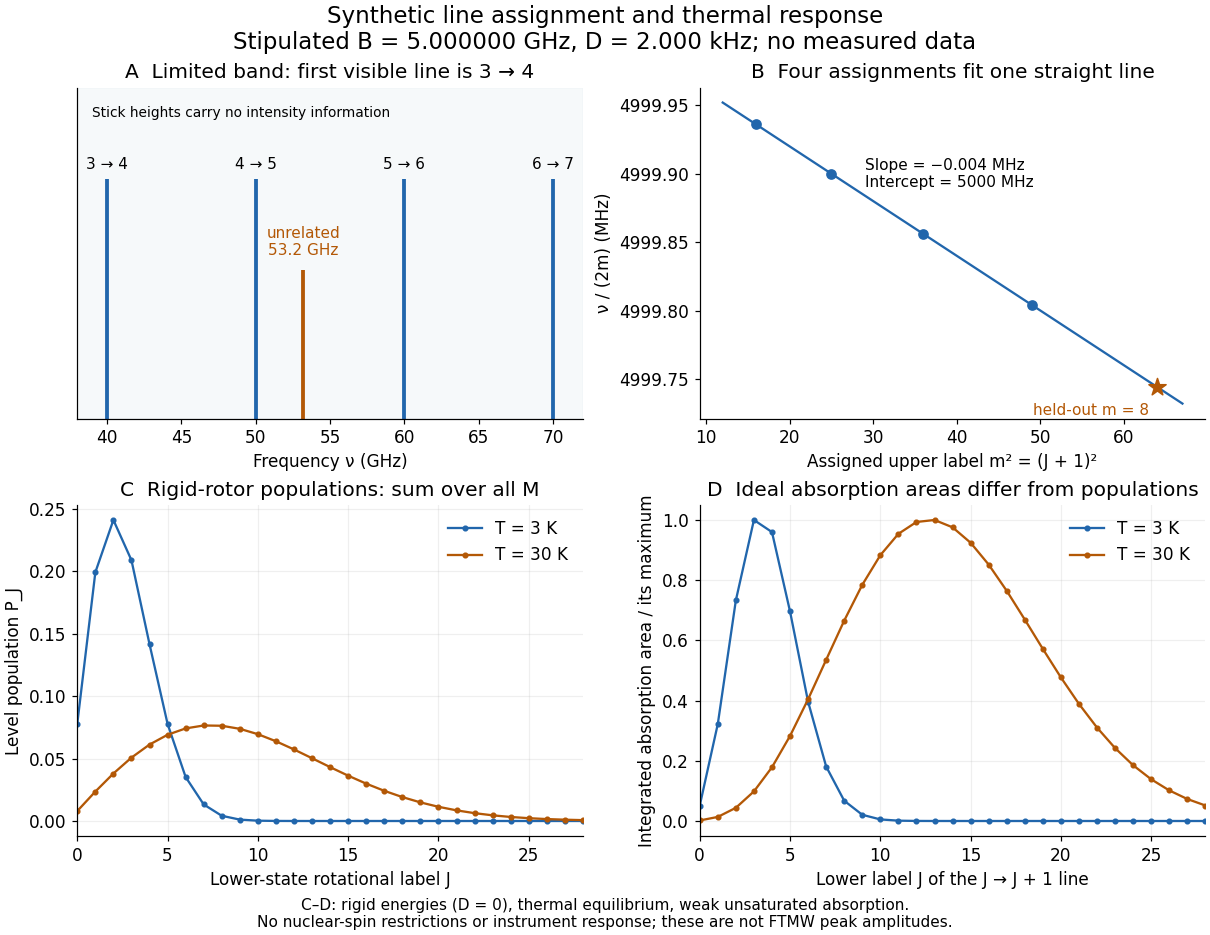
Original synthetic rotational spectral line assignment, fit diagnostic, and rotational state populations
. Stipulated values, not measured data. Upper panels use and ; stick heights show positions only. Lower panels independently use the linear rigid rotor with the same , , and temperatures and . Rotational state populations and ideal integrated absorption areas are different quantities; each absorption curve is normalized separately. Neither is a predicted pulsed FTMW spectroscopy peak amplitude. Details.
An assignment earns confidence when several independently observed spectral lines, including lines outside the fitted interval, agree within uncertainty and expected strong accessible lines are present. Inspect the residual of an inverse problem for each line against : systematic curvature can signal inadequate centrifugal distortion, whereas isolated discrepancies suggest a blend or wrong assignment. Comparing a known sample, a blank, and an isotope shift of a linear rotor supplies different checks. These are general inference controls; the actual reported controls of the NIST trace-gas FTMW validation experiment are described separately. One isolated match or one fitted rotational constant alone cannot certify molecular identity.
Work by Rodolfo Ruben Rosales 2026-10-14
Work by Robbert Fokkink 2026-10-14
Work by Richard W. Deibler 2026-10-14
Work by Richard W. Cole 2026-10-14
Complementary DNA 2026-10-14
Complementary DNA is DNA made from an RNA template by reverse transcription. When its template is mature messenger RNA, its sequence reflects the processed transcript rather than every intervening intron in the corresponding gene.
Reverse transcriptase 2026-10-14
Respirometer gas balance 2026-10-14
For an original idealized mathematical model, let be the amount of substance of molecular oxygen consumed since the initial reading and the carbon dioxide produced. Suppose a fraction of that carbon dioxide is removed from the gas, all other gas inventories remain fixed, and temperature and gas pressure stay constant. The ideal gas law gives the positive gas contractionwhere is the molar gas constant and the gas volume. With complete absorption, , the contraction reflects molecular oxygen uptake regardless of the amount of carbon dioxide made. For a uniform pipette bore of area , an inward boundary displacement gives . A graduated pipette can instead supply the displaced volume directly.
Let denote sample contraction and the matched blank contraction. Define with both taken relative to their own initial readings. Under the preceding assumptions,The slope of corrected volume against time estimates uptake over the chosen interval. The approximate sign acknowledges that a liquid boundary also responds to hydrostatic and capillary pressure, while the gas can exchange water vapour. A fixed-volume apparatus would instead show a pressure decrease; its ideal conversion is after complete absorption and appropriate blank correction.
The ideal gas law also exposes drift without any biology: for fixed gas inventory, . A one-percent rise in absolute temperature at fixed pressure produces a one-percent expansion. Matching the initial gas spaces makes such common changes easier to subtract. Subtracting unmatched blanks can leave a physical signal that looks biological.
Pea seed respirometry 2026-10-14
The University of Oklahoma K20 Center's handout describes three sealed vial-and-pipette respirometers in each temperature bath: soaked, germinating peas; nongerminating peas plus inert plastic beads; and beads alone. Displaced water establishes equal occupied volumes. Absorbent cotton holds potassium hydroxide, which removes carbon dioxide; nonabsorbent cotton separates it from the peas. The source equilibrates the vials before submersion and again before the initial reading. Colored water makes the boundary visible in each calibrated pipette. Readers then record positions every five minutes for twenty minutes.[ref]
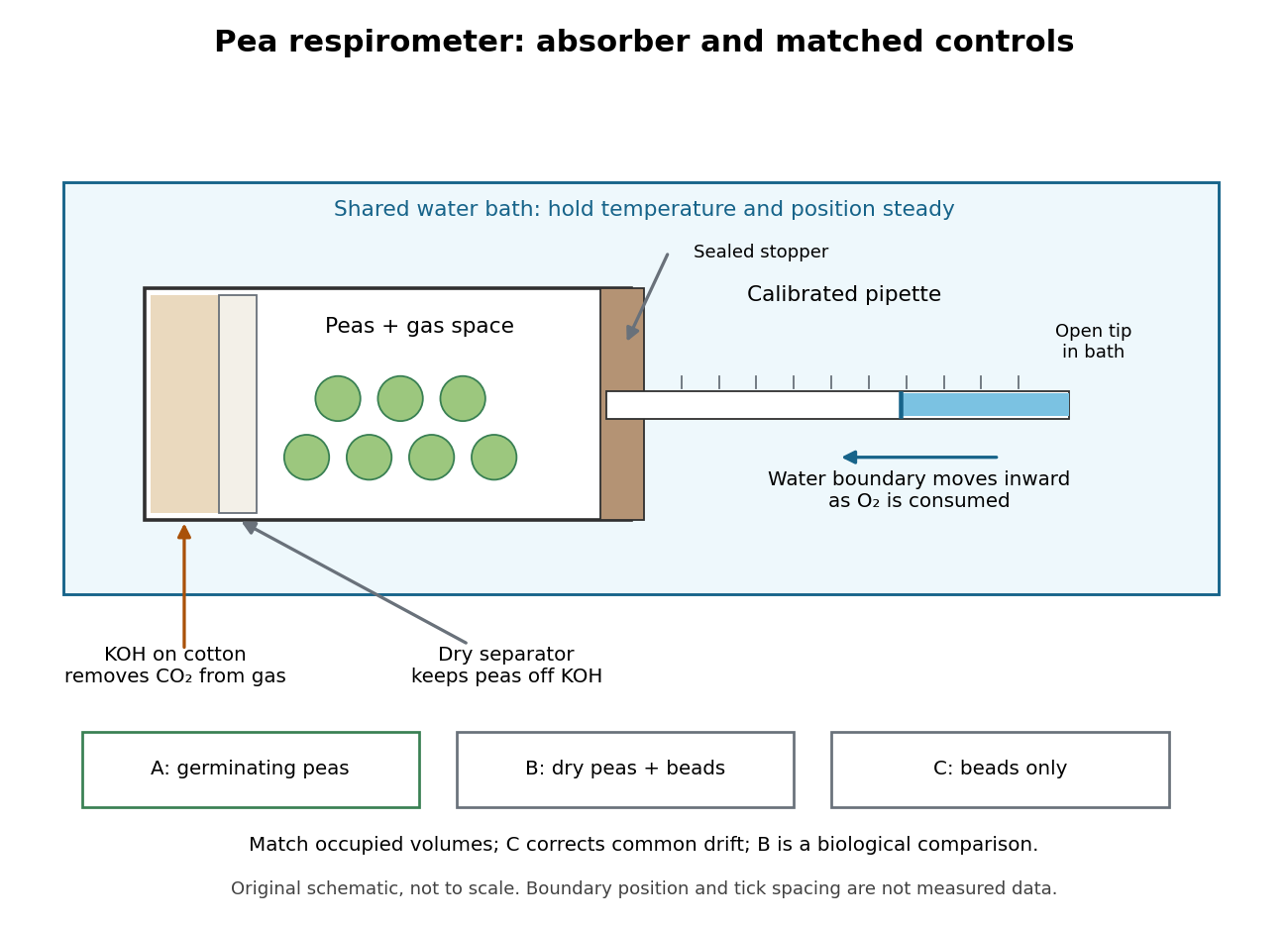

Bath temperature, vial position and seal integrity matter. The beads-only respirometer detects common temperature or atmospheric pressure drift; its change is subtracted from each pea reading. Nongerminating peas provide a biological comparison, not an assumption of zero cellular respiration. A larger corrected uptake slope for germinating peas would support greater molecular oxygen consumption by that sample under the tested conditions.[ref]
Cell Respiration by the K20 Center. Cell Respiration, pp. 1, 3–4 and 6: living dormant seeds, position/leaks, corrected differences and slope
Equal displaced volumes help match the gas spaces; they do not establish equal living mass or equal developmental state. Comparing uptake per seed and uptake per dry mass asks different questions. Leaks, incomplete carbon dioxide absorption, gas dissolution and changing water-vapour contributions can distort the respirometer inference. A blank correction cannot repair a sample-specific leak. These are consequences of the respirometer gas balance, rather than measurements reported in the handout.
Respirometry Created 2026-10-14 Updated 2026-11-05
Respirometry measures gas exchange associated with metabolism, commonly oxygen consumption or carbon-dioxide production. In a closed chamber, the change in gas amount over time can estimate a rate after correcting for chamber volume, background and temperature. Flow systems instead compare incoming and outgoing gas. A measured oxygen flux reports aggregate oxidative activity under the stated conditions; it does not uniquely identify which fuel or individual reaction produced it. [ref]
Respiratory enzymes in oxidative phosphorylation. I. Kinetics of oxygen utilization by Britton Chance and G. R. Williams. 1955, recording oxygen utilization and respiratory states
There are unlisted articles, also show them or only show them.