
PCR efficiency 2026-10-14
For a stipulated population of amplifiable copies, let be the amount after cycle and define PCR efficiency by the fractional new yieldHere means one additional copy per existing copy, hence ideal doubling. If every cycle has the same PCR efficiency , the exponential growth model gives . Starting with copies, twenty ideal cycles give copies; the stipulated value gives about . An efficiency of 80 percent therefore means multiplication by 1.8 each cycle, not retention of 80 percent of the final ideal yield.
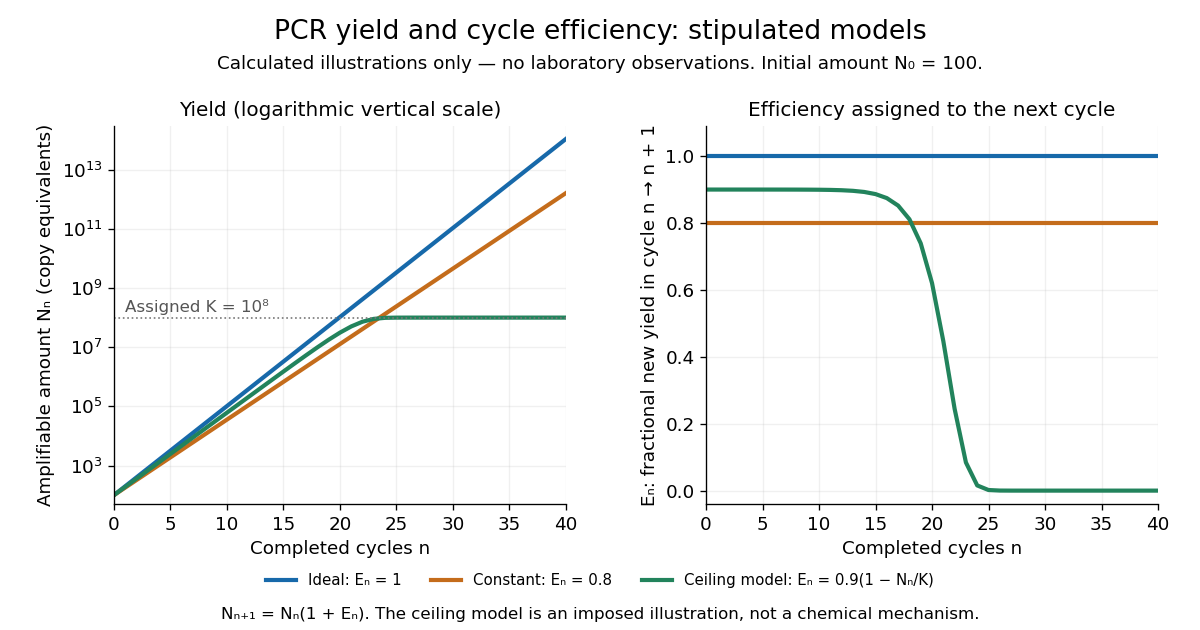
In the ideal strand-counting example, all duplex-equivalent material doubles, but exact-length amplicons lag initially. Starting from one longer duplex and retaining its two original strands, cycle contains exact-length strands out of total strands. Thus their fraction is : zero after cycle 1, one quarter after cycle 2 and one half after cycle 3. This counts strands rather than assuming every strand immediately finds an exact-length partner. The generic yield model above ignores this early distinction.
Thermal cycler 2026-10-14
A thermal cycler changes the temperature of reaction tubes through a programmed sequence. A heated lid can reduce evaporation and condensation above the reaction. Instrument timing, sample temperature and nominal block temperature need not be identical.
PCR thermal cycle Created 2026-10-14 Updated 2026-10-18
A PCR thermal cycle separates three jobs. During PCR denaturation, heating separates the paired DNA strands without intentionally cutting their phosphodiester bonds. During PCR annealing, cooling permits base pairing between PCR primers and templates. During PCR extension, the chosen interval supports DNA polymerase synthesis from the paired ends. Each new nucleotide is supplied as a deoxynucleoside triphosphate; its incorporation lengthens the strand. The DNA polymerase is a catalyst, while these nucleotides are consumed substrates.[ref]
Principles of PCR by Thermo Fisher Scientific. Principles of PCR, accompanying description: denaturation, annealing, primer-dependent extension and dNTP incorporation
Taq polymerase withstands repeated high-temperature strand separation better than a heat-sensitive DNA polymerase. Its extension activity still depends on temperature, buffer solution and magnesium ions. Heat resistance does not mean constant activity at every stage: the separation temperature serves the DNA, whereas the extension temperature serves the copying enzyme. As one institutional example, Addgene's Basic PCR Program specifies separation, primer binding and extension. These are example settings, not universal properties of all PCR primers or DNA polymerases.[ref]
Polymerase Chain Reaction (PCR) by Addgene. Basic PCR Program, steps 1–6; Materials List: Taq buffer with magnesium chloride
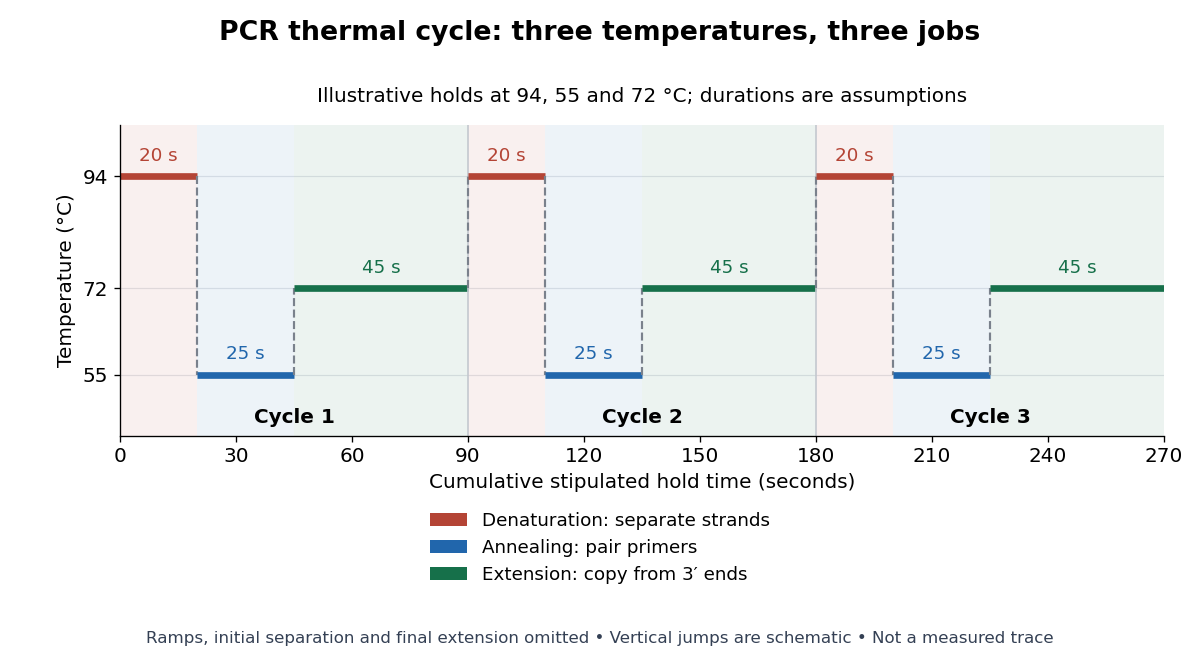
For timing arithmetic alone, those stipulated holds give per PCR thermal cycle, and three cycles give . Adding an assumed initial separation and final extension gives of holds. A real thermal cycler also takes time to move between temperatures. The schedule tells us when conditions favour PCR denaturation, PCR annealing or PCR extension; it does not measure the fraction of DNA copied.
An actual institutional protocol makes the distinction concrete. New England Biolabs specifies mixing templates and PCR primers with its OneTaq master mix in a thin-walled tube; a quick spin collects liquid at the bottom. Its preparation uses of the twice-concentrated mix and of each PCR primer stock, with water completing the volume. Tubes enter a thermal cycler preheated to ; mineral oil is specified if there is no heated lid. The program gives thirty cycles of separation, – binding and extension, with extension time scaled to product length. The binding setting must be selected for the PCR primers; the range is not a continuously swept setting.[ref]
Protocol for OneTaq 2X Master Mix with Standard Buffer by New England Biolabs. Protocol, Reaction setup steps 1–2, 25 microlitre table and Thermocycling conditions; General Guidelines, Annealing and Extension
The dilution can be checked independently: each PCR primer has final concentration , while the mix is diluted twofold. For an endpoint readout, Addgene specifies examining a product aliquot by gel electrophoresis.[ref]
Polymerase Chain Reaction (PCR) by Addgene. Procedure, Primer Design and PCR step 13: run 2 microlitres on a gel
Pair that size comparison with the existing PCR controls: a known template and a no-template tube test different explanations of success or failure. Those comparisons are an analytical addition, not controls documented in the OneTaq schedule. An expected-sized band supports production of a length-compatible amplicon; it does not establish its nucleotide sequence, ideal PCR efficiency or successful separation during every cycle. Neither protocol supplies a measured temperature or yield curve for the schematic above. Amplicon 2026-10-14
An amplicon is a nucleic acid product of amplification. In ordinary PCR amplification without added primer tails, its boundaries eventually correspond to the outer ends of the two PCR primer binding sites. First-cycle extensions on long starting templates can run beyond the opposite site; exact-length single strands appear in cycle 2 and exact-length duplex products in cycle 3 under complete extension. This explains why the bounded product becomes dominant even though the initial extensions need not have its length.
PCR primer Created 2026-10-14 Updated 2026-10-20
A PCR primer is a short DNA strand that supplies a paired end for a DNA polymerase. Its nucleotide sequence determines where base pairing can initiate copying. Matching a PCR primer at one site is insufficient: both PCR primers must support opposed extension across a copyable interval for sustained selective PCR amplification.
Self-pollination Created 2026-10-14 Updated 2026-11-05
Self-pollination transfers pollen within one plant, either within a flower or between its flowers. It describes the transfer step, whereas self-fertilization requires successful fusion of gametes from the same individual.
A self-incompatibility system can prevent a self-pollination from yielding successful fertilization. Observing pollen on a stigma therefore does not by itself establish which parent produced a later seed.
Cross-pollination Created 2026-10-14 Updated 2026-11-05
Transfer of pollen between different individuals of the same species; compare self-pollination.[ref]
32.2 Pollination and Fertilization. Biology 2e, §32.2 opening paragraphs: self-pollination and cross-pollination
A flower can contain both reproductive groups and still receive pollen from another individual. Conversely, transfer between two flowers on one plant does not by itself imply cross-pollination. Following the donor and recipient individuals makes pollination useful for studying genetics: organ position alone cannot identify whose alleles meet at fertilization.
Angiosperm 2026-10-14
Plant tissue Created 2026-10-14 Updated 2026-11-05
A grouping of biological cells in a plant with related functions. In a seed, plant embryo tissues and endosperm have distinct developmental identities.
Leaf Created 2026-10-14 Updated 2026-11-05
A leaf is a plant organ commonly specialized for light capture and photosynthesis, with internal transport and regulated surface exchange. Modified leaves can instead emphasize storage, protection or other functions. A cotyledon is an embryonic leaf, so function alone does not define organ identity.
Root (botany) Created 2026-10-14 Updated 2026-11-05
Lettuce Created 2026-10-14 Updated 2026-11-05
Lettuce, Lactuca sativa, is a flowering plant grown for its leaves and used in studies of germination. In the lettuce red and far-red germination experiment, responses to successive light treatments helped distinguish photoreceptor state from a simple cumulative light dose.
Fresnel diffraction Created 2026-10-14 Updated 2026-10-18
Fresnel diffraction describes diffraction when the quadratic propagation wave phase across an aperture must be retained. Its Fresnel propagator becomes the Fraunhofer diffraction description when that curvature is negligible.
A Fresnel diffraction pattern is a map of how propagation changes the wave interference of light from an aperture. It can resemble the opening, develop bright and dark structure near its edges, and eventually approach a Fraunhofer diffraction pattern. The controlling comparison involves wavelength, opening size and propagation distance together; a distance large compared with the opening need not give the far field.
For a monochromatic wave, use time dependence , wavenumber and complex amplitude . Let be the transmitted field immediately behind an aperture in the plane . In a homogeneous medium, the scalar paraxial approximation givesThis is the two-transverse-coordinate Fresnel propagator, with its carrier restored. It adds complex amplitudes before taking their squared complex modulus to obtain light intensity. It is a scalar paraxial approximation, rather than a full vector solution of Maxwell equations.[ref]
Scalar Diffraction Optics. Interactive Optics by Sander Konijnenberg, Aurèle J.L. Adam and H. Paul Urbach; Fresnel Approximation, equations (381)–(385), and the following paraxial-wave-equation remark
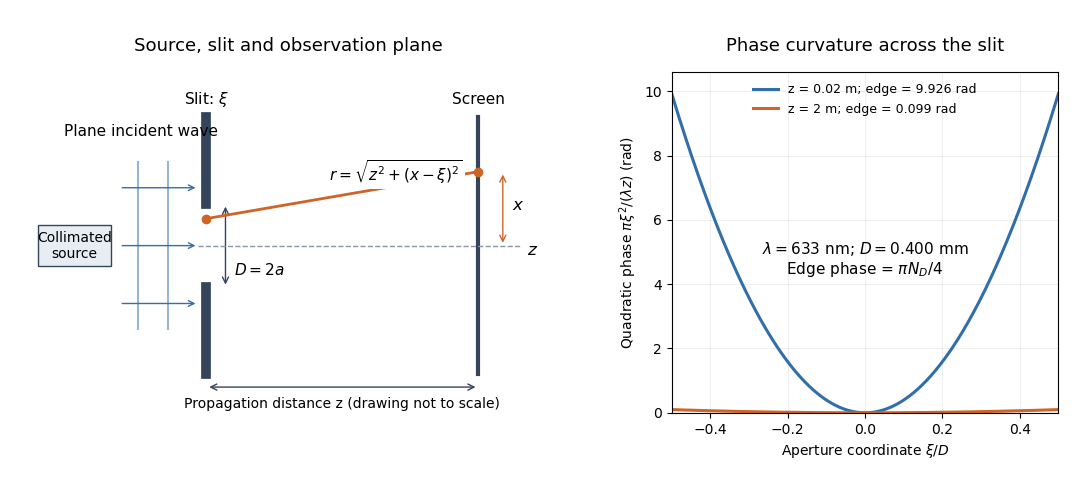


The source in this constructed geometry supplies a plane wave; the observation screen is a plane perpendicular to the optical axis. The right panel isolates the aperture-dependent wave phase that distinguishes Fresnel diffraction from Fraunhofer diffraction. Its vertical scale is in radians, and the drawing's lengths are schematic.
Keeping this wave phase is useful when transporting a field between nearby optical components: both the shape and the complex amplitude matter for subsequent wave interference. A particularly striking feature is that propagation can create a dark centre even from a uniformly illuminated symmetric aperture; the incident wave amplitudes need not be unequal for their outgoing contributions to cancel.
Phosphatidylinositol 4,5-bisphosphate Created 2026-10-14 Updated 2026-11-05
Phosphatidylinositol 4,5-bisphosphate is a membrane phospholipid whose inositol headgroup bears additional phosphate groups at positions 4 and 5. Its charged headgroup interacts with membrane-associated proteins.
Cleavage of phosphatidylinositol 4,5-bisphosphate generates membrane-associated diacylglycerol and soluble inositol trisphosphate. These products act as second messengers, connecting a change in a membrane lipid with intracellular signal transduction.
Work by Philip McCord Morse 2026-10-14
List of pharmacologists 2026-10-14
Work by Peter Ljunglöf 2026-10-14
Work by Peter G. Doyle 2026-10-14
Work by Paul Russell 2026-10-14
Work by Pamela M. Chu 2026-10-14
There are unlisted articles, also show them or only show them.