
Planform Created 2026-10-14 Updated 2026-11-05
A planform is the spatial arrangement of a pattern, especially its horizontal structure in a fluid layer. In a Fourier mode description it includes the active wavevectors, their relative amplitudes and their phases. Those data determine more than a list of preferred wavelengths.
For example, describes parallel bands, with wavevectors . Adding an equal perpendicular pair gives , a square-symmetric planform. Unequal coefficients retain the two directions but generally lose the symmetry exchanging them.
A common translation symmetry changes the phases by without changing the physical shape. Relative phase combinations that cannot be removed by a translation can distinguish different arrangements, as the translation invariants of Fourier-mode phases show. Thus choosing a planform identifies a symmetry type; the amplitude equations still have to determine whether that state exists and is stable.
Osmosis Created 2026-10-14 Updated 2026-10-14
Osmosis is net movement of water across a boundary whose permeability differs for water and relevant solutes. The direction depends on the chemical potential of water, including both dissolved material and pressure. A cell wall can let water reach the cell membrane, yet oppose expansion through turgor pressure. Zero net movement does not mean individual water molecules have stopped crossing.
Imagine pure water on side A and a chemical solution on side B of a semipermeable membrane. At equal temperature and pressure, dissolved particles lower the chemical potential of water in B, and net water transfer initially favors A to B. Retaining the solutes lets water redistribute without simply mixing everything. Increasing B's pressure opposes entry; enough pressure gives thermodynamic equilibrium with unequal solute concentrations. This is why “water moves toward more solute” requires a pressure condition.[ref]
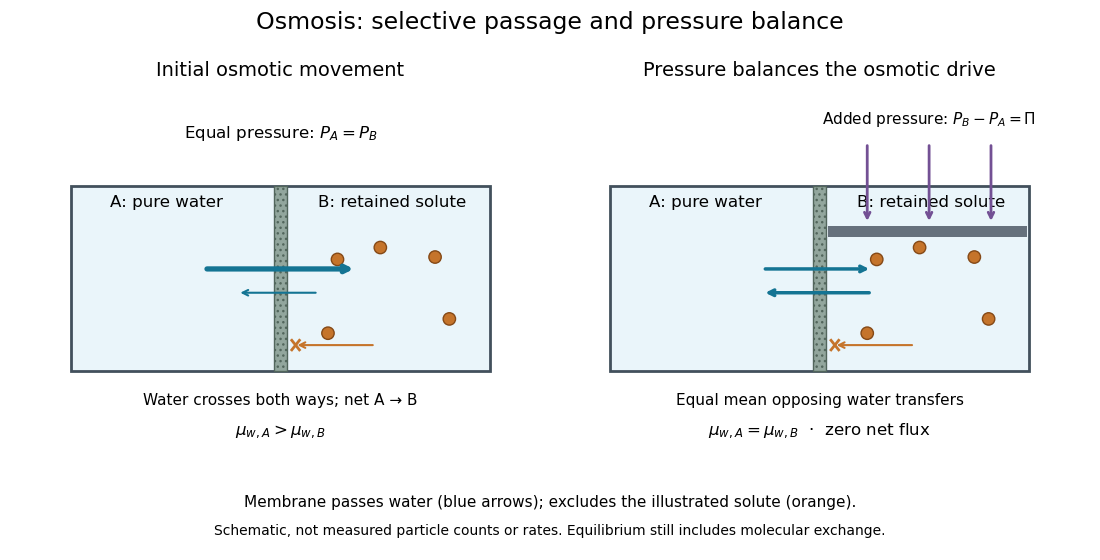

At thermodynamic equilibrium, the chemical potentials of exchangeable water are equal. Individual water molecules still move and cross in both directions, with equal mean opposing transfer rates and zero net flux. A stationary liquid level alone does not prove this: a blocked route can also give no visible transfer. Selective permeability provides a route; water potential supplies the direction, and neither alone determines the speed. The cell wall, turgor pressure and plasmolysis articles show why a living boundary's mechanical support and its selective permeability must be distinguished.
Facilitated diffusion 2026-10-14
Facilitated diffusion is passive transport through a membrane transport protein, such as an ion channel or carrier protein, down the relevant electrochemical gradient. The protein supplies a route; it does not by itself provide free energy for uphill transfer.
Obukhov-Corrsin theory 2026-10-14
Obukhov-Corrsin theory concerns transfer of scalar variance across scales in turbulent mixing. In the inertial-convective range, a constant scalar-variance flux and an eddy turnover time predict the displayed second-order scalar structure function. It assumes a passive scalar, local transfer, approximate statistical equilibrium and separation from the molecular diffusion and forcing scales.
Scalar structure function 2026-10-14
For a homogeneous scalar, . Decorrelation at large separation gives saturation at twice the variance. If the scalar is mean-square differentiable and isotropic, at small separation. Statistical isotropy and zero mean alone do not imply decorrelation at infinity.
Differentiate the advection equation componentwise: . Along a Lagrangian trajectory, the scalar gradient therefore evolves by the negative transpose of the velocity gradient tensor. If is the deformation gradient, this says , as expected for a covector. Fluid material vectors and scalar gradients transform oppositely under stretching.
Schmidt number (fluid mechanics) 2026-10-14
The molecular Schmidt number is the ratio of kinematic viscosity to scalar diffusivity. A large value allows a passive scalar to develop structure below the viscous smoothing scale of the velocity field. It is distinct from the turbulent Schmidt number, which compares effective turbulent transport coefficients, and from the Schmidt number used for quantum entanglement.
For in two dimensions, take positive definite, and positive conserved mass . The Gaussian integral gives , and . Substitution in the advection-diffusion equation gives and , equivalently the displayed moment equation. If , its solution is , with .
In the trap frame, a particle under linear drag has relative speed . A uniform strictly negative relative speed guarantees finite passage through a compact support. For a bounded continuous force, supplies that condition. For ordinary smooth forces, an encountered zero of the relative speed is an equilibrium or a passage bottleneck, not a finite crossing. Negative forces do not impede forward trap passage.
If the maximum force-induced speed is smaller in magnitude than , expand the passage denominator as a uniformly convergent geometric series. For a localized conservative well with equal outside potential levels, the first force moment vanishes and displacement starts at order . An odd force has no cubic moment, giving the next correction at order . Compact force support alone does not guarantee a vanishing first moment or positive displacement.
Erdős-Rado theorem for pairs 2026-10-14
For every infinite cardinal , every coloring of pairs from by colors has a monochromatic subset of size . Construct an end-homogeneous tree by routing a new vertex through the least preceding vertices that match its colors to all previously chosen ancestors. An ancestor's color to every later vertex on a branch is constant. A node at height is determined by its color sequence of length , so levels below have size at most . The whole tree has more than vertices, forcing a branch of length . One of the ancestor-colors occurs times, giving the required set.
Erdős-Rado theorem for finite arities 2026-10-14
For an infinite cardinal and finite , put and . Every -coloring of -element subsets of has a homogeneous subset of size . The case is the Erdős-Rado theorem for pairs. For the induction, the end-homogeneous routing tree yields a sequence of length on which the color of an -tuple depends only on its first entries. The previous-arity theorem homogenizes those entries. The case is the infinite pigeonhole principle at a successor cardinal.
Choose a representative of each class of countably infinite sets modulo finite symmetric difference, and colour by the parity of . Removing one element stays in the same class and flips the parity. Every infinite candidate homogeneous set therefore has two countably infinite subsets of opposite colours. With choice, this refutes unrestricted countably infinite-arity positive partition relations on every infinite cardinal.
Parity transformation of a Dirac bilinear Created 2026-10-14 Updated 2026-10-25
For parity acting as , the Dirac adjoint transforms as . A bilinear with matrix therefore transforms by , with its fields evaluated at . Since and the chirality matrix anticommutes with , the scalar bilinear is even and the pseudoscalar bilinear is odd. The same calculation shows that parity exchanges the chiral projectors.
Fringing field of a capacitor Created 2026-10-14 Updated 2026-10-25
The fringing field of a capacitor is the nonuniform electric field near the edges of its electrical conductors, extending outside the gap. For a parallel-plate capacitor, neglecting it is useful when the gap is much smaller than both plate widths; the approximation is less reliable when these lengths become comparable.
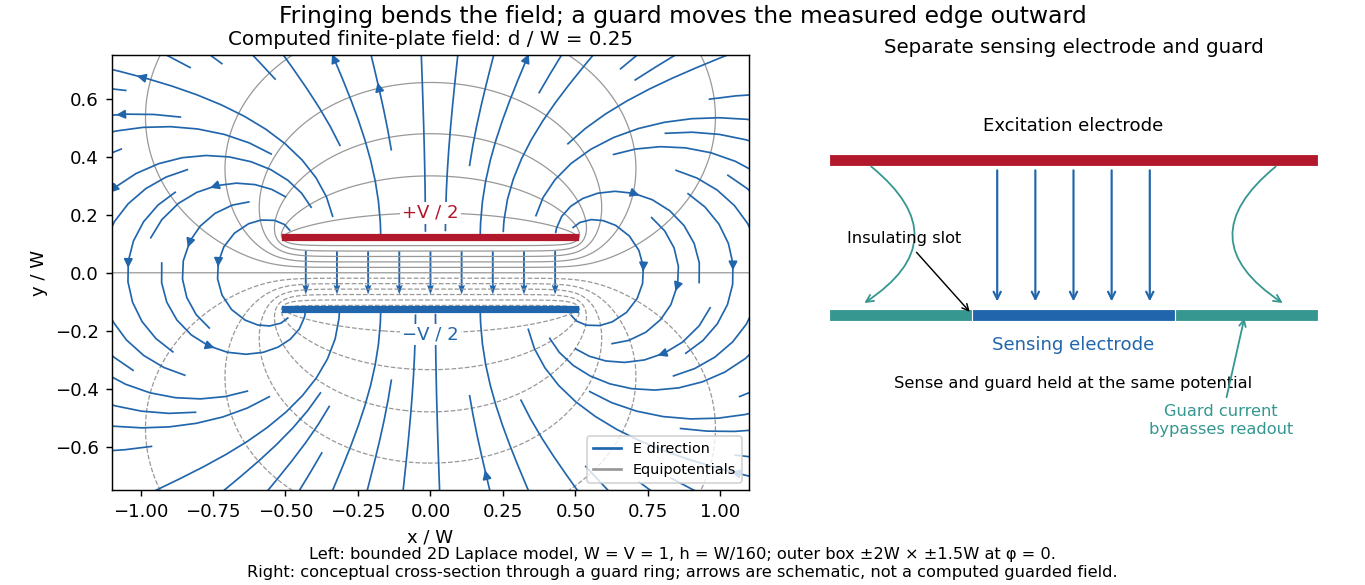
Finite plates break the translational symmetry of the infinite-plate model. Each conductor in electrostatic equilibrium is an equipotential, so the electric field must meet a smooth conducting surface normally. Near an edge, the equipotentials curve into the surrounding space and the electric field changes both direction and magnitude. The surface charge density adjusts to enforce the conducting boundary conditions; it is not uniform all the way to a sharp edge. The electrostatic boundary conditions at a conductor explain why zero electric field inside the metal does not imply zero electric field just outside it.
The practical issue is where the nearly uniform region ends. A probe near the centre can support while a probe close to an edge detects a lateral component and a different magnitude. A total capacitance reading also includes electric flux outside the simple footprint. The fringing field of a capacitor can therefore matter in permittivity measurements even when a central electric field measurement looks nearly ideal. Keysight's three-electrode fixture diverts the fringe contribution away from the measured response.[ref]
Materials Measurement: Dielectric Materials. Solution: fringe capacitance and the three-electrode 16451B fixture

For with zero Dirichlet boundary condition, choose . The constants and are a supersolution and a subsolution. More explicitly, testing with gives , since the reaction derivative is at most and the reaction at is nonpositive. The Gronwall inequality and the corresponding argument for prove that is invariant. A local variation-of-constants formula in the supremum norm then has a lifespan depending only on , which prevents finite-time loss of the classical solution.
The parity construction of pairwise independent bits turns two independent fair bits into three pairwise independent random variables. With , , and , their allowed triples are , each of probability . Every coordinate has the Bernoulli distribution with parameter . Every pair has the same joint probability mass function:All twelve pair cells equal the product of the corresponding probabilities in their marginal distributions. This establishes pairwise independent random variables, a requirement involving every pair of value-events, rather than merely one chosen event per coordinate. For general real-valued random variables , the requirement isfor every pair of Borel sets . For these binary random variables, checking all four cells of each pair suffices: any value-event is a union of the checked cells. In fact, for binary random variables, independence of their one-value events also gives the other cells by taking complements. Siegrist gives the all-set definition and its connection to indicator random variables in Random Services: independence of random variables.
The full joint probability mass function tells a different story:The integer parity of is always even. Any two bits determine the third: , , and . Each coordinate is independent of either other coordinate individually, but is dependent on the pair together. For example, the conditional probabilities satisfy and . See also pairwise independence does not imply joint independence for the general distinction.
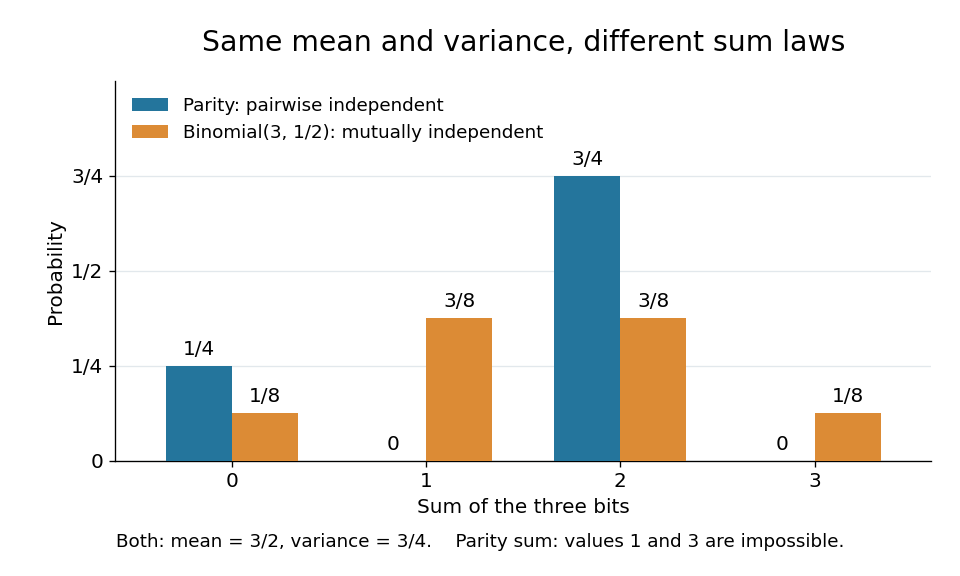
The constraint changes the sum's probability distribution without changing its expected value or variance. Let . Only gives ; each other allowed triple gives . Direct calculation givesThe same variance follows from the variance of a sum: each Bernoulli distribution has variance , and pairwise independent random variables have zero cross covariances. Linearity of expectation gives the expected value even without independence.
For comparison, the sum of three mutually independent fair bits has the binomial distribution :Both sums have identical expected values and variances, but never takes the values one or three. Even their third moments differ: , whereas . Pairwise independence preserves these first two sum summaries while allowing a different joint probability distribution and a different sum law. The calculation is an exact finite example.

The inward radial geodesic congruence with unit Killing energy has , where . Its metric dual is , so is a synchronized proper time for the congruence. Locally . This yields Painlevé–Gullstrand coordinates with flat spatial slices and a regular future horizon.
Choose Kruskal–Szekeres coordinates with the right exterior at and . The ingoing Painlevé–Gullstrand coordinates cover that exterior and the future black-hole region , together with their common future horizon. They exclude the other exterior, the white hole, the bifurcation sphere and the singularity. Indeed , with and ; the difference is finite at , whereas requires infinite coordinate time.
Page table walk 2026-10-14
Looking up page table entries to obtain a page frame number and effective access attributes. On ordinary x86 hardware paging, a TLB miss can initiate this lookup without entering the operating system.
// Target: computer-science.bigb
There are unlisted articles, also show them or only show them.