
Fitting subgroup Created 2026-10-14 Updated 2026-10-20
The largest nilpotent normal subgroup of a finite group . If denotes its p-core, distinct p-cores commute, and . Every normal nilpotent group has Sylow subgroups which are characteristic subgroups, so it is contained in this product.
Symmetric finite game 2026-10-14
A finite game is symmetric when all players have the same pure strategies and permuting the players permutes their payoffs. In the anonymous special case, a player's payoff depends on their own action and the multiset of opposing actions. A symmetric equilibrium exists even when there are more than two players, by the gain-map proof of symmetric equilibrium.
Quadratic finite-field norm and trace surjectivity Created 2026-10-14 Updated 2026-11-05
For , the field norm maps the nonzero elements onto : the multiplicative group of a finite field is cyclic, and the power has image of order . The field trace is also onto. Indeed it is an -linear map into , and is not zero because its polynomial has degree and cannot vanish at all field elements. Consequently is onto whenever .
Finite sigma-model energy need not give a limit at infinity Created 2026-10-14 Updated 2026-11-05
For arbitrary maps , integrability of the Dirichlet energy does not imply continuous extension to the one-point compactification. For large , takeand interpolate smoothly to a constant on a bounded disk. Its exterior energy isThe field has no limit because keeps winding. A continuous extension at the point at infinity instead requires uniformly outside sufficiently large disks. This fixed-limit boundary condition is standard for a sigma-model lump, but is extra information beyond finite energy for arbitrary fields.
Rayleigh-Ritz method Created 2026-10-14 Updated 2026-11-05
The Rayleigh-Ritz method minimizes an energy functional over a finite-dimensional trial space. For a real Hilbert space , a symmetric coercive bilinear form and a continuous linear functional , takeWriting in a trial basis and differentiating with respect to each coefficient givesThe same equations follow from testing the variational problem against each , which is the Ritz-Galerkin equivalence for a symmetric coercive form. Nonsymmetric problems need a separate argument because differentiating sees only its symmetric part.
For on with zero Dirichlet boundary conditions, choose , and the one-dimensional trial space spanned by . Then and , giving . Here the exact solution lies in the trial space, so minimization recovers it exactly; in general the Céa lemma controls the approximation error.
Finite element solution of the one-dimensional Poisson equation Created 2026-10-14 Updated 2026-10-31
Consider the Poisson equation on an interval with homogeneous Dirichlet boundary conditions:Two integrations and the endpoint conditions give the exact solution . To approximate it, multiply by a test function that vanishes at both endpoints. Integration by parts givesThe boundary term is zero. Thus the weak formulation is to find such thatThe zero-trace Sobolev space consists of square-integrable functions with square-integrable weak derivatives and zero endpoint values in their continuous representatives; it does not require a classical second derivative. This is why continuous piecewise linear functions are admissible despite corners. The Poincaré inequality makes a coercive bilinear form on . Strang derives this one-dimensional weak formulation, the piecewise-linear hat functions, and their load and derivative-product integrals in the cited lecture; its endpoint example uses a free left endpoint, while both endpoints here are fixed.[ref]
https://ocw.mit.edu/courses/18-085-computational-science-and-engineering-i-fall-2008/676ba0a00eef45a6cb3823c4da61ee11_18-085F08-L18.pdf. Strang, MIT 18.085, Lecture 18, transcript pp. 2–8: weak form, hat basis, and assembly
Take the uniform finite element mesh , , with . The continuous trial space isHere means polynomials of degree at most one on each interval. This is a conforming finite element space in , with interior piecewise-linear hat functions as a basis. Their endpoint values enforce the Dirichlet boundary conditions automatically. Set and test the weak formulation against each :Each interior hat has two slopes and , each over a length . Its squared derivative therefore integrates to . Adjacent hats have opposite slopes on their one shared interval, giving . All other derivative products vanish. The stiffness matrix is the tridiagonal matrixThe load is the area of a triangle of base and height one, including hats next to the boundary. Boundary hats are omitted because the boundary values are prescribed. The piecewise-linear hat function article explains how the same entries arise by adding local two-node contributions.
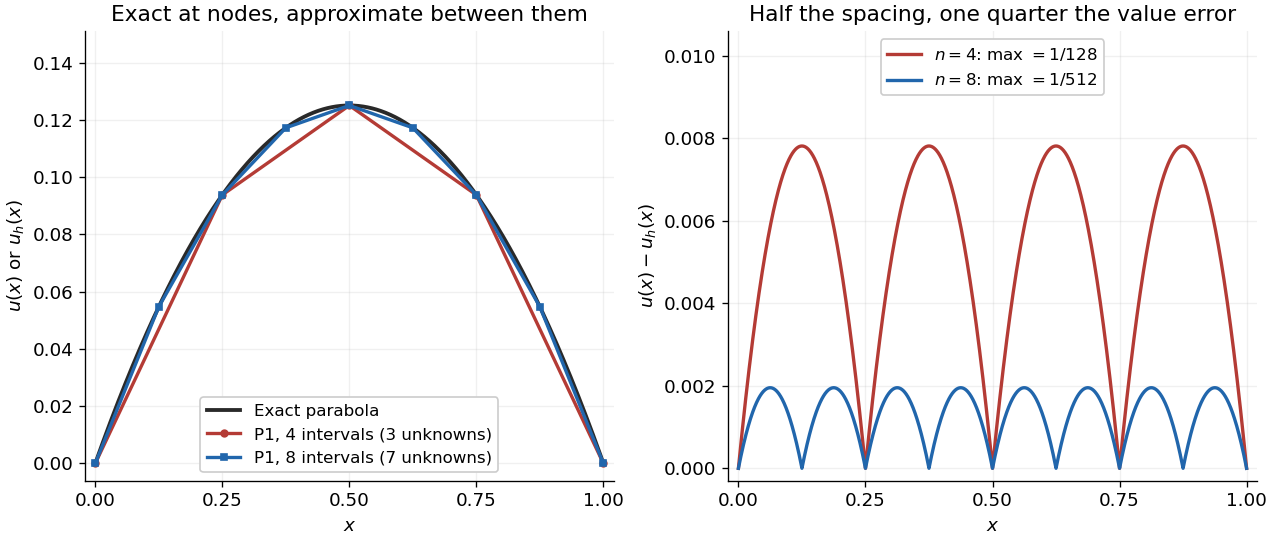
With four mesh intervals, , there are three unknowns:For example, the first row gives and the middle gives . The coefficients are the nodal values . At , linear interpolation gives , whereas : exactness at the nodes still leaves a visible error between them.
In this model the Galerkin method solution equals the nodal approximation obtained by linear interpolation on any finite element mesh. Indeed, on each interval , is the average of and is constant. Therefore . Summing proves Galerkin orthogonality for , and uniqueness gives . This argument relies on the constant diffusion coefficient, conformity and exact integration; nodal exactness is not a general promise for finite element methods with other operators or integration rules.
On a uniform mesh, direct subtraction of the chord from the parabola gives, on every element of length ,The largest value error is at an element midpoint. Its size and the energy norm error are exactlyThus gives and . With eight elements, , these become and . Halving the mesh spacing quarters the maximum value error but only halves the energy norm error: values and slopes converge at different rates. The figure shows the small value error at its own scale, where the four-to-one reduction becomes clear.

Material isotropy Created 2026-10-14 Updated 2026-11-05
Material isotropy makes the elastic response independent of a rotation of reference material directions: for proper rotations . Combined with material frame indifference, it yields coaxiality of isotropic elastic stress.
Hyperelastic material Created 2026-10-14 Updated 2026-11-05
A hyperelastic material derives its elastic stress from a strain energy density. In reference-volume units its first Piola-Kirchhoff stress tensor is the derivative of that density with respect to the deformation gradient.
Inextensible fibre constraint Created 2026-10-14 Updated 2026-11-05
A unit reference fibre direction retains its length under this constraint on the deformation gradient. Its reaction contributes an undetermined tension along the current fibre direction, independently of the pressure reaction enforcing incompressibility.
Twist and inflation of an incompressible tube Created 2026-10-14 Updated 2026-11-05
In cylindrical orthonormal bases the deformation gradient is and has unit determinant. One principal stretch is ; the squares of the other two are the roots of . The reference-volume energy per height is . Virtual work gives end torque and inner pressure at fixed reference radii and height.
Torque and axial force of a twisted incompressible cylinder Created 2026-10-14 Updated 2026-11-05
For axial stretch and twist per reference length , the deformation in local cylindrical orthonormal bases hasThe principal stretches follow from the eigenvalues of . For a cylinder of reference radius , stored energy per reference length is . Reversible power gives torque and axial force . The relevant derivative holds the reference twist fixed, not the twist per current length.
Constrained second-variation stability in elasticity Created 2026-10-14 Updated 2026-11-05
For an equilibrium with and dead loads, the constrained second variation on isIndeed, a constraint-preserving perturbation path has , and stationarity of the total potential supplies the multiplier term. Linearized kinetic energy plus is conserved. Positivity gives the usual energy-norm linear stability; control in a specified displacement norm additionally requires the corresponding coercivity and treatment of rigid-motion modes.
Inflation and extension of an incompressible tube Created 2026-10-14 Updated 2026-11-05
For reference radii , current inner radius and uniform axial stretch , incompressibility integrates to . The principal stretches are , and . Write and per reference length. Virtual work gives and the total axial wall load , both derivatives holding the other displayed parameter fixed. For pressurized closed ends the independently applied axial load is . The distinction follows from the axial pressure power .
Open rectangles in a finite product 2026-10-14
On two copies of the real line with their usual topologies, let and . The coordinate projection maps giveThe first two open sets are unbounded strips; their set intersection is an open rectangle. The point passes both coordinate tests, whereas fails the first because the endpoint is excluded.
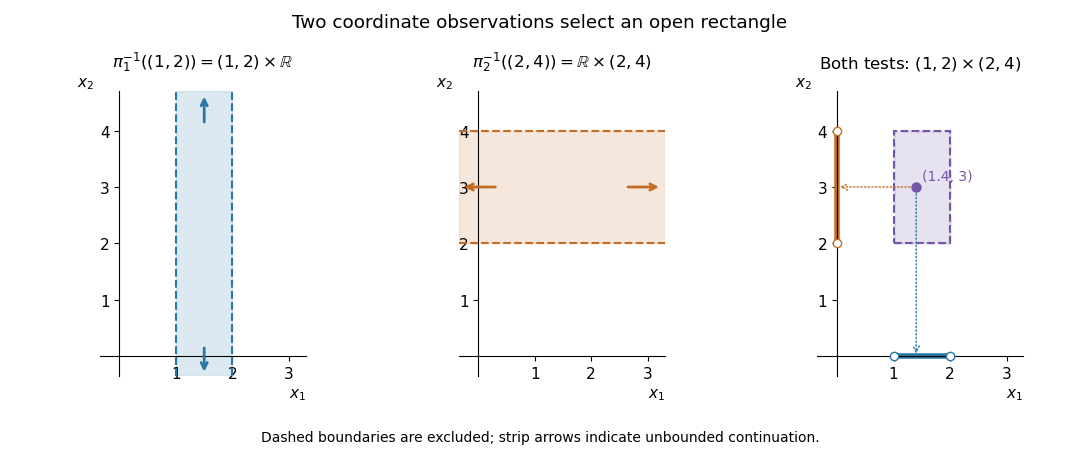
An open rectangle is the intersection of two coordinate-projection strips
. Dashed boundaries and hollow endpoints are excluded. Arrows at the ends of the strips indicate that the strips continue indefinitely. The final panel projects the interior point onto the two tested intervals. Details.
Every point of an open set in the Euclidean plane has such an open rectangle around it inside that open set. Conversely, every open rectangle contains a small Euclidean ball around each of its points. Thus the product topology here is the usual metric topology of the Euclidean plane. With finitely many factors all coordinates may be restricted; on an infinite Cartesian product a basic cylinder set must leave all but finitely many factors free.
Colour class 2026-10-14
A colour class of a finite colouring is a fibre . Each colour class is a monochromatic set, and these fibres give a finite set partition of after empty fibres are omitted.
Colour profile of a finite block 2026-10-14
The colour profile of a length- block under a finite colouring is the ordered tuple . There are at most profiles when uses at most colours. Equally profiled blocks reproduce every colour configuration at the same relative positions; this converts a colouring of points into a finite colouring of blocks in the colour-focusing proof of Van der Waerden theorem.
Frictionless market Created 2026-10-14 Updated 2026-10-25
A financial market model that omits trading frictions such as transaction costs and a difference between buying and selling prices. The exact idealization must still specify permitted holdings, short selling, and borrowing and lending terms; the worked binomial market allows divisible holdings and unrestricted borrowing at the bank growth factor.
Risk-free asset 2026-10-14
For a fixed horizon, a risk-free asset has a deterministic terminal payoff. If the price of a unit terminal payoff is , its gross return is . In a finite state market, the sum of the Arrow state prices is . Risk-free does not mean that a longer-maturity bond has a deterministic resale price before its maturity.
Credit derivative 2026-10-14
A credit derivative transfers exposure to deterioration of credit quality or a specified credit event of a reference borrower without necessarily transferring the underlying loan or bond. Credit default swaps transfer a defined loss exposure; total return swaps transfer a wider asset return. Funded structures such as credit-linked notes combine the exposure with an investor's initial principal. Documentation specifies the reference entity, obligations, credit events and settlement; a hedge can leave counterparty credit risk and mismatch with the original exposure.
Strike price 2026-10-14
The fixed price parameter at which an option permits an underlying trade. A European call option pays at maturity; a European put option pays . Specifying therefore determines how terminal prices translate into the financial payoff.
There are unlisted articles, also show them or only show them.