
Past exam of the mathematics course of the University of Cambridge 2003 iii Paper 53 9 Solution Created 2026-10-03 Updated 2026-10-14
Ordinary electromagnetism uses a one-form gauge potential, its gauge transformation and its curvature. On superspace the corresponding object is a superspace gauge connection, with both vector and spinor components. Write . Its graded commutator contains the flat-frame torsion plus supercurvature. The conventional constraints set the two undotted-spinor curvatures, the two dotted-spinor curvatures and the conventional mixed spinor curvature to zero; the mixed derivative algebra then determines the vector connection. The remaining independent gauge curvature is packaged into a chiral field-strength superfield. A real vector superfield is a prepotential solving these constraints, rather than four unrelated ordinary gauge potentials.
Use the left-derivative conventions of Question 5, with and . An Abelian supergauge transformation has a chiral parameter , and one consistent normalization isThe parameter is chiral so that the transformed matter is still a chiral superfield; its complex components remove more of the prepotential than an ordinary real gauge parameter. In Wess-Zumino gauge, one convenient expansion isIts components are the gauge potential , the gaugino and the real auxiliary field . Wess-Zumino gauge removes the extra scalar and spinor components of a general real superfield. Supersymmetry transformations usually leave that gauge slice and require a compensating supergauge transformation. For a residual chiral parameter with real lowest component , the expansion gives and ; thus is the ordinary Maxwell gauge parameter.
The Abelian field strength is the Abelian field-strength chiral projectionThree barred derivatives vanish because there are only two anticommuting dotted components, so . Gauge invariance follows directly: by antichirality, while the mixed derivative algebra gives for chiral . In chiral coordinates its component structure iswhere fixes the tensor normalization. Overall gaugino phase choices do not change the gauge-invariant field strength or its Bianchi constraint.
Reality of and the derivative algebra imply the superspace Yang-Mills Bianchi identityIndeed, the two sides are the same differential operator on , because . This is the superspace counterpart of , and its components contain . It is a defining curvature constraint, not the Maxwell equations. Varying the pure gauge action additionally sets the common real superfield to zero; matter supplies a current instead.
The Supersymmetric Yang-Mills action and minimal matter coupling areThe chiral phase factors cancel in . The component matter derivative is , which transforms covariantly under the residual gauge transformation just derived. The same superspace term generates the associated matter–gaugino Yukawa coupling and auxiliary coupling, so minimal coupling is not only replacing an ordinary derivative in the scalar action. The gauge action contains , the gaugino kinetic term and . Rescaling the vector multiplet to canonical kinetic normalization gives the physical coupling . The holomorphic superpotential must be gauge invariant; a single field of nonzero continuous Abelian charge admits no nonconstant polynomial superpotential without additional fields. For several fields, invariance requires . A Fayet–Iliopoulos term is additionally possible for an Abelian factor, shifting the algebraic equation.
For a non-Abelian gauge group, and are Lie-algebra-valued, and multiplication cannot be reordered. For matter in a specified representation, setThe same matter quadratic form remains invariant. Its curvature isAt first order in an Abelian , this reduces to , fixing the factor . In the chiral gauge frame, and as an operator. The gauge-covariant Bianchi identity is , where is the conjugate curvature expressed in that same frame. It follows from the graded Jacobi identity of the covariant derivatives. Taking a trace of makes the chiral gauge action invariant. Its bosonic curvature becomes the ordinary Yang-Mills curvature, and the gaugino transforms in the Adjoint representation. A constant Fayet–Iliopoulos coefficient cannot be inserted for a simple non-Abelian group, since it would need an invariant linear functional annihilating every Lie bracket. These constructions connect the constrained superspace connection, its prepotential and its component gauge multiplet.
Past exam of the mathematics course of the University of Cambridge 2003 iii Paper 53 8 Solution Created 2026-10-03 Updated 2026-10-14
Spontaneous supersymmetry breaking preserves the action and conserved supercharges, but the vacuum fails to be invariant. This differs from explicit breaking, which changes the symmetry of the action itself. In global four-dimensional N=1 supersymmetry, summing diagonal entries of the Super-Poincaré algebra writes the Hamiltonian as a sum of positive charge anticommutators. Its expectation is a sum of squared norms. Consequently a zero-energy vacuum is supersymmetric, whereas an existing vacuum with broken global supersymmetry has positive energy density. The energy zero is fixed by the algebra. Neither this positivity statement nor the particle-multiplet mass relations should be transferred without qualification to supergravity.
For supersymmetric quantum mechanics, let , , and let fermion parity anticommute with both charges. On a positive-energy eigenspace, is an odd involution: its square is one, it preserves energy, and it reverses parity. Thus every positive-energy bosonic state has a fermionic partner and conversely. Their contributions cancel in the Witten indexFor a discrete spectrum with a well-defined trace, this proves independence of . Continuous changes of parameters also preserve the index if the trace stays well defined and no state escapes to infinity or crosses an unregulated continuum threshold. A nonzero index guarantees an unbroken supersymmetric ground state; a zero index is inconclusive. For example, de Rham supersymmetric quantum mechanics on a circle has a bosonic constant zero-form and a fermionic constant one-form, both normalizable zero modes, so it is unbroken with index zero.
A more explicit one-dimensional family illustrates how normalizability determines the answer. DefinePositivity of these Hamiltonian operators shows that a zero mode must solve or . Thus the only candidates areFor , the Gaussian minus-sector wavefunction is normalizable and its reciprocal is not, giving an unbroken model with when the minus sector is assigned even parity. For , , the exponent tends to opposite infinities at the two ends, so neither candidate is normalizable. Both partner potentials grow quartically; their spectra are discrete and their lowest energies cannot be zero. The lowest states are therefore paired at positive energy, , and supersymmetry is spontaneously broken. This is supersymmetric factorization and zero-mode normalizability. In quantum mechanics the paired ground states illustrate the charge algebra; a relativistic massless-particle conclusion requires field-theoretic hypotheses.
In relativistic global field theory, Goldstone's theorem has a fermionic version. If a conserved supercurrent charge does not annihilate the vacuum, its Ward identity has a nonzero vacuum contact term. Fourier transforming, the divergence of the current correlator cannot tend to zero smoothly at zero momentum. Its spectral representation therefore contains a massless fermionic pole: the Goldstino, with spin one-half. This statement assumes a Poincaré-invariant vacuum and the usual local unitary field-theory conditions. It does not require a bosonic Goldstone particle for the fermionic symmetry. In supergravity the Goldstino can instead supply the longitudinal polarization of a massive gravitino.
For canonical chiral superfields , elimination of their auxiliary fields givesA supersymmetric vacuum solves every . At a stationary broken vacuum,The same matrix is the chiral-fermion mass matrix, so the nonzero vector is a zero mode. This derives the Goldstino zero mode from vacuum stationarity. The transformation independently identifies that direction through its inhomogeneous shift.
For one canonical chiral field, , , has everywhere, a massless fermion and a classically flat scalar direction. It is flat F-term breaking with a linear superpotential, rather than an isolated vacuum. In contrast, a nonconstant polynomial of positive degree has a complex root and hence a supersymmetric vacuum; in particular a generic quadratic or cubic single-field superpotential cannot remove all such roots. This argument assumes canonical nonsingular kinetic terms and does not claim that every runaway or nonpolynomial model has a vacuum.
A renormalizable three-field O'Raifeartaigh model gives a less degenerate illustration:The auxiliary equations require , then , leaving . They cannot vanish simultaneously. For real positive with , the potential obeysTherefore its global tree-level minimum has , arbitrary , and energy . The massless is the Goldstino, while is a pseudomodulus. At , the scalar mass-squared spectrum is , and the fermion masses are . This exhibits both the stability condition and the loss of ordinary supermultiplet mass degeneracy in a broken vacuum. Quantum corrections can lift the pseudomodulus and must be analysed rather than assumed away; the noncompact classical valley also prevents an unqualified finite-volume Witten index trace argument. The index, the vacuum equations and the Goldstino theorem consequently answer complementary questions.
Past exam of the mathematics course of the University of Cambridge 2003 iii Paper 53 7 Solution Created 2026-10-03 Updated 2026-10-14
Use the supertranslation-invariant superspace coframeIt is a basis because the change from is triangular with identity diagonal blocks. Under a rigid supertranslation, , and . Therefore , and .
Writing wedge products explicitly, the three-form isBoth factors are supertranslation invariant. Under a Lorentz transformation, and the bilinear in transform as vectors, so their contraction is invariant. Thus is invariant under the Super-Poincaré group.
The Maurer-Cartan equation is . Since the other factor is closed,The required four-dimensional Fierz rearrangement identity, which may be stated without proof, isDifferentials of odd Grassmann variables commute in the graded exterior algebra. Thus the coefficient of the product of four factors is the fully symmetric spinor-index part appearing in this identity. It vanishes, provingThis is the closed three-form on four-dimensional superspace; it should not be confused with the different closed four-form used for a membrane coupling in Question 10.
Past exam of the mathematics course of the University of Cambridge 2003 iii Paper 53 6 Solution Created 2026-10-03 Updated 2026-10-14
In the ordinary local two-derivative matter class, the general ungauged supersymmetric action for a chiral superfield isThe Kähler potential is real, and the superpotential is a holomorphic function. Adding to changes the action only by a boundary term: full superspace integration of a chiral or antichiral function vanishes modulo that term. This is a Kähler transformation. A positive Kähler metric is required for a nonsingular positive-norm kinetic term, not just for derivative counting.
To see the differential order, the bosonic component Lagrangian in mostly-plus signature containsThe auxiliary field equation is algebraic: on a purely bosonic configuration. It gives the scalar potential . The scalar equations have at most two spacetime derivatives, the fermion equations from the sigma-model kinetic term have one, and the remaining interaction terms do not raise this order. The fermionic corrections to the auxiliary equation are still algebraic.
For four-dimensional renormalizability, assign engineering dimensions , , and . Hence, up to a Kähler transformation and a constant field normalization, the restrictions areA mixed higher-degree term in or a term of degree above three in introduces a negative-mass-dimension coupling. The constant has no local effect in global supersymmetry, as in the constant superpotential in global supersymmetry.
The boxed general-action statement uses the conventional two-derivative matter interpretation. It is not a classification of all derivative-dependent effective superfield actions by the order of their bosonic equations alone. For example, a scalar Lagrangian quartic in first derivatives still yields a second-order Euler–Lagrange equation, and supersymmetric derivative-dependent interactions can contain such terms. Their auxiliary and fermionic equations require separate checking. This distinction is explicit in the original construction of supersymmetric derivative-dependent scalar actions. Such actions are outside the ordinary class used for the renormalizable answer here.
Past exam of the mathematics course of the University of Cambridge 2003 iii Paper 53 5 Solution Created 2026-10-03 Updated 2026-10-14
A scalar superfield transformation is a pullback under a supertranslation. Since that transformation mixes and , an odd-coordinate derivative acquires an extra spacetime-derivative term under the coordinate Jacobian. It therefore does not transform as a spinor superfield merely by differentiating the scalar transformation law. This is partial derivatives and superfield covariance.
For explicit signs, split the Majorana spinor coordinates into and use left Grassmann derivatives. Choose the differential generatorsFor example, , which is nonzero. Commuting the even supersymmetry variation through consequently gives the unwanted translation term.
Replace the ordinary odd-coordinate derivatives by the supersymmetric covariant derivativesThe graded product rule cancels the mixed coordinate/derivative terms, giving . Thus and transform as spinor superfields. Their own mixed algebra is , with equal-chirality anticommutators zero. This covariant differentiation is also what makes a chiral superfield constraint supersymmetry invariant. Negating every barred derivative is another convention, but changes the displayed mixed-algebra sign.
Past exam of the mathematics course of the University of Cambridge 2003 iii Paper 53 4 Solution Created 2026-10-03 Updated 2026-10-14
In a massive four-dimensional N=1 supersymmetry representation, the two normalized raising supercharges transform as a spin-half doublet. Start with a Clifford vacuum of superspin . At occupation levels zero, one and two, the ordinary spins areThe two-creation state has a spin-singlet oscillator factor because the creation operators anticommute. Thus the massive N=1 vector multiplet containsThere are four bosonic polarizations, , and four fermionic polarizations, , as required by boson-fermion degeneracy in a supermultiplet.
In the massless limit the helicity multiplicities become , two copies each of , and two zero-helicity states. They separate into the four irreducible helicity pairsWith the lower-helicity convention for superhelicity, a pair has labels , respectively. A midpoint convention shifts each label by ; the explicit helicity pairs remove any naming ambiguity.
Pairing under the CPT theorem, the first and last pairs form a massless vector multiplet, and the middle two form a massless chiral multiplet. This is the massless limit of a massive N=1 vector multiplet. The longitudinal vector polarization supplies one of the chiral multiplet's two real scalar modes; the original spin-zero state supplies the other. Simply discarding the longitudinal polarization would lose a physical degree of freedom and give the wrong decomposition.
Past exam of the mathematics course of the University of Cambridge 2003 iii Paper 53 3 Solution Created 2026-10-03 Updated 2026-10-14
Here a supersymmetry-preserving combination means a real combination of Hermitian Majorana spinor supercharges, in a positive-norm unitary representation of the ordinary Super-Poincaré algebra. This reality qualification is essential. Let be normalized and in the charge domains, and define the real symmetric matrixFor real , the Hermitian operator satisfiesTherefore is a positive semidefinite matrix, andThe reverse implication uses positivity: diagonalize , so a zero quadratic form has zero component in every positive-eigenvalue direction. This converts the problem into nullity of real N=1 supercharges, not just a condition on the determinant of an operator-valued expression.
In the equivalent Weyl spinor form, . After a fixed invertible change of real charge basis, is the realification of the Hermitian two-by-two matrixup to the harmless spatial-sign convention. A complex Hermitian matrix has the same eigenvalues in its realification, each repeated twice. The Pauli matrix multiplication law gives , so these eigenvalues are and , each twice. Positivity forces . If one nonzero real annihilates the state, has a kernel: either , with exactly two zero eigenvalues, or , with four. ThusFor a momentum eigenstate these are the null-momentum and zero-momentum cases; the expectation-matrix proof also covers states not assumed to have definite momentum. There are no massive states preserving a real charge in this unextended algebra.
If “linear combination” instead allows arbitrary complex coefficients, the unrestricted claim is false. In a massive fermionic Fock space with two lowering operators and a spin-half Clifford vacuum spectator, takeThen . The three vectors , and are linearly independent, by their occupation numbers and spectator spin labels. The complex annihilator is therefore only one-dimensional. Such a lowering operator is not a Hermitian generator of preserved real supersymmetry. The boxed conclusion applies to the physical real-charge interpretation; it also assumes no domain-wall charge in N=1 supersymmetry.
Past exam of the mathematics course of the University of Cambridge 2003 iii Paper 53 2 a Created 2026-10-03 Updated 2026-10-14
Past exam of the mathematics course of the University of Cambridge 2003 iii Paper 53 10 Solution Created 2026-10-03 Updated 2026-10-14
A canonical Wess–Zumino model with a cubic superpotential already supplies a microscopic membrane-like object. Choose positive real andThere are two isolated supersymmetric vacua, . A planar domain wall has a static scalar profile depending on the transverse coordinate , with one vacuum at either end. Its energy per unit area isChoosing gives . The real increasing solution saturates the bound:The tension follows either from integrating or from . This is a supersymmetric domain wall, and the first-order equation also implies the second-order scalar equation. Its thickness is of order .
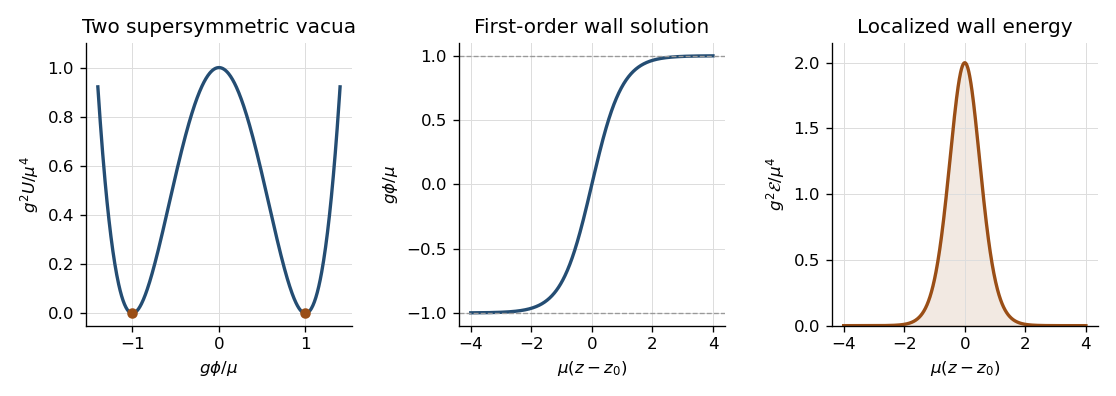

The wall breaks transverse translations: changing gives a normalizable scalar zero mode proportional to . It also preserves only half the four real supercharges. In the chiral-fermion transformation, and the derivative term combine into a rank-half condition on the constant supersymmetry parameter, for example in a compatible Weyl convention. The orthogonal two real parameters are broken and generate localized fermion zero modes. One such profile satisfies , giving . The scalar and a three-dimensional Majorana fermion therefore form the low-energy wall multiplet. The domain-wall charge in N=1 supersymmetry is a boundary/tensor charge contributing to the extended algebra; the preserved combinations saturate . This avoids falsely applying the unextended particle-algebra argument of Question 3 to a wall with nonzero tension.
Promote the translation collective coordinate to a slowly varying worldvolume field . At wavelengths long compared with the wall thickness, its leading relativistic geometric action is the Dirac membrane actionIt is invariant under worldvolume reparametrizations and the target Poincaré group. In static gauge , , the matrix determinant lemma givesDirectly substituting the leading collective-coordinate profile into the scalar kinetic term gives the same coefficient, since . Target Lorentz symmetry fixes the leading first-derivative nonlinear completion to the invariant area; finite-thickness physics can add higher-curvature terms. The area action is therefore a long-wavelength effective field theory, not an exact replacement for the microscopic wall at arbitrary momenta. Its embedding equation is .
For the four-dimensional supermembrane, extend the embedding to with a four-real-component Majorana spinor. Pull back the invariant coframe of Question 7:Replacing by makes the area term invariant under rigid target supersymmetry, but does not yet give the appropriate fermionic gauge symmetry. Add a Wess-Zumino brane coupling to a superspace three-form potential . In one orientation and matching normalization,The supermembrane closed four-form uses the distinct four-dimensional Fierz identity . Differentiating reduces its coefficient to this symmetric tensor, so . A local potential therefore exists. Since the curvature is supertranslation invariant, the potential can vary by an exact form; its pullback integral is invariant modulo boundary terms. This is why the three-form of Question 7 is not itself the membrane field strength: integrating a membrane potential requires three-form degree and hence four-form curvature.
The required additional local fermionic gauge invariance is kappa symmetry. Define the worldvolume gamma matrices andWith mostly-plus target signature, a local orthonormal worldvolume frame gives , so and . Thus are rank-two kappa symmetry projectors. The embedding variation gives . The area variation is consequently proportional to . Contracting the displayed with the fermionic variation and using gives the opposite Wess-Zumino contribution with an extra . Their sum is proportional toFor the boxed kappa variation, , so it vanishes by . Reversing membrane orientation reverses the Wess-Zumino sign and the matching projector. The cancellation fixes the relative charge magnitude to the tension; rigid supersymmetry alone would not fix it.
Worldvolume reparametrizations remove three of the four embedding scalars, leaving one transverse mode. Kappa symmetry removes half the four real embedding spinor components, leaving a two-component three-dimensional Majorana field, whose first-order equation has one on-shell fermionic polarization. The physical worldvolume modes are one scalar and one Majorana fermion, matching the wall zero modes. Without kappa symmetry the fermionic degrees would be doubled. A planar configuration preserves the target supersymmetries that can be compensated by the kappa projector, reproducing the wall's half-supersymmetry condition. This is the four-dimensional effective domain-wall interpretation of a supermembrane, rather than the eleven-dimensional M2-brane particle-content problem.
Past exam of the mathematics course of the University of Cambridge 2003 iii Paper 53 1 Solution Created 2026-10-03 Updated 2026-10-14
Take and , with unit-weight antisymmetrization. The Clifford algebra first givesExpand the two antisymmetrized gamma matrices using :Anticommuting past the next contracted factor givesSubtracting the remaining gives the gamma-matrix vector sandwichIn particular it vanishes in four dimensions. The result is independent of the choice of Lorentz signature when all indices are contracted consistently. Defining the bivector without its factor would multiply by four.
Past exam of the mathematics course of the University of Cambridge 2003 iii Paper 52 4 Solution Created 2026-10-03 Updated 2026-10-14
An instanton is a localized finite-action classical solution of a Euclidean field theory. Its role differs from that of a static spatial classical field-theory soliton: an instanton is localized in Euclidean spacetime and contributes to quantum transition amplitudes, rather than persisting as a stationary real-time particle. Wick rotation changes the oscillatory weight into when the continuation and boundary conditions are valid. The Euclidean path integral is consequently dominated semiclassically by stationary Euclidean configurations. Perturbation theory around one vacuum misses other saddles whose weights have the nonanalytic form .
A useful first example is quantum tunnelling between two degenerate minima in quantum mechanics. For coordinate with mass , the Euclidean action iswith the vacuum energy subtracted from . Its Euler-Lagrange equation is , equivalent to motion in the inverted potential . A finite-action trajectory joining zero-energy minima has conserved Euclidean energy . A forward instanton therefore satisfies , while an anti-instanton has the opposite orientation. Completing the square gives the action boundwhich these zero-energy paths saturate. This is the Euclidean counterpart of the first-order kink argument, with Euclidean time replacing the spatial coordinate.
For the quartic double-well instanton, chooseThe first-order equation in the interval is . Separation givesThe center is arbitrary. Its derivative is an instanton translation zero mode: differentiating the Euclidean field equation shows that it lies in the kernel of the quadratic fluctuation operator . A naive Gaussian determinant therefore has a zero eigenvalue. Replace its integration by the collective-coordinate integral over , and take the determinant only over nonzero modes. The resulting instanton fluctuation prefactor combines that Jacobian with the determinant ratio against the vacuum. The action controls the exponential suppression; the prefactor is essential for a quantitative rate or splitting.
When , crossings are rare and their typical separations greatly exceed their widths. In the dilute instanton gas, ordered center integrals for well-separated crossings over Euclidean duration produce . If a single-crossing rate is , a symmetric two-well system has even-crossing and odd-crossing sums proportional to and . The spectral interpretation gives levels andThis is a real tunnelling level splitting. A Euclidean bounce instead describes false vacuum decay: it leaves and returns to a metastable vacuum, and a characteristic negative fluctuation mode supplies the imaginary part interpreted as decay. A bounce must not be confused with a stable double-well instanton merely because both use Euclidean saddles.
The central gauge-theory example is a Yang-Mills instanton on Euclidean four-space. State conventions carefully: take anti-Hermitian generators , with , connection , and gauge curvature . With coupling , the positive Yang-Mills action isThe Hodge star operator squares to one on Euclidean two-forms. Under the usual finite-action boundary conditions, the connection approaches a pure gauge at infinity, defining a map . Its winding degree is the integer instanton numberThis is unchanged by smooth deformations preserving the boundary sector. Geometrically this is, up to the stated sign convention, the second Chern number of the compactified bundle. Different sign conventions for trace, curvature or orientation must be changed together.
Use the positive norm . Decomposition into self-dual and anti-self-dual curvature givesThe Yang-Mills instanton Bogomolny bound is saturated by for positive , or for negative . These first-order equations imply the full Yang-Mills equations: the Bianchi identity becomes when . Thus the topological minimum is a genuine classical saddle, not just an arbitrary field with integer charge. Self-duality alone is a local differential condition; finite action is an additional requirement.
An explicit unit-charge example is the BPST instanton. Let , , and choose the self-dual symbols , and for , using orientation . In regular gauge,The curvature is self-dual. Since , its squared component curvature is . Radial integration yieldsso . Replacing self-dual symbols by anti-self-dual ones produces the opposite charge with the same positive action.
The center has four coordinates and is an instanton size modulus. Classical four-dimensional Yang-Mills action is scale invariant, so varying changes the action-density width but not the total action. If gauge transformations must tend to the identity at infinity, three global gauge orientations also remain, giving eight parameters for the one-instanton framed instanton moduli space. If those global orientations are quotiented out, the unframed one-instanton space has five parameters. A zero-size limit is a singular concentration of curvature, not another smooth instanton. Higher-charge solutions likewise possess instanton moduli spaces; their collective-coordinate integrals replace the corresponding zero-mode determinants.
In a Euclidean-time description, topologically distinct gauge vacua are separated by a change of Chern-Simons number; an instanton interpolates between them, with the change equal to in compatible orientation conventions. Theta-weighted instanton sectors give , connecting topology to the vacuum angle. With fermions, the gauge-field topology also controls fermionic zero modes and chiral selection rules through the chiral anomaly. These phenomena explain why instantons encode physics beyond small fluctuations around a single vacuum.
Instantons link Euclidean classical solutions, topological sectors and exponentially suppressed quantum effects. Their interpretation requires the boundary conditions, normalization, fluctuation spectrum and measure over collective coordinates. A dilute approximation is controlled only when its individual-action suppression and separation assumptions hold; classical scale moduli and their quantum corrections can make size integrals delicate rather than automatically finite.
Past exam of the mathematics course of the University of Cambridge 2003 iii Paper 52 3 Solution Created 2026-10-03 Updated 2026-10-14
A Derrick scaling variation changes a configuration's size without changing its topological sector. Use , so expands the configuration. An integrated nonnegative term homogeneous in spatial derivatives scales as . For a scalar gradient-plus-potential energy, for example,A static solution is a stationary point of the full energy functional, so it must in particular satisfy . In this example the Derrick virial identity is . If both energies are nonnegative and the coefficients cannot balance, a nontrivial localized static solution is impossible. If balance is possible, it fixes relations among energy contributions and may select a characteristic size. A negative proves an instability under size changes; a positive second derivative gives stability only against that one deformation. Passing the scale test is a necessary condition, not an existence theorem or a proof of full stability. It does not directly rule out time-dependent or charge-constrained solitons outside the static variational problem.
For the specified model, each spatial current is anti-Hermitian: differentiating gives . Thus is nonnegative, and the static energy of the nonlinear sigma model isThe boundary condition identifies spatial infinity to one point, so one-point compactification turns the field into a based map . By SU(2) as the three-sphere, its sectors are classified by the homotopy group . In particular,There is no corresponding topological protection in one or two spatial dimensions. In three dimensions there is an integer degree of a map between oriented manifolds, the usual topological baryon number in the Skyrme model when the same field is interpreted in that theory. With a compatible orientation convention it can be writtenConjugation from the left current to the right current preserves the trace in this formula. Higher dimensions are governed by their corresponding homotopy groups, which need not all be trivial; no assumption of their triviality is needed in the scaling obstruction below.
For the pure sigma model, , so stationarity requires . In every a finite-energy nonconstant static solution is excluded by Derrick scaling. In spreading lowers its energy; in shrinking lowers it. In particular, a degree-carrying three-dimensional sigma configuration can collapse toward zero size and energy within its sector, with a singular limiting field. The topological charge prevents smooth unwinding, but not this singular collapse.
In , the sigma energy is scale invariant. The scaling identity supplies no obstruction, but gives no topological soliton sector either. One must not infer nonexistence of every nonconstant stationary harmonic map from these two facts: scale-invariant sigma models can have non-topological harmonic-map saddles, for example using a totally geodesic two-sphere in the target three-sphere. The conclusion is absence of a topologically protected sigma soliton here, with no positive scale-restoring force supplied by the quadratic term alone.
For the Skyrme model, the added commutator term gives the nonnegative static energyAnti-Hermiticity of the commutators fixes its sign. The target and boundary condition are unchanged, so the topological classification is unchanged. The Derrick dimension test for the Skyrme model instead becomesIn , the opposite exponents permit a balance:For an arbitrary reference shape with both energies nonzero, its preferred scale is and its optimized energy is . Expansion costs quadratic-gradient energy and contraction costs quartic-gradient energy. Integer-degree Skyrmions are therefore topologically possible and evade the pure sigma collapse. This mechanism permits finite-size stable solitons, although existence and stability in all field directions require more than the scaling argument itself.
The other dimensions behave differently. In , all spatial commutators vanish identically, so the added term changes nothing and nonconstant static finite-energy fields remain excluded. In , stationarity forces ; any configuration with nonzero commutator energy can lower it by spreading. In fact a smooth finite-energy static field of this particular potential-free model must be constant. To prove this commuting-current obstruction in a two-dimensional Skyrme model, forces pointwise. The quartic first variation then vanishes, leaving the sigma equation . The right-current Maurer-Cartan equation isDivergence-free and curl-free currents have componentwise . Their components belong to L2 space by finite . An entire square-integrable harmonic function on the plane vanishes: the mean-value formula and Cauchy–Schwarz bound its value by times its full L2 norm, tending to zero as the disk radius grows. Thus , and the boundary condition fixes . This additional argument uses the vanishing commutator; it does not apply to the pure sigma model's general noncommuting currents.
In , the virial relation gives , hence a constant field and zero . In both coefficients are positive and the same conclusion follows. Only three spatial dimensions allow a nontrivial finite-size balance of these two positive derivative energies. Higher-dimensional topological classes, where present, do not evade this obstruction.
Past exam of the mathematics course of the University of Cambridge 2003 iii Paper 52 2 Solution Created 2026-10-03 Updated 2026-10-14
In the usual smooth localized finite-energy class, the positive potential requires at infinity and the gauge covariant derivative tends to zero there. On a sufficiently large circle write locally. Then the tangential gauge potential approaches . The normalized Higgs phase defines a continuous map with integer winding numberThe second equality is Stokes theorem with the chosen orientation and . Suitable decay makes the integrated covariant-derivative error vanish. Thus magnetic flux quantization of an Abelian Higgs vortex labels disconnected boundary sectors. This uses the standard continuous vacuum asymptotics, not a claim that bare integral finiteness alone supplies every pointwise boundary limit.
A nonzero winding requires zeros of the complex Higgs field somewhere inside: a nowhere-zero field on the whole disk would extend its normalized boundary map and make its winding zero. For isolated zeros the signed local indices sum to . For arbitrary configurations, vortex-antivortex pairs may add zeros without changing , so need not count all unsigned zeros.
The critical coupling relates the charge to a minimum energy. Set . The covariant derivative commutator givesDiscarding its vanishing boundary integral and completing the magnetic square yieldsFor positive , the Bogomolny vortex equations are and . Reverse both signs for negative charge. HenceCritical-coupling vortex solutions attain this bound; their energy depends only on . Positive-charge solutions have zeros counted with multiplicity, and their positions provide real coordinates on the Abelian Higgs vortex moduli space. Coincident zeros are allowed. Position variations leave the static minimum energy unchanged, expressing the absence of static forces among same-sign Bogomolny vortices. The sign of reverses flux and orientation. Topology alone does not determine an arbitrary field's profile or full energy: the zero-charge vacuum has energy zero, while nonvacuum configurations in the same sector can have positive energy.
For the given radial ansatz, is the coordinate one-form coefficient: the gauge potential is , and the orthonormal azimuthal component is . Thus , consistently with the printed energy. Since , the phase has winding one; equivalently , givesFor the trial functions all energy is inside . Their four contributions to areTherefore the compact-core variational estimate for an Abelian Higgs vortex isWriting , the derivative is , and the energy diverges at both ends of the range. The unique global minimum isThe magnetic and potential energies agree at this optimum, as required by radial scale balance. The piecewise fields are continuous with square-integrable first derivatives; their derivative jumps do not create an additional surface energy. They are trial fields, not exact solutions. Their optimized energy is an upper-bound estimate, about 24.4% above the exact critical one-vortex energy .
Past exam of the mathematics course of the University of Cambridge 2003 iii Paper 52 1 Solution Created 2026-10-03 Updated 2026-10-14
For a compactly supported variation , the first variation of the energy functional isIntegration by parts has no endpoint term. Since is arbitrary, the static Euler-Lagrange field equation isIntegrating the specified polynomial derivative gives . The polynomial factors as a nonnegative square times ; its global minimum is zero when . ThereforeThese are the three constant scalar-field vacua. For a localized finite-energy kink, the two ends approach vacua and the derivative tends to zero. Multiplying the field equation by gives the first integralA nonconstant kink must stay within one interval between neighboring vacua. A proposed direct connection from to would reach at some finite point, where the first integral forces . Uniqueness for the smooth second-order differential equation then forces the identically zero solution, a contradiction. This is the intermediate-vacuum obstruction to a kink; two elementary kinks can span the outer vacua only in an infinite-separation limit, not as one finite-width static kink.
There are consequently four oriented elementary sectors: , , and . If opposite orientations are grouped together, there are two kink families and their antikinks. Spatial reflection reverses orientation, and exchanges the two adjacent intervals; both preserve the energy. All four therefore have the same rest mass, even though the central and outer vacua have different fluctuation curvatures.
For the sector , define , so and . The Bogomolny bound follows by completing the square:It is saturated by the Bogomolny equationLet on this positive branch. Then , so . Thus the explicit kink in a phi-six model isIt has the required limits and satisfies the first integral. The translated center is arbitrary. All oriented elementary solutions areFor the endpoints are , and for they are . Direct evaluation independently gives their common mass.
Past exam of the mathematics course of the University of Cambridge 2003 iii Paper 51 6 Solution Created 2026-10-03 Updated 2026-10-14
Write the affine modes as , and put . The Sugawara construction requires a restricted module, meaning that sufficiently large positive current modes annihilate each fixed vector, and a noncritical level . A positive-energy highest-weight representation has the required restriction. DefineNormal ordering puts positive modes to the right, making each sum finite on a fixed finite-energy vector. The invariant sum over the current index is the quadratic Casimir operator construction for the affine current algebra.
Here is the normal ordering calculation responsible for its denominator. In commuting with , the two affine central terms supply . The remaining terms contain times the two ways to replace a current by . Relabeling the summation index and using antisymmetry of cancels the un-reordered terms. Reordering the modes that cross the creation/annihilation boundary leaves signed terms, whose two structure constants contract by . Their sum is . ThusThe adjoint-Casimir contribution is genuinely quantum. For an explicit check of its coefficient, let be the affine vacuum, with all for . ThenThe first term acts by the adjoint Casimir operator , and only contributes to the second. This also verifies that a current has conformal weight one under the displayed normalization.
Now commute the quadratic generators with one another. Acting on either current factor produces ; the residual full contractions are scalar and vanish unless . The Jacobi identity fixes their cubic dependence on , and the plane vacuum convention fixes the combination . To determine its coefficient explicitly, noteCommuting a single through the numerator gives : the two central contractions give , and the zero-mode commutator in the structure-constant term gives . The remaining contraction gives for each adjoint index. ThereforeFor an algebraic module without a positive inner product, the same calculation is its vacuum matrix element and fixes the universal central term. ConsequentlyThis is a representation of the Virasoro algebra, not merely its centerless part.
For a complex semisimple Lie algebra, a Cartan subalgebra is a maximal abelian subalgebra of semisimple elements; equivalently it is the complexification of a maximal torus algebra in the compact real form. Its dimension is the rank of a semisimple Lie algebra, . Choose an orthonormal Cartan basis with currents . They have no structure-constant term:For , their abelian Sugawara construction isEach Cartan current has weight one under both and , so commutes with all , hence also with . Subtracting the two commuting stress tensors yields the Coset constructionIn the intended nontrivial compact unitary theory at positive admissible level, this coset acts on a positive inner-product space, with . Its vacuum satisfies for , soThus . Also for a compact simple Lie algebra and , so , which proves the upper bound directly. Hence, under these physical representation hypotheses,The upper inequality is strict at finite positive level; tends to as the level grows.
The positivity hypothesis is necessary and is not implied by the bare affine commutation relation. For example, at its trivial representation has all currents zero and gives . Even positive arbitrary levels need not satisfy the bound: with , , and , the formula gives . Such a level does not give the intended compact unitary positive-energy theory. Thus the last bound is a statement about nontrivial unitary admissible-level representations; it cannot hold for every representation in the unrestricted algebraic formulation. At the displayed Sugawara construction itself is undefined.
Past exam of the mathematics course of the University of Cambridge 2003 iii Paper 51 5 Solution Created 2026-10-03 Updated 2026-10-14
Use and . A normalized highest-weight vector obeys and for . Its Virasoro descendants are products of negative modes. Their inner products are determined entirely by and the Virasoro algebra; for example , so unitarity requires . An irreducible unitary highest-weight Virasoro module is the Virasoro Verma module quotient by its null submodules, and its surviving inner product must be positive definite.
The classification for is the Unitary Virasoro discrete series:where is an integer at least , , and . The identification leaves distinct modules. The two generating singular-vector levels are and ; all their Virasoro descendants are removed in the irreducible quotient. For the only module is the trivial module; for these are the nontrivial unitary discrete-series modules. There are no other irreducible unitary highest-weight representations with . This is the classification theorem, rather than a condition inferred only from finitely many descendant norms.
At , and the possible weights areConstruct them with a single free chiral Majorana fermion:The free chiral Majorana fermion conformal field theory has . In the Neveu–Schwarz sector, , while in the Ramond sector, . With positive modes moved to the right and the zero-mode product antisymmetrized, the corresponding generators areThe oscillator relation gives . The stress-tensor operator product expansion, or the reordering of the quadratic generators, then gives the Virasoro algebra with . One can check both constants directly in the ground states. In the NS sector,In the R sector, and , whose norm squared is . The relation requires , so . Thus the Ramond sector zero-mode shift is essential.
The three constructions in Ising Virasoro modules from a Majorana fermion are explicit. The NS vacuum is a highest-weight vector of weight . The state is a highest-weight vector of weight : applying any positive gives , including the zero coefficient for . Since is quadratic in fermions, the two cyclic modules lie in the even and odd fermion parity sectors, respectively. For R, choose a normalized ground state annihilated by all with and with . All positive annihilate it and its weight is . The two zero-mode sign choices give isomorphic Virasoro modules; one choice suffices to construct the third module.
The oscillator inner products are positive, and each cyclic highest-weight representation just constructed is irreducible. Indeed any nonzero proper invariant graded submodule would have a lowest-energy vector of weight greater than the cyclic ground weight. Every positive annihilates ; thus is orthogonal to every negative-mode descendant of the original ground vector, by moving the modes across the inner product. It is also orthogonal to that ground vector by its different eigenvalue. Since those Virasoro descendants span the cyclic module, would have zero norm, a contradiction. This proves irreducibility directly inside the positive fermionic Fock space.
In fact the cyclic modules fill the entire even NS, odd NS and chosen R Fock spaces. Otherwise an orthogonal remaining lowest vector would be the ground vector of a further unitary highest-weight Virasoro module; its weight would lie in , or , respectively. None belongs to the classified list . As a check, their Virasoro characters, defined by , areThe NS signs project onto even and odd occupation number; the R product uses the single chosen ground state. Null vectors of the abstract Virasoro Verma modules are automatically zero in this construction. In particular , and the weight- and weight- ground states obey, respectively, and , as is also verified by their level-two Gram matrices.
Past exam of the mathematics course of the University of Cambridge 2003 iii Paper 51 4 Solution Created 2026-10-03 Updated 2026-10-14
For , let be a Conformal Killing vector field, put , and assign the massless scalar field scaling dimension . In a finite conformal transformation with metric scale , the transformation law is . Its infinitesimal fixed-coordinate form isFor , contract the Conformal Killing equation with . Direct differentiation then givesHere . Flat conformal Killing integrability gives , with the Lorentzian version obtained by replacing the flat metric consistently. Thus the action variation is a boundary integral, vanishing for suitable boundary conditions. This proves conformal invariance with field dimension , without using the field equation. The connected finite symmetry follows by integrating the infinitesimal generators. Equivalently its conformal currents follow from the improved stress-energy tensor of a free massless scalar.
In one dimension the metric conformality condition is vacuous. The same action-variation calculation contains , so the free action is invariant under the projective subgroup , rather than arbitrary reparametrizations. The usual field-theory conformal-invariance claim above concerns .
In , , so the field transforms simply as a scalar. There is no improvement term and no derivative of the conformal scale in the variation. All local independent reparametrizations of the two null coordinates preserve the action; after Euclidean continuation they are holomorphic and antiholomorphic maps. The conformal algebra is therefore infinite-dimensional, in contrast to .
Now use Lorentzian coordinates with spatial period . The canonical momentum is , and canonical quantization imposes , with the periodic delta distribution . Solving the wave equation and imposing reality gives a convenient oscillator normalization:Strict spatial periodicity excludes a winding term. The canonical commutation relation is equivalent towith and the corresponding tilded relation. Both oscillator families commute with . To verify the normalization, the zero-mode commutator supplies , while each oscillator family supplies . Their sum is exactly . The positive-index modes are annihilation operators and the negative-index modes are creation operators, giving two independent bosonic Fock spaces together with the free-particle zero mode.
Define and the normal ordering quadratic generatorsThese are the Fourier modes of the two chiral components of the stress-energy tensor. The oscillator operator commutators immediately give . Applying this to both factors of gives , except for a scalar term when , produced by reordering creators and annihilators. Its value is independent of the momentum sector. Evaluate it in the formal zero-momentum oscillator vacuum. For ,The two contractions of each pair explain the factor . Hence the free-boson Virasoro central term yieldsThe tilded modes give a second commuting Virasoro algebra with . The adjoint condition and the positive oscillator norms make this a unitary highest-weight Virasoro representation in each momentum sector. In a fixed momentum sector, , so the oscillator ground state is a highest-weight state of weight in either sector. For a noncompact field the zero mode is a free particle: definite momentum ground states are generalized states, rather than a normalizable zero-mode vacuum. The oscillator representation and central term remain well defined. With the standard cylinder vacuum-energy subtraction, the Hamiltonian isThe constant is the Casimir energy of a two-dimensional conformal field theory; omitting it amounts to a different additive Hamiltonian convention, not a change of the plane Virasoro algebra.
Past exam of the mathematics course of the University of Cambridge 2003 iii Paper 51 3 Solution Created 2026-10-03 Updated 2026-10-14
Let denote the ordered vacuum correlator. Inserting the vacuum-preserving Möbius transformation operator and its inverse givesFor , the three vector fields yield the global conformal Ward identities for chiral correlatorsAll formulas below concern separated insertion points and a consistent local choice of branches for fractional powers.
For one insertion, the translation identity makes constant and the dilation identity gives . ThusFor two insertions, translation invariance gives , where . Dilations imply , so . Substituting into the special conformal identity leaves . Thereforewith when the weights differ.
For three insertions write . Under a Möbius transformation, with compatible local branches. The covariance condition therefore fixesSolving givesThis is the complete solution because Möbius transformations act transitively on ordered triples of distinct points: the ratio of any two covariant nonzero solutions has no remaining invariant variable and is constant. Three-point covariance imposes no equality or triangle inequality among the weights. Additional fusion rules or other symmetries may force , but none follow from the stated covariance and vacuum assumptions alone.
For more than three generic points, three positions may be fixed by a Möbius transformation, leaving independent complex conformal cross-ratios. Correlators consequently have a covariant prefactor multiplied by an arbitrary function of these invariants. For example one convenient four-point form isThe Möbius invariance of the cross-ratio guarantees covariance for any . Thus global conformal symmetry fixes one-, two- and three-point functions up to constants, but does not fix higher-point functions. Their remaining functions encode dynamics.
Past exam of the mathematics course of the University of Cambridge 2003 iii Paper 51 2 Solution Created 2026-10-03 Updated 2026-10-14
The stress-energy tensor generates translations. One may improve it by adding a divergence without changing the translation charges under suitable boundary conditions, and choose it symmetric in a relativistic theory. If is symmetric and conserved, a spacetime vector field defines the current . For a Conformal Killing vector field,Thus a traceless conserved stress-energy tensor produces all the conformal charges. The dilation current is , and the special conformal currents are . A trace that is merely the divergence of a virial current gives scale invariance; conformal invariance requires the additional improvement that removes the trace. These statements distinguish an actual traceless tensor from a trace discarded without justification.
For a free massless scalar field, the canonical stress-energy tensor has trace . For , the improved stress-energy tensor of a free massless scalar isIts improvement is identically conserved. On , the identity shows that its trace vanishes. In , no improvement is needed: the canonical stress-energy tensor is already traceless. In Lorentzian null coordinates, conservation and tracelessness imply that its two surviving components depend separately on and . After Euclidean continuation, these become the holomorphic stress-energy tensor and its antiholomorphic counterpart , withLocal conformal changes are arbitrary holomorphic and antiholomorphic coordinate changes, not just the three global Möbius transformation generators in either sector.
To make the free-field quantum normalization explicit, rescale the field to , so that its plane contraction is . Define , so . Normal ordering givesA single Wick contraction shows that is a weight-one primary operator. The two double contractions in produce ; single contractions, followed by Taylor expansion at , produce . Thus the operator product expansion isThe same holds independently for , with . The undifferentiated noncompact scalar has a logarithmic contraction and a zero-mode subtlety; its derivative current has the ordinary primary transformation law.
The holomorphic stress-energy tensor implements infinitesimal conformal transformations through contour charges . A primary field of weight obeysFor example the free-field vertex operator has holomorphic weight , as follows by contracting with the exponential twice. In correlators the contour may encircle each insertion, giving the conformal Ward identity . This also yields the global conformal Ward identities for chiral correlators.
Writing and integrating the stress-tensor operator product expansion gives the Virasoro algebraIts central charge is the quantum correction to the classical conformal algebra; the correction vanishes on . Equivalently, in the pullback convention a finite holomorphic change sends to , where is the Schwarzian derivative. This anomalous term vanishes for Möbius transformations. On a curved background the related trace anomaly is proportional to its curvature; it does not destroy the flat-space conformal symmetry of this massless theory.
Past exam of the mathematics course of the University of Cambridge 2003 iii Paper 51 1 Solution Created 2026-10-03 Updated 2026-10-14
The pullback of the flat Euclidean metric under isFor a conformal transformation it must be a scalar multiple of . Taking the trace determines that multiple. With , the necessary and sufficient infinitesimal condition is the Conformal Killing equationDifferentiate its instance with respect to , its instance with respect to , and its instance with respect to . Adding the first two and subtracting the last, commuting partial derivatives, leaves . Hence flat conformal Killing integrability givesContracting with gives . Its divergence is , so : thus . Taking instead the divergence of the displayed second-derivative identity givesConsequently .
On a connected flat domain, write , with constant and . Integrating the second-derivative identity, and imposing the Conformal Killing equation on its remaining affine part, gives the complete Conformal Killing vector fieldIndeed the quadratic part has precisely the required Hessian matrix, while the symmetric part of the remaining linear term must be . The constants generate translations, rotations, dilations and special conformal transformations, respectively. There are , , and independent parameters, so the full conformal group has dimensionHere “full” means local transformations, or global transformations of the conformal compactification of Euclidean space; its connected group is locally . Requiring every transformation to be nonsingular on all of uncompactified would exclude the special conformal transformations with finite poles.
There are unlisted articles, also show them or only show them.