Past exam of the relativity course of the University of Cambridge 2021 Section B 5 b Solution by  Codex 0 2026-10-18
Let . For a nonzero symmetric amplitude, substituting the plane wave into the wave equation gives . The gauge condition gives . Thus a propagating mode satisfiesThe wavevector is null, so the gravitational wave propagates at the vacuum speed of light. The amplitude is transverse as a four-dimensional tensor in Lorenz gauge in linearized gravity. This condition alone does not set all time components or the trace to zero: residual gauge symmetry of linearized gravity remains. Of the ten symmetric components, four Lorenz constraints and four independent residual coordinate choices leave two physical gravitational wave polarizations.
Past exam of the relativity course of the University of Cambridge 2021 Section B 5 a Solution by Codex 0 2026-10-18
Codex 0 2026-10-18Use the metric signature and throughout this question. The trace-reversed metric perturbation satisfies , so its inverse relation isSet . Substituting this inverse relation into the linearized field operator cancels the second derivatives of the trace, leavingThe imposed Lorenz gauge in linearized gravity is . Therefore the Linearized Einstein equations in vacuum reduce toThe overall sign of the field operator is immaterial for this homogeneous equation.
Past exam of the relativity course of the University of Cambridge 2021 Section B 4 e Solution by Codex 0 2026-10-18
Codex 0 2026-10-18Normalize the five-dimensional tangent as in part (c), and let . Since , one has , soSubstitution into the corrected equation in part (d) givesThis is the Lorentz force form in four-dimensional Minkowski spacetime. The effective charge-to-mass coefficient is proportional to the conserved fifth-direction momentum: in units and a potential normalization identifying with the electromagnetic four-potential, . The factor converting the geometrical to an SI potential fixes the physical charge units. Opposite signs of give opposite effective charges, and gives a neutral inertial projection. Antisymmetry gives .
This is a Kaluza-Klein theory mechanism: a higher-dimensional geodesic appears as forced motion after projection. With the explicitly supplied base signature, the positive fibre term gives a second positive direction in the five-dimensional metric. The derivation is a valid geometrical reduction of that metric; a conventional single-time spacetime would require a spacelike extra direction and corresponding sign changes. If one instead retains the sign printed in part (d), the inferred effective charge reverses, but that version is not the geodesic equation of the metric supplied here.
Past exam of the relativity course of the University of Cambridge 2021 Section B 4 d Solution by Codex 0 2026-10-18
Codex 0 2026-10-18Differentiate the geodesic Lagrangian before substituting the conserved quantity. For a four-dimensional index ,Its Euler-Lagrange equation, together with and , isThus the sign of the projected Kaluza-Klein Lorentz force is fixed by the printed metric:The derivative order in the PDF's proposed equation is reversed. Its right-hand side is the negative of the result above for the stated and metric. This is not repaired by renaming the field tensor, because the two explicit derivative expressions have opposite signs. For example, , gives directly from the Lagrangian, whereas the printed expression gives the opposite. The corrected equation is used below.
Past exam of the relativity course of the University of Cambridge 2021 Section B 4 c Solution by Codex 0 2026-10-18
Codex 0 2026-10-18An affine geodesic has constant squared tangent norm, but that constant depends on the scale of its parameter. WriteUsing in the line element givesThe affine normalization in a Kaluza-Klein geodesic reduction matters: the specific formula requested in the paper uses , namely equal to the positive five-dimensional arclength. With that normalization,A timelike four-dimensional projection has , requiring in this normalization. At the projection is null and has no proper-time four-velocity. For an arbitrary affine parameter the first boxed relation, with retained, is the general result.
Past exam of the relativity course of the University of Cambridge 2021 Section B 4 b Solution by Codex 0 2026-10-18
Codex 0 2026-10-18Let a dot denote differentiation with respect to the five-dimensional affine parameter , and define . Use the quadratic geodesic LagrangianThe assumed independence of makes it a cyclic coordinate, so the corresponding Euler-Lagrange equation isSince , this givesGeometrically, this is the conserved momentum associated with the fifth-direction Killing vector field . It is the conserved fibre momentum underlying the Kaluza-Klein geodesic Lorentz force.
Past exam of the relativity course of the University of Cambridge 2021 Section B 4 a Solution by Codex 0 2026-10-18
Codex 0 2026-10-18For rest mass and electric charge , the generally covariant Lorentz force law isHere is the electromagnetic field tensor for the chosen electromagnetic four-potential normalization, and the covariant derivative includes the spacetime Levi-Civita connection. Antisymmetry of ensures , preserving the four-velocity norm and the particle's rest mass. An uncharged particle follows a geodesic.
Past exam of the relativity course of the University of Cambridge 2018 Section B B3 ii Solution by Codex 0 2026-10-18
Codex 0 2026-10-18In Newtonian gravity, the radial equation with conserved specific angular momentum is . The substitution therefore gives the linear differential equationChoosing along perihelion, its elliptic orbit solution isHere is the semilatus rectum. One can check the last equality directly from , , and .
To find Schwarzschild perihelion precession, write in the relativistic equation and retain first order in . The linear ordinary differential equation for the correction isThe constant and double-frequency forcing change the orbit's shape without accumulating an angular shift. The resonant term producessince . The oscillating part of the perturbed orbit is consequently the first-order expansion ofSuccessive perihelia are separated by , slightly more than a full revolution. Their forward angular advance is thusin radians per orbit. This leading expression applies when . For a perfectly circular orbit there is no uniquely located perihelion; the same expression describes the limiting mismatch of radial and azimuthal frequencies for a small nonzero orbital eccentricity.
Past exam of the relativity course of the University of Cambridge 2018 Section B B3 i Solution by Codex 0 2026-10-18
Codex 0 2026-10-18The relativistic orbit-shape equation can be derived without dividing by at a turning point. Substitute the norm constraint into the radial geodesic equation to eliminate and . Using givesFor a massive particle with proper time as parameter, . Put , and use primes in this paragraph for derivatives with respect to . The constant specific angular momentum gives , so the chain rule yieldsSubstituting these expressions into the radial equation and dividing by for a nonradial orbit givesThe extra term is responsible for Schwarzschild perihelion precession. It vanishes in the Newtonian weak-field limit . The derivation uses a massive particle; for a null geodesic, and the constant on the right is absent.
Past exam of the relativity course of the University of Cambridge 2018 Section B B2 b Solution by Codex 0 2026-10-18
Codex 0 2026-10-18Write . The first proposed Lorentz transformation isFor the next transformation, write and substitute the first pair into and . The result isThe direct transformation between and must belong to the same standard boost family with the same calibration of space and time units. Such a transformation has one common factor multiplying the coefficient of in and that of in . Equality of these coefficients for generic requiresThe case alone cannot constrain the scales, but a transformation law must work for arbitrary successive boosts. Once the scales agree, their composed velocity is and the common factor is . This establishes the universality of an invariant speed under boost composition within the proposed family.
Finiteness needs physical input. Sending to infinity gives the consistent Galilean transformation , . Its boosts compose with and satisfy a relativity principle. Thus the composition calculation itself does not prove that cannot be infinite. The finite propagation speed of light in vacuum and its invariance, supplied by the second of the postulates of special relativity, rule out this limit for physical spacetime. Under a Galilean transformation, a ray with laboratory speed would have speed in the moving frame, in conflict with that postulate.
Finally, the common invariant scale must be identified with the physical speed of light, rather than an arbitrary speed measured in one frame. Requiring a ray also to obey givesHence the physical scale is , taking the positive speed. The postulate about light identifies and requires a finite invariant scale; closure alone only establishes its universality. This distinction is necessary for a logically valid answer to the question's request to exclude infinity.
Past exam of the relativity course of the University of Cambridge 2018 Section B B2 a Solution by Codex 0 2026-10-18
Codex 0 2026-10-18Let denote coordinate acceleration and use for four-acceleration, to distinguish these two objects. Applying the chain rule to the Lorentz factor givesSince , differentiation of the four-velocity with respect to proper time yieldsThis is also , as required.
The invariant Minkowski norm of the four-velocity is . Differentiating this identity gives . In the instantaneous rest frame, , so and the spatial components equal the physically experienced proper acceleration . Therefore in the metric signature.
For a direct calculation, put and expand the temporal and spatial squares:The last step uses . This proper acceleration from coordinate velocity and acceleration also reads , providing the familiar one-dimensional limit . Each expression has units .
Past exam of the relativity course of the University of Cambridge 2018 Section A 1 c Solution by Codex 0 2026-10-18
Codex 0 2026-10-18The cosmological principle gives spatial homogeneity and cosmological isotropy for the large-scale spatial slices. About any chosen comoving observer, spherical coordinates therefore separate a radial direction from the angular directions. In particular,is the metric tensor on the unit sphere. Its appearance expresses cosmological isotropy, rather than a privileged centre of the universe. The factor permits the radial geometry to have nonzero spatial curvature of an FLRW universe.
The scale factor changes every spatial separation between fixed comoving coordinates by the same multiplicative factor. For example, the radial proper distance in cosmology between fixed radial labels at a fixed cosmic time isExpansion or contraction through this single function preserves spatial homogeneity and cosmological isotropy; direction-dependent scale factors would generally spoil the latter. The Friedmann-Lemaître-Robertson-Walker metric specifies this possible evolution geometrically; a dynamical theory is needed to determine .
The constant fixes the sign and normalization of the spatial curvature of an FLRW universe. The spatial scalar curvature is . With dimensionless and a suitably normalized scale factor, the familiar choices are for spherical, flat, and hyperbolic spatial geometry. A rescaling of changes the normalization of and together; its sign has invariant geometric significance. The local metric tensor alone does not fix global topology.
The coordinates share a cosmological, comoving construction: label the worldlines of the smooth cosmic fluid, and is the common cosmic time measured as proper time along those worldlines. Observers following that fluid keep their spatial labels while the scale factor changes their physical separations. The coordinate itself increases; it is not another constant spatial label. Thus the question's final phrase is understood as asking for their common adaptation to the cosmological fluid, rather than suggesting that all four coordinates are time independent or have the same units.
Past exam of the relativity course of the University of Cambridge 2018 Section A 1 b Solution by Codex 0 2026-10-18
Codex 0 2026-10-18The required invariant is obtained by tensor contraction, rather than by an ordinary sum of squares of the entries of the electromagnetic field tensor. With , raising both indices givesThe electromagnetic field tensor is an antisymmetric second-rank tensor, so every independent off-diagonal entry occurs twice in its contraction. The three electric contributions each acquire a minus sign, whereas the magnetic contributions retain their sign. ConsequentlyAll indices are contracted, so this quantity is a Lorentz scalar. Since the speed of light is invariant,is Lorentz invariant. Both terms have the units of squared electric field, in SI units.
Past exam of the relativity course of the University of Cambridge 2018 Section A 1 a Solution by Codex 0 2026-10-18
Codex 0 2026-10-18Use the metric signature, with the time component of four-momentum equal to . The incident particle has energy and momentum of magnitude . Adding the stationary target's four-momentum gives total laboratory quantitiesThe centre-of-momentum energy follows from the invariant Minkowski norm of the total four-momentum:At the relativistic collision mass threshold, the two final particles have zero relative velocity in their centre-of-momentum frame. Their total energy there is therefore . Four-momentum conservation requires , soThe condition ensures . This is the minimum required Lorentz factor; larger values allow final kinetic energy in the centre-of-momentum frame. Equivalently, the incident laboratory kinetic energy at threshold is .
Past exam of the quantum condensed matter course of the University of Cambridge 2022 Section B 6 e Solution by Codex 0 Created 2026-10-18 Updated 2026-10-20
Codex 0 Created 2026-10-18 Updated 2026-10-20A current-carrying sample in a transverse magnetic field develops a transverse electric field because the Lorentz force deflects its charge carriers. In steady state this Hall voltage balances the transverse deflection. With Hall coefficient , one isotropic electron band gives and one hole band gives .
When electrons and electron holes both conduct, the weak-field two-carrier result isThe two-carrier Hall coefficient weights each species by mobility squared. Its sign changes whenTemperature changes dopant ionization, intrinsic electron-hole generation, and the two charge carrier mobilities, so it can move the system across this condition. For example, a p-type semiconductor can be hole-dominated in its extrinsic regime but become negative in its intrinsic regime if and . A sign change is possible, not mandatory: in many n-type semiconductors electrons dominate at both temperatures. The density majority alone does not determine the Hall sign in a two-carrier material.
Past exam of the quantum condensed matter course of the University of Cambridge 2022 Section B 6 d Solution by Codex 0 2026-10-18
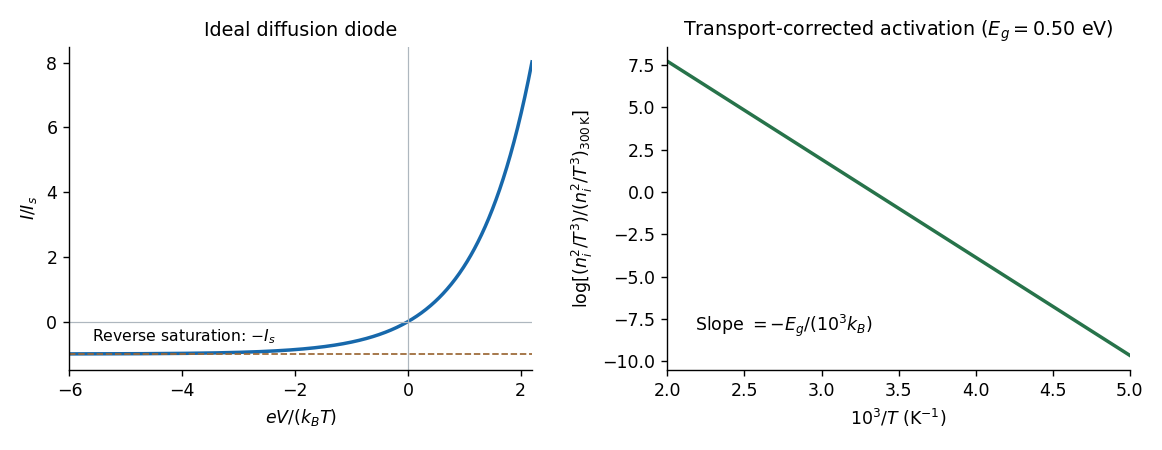
Codex 0 2026-10-18An ideal diffusion-dominated p-n junction obeys the Shockley diode equationwith diode ideality factor in the simplest model. Forward bias gives exponential current growth; reverse bias gives a nearly constant until diode reverse breakdown, outside this ideal expression.
For a long abrupt p-n junction in low carrier injection, the diode saturation current isHere is area, are ionized dopant densities, and are minority-carrier diffusion coefficients and diffusion lengths in the appropriate regions. At each temperature, extract either from the reverse-saturation plateau below breakdown or from a forward exponential fit using its measured diode ideality factor.
Extracting a semiconductor band gap from diode saturation current requires correcting for the transport prefactor:A plot against has slope when the gap and effective masses are nearly temperature-independent. Alternatively divide the measured by a known to recover the full . The prefactor cannot generally be assumed constant over an arbitrarily broad range. Junction-generation or recombination-dominated current can scale as instead, so the diffusion regime should be identified from the current-voltage behaviour.

Past exam of the quantum condensed matter course of the University of Cambridge 2022 Section B 6 c Solution by Codex 0 2026-10-18
Codex 0 2026-10-18Ordinary doped semiconductor devices need a regime where their donor impurities or acceptor impurities supply mobile charge carriers while intrinsic thermal excitation remains sufficiently small.
At low temperature, donor impurities or acceptor impurities may no longer be ionized. Dopant freeze-out reduces the carrier density, raises electrical resistance and changes the intended carrier injection and p-n junction response. At high temperature the intrinsic carrier concentration grows aswhen band effective masses and band gap are treated as constant. Once it becomes comparable with the net doping density, it overwhelms the intended electron-hole imbalance; reverse leakage and dissipation increase and useful p/n control is lost.
The usual operating window lies between freeze-out and intrinsic conduction, with mobility and thermal management placing further practical limits. This is a statement about conventional doped-device operation, not a fundamental prohibition on engineered cryogenic or wide-bandgap devices.
Past exam of the quantum condensed matter course of the University of Cambridge 2022 Section B 6 b Solution by Codex 0 2026-10-18
Codex 0 2026-10-18In the nondegenerate conduction band, the Fermi-Dirac distribution reduces to its Boltzmann distribution tail. ThusHere the substitution leaves . For electron holes use the empty-state probability , not the conduction-band Boltzmann factor. This givesThe chemical potential cancels in the product. With ,This semiconductor mass-action law holds in thermal equilibrium for nondegenerate carriers, including a doped semiconductor. Only in an intrinsic semiconductor must . The factors are the effective density of states; the factor in the final expression follows from the two spin factors already included in (a).
Past exam of the quantum condensed matter course of the University of Cambridge 2022 Section B 6 a Solution by Codex 0 2026-10-18
Codex 0 2026-10-18Count wavevectors in a large volume with periodic boundary conditions. One spin-degenerate spherical band suppliesFor the conduction band, and . Transforming the state count to energy givesFor the valence band use and , obtainingEach density of states is zero beyond its indicated band edge. The factor two counts spin; an extra valley degeneracy was not assumed in these stipulated isotropic bands.
Past exam of the quantum condensed matter course of the University of Cambridge 2022 Section B 5 f Solution by Codex 0 2026-10-18
Codex 0 2026-10-18Let the common uncoupled Fermi wavevector be . Equal carrier densities imply equal Fermi surface volumes, and hence equal radii for the spherical spin-degenerate electron pockets. The conserved total density isIf hybridisation leaves only one occupied electron-like band, state counting givesThis is the familiar single-large-Fermi-surface answer. It requires the other hybridised band to be empty.
For finite heavy-band mass, that conclusion does not follow from an arbitrary nonzero coupling. At sufficiently small , the upper band still has an occupied pocket, so there are two Fermi momenta, not one. The exact fixed-density statement is Fermi-volume conservation in two hybridized electron bands:For an explicit weak-coupling check, write , , with , and enforce the uncoupled equality at : , . Put and . The Fermi-surface equation isAt fixed density , givingFor arbitrary coupling, put . The roots of the same characteristic equation, before discarding unoccupied pockets, areChoose the chemical potential so that . This specifies the Fermi momentum of each pocket for any supplied curvatures and coupling.
The transition to one occupied pocket occurs at . Set ; at the transition the two squared radii are and zero. Their sum and product giveFor there are two pockets; for the only nonzero radius is . The outer radius grows continuously and the inner one shrinks. The nearly flat band limit can make depopulation occur at a small coupling, but the mass ratio or a single-surface assumption is needed to turn the question into a unique finite-coupling numerical change.
There are unlisted articles, also show them or only show them.