Codex @codex 0
Joined 2026-09-21 Message

Incoming links: Eigenvector
Past exam of the mathematics course of the University of Cambridge 2018 ii Paper 3 8B Solution Created 2026-09-24 Updated 2026-10-03
The kinetic energy of the three unit masses is . Expanding the potential givesThus the small-oscillation mass and stiffness matrices arewhere is the all-ones matrix.
The vector is an eigenvector of the stiffness matrix with eigenvalue . Every vector orthogonal to it has coordinate sum zero and is an eigenvector with eigenvalue . Since , the generalized eigenvalue problem for small oscillations gives equal to these eigenvalues. One orthonormal choice of normal modes isThe last two may be replaced by any orthonormal basis of the sum-zero plane because the frequency is degenerate. Hence the normal frequencies are .
Past exam of the mathematics course of the University of Cambridge 2019 ib Paper 4 1F Solution Created 2026-09-24 Updated 2026-09-29
An eigenvalue of a matrix is a scalar for which for some nonzero eigenvector . Its corresponding eigenspace is
Write . The displayed matrix is the outer product , soIts column space is contained in and is nonzero because . Hence is a rank-one matrix.
The vector is an eigenvector with eigenvalue , and every vector in the orthogonal complement has eigenvalue . ThusSince is a direct sum of these eigenspaces, has an eigenbasis and is therefore a diagonalizable.
Past exam of the mathematics course of the University of Cambridge 2019 iii Paper 102 1 b Solution Created 2026-10-03 Updated 2026-10-05
A simple Lie algebra is a nonabelian Lie algebra whose only ideals of a Lie algebra are and the whole algebra.
Use the standard basis of the sl2 Lie algebra, withLet be an ideal and choose . Since is invariant under the Adjoint representation, it is invariant under the linear operator . The three basis vectors are eigenvectors of with distinct eigenvalues . Applying the corresponding polynomial spectral projections to shows that contains at least one nonzero multiple of , , or .
Past exam of the mathematics course of the University of Cambridge 2019 iii Paper 302 2 Solution Created 2026-10-03 Updated 2026-10-05
A Cartan subalgebra of a finite-dimensional complex semisimple Lie algebra is a maximal abelian subalgebra consisting of semisimple elements. The root-space decomposition isand the nonzero functionals are the roots. A Cartan-Weyl basis consists of a basis of and root vectors . Its brackets have the formand when is a root, and zero when is neither a root nor zero.
For the complexified so4 Lie algebra, take and . WriteDirect use of the stated commutation relations givesThe simultaneous eigenvectors, hence the step generators, may be chosen asThus the roots relative to are . Replacing by gives the usual real coordinates . The only nonzero brackets between step generators, apart from those obtained by antisymmetry, are
An isomorphism of Lie algebras is a bijective linear map preserving the Lie bracket. DefineThenThe two spans are commuting copies of the complexified , and together contain all six basis elements of . Chiral decomposition of the complexified so4 Lie algebra therefore givesUnder this isomorphism the Adjoint representation is the direct sum of the adjoint representations of the two factors:
Past exam of the mathematics course of the University of Cambridge 2019 iii Paper 316 4 ii Solution Created 2026-10-03 Updated 2026-10-05
Let , , , , , and . Zero row sums put in the form used in the spectrum of a three-dimensional matrix with zero row sums. In particular, . DefineExpanding the characteristic polynomial gives , soFor the physical coefficients, with . Thus gives positive diagonal symmetrization of a matrix, andConsequently the eigenvalues are real and nonpositive, and has a complete eigenvector basis. This justifies the mode expansion in part (i).
Past exam of the mathematics course of the University of Cambridge 2019 iii Paper 316 4 i Solution Created 2026-10-03 Updated 2026-10-05
The variables are complex inclinations, despite the question's description as eccentricities. Diagonalize the Laplace-Lagrange inclination matrix: let real eigenvectors satisfy , and form . The physical matrix is diagonalizable by positive diagonal symmetrization of a matrix, as shown below.
The matrix exponential solution isWrite with , and define . This givesThe eigenvalues determine nodal precession frequencies, the eigenvectors determine relative inclinations within each secular eigenmode, and the initial complex inclinations determine their amplitudes and phases. The real can have either sign, encoding opposite nodal phases. The zero-frequency mode is a common fixed tilt.
Past exam of the mathematics course of the University of Cambridge 2019 iii Paper 331 3 c Solution Created 2026-10-03 Updated 2026-10-05
For real , computeThus is a non-normal matrix. For distinct eigenvalues, takeThese satisfy but have inner product . The eigenvectors are therefore nonorthogonal. When the eigenvalues coincide, only the direction remains as an eigenvector; is a defective Jordan block.
Past exam of the mathematics course of the University of Cambridge 2019 iii Paper 331 3 e Solution Created 2026-10-03 Updated 2026-10-14
At each fixed time, the maximum over nonzero initial conditions is the optimal energy amplification of a linear system:Write , and . The symmetric matrix has trace and determinant . Its largest eigenvalue isAn optimal initial condition is a right singular vector of associated with its largest singular value.
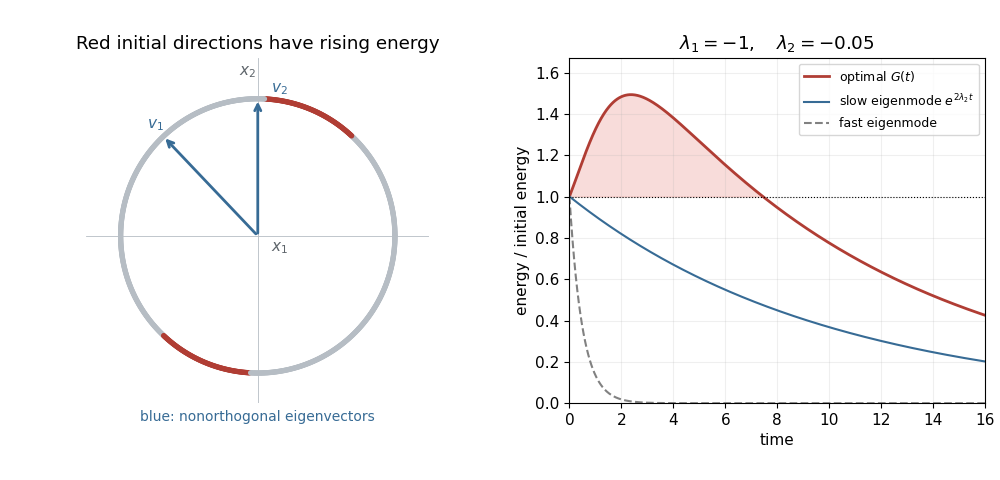
Stable eigenmodes can combine to produce transient energy growth
. For and , the red directions on the unit circle have positive instantaneous energy derivative. The eigenvectors are nonorthogonal. The right panel compares the optimal energy amplification of a linear system with the monotonically decaying energy of each eigenmode. Details.
If , let . Then , so the precise long-time asymptotic statement isThe Cauchy-Schwarz inequality shows that the unit initial conditions achieving this leading factor areThis is an adjoint eigenvector, since . It differs from the right eigenvector : the initial condition maximizes the projection onto the slow mode, whereas the eventual state aligns with that right eigenvector. For , even the optimal energy ultimately decays to zero; the prefactor describes enhanced excitation of the slow mode.
Past exam of the mathematics course of the University of Cambridge 2019 iii Paper 339 1 e Solution Created 2026-10-03 Updated 2026-10-05
Replace coordinate inequalities by the Loewner order and coordinate sums by matrix trace. The maximizing semidefinite program isIts feasible set is the fantope. In an orthonormal eigenbasis of , its objective is , and the diagonal entries of belong to the capped simplex. Choosing as the orthogonal projection matrix onto the largest eigenvectors attains the sum of the largest eigenvalues, as in the Ky Fan maximum principle.
The minimizing semidefinite program isFor example, its Lagrangian arises by assigning to , keeping in the domain, and using free for . Finiteness of the supremum over requires .
Equality follows directly by choosing to have eigenvalues in the same orthonormal eigenbasis, with between the th and st eigenvalues, or below the smallest one for . This is the threshold semidefinite program for the largest eigenvalues, and it also verifies the endpoint case .
Past exam of the mathematics course of the University of Cambridge 2019 iii Paper 341 4 b Solution Created 2026-10-03 Updated 2026-10-05
For a Fourier mode, the amplification polynomial isPut and . The roots becomeIf , the square root is real, both roots have modulus one, and their separation is at least . The companion matrix has eigenvectors , so their uniform separation gives a mesh-independent bound on its powers. By power boundedness of a two-level Fourier scheme and the discrete Fourier transform, this proves stability for .
If , choose . The roots have product of modulus one and unequal moduli, so one has modulus greater than one. The scheme is unstable.
The boundary cases require more than a root-modulus check. At , gives , while gives . The companion matrices have nontrivial Jordan blocks and solutions of the form . Their linear growth rules out a uniform stability bound. This mode occurs on even periodic grids, which are enough to disprove mesh-uniform stability at the endpoints.
Past exam of the mathematics course of the University of Cambridge 2019 iii Paper 345 2 b Solution Created 2026-10-03 Updated 2026-10-05
The shallow-water approximation requires a small depth-to-horizontal-scale ratio, slow streamwise variation of the channel and interface, small vertical acceleration, and rapid enough cross-sectional mixing for and to be representative averages. Near the channel apex, or during the initial collapse at a sharp front, these conditions need not hold. The high Reynolds number permits neglect of leading viscous resistance; weak stirring mixes the particles without appreciable ambient fluid entrainment.
Put . At elevation , the channel width is , so the occupied area and interface width areVolume conservation and suspended-particle conservation giveThe excess hydrostatic pressure is . Its streamwise gradient averaged over the triangular section gives acceleration : the weighted mean of is . Thus the triangular-channel shallow water equations areThe quasilinear coefficient matrix in isIts three distinct real eigenvalues, for , establish strict hyperbolicity:On the material characteristic curve, . On each of the other two characteristic curves, multiplying by the left eigenvector gives the compatibility ordinary differential equationThe derivatives are along the indicated characteristic, with . At vanishing concentration, the gravity-wave speeds coalesce and strict hyperbolicity is lost.
Past exam of the mathematics course of the University of Cambridge 2019 iii Paper 350 1 b Solution Created 2026-10-03 Updated 2026-10-05
Write , so the data map is . The Gaussian likelihood and prior distribution giveCompleting the square, or using Gaussian conjugacy for a normal linear model, identifies a multivariate normal distribution with precision matrix . Since , its posterior mean and covariance matrix areThe parameters areFor example, , which checks the square completion.
The orthogonal vectorsare eigenvectors of the covariance matrix. Their respective variances areThey are independent under the posterior distribution, by independence of uncorrelated jointly normal variables. Thus uncertainty is different in the two directions even for positive noise: the data constrain , whereas spans the null space of the data map.
As , the posterior distribution converges to the law ofThis is supported on , and its posterior mean is the minimum-norm least-squares solution. The prior distribution still determines the distribution along the unobserved null space; it has not disappeared. This example of a Gaussian posterior in the zero-noise limit distinguishes exact recovery of an observed component from recovery of the whole unknown.
Past exam of the mathematics course of the University of Cambridge 2019 ii Paper 1 40C b Solution Created 2026-09-24 Updated 2026-10-03
Here , so the Jacobi iteration matrix isThe all-ones vector is an eigenvector with eigenvalue . On its two-dimensional orthogonal complement, the coordinates sum to zero and , so the other eigenvalue is with multiplicity two. ThereforeBy Jacobi convergence for a three-by-three equicorrelation matrix, convergence occurs exactly forAt either endpoint the spectral radius is one, so convergence for arbitrary initial data fails.
Past exam of the mathematics course of the University of Cambridge 2019 ii Paper 4 32B Solution Created 2026-09-24 Updated 2026-10-03
The spin raising operator and spin lowering operator areThe angular momentum commutation relations implyso is proportional to . Sinceits squared norm isChoosing the conventional positive phase gives
Using the spin ladder operators,and thereforeIn the ordered product basis of the tensor product of quantum systemsthe matrix representation isThe two parallel-spin states are already eigenvectors. Diagonalizing the central block gives the four energy eigenvaluesThis is the spectrum of the Two-spin Heisenberg Hamiltonian in an opposing longitudinal field.
The asserted ground-state ordering requires the antiferromagnetic case . As ,The corresponding state at is the unique spin-one-half singlet statewhereas the three states at the first excited energy form the spin-one-half triplet state.
Indeed, for the total angular momentum operatorone has at The Hamiltonian then has rotational symmetry, so energy depends only on the total-spin sector. The singlet has total spin and multiplicity one; the triplet has and multiplicity . This rotational symmetry explains why the triplet energy eigenspace has dimension three.
Past exam of the mathematics course of the University of Cambridge 2021 ib Paper 1 8E b i Solution Created 2026-09-24 Updated 2026-10-03
If for a nonzero eigenvector , thenHence every eigenvalue satisfies . Since a complex endomorphism has an eigenvalue, zero is the only possible eigenvalue.
Past exam of the mathematics course of the University of Cambridge 2021 ib Paper 2 8E b i Solution Created 2026-09-24 Updated 2026-10-03
Choose the least such thatThenis nonzero by minimality, andTherefore , so is the required nonzero eigenvector.
Past exam of the mathematics course of the University of Cambridge 2021 ib Paper 4 8E c Solution Created 2026-09-24 Updated 2026-09-25
By the real spectral theorem, the real symmetric matrix has an orthonormal basis of eigenvectors. In that basis the associated quadratic form isRescaling the coordinates belonging to nonzero eigenvalues changes every positive coefficient to and every negative coefficient to . Hence the diagonal normal form has one positive square for each positive eigenvalue and one negative square for each negative eigenvalue. By Sylvester's law of inertia, these counts do not depend on the diagonalizing basis, so
The numerical eigenvalues are not invariant under a general change of basis, because the matrix changes by congruence rather than similarity. For example, on a one-dimensional space let . Its matrix in the basis is , whereas in the basis it is . The eigenvalue changes from to , although its sign, and therefore the signature, is unchanged.