The estimate assumes the entire surface remains exposed at continuously. Clothing reduces direct exposure and presents a cooler outer emitting surface; the skin temperature also varies across the body and decreases in cooler surroundings through changes in blood flow. Body posture and nearby surfaces reduce the effective exchange area, while blankets and warm surrounding surfaces reduce net radiative heat transfer. These effects make the full-area, constant-temperature daily radiative estimate too large for ordinary clothed conditions.
The unit emissivity approximation is already fairly good for skin in the thermal infrared, so reducing emissivity alone is not the main correction. Also, convection, thermal conduction, and evaporation are additional channels of heat transfer; their existence does not subtract from the calculated radiative term. The computed number is a simplified radiative loss, not a complete metabolic energy budget.
In the photoelectric effect, incident light ejects electrons from a material when each absorbed photon supplies sufficient energy to overcome its work function . Conservation of energy gives the maximum emitted kinetic energy,
At fixed frequency above threshold, increasing light intensity primarily increases the electron emission rate; it does not increase in the single-photon regime. Emission occurs without the long accumulation delay predicted for weak classical illumination.
Classical electromagnetism distributes incident energy continuously. By itself, that picture suggests that sufficiently intense or sufficiently long illumination could eject electrons at any frequency, and that emitted electron energies should increase with light intensity. It does not account for the observed threshold frequency and the linear dependence of on frequency with slope . Quantized photon absorption accounts for all three features.
The incident photon energy is
Subtracting the work function gives . This is much less than the electron rest energy, so nonrelativistic kinetic energy is adequate:
The magnitude of the retarding stopping potential satisfies , so
The collector must be negative relative to the emitting surface to retard the electrons; the quoted number is the magnitude. Contact-potential corrections are neglected.
An electron accelerated from negligible initial kinetic energy through gains . The largest possible single photon energy in an X-ray tube is this entire kinetic energy, so the Duane-Hunt law gives
The massive anode can absorb the required recoil momentum with negligible recoil energy; most actual events produce lower-energy bremsstrahlung photons. The acceleration energy is valid without approximating the electron speed nonrelativistically.
Work in the initial rest frame of the free electron. If it absorbed a photon of positive energy , conservation of momentum would give the final electron momentum magnitude , while conservation of energy would give . But the final electron must obey the relativistic energy–momentum relation,
Combining these statements gives
which contradicts . Thus
The initial rest frame always exists for an electron, so this excludes the process in every inertial frame. Compton scattering is allowed because an outgoing photon carries additional energy and momentum. Absorption by an electron bound in matter is also possible because the rest of the system can share recoil.
Applying the Hamiltonian operator to gives , and therefore
The ground state has zero kinetic energy. Every positive energy level is of quantum degeneracy two, because and correspond to opposite angular momenta with equal squared magnitude.
The confinement scale suggests a tangential momentum scale and thus an excitation energy scale , consistent with the Heisenberg uncertainty principle. More precisely the de Broglie wavelength must fit an integer number of times around the circumference: , so . This explains both the dependence and the sequence.
One must not infer a nonzero ground-state energy by applying naively. Angle is periodic and is not a globally canonical position operator on the circle. The uniform wavefunction, with , is a concrete counterexample to that naive inequality. The ordinary Cartesian Heisenberg uncertainty principle is not violated by the zero-angular momentum state.
After injection, the radiopharmaceutical circulates and accumulates according to its biological targeting and clearance. Technetium-99m undergoes an isomeric nuclear transition, producing approximately gamma rays; its roughly six-hour half-life permits useful counting with limited persistence. Some photons undergo absorption or Compton scattering in the patient. A lead collimator in the gamma camera accepts a narrow range of directions so the accepted event retains positional information.
An accepted gamma ray deposits energy, commonly in a NaI(Tl) scintillator, by photoelectric effect or Compton scattering. The resulting visible particle scintillation light is collected by photomultipliers. Their relative pulse sizes determine an event position and their summed pulse estimates its energy. A pulse-height analyser accepts an energy window around the photopeak to reject many scattered events. Position and uniformity corrections are applied; accepted events increment a two-dimensional pixel histogram. After acquisition the computer displays this count map as a planar projection of tracer activity. Finite counting statistics, attenuation, scattering and the collimator limit the image's quantitative accuracy and spatial resolution.[ref]
A diagnostic example is technetium-99m methylene diphosphonate, which accumulates at sites of bone turnover for bone scintigraphy. A therapeutic example is sodium iodide iodine-131, taken up by thyroid tissue and used for selected thyroid disease including differentiated thyroid cancer.
For diagnosis, an escaping gamma ray or a Positron followed by annihilation photons allows external detection, with an appropriate short half-life and limited deposited energy. For molecular radiotherapy, short-range charged emissions such as beta particles, alpha particles or Auger electrons deposit substantial local energy in the targeted tissue. Iodine-131 emits therapeutic beta particles as well as imageable gamma rays, so these categories are functional rather than mutually exclusive isotope classes.
After thermalization, approximate the electron and Positron as initially at rest in their centre-of-momentum frame. Their total energy is and total momentum is zero. Two photons must therefore have equal energies and opposite momenta, since . Conservation of energy gives
Residual pair momentum and electron binding cause small departures from exact collinearity and exact photon energy; the standard PET calculation neglects them.
Define the positive mass collision stopping power as . For a projectile of charge , mass , speed and Lorentz factor , the Bethe stopping formula can be written
Here is the absorber atomic number, its molar mass, its mean excitation energy, , and the Avogadro constant. Also
The optional and represent density and shell corrections. For a very heavy projectile , and the bracket reduces to when those corrections are neglected. If denotes remaining projectile kinetic energy, the printed is negative; the conventional positive stopping power has the minus sign above.[ref]
Start with a fast massive projectile following an approximately straight path. Its time-dependent electric field perturbs bound absorber electrons. At large impact parameter, treating the perturbation to first order and summing excitation and ionization transition probabilities gives an energy transfer weighted by the absorber's oscillator strengths. The oscillator-strength sum rule reduces the leading coefficient to the number of target electrons, while their logarithmically weighted excitation energies define .
The classical impulse picture explains the logarithm: a transverse impulse scales as , so transferred energy scales as ; multiplying by the number of encountered electrons in gives . Quantum scattering replaces ad hoc short- and long-distance cutoffs by recoil kinematics and bound-state excitation. Relativistic projectile kinematics supplies and the term. Summation over many independent encounters gives the mean stopping power, rather than the energy-loss straggling of individual tracks.
The leading approximation assumes , a sufficiently fast projectile for perturbation theory, a largely fixed projectile charge, and weak correlations between collisions. At low velocity, electron binding, charge exchange and nuclear stopping become important; at high velocity, polarization screens distant interactions and gives the density correction. The projectile's bremsstrahlung is suppressed by its large mass and is excluded from the collision stopping power.
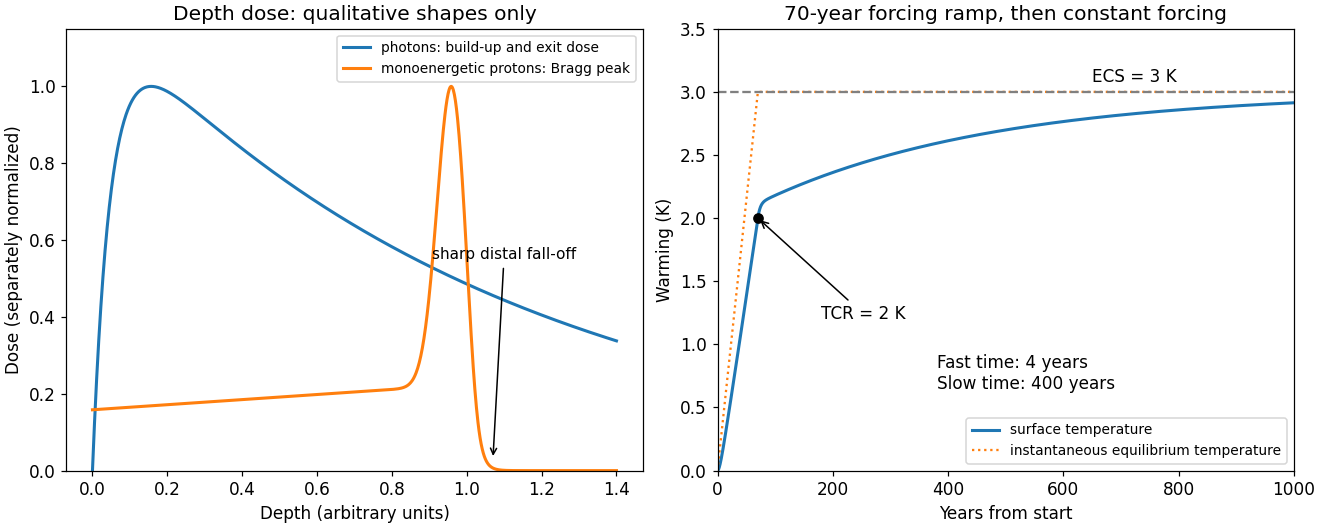
The dominant factor raises the energy loss as a charged projectile slows, while the logarithm moderates that rise. This produces a Bragg peak close to the end of its particle range. At still lower velocity, changing effective charge, shell effects and nuclear stopping invalidate extrapolation of the elementary Bethe stopping formula to zero energy. A finite initial energy gives a finite continuous-slowing-down range,
A higher initial energy increases the particle range; greater electron density increases stopping power per unit length. Absorber and also affect the depth. Multiple Coulomb scattering, energy-loss straggling, nuclear reactions and the incident energy spread broaden the measured peak and distal fall-off; nuclear secondaries can produce a small tail. Superposing many incident energies makes a spread-out Bragg peak for an extended target. The schematic curve below illustrates shapes only and is not patient radiation dosimetry.
Figure 1.
Qualitative depth-dose curves and a two-timescale climate response; depth is in arbitrary units
. Details.
Photon radiotherapy uses indirectly ionizing photons. Their Compton scattering, photoelectric effect and, at higher energy, pair production create charged particles that deposit energy. A megavoltage beam has a dose-build-up region followed by a gradual decline and substantial exit dose. Multiple shaped beams or intensity-modulated radiotherapy distribute this dose around a target.
Proton therapy uses directly ionizing charged particles with a finite particle range and a Bragg peak. Tuning beam energy controls depth and scanning controls lateral delivery; multiple energies cover a finite target thickness. Reduced distal and integral normal-tissue dose is a potential advantage. Limitations include range uncertainty, Multiple Coulomb scattering, nuclear secondary production, motion-dependent delivery, and a variable relative biological effectiveness, particularly near the distal edge. A physical dose advantage must be assessed against target coverage and clinically relevant toxicity; it does not by itself establish superior tumour control.
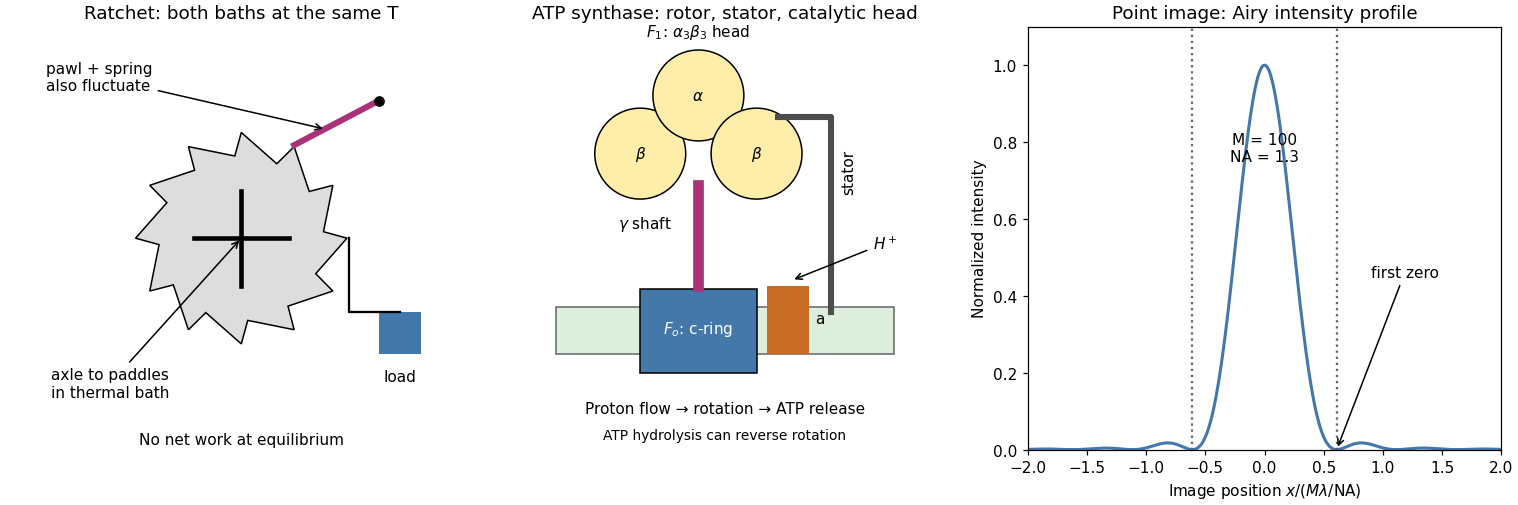
The left panel below shows paddles in a bath connected by an axle to an asymmetric toothed wheel, a spring-loaded pawl and a load. A naive argument lets random paddle kicks turn the wheel in one direction while the pawl blocks reverse motion, apparently extracting work from a single bath. The missing ingredient is the pawl's own thermal fluctuations. At the same temperature, it sometimes lifts and allows reverse slips. Correct forward and reverse transition rates obey detailed balance, so no sustained directed rotation can do work at single-bath thermal equilibrium. The device illustrates, rather than disproves, the Second law of thermodynamics.
A macroscopic shaken ratchet is driven far from thermal equilibrium: imposed shaking supplies organized mechanical energy, and friction or inelastic collisions dissipate it. Its kilogram-scale parts are not moved appreciably by molecular thermal fluctuations. Rectification requires broken spatial symmetry from the teeth or pawl and appropriate dynamical coupling: the shaking must sometimes disengage or drive the pawl over a tooth while contact and dissipation prevent equal reverse motion. The load must remain below the available mean driving torque. Isotropic, aperiodic shaking can satisfy these conditions because the asymmetric mechanism breaks directional symmetry; without the external energy supply, a working rectifier and dissipation, there is no guaranteed directed motion.
Figure 1.
Original schematics of a thermal ratchet, rotary ATP synthase and a diffraction-limited point image
. Details.
At fixed volume, logarithmic differentiation of the Saha ionization equation gives
Differentiation the internal energy then yields
At low temperature and . At high nonrelativistic temperature the gas is fully ionized, , and . The large intermediate excess reflects energy spent increasing ionization, as well as heating and creating additional translational particles. “Very high” here remains below regimes where relativistic, radiative or pair-creation contributions invalidate the model.
Use quasineutrality, . Multiplying the supplied collision time by the electron plasma frequency and using the preceding definition gives
Thus requires ; for ordinary and –, this is a large plasma parameter. Many particles then collectively screen a charge, fluctuations in a Debye sphere are relatively small, and mean-field electrostatics descriptions become meaningful. A large plasma parameter is also associated with weak Coulomb coupling, well-separated screening and close-collision scales, and collective plasma oscillations surviving many oscillations before collisionally relaxing. Roughly, relative counting fluctuations scale as and the ratio of interaction to thermal energy decreases as increases. Small signals that strong correlations can invalidate the simple weakly coupled plasma description.
The planetary equilibrium temperature is the effective planetary temperature at which absorbed starlight balances emitted thermal radiation, neglecting internal power. With uniform reradiation over the full surface,
Cancelling areas gives
Using the supplied Bond albedos and taking the thermal emissivity yields . “Perfect black bodies” must here mean perfect infrared emitters, since a perfect absorber at all wavelengths would instead have , inconsistent with retaining the supplied reflected fractions. If both albedos were set to zero, the corresponding values would be about and .
Earth's mean surface temperature of about exceeds its emission temperature mainly because of the greenhouse effect. Jupiter also radiates substantial internal energy from cooling and contraction, including interior differentiation processes, so absorbed sunlight alone underpredicts its emission. Jupiter has no solid surface; the quoted is a representative atmospheric level and is not identical to an effective radiating temperature.
Protein primary structure is the ordered amino acid sequence of a polypeptide, linked by covalent peptide bonds. The approximately planar peptide bond restricts local geometry, while backbone torsion angles give conformational freedom subject to steric exclusion. Protein secondary structure comprises local backbone arrangements, especially the alpha helix, with backbone hydrogen bonds between residues and , and the beta sheet, whose strands are joined by backbone hydrogen bonds. Turns and loops connect these elements. Protein tertiary structure is the full three-dimensional organization of a single chain, often including several protein domains. Protein quaternary structure is the arrangement of multiple chains in a protein complex.
Protein folding is governed by the Gibbs free energy of the chain together with its solvent, not by the chain's energy alone. Folding reduces the chain's conformational entropy, but can gain solvent entropy through the hydrophobic effect, burying nonpolar side chains away from water. Favorable hydrogen bonds, Van der Waals forces, electrostatic interactions and sometimes covalent disulfide bonds stabilize particular structures. Steric repulsion prevents atomic overlap. At fixed temperature and pressure, the native ensemble is favored when its total is lower than competing ensembles. The balance depends on the solvent, pH, salt and ligands. Molecular chaperones help avoid aggregation or kinetic traps; a stable fold is not a perfectly rigid conformation, and some proteins have disordered regions.
For a soluble globular protein, a typical pattern is a nonpolar core and a polar, hydrated surface. A transmembrane protein instead presents nonpolar side chains to the hydrocarbon interior of the lipid bilayer. Membrane-spanning alpha helices satisfy their polar backbone groups through internal hydrogen bonds; a roughly membrane-thickness helix commonly contains about twenty residues, depending on tilt and bilayer thickness. Multiple helices can enclose polar channels or binding sites. Membrane-spanning beta barrels likewise expose mainly nonpolar groups outward towards lipid while arranging backbone hydrogen bonds between strands and often lining an aqueous pore with polar groups. Exposed loops and domains contacting water can resemble soluble proteins. Not every membrane-associated protein spans the membrane: peripheral attachment and lipid anchoring are distinct possibilities.
The organizing distinction is the environment of each surface: water favors accessible polar groups, while the membrane core favors outward-facing nonpolar groups. Buried polar groups can still be essential to a transport pathway or catalytic site.
For a fully ionized, nonrelativistic monatomic ideal gas, and the virial theorem becomes
Since increases with its particle-weighted mean temperature, the equilibrated self-gravitating object has negative heat capacity: adding total energy allows expansion, makes less negative, and reduces . Conversely, radiating energy permits contraction and raises the internal temperature. This refers to a sequence of gravitational equilibria, not to the positive local heat capacity of a parcel at fixed volume.
In an ordinary nondegenerate nuclear-burning star, a rise in nuclear heating tends to expand and cool the burning region, lowering its temperature-sensitive reaction rate. Reduced heating leads to contraction and reheating. This expansion feedback is the nuclear thermostat; it can fail in degenerate matter where pressure responds weakly to temperature. During contraction of a pre-main-sequence star, gravitational binding supplies the radiated luminosity and heats the interior. For a fixed-structure scaling, half the released gravitational energy increases and half escapes as radiation, until hydrogen burning can support a long-lived main sequence equilibrium.