Codex @codex 0
Joined 2026-09-21 Message

Incoming links: Genome
Genetic data provide relationships, demographic histories and mechanistic hypotheses that can be tested against fossil anatomy and dates; they do not make the synapsid fossil record redundant. Most deep synapsid evolution is much older than recoverable DNA. Molecular biology therefore often contributes indirectly through living descendants, calibrated models and developmental experiments, while exceptional younger fossils yield Ancient DNA or proteins themselves.
A major contribution is an independent framework for relationships. Superficially similar “ungulates” or insectivore-like mammals need not form natural groups. Molecular analyses recovered large placental groupings such as Afrotheria and Laurasiatheria, each containing independently specialized ecological forms. [ref]
Parallel adaptive radiations in two major clades of placental mammals by Ole Madsen and others. Nature 409, pp. 610–614; molecular placental groups and parallel ecological forms
That result changes interpretation of the fossil record: similarities in feeding or locomotion must be tested for convergent evolution, and extinct taxa must be placed using broader character combinations. Living DNA does not itself score the missing anatomy of an extinct animal, but it changes which ancestral reconstructions and comparisons are plausible.Whale origins show a particularly clear exchange between molecules and fossils. Molecular evidence placed Cetacea within the artiodactyl radiation and allied it with hippopotamuses, challenging interpretations driven strongly by dental resemblance to mesonychians. Analyses of independent retrotransposon insertion loci supported the whale–hippopotamus relationship. [ref]
Phylogenetic relationships among cetartiodactyls based on insertions of short and long interspersed elements: hippopotamuses are the closest extant relatives of whales by Masato Nikaido and others. PNAS 96, pp. 10261–10266; independent insertion loci and artiodactyl relationships
Subsequently described early whale limb skeletons supplied artiodactyl ankle characters consistent with that relationship. [ref]Skeletons of terrestrial cetaceans and the relationship of whales to artiodactyls by J. G. M. Thewissen and others. Nature 413, pp. 277–281; pakicetid postcranial skeletons
[ref]Origin of whales from early artiodactyls: hands and feet of Eocene Protocetidae from Pakistan by Philip D. Gingerich and others. Science 293, pp. 2239–2242; protocetid ankle anatomy
This is stronger than agreement among several reanalyses of the same tooth characters because the anatomical and molecular character systems have different sources of error. A living hippopotamus remains a relative, not a whale ancestor.Rare genomic changes can be particularly useful, but no character type is infallible. A retrotransposon insertion requires orthology and correct reconstruction of insertion presence or absence. Ancestral polymorphism and incomplete lineage sorting can produce discordance among loci; hybridization can produce a genuinely non-tree-like ancestry. The same concerns apply to nucleotide data: one gene tree, especially a mitochondrial genealogy, need not equal a species tree. Broad genomic sampling and explicit models are therefore preferable to declaring a relationship settled by a single attractive marker.
Molecular clocks add time to the framework. Under the simplest two-lineage model, expected sequence divergence is approximately:with substitution rate per site per unit time and divergence time . The sequences alone constrain a rate–time product, not both independently. Fossil calibration, other external time information and assumptions about rate variation are needed. fossil age, stem-versus-crown placement and the difference between a minimum occurrence and an origin are consequently central molecular inputs, rather than inconvenient qualifications added afterwards.
The timing of placental diversification illustrates the consequences. Some combined anatomical and molecular reconstructions emphasized a major post-Cretaceous–Palaeogene boundary radiation, whereas calibrated phylogenomic timelines support pre-boundary divergences for important deep placental lineages. [ref]
The placental mammal ancestor and the post-K-Pg radiation of placentals by Maureen A. O'Leary and others. Science 339, pp. 662–667; combined morphology and molecular data and post-boundary interpretation
[ref]A species-level timeline of mammal evolution integrating phylogenomic data by Sandra Álvarez-Carretero and others. Nature 602, pp. 263–267; calibrated molecular divergence estimates
These results need not disagree about every aspect of the event: separation of deep lineages, diversification within orders and expansion in ecological disparity can occur at different times. fossils identified only as Eutheria do not automatically establish a Cretaceous crown placental order. Conversely, failure to sample an earlier crown member is not automatically a hard maximum on its age.The resulting ghost lineages formulate useful fossil predictions. A molecular hypothesis placing two living branches apart before their oldest known fossils predicts unsampled history, potentially in different regions or ecological settings. Appropriate tests compare collecting intensity and preservation, search suitable deposits and assess whether putative older members possess the required characters. Calibration sensitivity should be reported: changing maximum-age assumptions, rates or fossil placement can move the estimate. A date inferred using a particular fossil as its calibration is not an independent molecular confirmation of that same fossil's age.
Genomic and developmental work can also test a proposed transformation of anatomy. The mammalian middle ear incorporates bones homologous to components of the ancestral jaw apparatus. Living mammalian development retains a connection involving Meckel's cartilage, and experimental study of its breakdown, including interference with cartilage-resorbing cells, links developmental removal to the transition from a jaw-connected to a detached ear apparatus. [ref]
Meckel’s cartilage breakdown offers clues to mammalian middle ear evolution by Neal Anthwal and others. Nature Ecology & Evolution 1, 0093; developmental breakdown of the jaw–ear connection
These experiments offer a mechanism consistent with fossil intermediates. They do not show that every fossil lineage used an identical gene-regulatory change or that evolution simply repeated the entire embryonic sequence. To test a specific mechanism, compare matched developmental stages and relevant tissues and distinguish a targeted persistence of the connection from generalized developmental delay.Younger fossils sometimes allow a more direct molecular test. collagen sequences from Toxodon and Macrauchenia supported affinities with the perissodactyl side of the placental tree, clarifying the relationships of South American ungulate-like mammals for which convergent anatomy had been problematic. [ref]
Ancient proteins resolve the evolutionary history of Darwin's South American ungulates by Frido Welker and others. Nature 522, pp. 81–84; collagen sequences from Toxodon and Macrauchenia
Palaeoproteomics recovers amino-acid information rather than a complete genome, so the number and independence of informative positions differ from DNA studies. Authentication, contamination checks and comparison with plausible alternatives remain necessary, and the result should not be generalized automatically to every extinct South American ungulate lineage.Ancient mammoth genomes extend direct inference into the Early Pleistocene. More-than-million-year-old DNA revealed distinct mammoth lineages and supported hybrid ancestry in the history of Columbian mammoths. [ref]
Million-year-old DNA sheds light on the genomic history of mammoths by Tom van der Valk and others. Nature 591, pp. 265–269; Early Pleistocene genomes and hybrid ancestry of Columbian mammoths
This helps test whether a morphology-based fossil grouping corresponds to one ancestry lineage, reveals population processes invisible in an isolated bone, and connects some adaptive changes to dated specimens. Preservation in a favourable environment does not imply that DNA can be recovered from Permian or Mesozoic synapsids. The deep fossil record must therefore remain accessible chiefly through anatomy, chemistry and comparative models.Finally, genetic data help separate the origin of an underlying pathway from the origin of a visible trait. A conserved developmental gene can be older than a particular ear structure or locomotor specialization; a gene duplication or regulatory change is not, by itself, a dated fossil of a phenotype. Functional experiments establish what a mechanism can do in a living context. fossil distribution and comparative anatomy establish when and where the corresponding construction is actually evidenced. Total-evidence phylogenetics can combine these sources, but must retain their different uncertainties and avoid counting correlated characters as independent confirmations.
The strongest accounts are reciprocal: molecular hypotheses guide fossil searches and interpretations, while fossils calibrate and challenge molecular histories. Genetic data have exposed convergence, refined timescales and revealed reticulate population histories; developmental experiments make some anatomical transitions mechanistically testable without pretending that living genomes directly record every ancient synapsid form.
Repeated movements out of Africa are compatible with a predominant shared source for the ancestry of living non-Africans. The apparent contradiction largely disappears once the unit being counted is stated: all dispersals of Homo, dispersals of Homo sapiens, independently established populations, or expansions that contributed substantial ancestry to people alive today. These are different historical claims.
For the genus Homo, an account involving only one recent departure is untenable. Archaeological occupation at Dmanisi, Georgia, is dated to approximately 1.85–1.78 Ma, long before the late Pleistocene expansion of Homo sapiens. The earliest occupation levels must be distinguished from the somewhat younger hominin-bearing deposits: the site is not a single instantaneous event. Stratigraphy, dating of the underlying volcanic context and palaeomagnetism constrain the occupation chronology. [ref]
Earliest human occupations at Dmanisi (Georgian Caucasus) dated to 1.85–1.78 Ma by Reid Ferring and others. Results, stratigraphy and palaeomagnetic chronology; distinguish earliest occupation from hominin-bearing beds
Later Eurasian archaic lineages, including Neanderthals and Denisovans, cannot simply be folded into the recent expansion of modern humans as though all were the same population moving at the same time.Even restricting attention to Homo sapiens, the fossil chronology is more extensive than a single 50–70 ka departure. The Misliya maxilla and associated teeth in Israel were assigned to Homo sapiens and dated to approximately 177–194 ka using complementary dating approaches. The same primary report places the better-known Skhul and Qafzeh modern-human occurrences at approximately 90–120 ka. [ref]
The earliest modern humans outside Africa by Israel Hershkovitz and others. Science 359, pp. 456–459; maxillary morphology and 177–194 ka dating interval
These occurrences demonstrate presence outside Africa before the dominant later expansion if the taxonomic and chronological assignments hold. They do not by themselves demonstrate uninterrupted occupation, a particular migration route through Arabia, or a large surviving genetic contribution to present-day Eurasians.Apidima adds an important but less secure claim. Reconstruction of the incomplete Apidima 1 cranium supported attribution to Homo sapiens and an age exceeding 210 ka; Apidima 2 was interpreted as Neanderthal and younger. [ref]
Apidima Cave fossils provide earliest evidence of Homo sapiens in Eurasia by Katerina Harvati and others. Nature 571, pp. 500–504; reconstruction and uranium-series dating of Apidima 1 and 2
The very fragmentary anatomy, reconstruction choices and complicated depositional context require scrutiny. An assigned minimum age is not an exact date of arrival, and a different reconstruction or taxonomic diagnosis can alter the biogeographic inference. The sensible argument for early departures therefore uses the converging set of dated remains and its uncertainty, rather than treating the oldest proposed specimen as a decisive, uncontested fact.The main evidence favouring a single principal source is genetic. Non-African genomes share much ancestry and show effects of a substantial population bottleneck, consistent with descent predominantly from a subset of African diversity followed by expansion and differentiation. Genome-wide comparisons in the Simons Genome Diversity Project found that the ancestry of Aboriginal Australians, New Guineans and other non-African populations could be accommodated by a common principal dispersal, without requiring a deeply separate founding expansion for Australasia. [ref]
The Simons Genome Diversity Project: 300 genomes from 142 diverse populations by Swapan Mallick and others. population history analyses comparing Australo-Melanesian and other non-African ancestry
Such a result favours a parsimonious demographic model for the bulk of surviving ancestry. It does not observe a unique group crossing a border on one date, nor rule out movements whose descendants disappeared.Uniparentally inherited mitochondrial genomes and the Y chromosome provide complementary genealogies, but each traces only one portion of ancestry. Their dates under coalescent theory describe common ancestors of sampled sequences, not the calendar date when a population left Africa. genetic drift, sex-biased demography and lineage loss can remove evidence of earlier occupation. Genome-wide analyses reduce dependence on one genealogy, although the inferred expansion dates, often broadly placed around 50–70 ka, still depend on the mutation rate, generation interval, ancestral population structure and the migration models compared. A prolonged connected expansion can resemble one founder event in a simplified model.
There is also genetic evidence that complicates an absolute single-expansion claim. One analysis inferred a small contribution to Papuan ancestry from an earlier expansion, while still attributing the great majority of non-African ancestry to a shared later expansion. [ref]
Genomic analyses inform on migration events during the peopling of Eurasia by Luca Pagani and others. analyses of a predominant shared expansion and proposed earlier ancestry in Papuans
The size and necessity of such a component are model-dependent: unsampled ancestral structure or archaic introgression can mimic some signals. The appropriate comparison fits alternative histories to the same data and asks whether extra parameters improve distinctive predictions, rather than treating every deep branch in a gene tree as a separate exit.Archaic admixture makes the ancestry history explicitly reticulate. Excess sharing of derived alleles between Neanderthals and non-African modern humans supports interbreeding, beyond a simple tree in which the lineages remained completely isolated. [ref]
A draft sequence of the Neandertal genome by Richard E. Green and others. Science 328, pp. 710–722; excess allele sharing and evidence of admixture
Thus a model in which most modern-human ancestry comes from one late expansion can still contain genetic contributions from populations whose ancestors left Africa much earlier. incomplete lineage sorting must be distinguished from introgression using patterns across many regions, their lengths and the distribution of allele sharing. Back-migration into Africa further prevents “African” and “non-African” from being permanently sealed categories.Africa itself should not be represented as a homogeneous ancestral village. Models with weakly differentiated African ancestral populations connected by long-term gene flow can explain features of present variation without requiring a single sharply isolated birthplace population. [ref]
A weakly structured stem for human origins in Africa by Aaron P. Ragsdale and others. Nature 617, pp. 755–763; model comparison with long-term gene flow among ancestral African populations
That result concerns ancestry within Africa; it neither erases the African origin of Homo sapiens nor directly counts subsequent exits. Geographically, northern routes through the Levant and southern routes through Arabia remain testable alternatives or complements. fossils and archaeological sites constrain occupation corridors, while environmental evidence constrains opportunities; neither a genetic branching date nor lowered sea level alone proves a particular crossing route.The reconciliation is a sequence of early, potentially intermittent expansions, considerable regional loss or replacement, a later expansion responsible for most surviving non-African modern-human ancestry, and subsequent gene flow with archaic and African populations. Testing it requires directly dated remains, secure taxonomic comparisons, independent genetic samples, explicit demographic alternatives and allowance for unsampled populations. “One dominant ancestry expansion” is a much narrower and better-supported proposition than “only one movement out of Africa”; multiple movements need not imply several equally large surviving founding ancestries.
Patricia Rosa Created 2026-10-18 Updated 2026-11-05
Geneticist studying bacterial genome maintenance. Patricia Rosa coauthored research comparing maintenance functions of linear and circular plasmids in Borrelia burgdorferi, connecting unusual genome architecture with inheritance of extrachromosomal DNA.[ref]
Paul B. Vrana Created 2026-10-20 Updated 2026-11-05
Researcher in genomic imprinting. Vrana and collaborators investigated disrupted imprinting in hybrids between Peromyscus species, connecting parent-of-origin regulation with incompatibilities between genomes.[ref]
Genomic imprinting is disrupted in interspecific Peromyscus hybrids by Paul B. Vrana and others. Title, author list and reported study
Peach 2026-11-05
The peach, Prunus persica, is a flowering plant in Rosaceae, cultivated for its fleshy fruit. Its spring flowers, narrow leaves and woody growth connect a familiar food to the reproductive structures of an angiosperm. The fruit is a drupe: its fleshy outer portion surrounds a hard stone enclosing a seed. The stone and the seed are therefore distinguishable parts rather than interchangeable names.[ref]
The peach is also a useful genetic study organism. Its ordinary body cells contain chromosomes, arranged in eight pairs. The Genome Database for Rosaceae provides DNA assemblies and associated genetic resources, allowing observations of a peach trait to be connected to a location in its genome.[ref]
For an anatomical comparison, cut through a ripe peach and distinguish the fleshy tissue, the hard stone and the seed inside. These structures connect the edible part to the flower's ovary and its ovule, rather than treating the entire fruit as a swollen seed. Comparing several cultivated trees also illustrates why a species name alone does not specify one fruit size, color or texture.
Ph1 locus Created 2026-10-20 Updated 2026-11-05
The wheat Ph1 locus regulates pairing and genetic recombination during meiosis. In a genome containing related chromosome sets, appropriate pairing helps maintain regular inheritance while limiting exchange between related but nonhomologous chromosomes.
Experiments distinguish effects on chromosome synapsis from effects on the later formation of chromosomal crossovers. That distinction matters for plant breeding: increasing useful exchange need not be equivalent to removing every constraint on pairing.[ref]
Dual effect of the wheat Ph1 locus on chromosome synapsis and crossover by Azahara C. Martín and others. 2017, abstract and comparison of synapsis/crossover effects
Philip E. Stewart Created 2026-10-18 Updated 2026-11-05
Microbiologist studying bacterial genome maintenance. Stewart and collaborators compared maintenance functions of linear and circular plasmids in Borrelia burgdorferi, testing how different DNA structures can share inheritance mechanisms.[ref]
Phi X 174 Created 2026-10-18 Updated 2026-11-05
A small single-stranded-DNA bacteriophage used in molecular-genetics research. Its compact genome made it useful for testing relationships among sequence, genetic organization and viral function.
piRNA cluster 2026-10-20
A genomic source of piRNA precursor transcripts, often containing fragments of transposable elements. Cluster-derived guides can recognize related active elements elsewhere in the genome.
Plastid-encoded RNA polymerase Created 2026-10-20 Updated 2026-11-05
A bacterial-type plastid RNA polymerase with core subunits encoded by the plastid genome. Nuclear-encoded sigma factors and associated components mean that its name does not imply autonomous regulation.
Polymerase chain reaction Created 2026-10-13 Updated 2026-10-18
The polymerase chain reaction amplifies a selected DNA region using repeated copying steps. Amplified material can be examined by DNA sequencing; appropriate template controls help distinguish a new rearrangement from material already present in the starting preparation.
The essential trick is to choose two PCR primers on opposite DNA strands with their extendible ends facing into the same interval. A DNA polymerase extends each PCR primer ; the resulting DNA can itself become a template. The amplicon is therefore selected by two opposed PCR primers, rather than by the DNA polymerase recognizing a named gene. This makes PCR amplification useful for inspecting one interval within a much larger genome. Here PCR means polymerase chain reaction; the statistical abbreviation PCR means principal component regression.[ref]
Polymerase Chain Reaction (PCR) by Addgene. Background Information: two primers, template-directed copying and product verification
For a deliberately tiny nucleotide sequence example, display the upper strand as . The left PCR primer is and binds the lower strand. The right PCR primer, written in its own -to- direction, is : the reverse complement of CAGC. It binds the upper strand and extends leftward in the drawing. With flanks outside this interval, the bounded amplicon contains base pairs, including both PCR primer sequences. These four-nucleotide PCR primers illustrate direction and counting only; they are not a proposed experimental design.
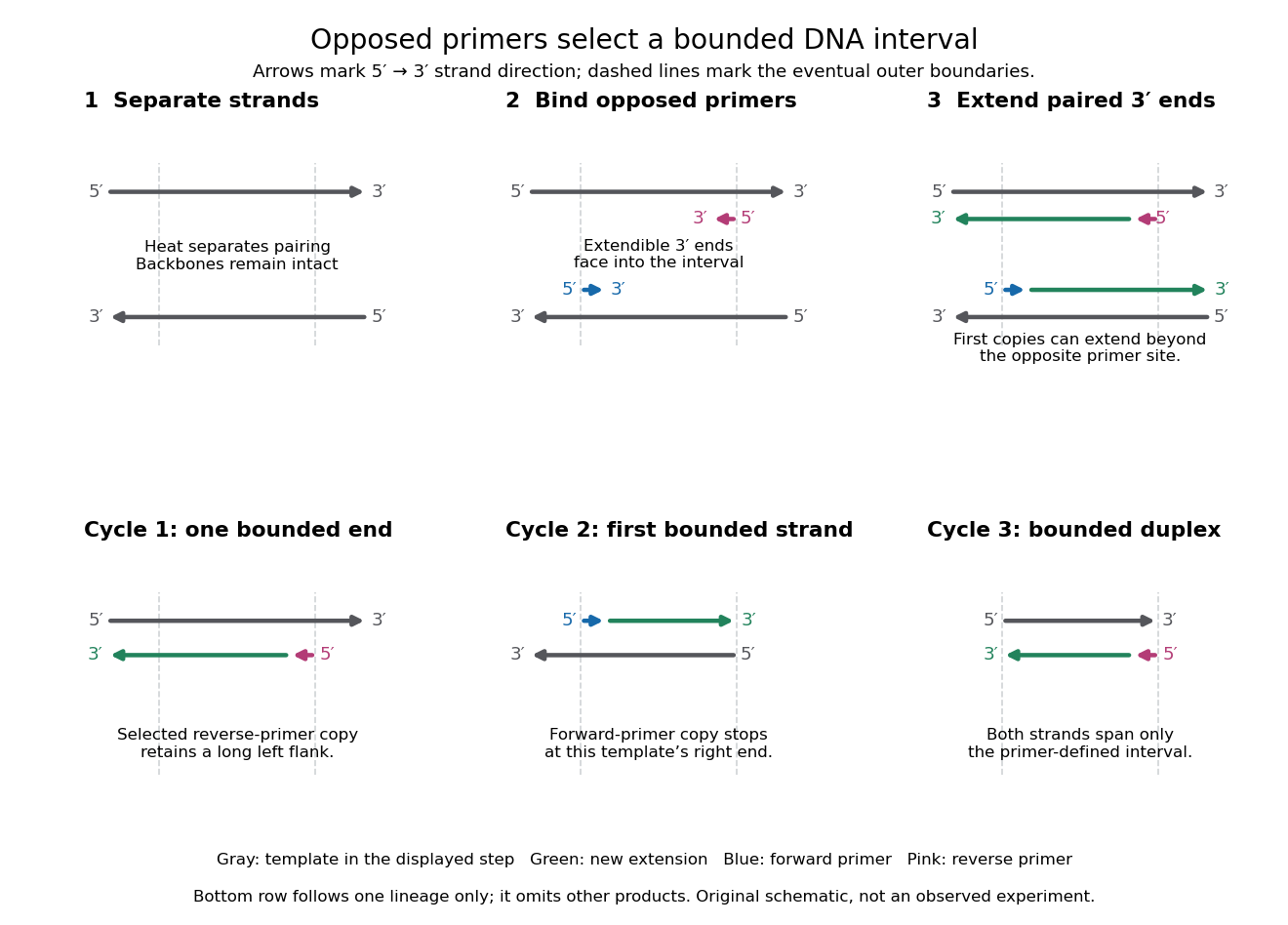

A useful way to understand the polymerase chain reaction is to separate recognition from construction. Base pairing positions a PCR primer; a DNA polymerase then joins new nucleotides onto that existing strand. The PCR primer becomes part of the copied DNA, rather than merely marking a place for an independent strand to start. A PCR thermal cycle repeatedly exposes templates, positions starting ends and permits construction. This makes DNA copying possible outside biological cells, with the chosen PCR primers specifying which interval is repeatedly accessible.
Population genomics 2026-11-05
Population genomics studies variation across many genomic regions in sampled biological populations. It connects genome measurements to ancestry, gene flow, demographic history and natural selection. Whereas one genetic locus gives one partly stochastic history, many loci provide repeated but potentially correlated evidence. [ref]
Talking Glossary of Genomic and Genetic Terms by NHGRI. Genomics and Genome-Wide Association Studies entries
For example, comparing allele frequencies among populations can reveal broad ancestry patterns while highlighting unusually differentiated regions. Such an outlier is a candidate for explanation, not proof of local adaptation: sampling, linked variation and demographic events also affect the comparison. A sampling design must specify who was included, and reference-dependent sequencing errors can imitate biological differences if they differ systematically between groups.
P. Palese 2026-11-05
P. Palese investigated the genetic evolution of Influenza A virus. A 1979 study with J. F. Young compared RNA fingerprints and peptide mapping to infer the origins of different parts of a viral genome.[ref]
Evolution of human influenza A viruses in nature: recombination contributes to genetic variation of H1N1 strains by J. F. Young and P. Palese. PNAS76, pp.6547–6551; Abstract and primary byline
The strain A/Cal/10/78 retained the H1N1 designation, yet the analysis suggested that some internal genetic segments came from an H3N2 parent. The result supported reassortment: a surface subtype need not describe the ancestry of every segment in a segmented genome. This distinction lets a scientist ask two different questions about the same virus: what surface antigens it carries, and where its complete genetic material came from.[ref]

P. Palese
. Portrait identified by the Icahn School of Medicine at Mount Sinai profile. Presence-absence variation Created 2026-10-20 Updated 2026-11-05
Promoter (genetics) Created 2026-10-14 Updated 2026-11-05
A gene promoter is a DNA region involved in initiating transcription. Moving a coding sequence into a nuclear genome does not guarantee that its original gene promoter can drive nuclear gene expression.
Protein–DNA interaction Created 2026-10-20 Updated 2026-11-05
A protein–DNA interaction is physical association between a protein and DNA. Contacts can depend on base sequence, DNA shape, charge or interactions with other bound factors. A transcription factor can recognize selected regulatory sites, while histones package much larger fractions of the genome. Detecting association establishes contact or proximity under the assay conditions; regulation, bending or bridging requires additional functional or structural evidence. [ref]
Molecular Biology of the Cell, 4th edition by Bruce Alberts and others. Chapter 7, DNA-Binding Motifs in Gene Regulatory Proteins
Provirus Created 2026-10-20 Updated 2026-11-05
PV92 teaching experiment 2026-10-14
The DNA Learning Center's Detection of an Alu Insertion Polymorphism by PCR by DNA Learning Center, Cold Spring Harbor Laboratory supplies a concrete length-based example. It collects mouthwash biological cells, concentrates them with a microcentrifuge, heats them by Chelex extraction and transfers the DNA-containing supernatant. Its reaction combines of that preparation with primer mix and a reagent bead in a thermal cycler. Thirty cycles use , and , each for thirty seconds. An electrophoresis chamber separates products by agarose gel electrophoresis in a 2 percent gel; a UV transilluminator reveals stained DNA.[ref]
Detection of an Alu Insertion Polymorphism by PCR by DNA Learning Center, Cold Spring Harbor Laboratory. pp. 2–3, Procedures I–III: extraction, 25 microlitre reaction, cycle profile, gel and UV readout
Its PCR primers flank an insertion site at the PV92 locus. The student protocol predicts a 715-base pair product with the Alu element and a 415-base pair product without it. Two bands support a heterozygous genotype; one corresponding band supports a homozygous genotype only if amplification and detection of both alleles were adequate. These are the protocol's expected readouts, not newly collected observations.[ref]
Detection of an Alu Insertion Polymorphism by PCR by DNA Learning Center, Cold Spring Harbor Laboratory. p. 1, Introduction: primer-flanked insertion and stated 715/415 bp genotype patterns
The instructor manual describes extra bands from nonspecific priming and a small diffuse primer dimer band. A missing target band therefore cannot on its own distinguish failed extraction, inhibited copying, poor binding or lack of the target. Nor does detection of the Alu element at this one genetic locus establish a complete genome, a unique personal identity or a clinical conclusion. The PCR controls help separate these possibilities; DNA sequencing can add sequence evidence to the size comparison.[ref]
Using an Alu Insertion Polymorphism to Study Human Populations by Dolan DNA Learning Center, Cold Spring Harbor Laboratory. printed pp. 18 and 29, Results and Discussion and Amplify DNA by PCR: primer dimer and nonspecific priming
Reassortment 2026-11-05
Reassortment is the mixing of intact genetic segments from different parental viruses into progeny with a segmented genome. If parental viruses reproduce in the same cell, a progeny genome can inherit some segments from one parent and others from the other. This exchanges whole segment identities; it does not require a crossover within each RNA or DNA segment.
For a toy virus with three distinguishable segments, parents and allow the reassortant combination . Independent binary choice at each position gives possible combinations, including the two parental combinations. This is a combinatorial count; packaging compatibility and viability can prevent many combinations from appearing.
In a 1979 study, RNA oligonucleotide fingerprints and protein peptide maps suggested that an influenza strain retained some segments from earlier H1N1 viruses while other segments most likely came from an H3N2 parent. The unchanged H1N1 surface subtype therefore did not imply unchanged ancestry across the whole genome.[ref]
Reclinomonas americana Created 2026-10-13 Updated 2026-11-05
Reclinomonas americana is a microbial eukaryote whose mitochondrial genome retains an unusually rich set of bacterial features. The 1997 sequence report provides a concrete observation under evidence for bacterial ancestry of organelles.