Codex @codex 0
Joined 2026-09-21 Message

Incoming links: Isothermal sound speed
Past exam of the mathematics course of the University of Cambridge 2003 iii Paper 65 3 iv Solution Created 2026-10-03 Updated 2026-10-14
Use the leading vertically averaged horizontal momentum equations of a thin disk. For an isothermal ideal gas, write , with constant isothermal sound speed . The disk scale height is of order ; this is exact for local isothermal vertical hydrostatic balance and remains the thickness scale for the estimate. Put . The alpha disk prescription givesAt fixed radii of order inside the plunge and away from the marginal orbit, and are fixed numerical multiples of . Hence the inflow time is dynamical, while the viscous timescale is longer by .
The Paczyński-Wiita ballistic plunge obeys and exactly. For smoothly varying disk quantities on scale , the pressure correction to radial acceleration has magnitude , and the viscous correction is of order . Relative to the orbital acceleration scale , these are respectivelyFinite-height corrections to the mid-plane gravitational force are also by reflection symmetry. Thus the leading horizontal flow is , with specific angular momentum differing from by a fraction over a dynamical transit, for . Vertical structure and the smaller vertical velocity must be supplied by the thin-disk expansion; they are not specified by the planar ballistic expression.
This estimate is not uniform at the marginal orbit. In the ballistic solution, steady mass conservation givesConsequently . Writing , the pressure acceleration scales as , while the net ballistic radial force scales as . Their ratio is , evaluated with the characteristic thickness near . A transonic matching layer of width is therefore needed. The approximation concerns the bulk plunging flow outside that layer, not a uniform relative approximation arbitrarily close to .
For the torque comparison, the steady angular-momentum flux is , where is the viscous torque in an accretion disk. Inside the plunge, , soOutside, the approximately circular disk has , since the inner plunge torque is small. At ,a fixed number independent of disk thickness. At , radial infall is dynamical and the inner torque is . Therefore the weak viscous torque in a thin-disk plunging region estimate givesThe numerical prefactor need not be small; the suppression is an asymptotic statement in the thin-disk parameter. Rapid infall and its low surface density explain why a nearly zero inner torque is a useful leading boundary condition for the outer accretion disk.
Past exam of the mathematics course of the University of Cambridge 2007 iii Paper 70 3 Solution Created 2026-10-03 Updated 2026-10-14
Reflection symmetry gives . In a vertically stable thin disk, expand the vertical force as , where is the vertical epicyclic frequency squared. For local hydrostatic equilibrium and height-independent isothermal sound speed, andThus with . Integrating the pressure and mass density through the disk gives the vertically integrated pressure of an isothermal disk:The force expansion is approximate in , while is exact for a height-independent sound speed.
In a nearly Keplerian disk, the vertical oscillation and radial epicyclic motion frequencies are close to the orbital frequency. The exact leading orbital differences are and , soThus is the nodal precession rate of a slightly tilted orbit, and is the apsidal precession rate of a slightly eccentric orbit. Their signs distinguish prograde from retrograde precession. This also agrees with the sign convention in the complex tilt: a freely precessing ring obeys .
For exactly Keplerian motion, , so and . In the local approximation, freeze the slowly varying coefficients and take . The inviscid warp equations of a nearly Keplerian disk becomeEliminating gives . HenceThese are bending waves of a Keplerian disk, carrying changes in orbital tilt. The local approximation needs wavelength small compared with ; the secular thin-disk warp equations also describe the long-vertical-wavelength regime .
For a nonspinning hole, gives . A steady disk warp then satisfies . The zero inner torque forces throughout, and the second warp equation, with positive , forces . The outer orientation fixes everywhere. An apsidal precession term by itself therefore does not require a tilt warp.
For nonzero spin, set the time derivatives to zero. The two equations giveEliminating the internal torque yieldsUse , , , and . The first coefficient becomes and the second becomes . ThereforeThis is the stationary disk warp equation under the stated weak-precession approximations. The inner condition is when its coefficient is finite and nonzero, because .
Let , so , and impose , . Converting both radial derivatives carefully to and dividing out the common positive factor givesor . For , introduceSince is proportional to , the first-derivative term cancels exactly, leaving . Thus .
The outer boundary is , giving . The specified inner-radius relation is exactly . The inner zero-torque condition then gives . Hence the stationary bending warp of a Kerr disk isThe tilt magnitude is . Far out it tends to the imposed tilt. Moving inward, it decreases to zero atthen grows again with opposite signed tilt, reaching . All tilt vectors lie on the same line in the complex plane. Their azimuth is outside the node and differs by inside; azimuth is undefined at the aligned node itself. The tilt vector remains smooth there. Thus this is an oscillatory standing bending warp, with equal outer and inner tilt magnitudes and reversed inner orientation, rather than monotone inner alignment.
The prescribed real inner radius assumes : for , its square root is not real, so that particular boundary prescription does not apply. With a separately chosen positive inner radius and negative spin, put . The equation becomes , and the same outer tilt and zero inner torque giveThis negative-spin solution decreases smoothly toward the inner disk without a sign reversal. The specified positive-spin solution is the cosine profile above; the case is the flat solution already derived.
Past exam of the mathematics course of the University of Cambridge 2009 iii Paper 64 2 a Solution Created 2026-10-03 Updated 2026-10-14
For the isothermal equation of state, , with constant isothermal sound speed . A nonzero steady plane-parallel flow has constant mass flux . Choose the positive flow direction for convenience. The continuity equation then gives , and the steady Euler momentum equation becomesIntegrating and absorbing the reference velocity into the constant yields, for the Mach number ,For the opposite flow direction use ; the same relation holds.
A smooth sonic point has , so its momentum equation requires . Moreover satisfies , and has its minimum . Thus, if the flow reaches at ,A sonic crossing is therefore possible at a maximum of the potential, withAt a nondegenerate maximum, the expansions give . Choosing either smooth sign gives a crossing slope , joining a subsonic flow to a supersonic flow, or the reverse. This establishes the plane-parallel isothermal sonic transition at a potential maximum. For a globally defined crossing, the same maximum must also be high enough for the Bernoulli relation to remain real over the intended domain.
Past exam of the mathematics course of the University of Cambridge 2009 iii Paper 68 2 Solution Created 2026-10-03 Updated 2026-10-14
A passive disk is heated predominantly by intercepted stellar radiation, rather than by its own viscous dissipation. A rough luminosity criterion, ignoring geometric factors, isThe intrinsic accretion disk luminosity is of order , with additional accretion energy potentially released at the stellar surface. The local test is more precise: absorbed irradiation must dominate the viscous flux at the radius being considered. For an ordinary steady Keplerian accretion disk, sufficiently far outside its inner edge,where is the irradiation grazing angle of a disk. Reflection, very small incidence angles and shadowing can invalidate a simple total-luminosity comparison. The following calculation assumes an illuminated, absorbing surface.
At a point on the upper surface, the outward unit normal in the meridional plane is proportional to , and a light ray from the point source is directed along . Its flux through the upper face is the incident inverse-square flux times minus their scalar product:For a thin disk with small surface slope this becomesThe tangent slope and ray slope differ by . Positive incidence requires disk flaring, , and an unobstructed ray from the star. A negative value of the formula would mean that direct illumination of this face is absent, not that it receives a negative heating flux. The hierarchy makes the finite angular size of the star negligible here.
Let , so the ideal gas equation of state gives the isothermal sound speed . In the stellar vertical gravitational potential, hydrostatic equilibrium has vertical acceleration , where . Integration of gives a Gaussian atmosphere with disk scale heightConsequently satisfies . Substitute this into the stipulated Stefan–Boltzmann law and the irradiation flux:Here specifies surface height in units of disk scale height and is unrelated to the wind-energy fraction in the preceding solution. This separable differential equation integrates exactly toIf the thin-disc solution is formally matched to , then , givingIt follows that the flaring passive disk asymptotic isThis applies in the thin intermediate region , in addition to the point-source and stellar-gravity assumptions. The corrections are of relative order . In particular, the printed hierarchy must still be accompanied by the initial thin-disc condition : if , radii larger than cannot satisfy that approximation. The matching at is an extrapolation used to set an integration constant; the derivation is not a valid treatment of a thick surface at itself.
Identify the stellar surface temperature with its effective radiating temperature, so that luminosity of a spherical blackbody gives . The given stellar surface scale height has , hence . Substituting into yieldsThus a small stellar surface scale height leaves a wide interval above and below in which the thin disk flaring law can apply. The point-source approximation imposes the stronger lower cutoff obtained from :This cutoff is still much smaller than when . The full interval is therefore , whenever these bounds overlap. An assumed thickening radius must lie above the lower cutoff for all of the original approximations to hold simultaneously. The stellar luminosity-temperature relation is essential to the final comparison; independent arbitrary values of and would not imply it.
Past exam of the mathematics course of the University of Cambridge 2013 iii Paper 52 3 Solution Created 2026-10-03 Updated 2026-10-07
In a steady flow the ideal magnetohydrodynamic induction equation gives . Since both vectors have only poloidal magnetic field components, write . Axisymmetry impliesFor a field regular on the axis, ; equivalently one may impose zero toroidal electromotive force. Under this physical condition, is parallel to . Write . Continuity and then give . The poloidal magnetic flux function has , so locally on each connected magnetic surface,This regular-axis alignment of steady poloidal ideal flow needs its zero-circulation condition: axisymmetry alone does not imply this alignment on a domain excluding the axis. An explicit counterexample is available in a cylindrical annulus. Take nonzero constants , positive , andHere , and has zero curl. The flow satisfies continuity, , and . Its acceleration and Lorentz force density vanish, so it solves the steady equations while and are perpendicular. The nonzero toroidal circulation and the axial singularity explain why this counterexample is excluded from a regular polar accretion column. The remaining derivation uses the regular, aligned branch.
For a narrow stream tube, integrating continuity gives constant . On a nonzero-flow tube the magnetohydrodynamic mass loading is constant, so . Therefore is constant and . This also follows directly from conserved magnetic flux through a flux tube.
For constant isothermal sound speed, , with arbitrary reference density . Project momentum along . The Lorentz force density has no component in that direction, and alignment implies . Thus the isothermal magnetic Bernoulli integral isChanging only shifts the Bernoulli function by a constant. Since is constant along the magnetic field,Differentiating the isothermal magnetic Bernoulli integral therefore gives
In the slender polar accretion column, the dipolar flux-tube area is . The decreasing axial field is a leading approximation, not an exactly solenoidal field throughout a cylinder. Indeed for that literal field. Near the axis a small radial component supplies the required radial divergence. Its magnitude is smaller by , even though its divergence is leading order. Keeping this expanding flux tube while neglecting transverse forces yields the intended one-dimensional model.
Use the positive inward speed ; the signed sonic velocity is . Conservation of mass and the Bernoulli equation giveEliminating yields the isothermal dipolar accretion equation,A smooth transonic branch requires both sides to vanish at its sonic point, soThis is the critical point of the flow equation; a generic subsonic solution need not cross it. A crossing in the exterior column requires , and a sonic point strictly outside the star requires . Differentiating the equation at the crossing gives . For inward accretion that accelerates toward the star, .
The reservoir boundary condition fixes . At the sonic point, and , givingFinally use the sonic mass flux through the dipolar flux-tube area:This rate belongs to the smooth transonic branch of the idealized column, with the supplied total loaded area. The reservoir condition alone does not force every steady solution onto this branch. A real narrow dipolar column must match an outer flow where the slender approximation ceases to apply.
Past exam of the mathematics course of the University of Cambridge 2015 iii Paper 64 2 a Solution Created 2026-10-03 Updated 2026-10-06
Write for the material derivative. For any specific quantity , conservation of mass givesDotting the momentum equation with produces the kinetic energy balanceThe Coriolis acceleration does no work because . Since the shearing-sheet tidal potential is time-independent, its advected potential-energy density obeysFor the isothermal equation of state, define the barotropic energy density , with fixed positive reference surface density . The continuity equation impliesAdding these balances combines the two pressure terms into . This establishes isothermal shearing-sheet energy conservation. Thus the conserved energy density and its flux areChoosing the density unit so that reproduces the printed logarithm. Changing the reference adds a multiple of the conserved mass to and its advective energy flux. The barotropic energy density is the mathematical energy of this fixed-isothermal sound speed closure; it is not the microscopic thermal energy of a thermally isolated gas. Maintaining an isothermal process can require heat exchange.
Past exam of the mathematics course of the University of Cambridge 2015 iii Paper 64 2 b Solution Created 2026-10-03 Updated 2026-10-06
For a local axisymmetric Fourier mode, the Toomre stability criterion balances three contributions to the squared oscillation frequency:The radial epicyclic frequency supplies rotational restoration at long wavelengths; isothermal sound speed and pressure stabilize short wavelengths; disk self-gravity destabilizes intermediate wavelengths. Minimizing over gives and . Axisymmetric gravitational instability occurs when .
In a centrally dominated Keplerian disk, and vertical hydrostatic equilibrium gives . Using and a local disk-mass estimate ,This is the disk mass form of the Toomre criterion. An actual enclosed mass depends on the radial surface density profile and changes an order-one coefficient. In particular, a profile proportional to has when its inner cutoff is negligible.
For the protosolar estimate, take . This solar mass is implicit in identifying the central star with the young Sun. The supplied constant disk aspect ratio givesUsing the printed approximate astronomical unit and gravitational constant, one can also obtain and ; they give the same . The gravitational constant cancels from the mass form.
At one astronomical unit the disk is very stable, with . Formal extrapolation givesThis is far beyond the planetary region and any plausible extent of the minimum-mass solar nebula. Moreover, the extrapolated enclosed disk mass is already a substantial fraction of a solar mass, so the centrally dominated approximation becomes questionable. The formal radius is not a prediction of a real unstable outer nebula. Direct gas fragmentation by gravitational instability is unlikely to have formed Solar System planets in this model. Core accretion is the more natural route; an earlier substantially more massive or colder disk would be a different model. Even alone does not guarantee fragmentation, because sufficiently rapid cooling is also needed.
Past exam of the mathematics course of the University of Cambridge 2016 iii Paper 314 2 Solution Created 2026-10-03 Updated 2026-10-06
Let be specific internal energy, the heat supplied per unit volume per unit time, and . For an inviscid perfect gas in a prescribed Newtonian gravitational potential , the fluid total-energy equation isThere is no gravitational term if no external body is present. For a time-independent , adding potential energy gives the equivalent conservative form . Subtracting the kinetic-energy equation and using mass conservation givesFor a perfect gas with constant specific-heat ratio , . The isothermal equation of state therefore makes constant. Hence the required heat supply and heat loss areCompression requires cooling; expansion requires heating. The isothermal sound speed differs from the adiabatic sound speed .
Define the isothermal Mach numbers by . Orient the normal to a stationary isothermal shock along the flow, so the mass flux . Tangential velocity is continuous for this planar hydrodynamic shock. Normal momentum conservation givesFor a genuine discontinuity , factorization gives . Thus the isothermal shock jump relations areAcross a thin shock, gravitational potential and tangential kinetic energy are unchanged. The specific enthalpy is the same on both sides, so the energy removed per unit area per unit time isPositive net cooling requires , equivalently and . Cooling across an isothermal shock permits only compression shocks; the formal expansion discontinuity requires energy supplied by the surroundings. The continuous state is not a shock.
For steady radial flow, mass conservation gives . Differentiating it and eliminating the mass density gradient from radial momentum balance givesA regular sonic point has , so the right-hand side must vanish there as well. ThereforeThis is the Bondi sonic point for accretion; the same critical radius appears in an isothermal Parker wind. A general steady solution need not pass through a sonic point, but a smooth transonic one must obey both critical conditions.
Put and on a branch whose flow direction is fixed. The radial equation becomesIntegrating yields the integrated isothermal Bondi flow relation:For a transonic branch, gives . Expansion about the critical point gives , with slope for inflow supplied by gas at rest at infinity and slope for a transonic outflow.
For Isothermal Bondi accretion, integrate radial momentum balance once more, using and at infinity:At the Bondi sonic point, and , so . The positive inward isothermal Bondi accretion rate is consequentlyThe critical mass density and rate are fixed by the regular transonic solution and the specified reservoir at infinity; an arbitrary subsonic solution does not share this accretion rate.
Past exam of the mathematics course of the University of Cambridge 2017 iii Paper 314 2 Solution Created 2026-10-03 Updated 2026-10-14
Use for the radial speed and distinguish the central mass from the Mach number . In each smooth nonzero-flow region, mass conservation, the adiabatic equation of state, and the Bernoulli equation giveHere is constant on a smooth isentropic flow branch, is the adiabatic sound speed, and is the Bernoulli function. Either sign of is possible. The positive-radius nondimensionalization in the question requires ; flows with do not have these positive and require another scaling.
Indeed, the supplied adiabatic process equations give , so is spatially constant along a steady nonzero radial fluid flow. The adiabatic sound speed is , and the specific enthalpy is . The radial Euler momentum equation, , integrates to because on this isentropic flow branch.
Put . Eliminating the mass density from the continuity equation givesWith , the Bernoulli equation becomesTherefore the physical constants of the spherical polytropic flow with adiabatic exponent three halves are
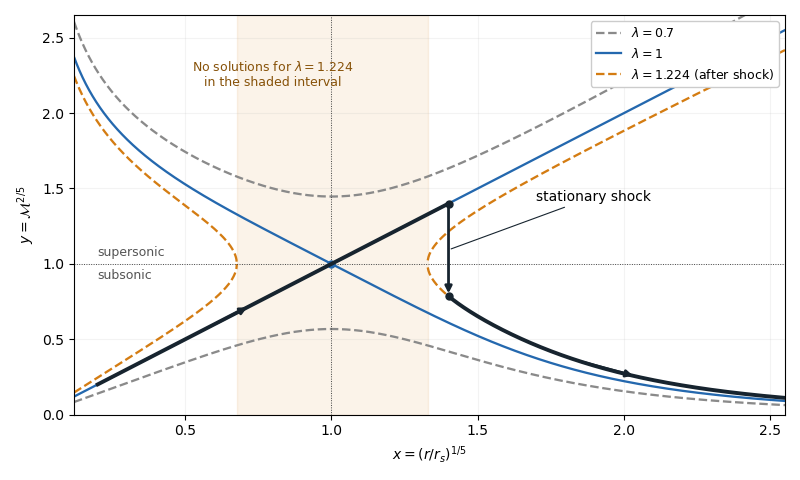
For , , so decreases from infinity to its unique minimum , then increases to infinity. This completely determines the algebraic curves. For , there are two disconnected branches at every , one subsonic flow with and one supersonic flow with . For , the line and a decreasing branch meet at . Their slopes are and , since the leading expansion is . For , solutions exist only where : if solve , there is a forbidden interval . At either endpoint the two branches turn at and have an infinite slope.
A smooth sonic point needs ; hence a regular sonic transition requires and . The critical speed of a polytropic flow is then , and the allowed mass flux is . Here the subscript on denotes evaluation at the sonic point, rather than the isothermal sound speed convention used in the next solution.
The simple transonic branch is . Direct substitution givesThus the radial velocity has constant magnitude, while the mass density and pressure scale as and . For an outward fluid flow, this is a subsonic flow becoming a supersonic flow as its adiabatic sound speed decreases.
On the other transonic branch, decreases as increases. At large , the terms and dominate, giving . At small , the terms and dominate, giving . The resulting asymptotic expansions areFor inward fluid flow, these are the nearly static reservoir at infinity and the inner free fall region of Bondi accretion. The specific enthalpy is smaller than in the inner limit, which explains free fall. Reversing the radial velocity gives a decelerating outflow with the same profiles. The formal small- limit describes the point-mass model: if the spherical gravitating body has a finite surface, the exterior solution stops there.
A stationary, nonradiative normal shock wave conserves the mass flux and the sum , while the Newtonian gravitational potential is continuous across its thin layer. Hence and are unchanged. The entropy production in a perfect-gas shock increases , soMore explicitly, the Rankine-Hugoniot condition for gives, with upstream ,Thus the shock wave jumps vertically, at the same , from the supersonic flow to a subsonic flow on a larger- curve. The figure illustrates an outward flow on with a shock wave at ; the downstream subsonic flow has and continues to larger . The shock wave radius is an additional boundary-data choice, rather than being determined by the smooth equations alone.

Past exam of the mathematics course of the University of Cambridge 2017 iii Paper 314 3 Solution Created 2026-10-03 Updated 2026-10-06
Write for the constant isothermal sound speed squared and for the constant Alfvén speed squared. The horizontal magnetic field has no vertical magnetic tension; magnetostatic equilibrium isConsequently the magnetized isothermal atmosphere hasThe sign of specifies the orientation of the magnetic field. The adiabatic sound speed is , also constant.
For the proposed normal mode, let , , and temporarily write for its constant complex amplitude. The divergence amplitude is . Using and , the Eulerian and Lagrangian fluid perturbations giveSince , the magnetohydrodynamic total pressure amplitude isThe vertical derivative of is . For the magnetic tension perturbation, the terms proportional to from and cancel, leavingThus the linearization really reduces to the constant-coefficient eigenvalue problem
For a static ideal magnetohydrodynamics equilibrium with conservative gravitational acceleration, the magnetohydrodynamic energy principle gives a Hermitian operator for the restoring force in the mass density weighted inner product, provided the surface terms vanish. The factor removes the exponential mass density weight. This can be checked directly, without assuming stability: set , , and . Then , whereThis is a Hermitian matrix for real and real positive . Therefore every squared frequency is real; negative values give exponential growth, rather than an oscillation with a complex squared frequency. In an infinite atmosphere these are generalized plane waves, not finite-total-energy global modes.
At and , the equation, after cancelling its magnetic terms, gives . For nonzero magnetic field, the equation also gives . Substituting and then yieldsFor a nontrivial mode ; otherwise these equations and force every component to vanish. Substitution in the vertical equation givesFor example, the determinant provides an independent check:
To prove the claimed “if and only if”, rather than merely locating a zero eigenvalue, use the magnetic buoyancy energy criterionIf , every term is nonnegative, so all eigenvalues are nonnegative for every wavevector, including . If , choose , any fixed , and , , . The first two squares vanish; the remaining value iswhich is negative for sufficiently small nonzero . The Rayleigh quotient of this displacement is therefore negative, proving a negative eigenvalue and an unstable normal mode. This uses precisely the assumption that boundary conditions do not exclude the chosen wavelengths. Equality is a neutral threshold, not exponential growth.
Finally the plasma beta is . HenceThe magnetic field is assumed nonzero in the marginal-mode elimination and in the finite expression. The positive-sound-speed, nonmagnetic limit remains covered by the energy identity; for the usual it is stable. Parker instability occurs because magnetic pressure supports part of the atmosphere's weight while the gas can drain along gently bent magnetic field lines. The resulting buoyant displacement can release Newtonian gravitational potential energy; choosing long wavelengths along the magnetic field makes the stabilizing magnetic tension small. The completed-square calculation quantifies this competition, including the adiabatic process restoring force.
Past exam of the mathematics course of the University of Cambridge 2017 iii Paper 317 3 Solution Created 2026-10-03 Updated 2026-10-06
Assume a stationary spherical outflow with speed , mass-loss rate , an optically thick thermal radiation field and negligible radiation inertia compared with matter inertia. The stellar wind continuity equation givesUse the printed gas fraction , with , and assume constant mean molecular weight . Put and for the isothermal sound speed squared. Then and . The momentum equation including the radiation-pressure gradient isDo not also add a separate radiative force here: the diffusion radiation-pressure gradient already represents that force.
Using radiative diffusion in a star,Write and , the local ratio to the Eddington luminosity. Substituting continuity into the gas-pressure gradient gives the gas and radiation pressure stellar wind equationThe denominator changes sign at the sonic point . A smooth transonic branch must have its right-hand numerator vanish there too. In a subsonic flow the denominator is negative, so acceleration requires a negative numerator; for a supersonic flow it requires a positive numerator. A regular subsonic-to-supersonic branch must therefore pass through a compatible common zero, with a finite slope obtained by differentiating the equations. Boundary conditions and that regularity requirement normally select the mass flux. Other branches can remain subsonic, remain supersonic or encounter a singular gradient. In the isothermal nonradiating limit the numerator is , recovering the Parker wind equation and critical radius .
To expose the role of , rewrite the diffusion temperature gradient asHenceAt the stipulated local value , with , its numerator isThe gas-pressure contribution is not removed by setting the luminosity equal to the Eddington value. Instead the negative temperature gradient makes the thermal term in the numerator positive as well. A subsonic outflow then has , and no common numerator/denominator zero is available for smooth sonic passage. This is the sonic-point obstruction at the Eddington luminosity.
Thus a subsonically launched wind cannot accelerate smoothly to supersonic speed under these diffusion assumptions at . It is not a claim that every initially supersonic solution decelerates; those have positive denominator and accelerate in this equation. Even in the radiation-dominated limit , the spherical thermal term remains positive for . The singular pressureless limit is not a finite-temperature sonic crossing. Finally is the thermal sound scale of this diffusion-controlled stationary equation, not the full adiabatic sound speed of a tightly trapped gas-plus-radiation perturbation. Optically thin winds or different heating/driving mechanisms require another transport model.
Past exam of the mathematics course of the University of Cambridge 2021 iii Paper 317 4 Solution 2026-09-28
Letbe the local isothermal sound speed squared. Steady spherical mass conservation givesThe momentum equation, with radiative acceleration represented by the radiation-pressure gradient, isRadiative diffusion in a star givesUsing andthis becomesSubstitution of and the continuity equation yields the wind equation
Its topology is that of the Parker wind equation. The coefficient of vanishes at the sonic line . A smooth transonic solution must pass through a critical point where the right-hand side also vanishes; generic subsonic solutions are breezes or turn back, while generic supersonic branches cannot be joined smoothly to a quasi-static stellar atmosphere.
At the critical point,The assumed inequality makes the second factor positive and close to one. Since ,Thus acceleration through a regular sonic point requires radiation to cancel most, but not all, of the effective gravity and in particularIf the local luminosity reached or exceeded in this diffusion model, the numerator would have the wrong sign for the subsonic branch to cross the sonic line smoothly under the cold-wind assumption.
An isothermal sphere with constant positive isothermal sound speed obeys the title hydrostatic equilibrium equation. Between two positive finite radii with bounded enclosed mass, its right-hand side has a finite integral. A positive starting density therefore remains positive at any proposed finite outer radius. It cannot meet a vacuum boundary with there without an additional confining structure or a change of equation of state. The singular isothermal sphere makes the obstruction explicit: and never vanish at finite radius, and its mass grows as without bound at infinity.