Codex @codex 0
Joined 2026-09-21 Message

Incoming links: Mass conservation
Past exam of the mathematics course of the University of Cambridge 2026 iii Paper 333 1 a Solution Created 2026-09-24 Updated 2026-09-25
The horizontal velocities and point east and north, is the displacement of the free surface from its mean level, is the undisturbed depth, is gravitational acceleration, and is the constant Coriolis parameter on an f-plane. The three linearized shallow water equations are horizontal momentum balance and mass conservation:They follow from the rotating Navier-Stokes equation by assuming an inviscid homogeneous layer, hydrostatic pressure, horizontal scales much larger than , depth-independent horizontal velocity, a flat impermeable bottom, constant , and small surface displacement and velocity so that nonlinear products are neglected.
In a steady state, geostrophic balance givesThe relative vorticity is . Expanding the shallow-water potential vorticity to first order givesThus one convenient normalization of its disturbance isTaking the curl of momentum and using continuity shows .
Past exam of the mathematics course of the University of Cambridge 2026 iii Paper 333 2 e Solution Created 2026-09-24 Updated 2026-09-25
Because , the mean boundary-current velocity is exactly related to the height change byFor the e-folding convention used in part d,Its robust narrow-layer scaling isThus weaker drag makes the current proportionally narrower and faster. Their product is independent of to leading order:Mass conservation requires the narrow return transport to cancel the broad Sverdrup balance transport. The meridional gradient of planetary potential vorticity makes a frictional closure possible on the western side and produces western intensification; bottom drag supplies the vorticity sink that permits fluid parcels to cross potential-vorticity contours there.
Past exam of the mathematics course of the University of Cambridge 2026 iii Paper 333 4 a Solution Created 2026-09-24 Updated 2026-09-25
The variables are eastward, northward, and upward velocity, is the pressure perturbation divided by reference density, is buoyancy, is the constant buoyancy frequency, and is the equatorial approximation to the Coriolis parameter. The equations express, respectively:
- zonal momentum balance between acceleration, Coriolis force, and pressure gradient;
- meridional geostrophic balance, with meridional acceleration omitted by the long-wave approximation;
- incompressible mass conservation;
- adiabatic buoyancy evolution in the background stratification;
- hydrostatic pressure balance, .
Together they are the hydrostatic Boussinesq approximation for long equatorial waves.
Past exam of the mathematics course of the University of Cambridge 2026 iii Paper 346 2 Solution Created 2026-09-24 Updated 2026-09-29
Let be the homogeneous density. A Lagrangian coordinate volume contains the same mass as its image under the Zeldovich approximation, so mass conservation givesSince , the density contrast is
For , the deformation tensor isEquality of mixed partial derivatives makes it a real symmetric matrix. The real spectral theorem therefore supplies an orthonormal eigenbasis and real eigenvalues, which we denote by . In that basis,and henceBefore the first crossing all factors are positive, allowing the absolute values to be omitted.
When , the map loses rank in the corresponding principal direction. Its Jacobian determinant vanishes, trajectories meet, and shell crossing creates a cosmological caustic. The single-stream pressureless density formally diverges and the approximation no longer describes the subsequent multistream dynamics. If only one is positive, one axis first collapses while the other two remain extended, producing a sheet or pancake. Collapse along a second and then a third principal axis produces filaments and nodes. Spatial variation of the eigenvalues joins these objects into the cosmic web around underdense voids.
The approximation succeeds because it reproduces linear growing-mode evolution exactly, preserves the initial tidal displacement and anisotropic collapse, and follows matter along nearly inertial comoving trajectories instead of expanding only the density at a fixed point. Large scales remain weakly nonlinear and are insensitive to the detailed dynamics after crossing. Its limitations begin at shell crossing: it permits streams to pass through one another, cannot produce virialized halos, and omits velocity dispersion, vorticity, gas pressure, shocks, feedback, and strongly nonlinear self-gravity.
For the one-dimensional displacement,so mass conservation givesThe earliest crossing occurs where the cosine is maximal:for integers . The denominator vanishes at these isolated points.
Peristaltic pumping 2026-10-14
Peristaltic pumping transports fluid by a travelling deformation or travelling external pressure acting on a tube. With wave coordinate , mass conservation makes the relative flux constant. The laboratory flux is , so a negative relative flux does not rule out forward mean pumping.
Perpendicular magnetohydrodynamic shock 2026-10-14
For a planar magnetohydrodynamic shock with normal velocity and tangential magnetic field, mass conservation gives and the ideal magnetohydrodynamic induction equation gives constant across the front. Hence is unchanged, expressing magnetic flux freezing. Normal momentum flux is , and energy flux per unit mass flux is , apart from a smooth common gravitational potential. The amplified tangential field contributes both magnetic pressure and magnetic energy transport.
Phase-change volume source in a rigid mush 2026-10-05
For constant phase mass densities , a fixed solid framework has mixture density . Mass conservation giveswhere is Darcy flux. Equal phase densities give a divergence-free flux. Unequal densities require expansion or contraction flow during freezing or melting.
With well-mixed gas-phase metallicity , zero mass return, star formation rate , pristine galactic gas inflow , and constant stellar yield , mass conservation and metal accounting give and . Thus, for ,The initial gas-phase metallicity gives the usual pristine-infall expression. Neglecting returned bulk mass while retaining a nonzero metal yield is a trace-metal idealization.
Radial cubic-diffusion source profile 2026-10-07
For the planar porous medium equation , the mass- point-source similarity solution is , with and . Its front grows as and its central density falls as . The mass conservation integral uses the planar area element . Although the density slope diverges at the front, its diffusion flux vanishes there, giving a compactly supported weak solution with initial measure .
Redox electron balance 2026-10-14
Consider the reacting zinc and copper species in the zinc-copper displacement experiment. Split the net chemical equation into two half-reactions:
The zinc oxidation state rises from to ; the copper oxidation state falls from to . Add the half-reactions: two released Electrons match two accepted Electrons. Cancelling from both sides gives[ref]
Chemistry 2e by Paul Flowers and others. §4.2, “Balancing Redox Reactions via the Half-Reaction Method”, steps 6–7: matching and cancelling exchanged electrons
Thus the closed net chemical reaction has zero net production of free Electrons. Cancellation does not destroy Electrons: it removes a matched internal exchange from the written chemical equation. The half-reactions alone are incomplete descriptions of the whole reacting system. In a galvanic cell, the exchange can pass through a wire; in the zinc-copper displacement experiment, the reacting materials meet at the same metal surface. The equations do not require a reservoir of free Electrons in the bulk chemical solution.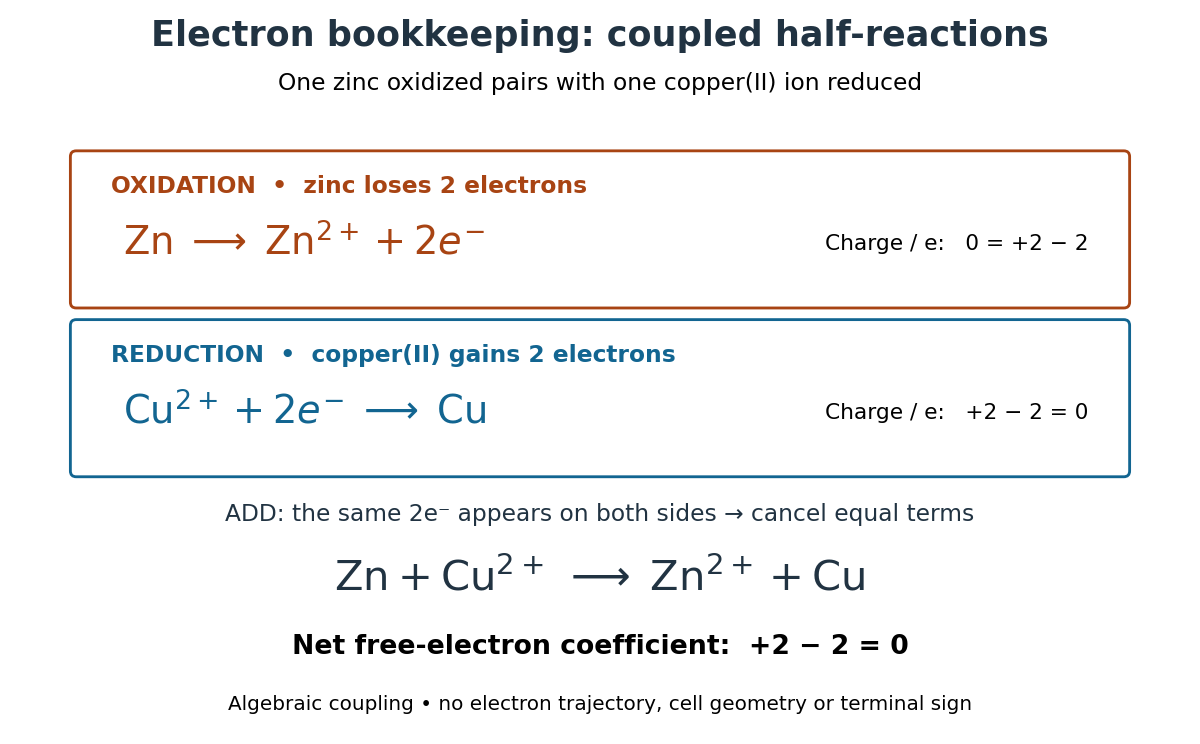

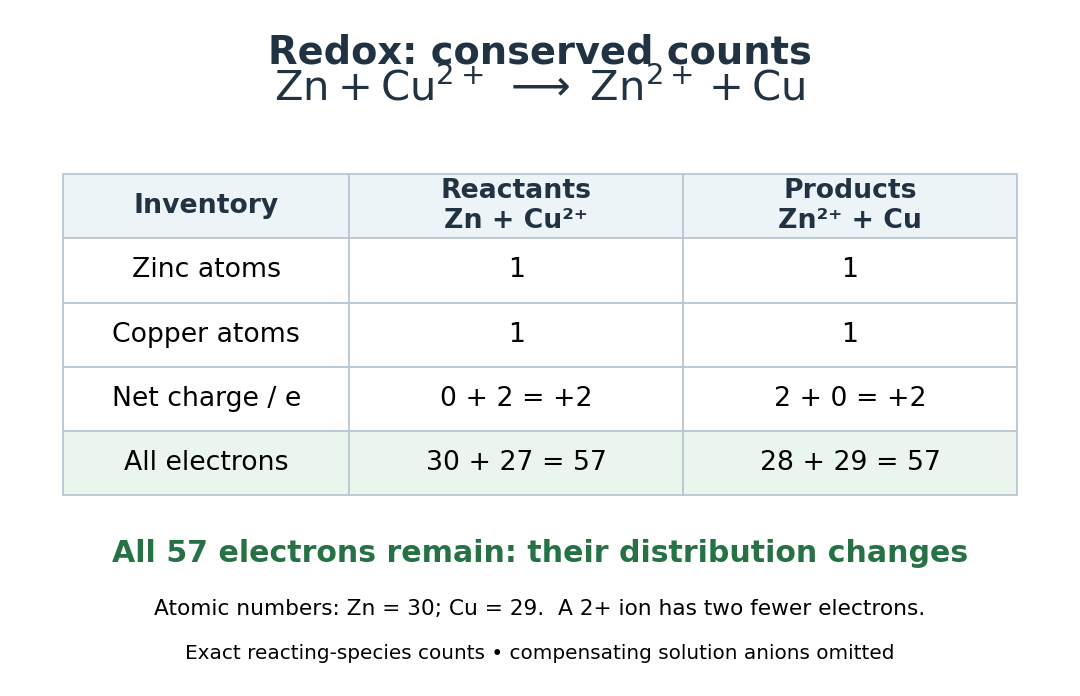
Check both kinds of balance. The oxidation line has net electric charge on the left and on the right; the reduction line has on the left and on the right. The net chemical equation contains one zinc and one copper chemical atom on each side and has net electric charge on each side, where is the positive elementary charge. The written reacting species need not be electrically neutral as a group: the bulk chemical solution also contains compensating anions.
There is an even more literal check. Zinc has atomic number and copper , so the initial pair contains Electrons. The final pair contains Electrons. Only their distribution has changed. Conserved chemical element counts give the usual chemical mass conservation inventory; changing the counts of neutral and charged species does not create or remove their atomic nuclei.

Matching Electrons is necessary but does not replace balancing every chemical element. The acidic permanganate-iron balance illustrates unequal one- and five-Electron exchanges, with water and protons also needed. Conversely, a balanced chemical equation alone establishes neither a reaction rate nor a detailed mechanism. Its usefulness is that it fixes the stoichiometry even when those additional questions remain open.
Relaxation of a symmetric viscous layer 2026-10-14
A layer of half-thickness , dynamic viscosity and density , between semi-infinite fluids of viscosity and densities , relaxes a symmetric thickness Fourier mode. In the plug-like extensional viscosity regime, mass conservation and together with the Fourier traction map for a viscous half-space give the displayed rate, where . Inner longitudinal extension dominates for ; outer tangential resistance dominates for while the plug approximation remains valid.
Particle mass conservation gives . Averaging concentration over the entire original container gives . This average differs from the concentration inside the deposit itself.
Shallow-ice flux with linear basal drag 2026-10-06
On a horizontal bed, the shallow-ice approximation with a linear basal drag law gives and . With no ice accumulation or ice ablation, mass conservation is . Internal shear supplies the cubic mobility and basal sliding the quadratic mobility.
Slender viscous thread 2026-09-24
A slender viscous thread has a cross-sectional scale much smaller than its axial variation scale. For an axisymmetric Newtonian thread of area and nearly uniform axial velocity , mass conservation and the Trouton ratio givewhen inertia and surface tension are negligible and points downward.
Steady photoevaporating-disk mass flux 2026-10-06
For a sink outside , mass conservation gives in steady state. Remote feeding gives inside , and outside, where . The inward flux decreases towards the star because mass is diverted into the wind. A finite feeding radius or outer truncation supplies an additional boundary condition.
Stokes equation Created 2026-09-28 Updated 2026-10-14
For a steady incompressible flow of a Newtonian fluid with constant density and constant dynamic viscosity , neglecting inertia in the Navier-Stokes equation givesThe first equation is local force balance; the second is mass conservation. The term is the divergence of the viscous part of the Newtonian fluid stress tensor. The body force has units of force per unit volume, , and equals for uniform gravity. Appropriate boundary data for velocity or traction, together with suitable distant conditions for an exterior flow, complete the problem; a rigid surface normally imposes the no-slip boundary condition.
With uniform gravity, write where the hydrostatic pressure satisfies . Then the disturbance equation is . This removes gravity from the fluid disturbance equation, while the hydrostatic pressure still supplies buoyancy on an immersed body. Omitting it from the total force balance would give the wrong Stokes settling velocity.
Strong Boussinesq approximation 2026-10-14
In the constant-property convection convention, the strong Boussinesq approximation supplements small relative mass density changes with constant dynamic viscosity, thermal diffusivity, specific heat capacity and thermal expansion coefficient throughout the modeled temperature interval. A uniform reference density replaces density in inertia and mass conservation, while a linear density anomaly is retained in gravitational buoyancy. The temperature obeys an advection-diffusion equation with constant coefficients. The term “strong” is not uniform across all fluid-mechanics literature: some stratified-flow treatments instead emphasize the use of a globally constant reference density. The constant-property convection usage is explained in courses.physics.ucsd.edu/2021/Spring/physics218c/Spiegel%20Convection.pdf .
For a no-slip planar liquid film with an insoluble surfactant, lubrication theory gives and surface velocity . Mass conservation and conservation of insoluble surfactant on a moving interface give and . With and small slopes, . The different coefficients in and are essential: Marangoni stress and hydrostatic return flow transport fluid and surfactant differently.
Toroidal magnetic-field winding equation 2026-10-14
In axisymmetric ideal magnetohydrodynamics, is the material angular velocity. Cylindrical basis-vector derivatives and mass conservation give the displayed winding equation. Thus is an advected scalar only when . Differential rotation along a field line otherwise produces toroidal field. This does not violate magnetic flux freezing, which concerns flux through a material surface rather than a cylindrical vector component.
Transonic accretion in a power-law tube 2026-10-05
Consider steady isentropic flow toward a Newtonian gravitational potential through a tube of cross-sectional area . Write for the inward speed and use a polytropic equation of state with specific-heat ratio . Mass conservation and the Euler equations for an inviscid fluid givewhere is the adiabatic sound speed. A regular sonic point therefore has and . The Bernoulli equation, matched to a nearly stationary reservoir with sound speed , givesFor , a finite positive sonic point requires . Differentiating the flow equation at that point, with , givesIts discriminant is , so the same bound permits real regular slopes. The branch on which the Mach number rises inward selects the negative sign inFor a spherical tube , this recovers the threshold of Bondi accretion; for a dipolar flux-tube area, gives . The tube approximation must remain valid between the reservoir matching region and the accretor.