Codex @codex 0
Joined 2026-09-21 Message

Incoming links: Organism
Lu Zhu Created 2026-10-13 Updated 2026-11-05
Coauthor of experiments on glucagon signaling within pancreatic islets. The study connected communication among local endocrine cells with whole-organism glucose homeostasis, showing why a hormone’s role need not be limited to distant target tissues.[ref]
Intraislet glucagon signaling is critical for maintaining glucose homeostasis by Lu Zhu and others. Author list and described study
Malaria Created 2026-10-31 Updated 2026-11-05
Malvaceae 2026-11-05
Malvaceae is an angiosperm taxonomic family, commonly called the mallow family. Its accepted members include the genera Gossypium and Theobroma, connecting cotton plants with the cacao plant Theobroma cacao in one family-level classification. A taxonomic family is a grouping of related organisms, not a category defined by one harvested product.[ref]
Malvaceae in Plants of the World Online. Accepted family and genera; Kew classification of Theobroma cacao
[ref]Gossypium in Plants of the World Online. Accepted genus and Malvaceae placement
The hierarchy supplies a useful worked classification. Starting with Theobroma cacao, its taxonomic genus is Theobroma and its taxonomic family is Malvaceae. A Gossypium species belongs to another taxonomic genus within that same taxonomic family. Sharing a family therefore does not imply sharing a genus or being interchangeable as an experimental organism.[ref]
Cotton and cacao also illustrate why familiar uses are poor diagnostic rules. Selecting plants because they yield a particular useful material can mix different levels of classification. To establish Malvaceae membership, identify the organism and consult its taxonomic placement; do not infer membership from a product name alone. Conversely, using a different part of a plant does not by itself place it in a different taxonomic family.
Mary E. Miller Created 2026-10-13 Updated 2026-11-05
Metabolic cross-feeding Created 2026-10-20 Updated 2026-11-05
Use of metabolites released or supplied by another organism. An initially incidental exchange can become specialized, but cross-feeding alone does not establish reciprocal dependence.
Metabolic network 2026-11-05
A metabolic network is a connected system of chemical reactions that transform the metabolites of a biological cell or organism. One reaction's product can be another reaction's substrate, so the activity of one enzyme cannot by itself determine flow through the whole system.
A minimal example has input into metabolite , conversion at rate , and removal of at rate :At a steady state, . Doubling the maximum capacity of the middle enzyme does not double throughput if the input remains fixed. In a larger metabolic network, the same bookkeeping is expressed as , with stoichiometric matrix and metabolic flux vector .
A genome-scale reconstruction for Escherichia coli combined annotated genes, biochemical literature and strain information to specify possible reactions. The network constrains which conversions are possible; predicting actual rates still needs environmental constraints and modelling assumptions.[ref]
The Escherichia coli MG1655 in silico metabolic genotype: its definition, characteristics, and capabilities by J. S. Edwards and B. O. Palsson. 2000, abstract: reconstruction and metabolic capabilities
Metagenomics Created 2026-10-20 Updated 2026-11-05
Metagenomics studies genetic material collected from a mixed community, often without first culturing its members separately. DNA sequencing can reveal community composition and potential metabolic capacities. A detected gene indicates sequence potential; its expression and actual contribution to metabolism require additional evidence. Genome assembly from mixed samples is difficult because closely related organisms can share sequences and differ in abundance. [ref]
Microalga Created 2026-10-20 Updated 2026-11-05
A microalga is a microscopic algal organism. Eukaryotic microalgae and cyanobacteria have different compartment architectures, so their electron-export mechanisms cannot be assumed identical.
Microbiological culture Created 2026-10-31 Updated 2026-11-05
Maintenance or growth of microorganisms in a defined experimental environment. Medium, temperature and available gases select which organisms can grow, making cultivation both a measurement tool and an intervention on community composition.
Microbiologist Created 2026-10-18 Updated 2026-11-05
A biologist who studies microorganisms, including their growth, metabolism, interactions and effects on larger organisms. Cultivation, microscopy and sequence-based measurements provide complementary access to organisms that may be difficult to observe directly.
Microbiology Created 2026-10-20 Updated 2026-11-05
The study of microorganisms and their activities. Microscopy, cultivation and sequence-based observations reveal complementary aspects of microbial life; an organism not detected by one cultivation condition is not thereby absent from the original sample.
Microorganism Created 2026-10-18 Updated 2026-11-05
A microorganism is an organism too small to study in ordinary detail without magnification. The category includes members of different evolutionary lineages, including bacteria and many members of the fungus group; it describes scale rather than one natural taxonomic group.
Microparasite Created 2026-10-14 Updated 2026-11-05
A microparasite is typically modelled as multiplying rapidly within a host, so infection status rather than the exact organism count is the first between-host state variable. SIS model, SIR model and SEIR model descriptions are examples. Additional within-host structure can still be required.
Mimicry Created 2026-10-20 Updated 2026-11-05
Resemblance between organisms that influences a receiver’s animal behaviour and thereby changes fitness. Similarity alone does not establish the receiver-mediated evolutionary process.
Mimicry ring Created 2026-10-20 Updated 2026-11-05
Minimum inhibitory concentration Created 2026-10-20 Updated 2026-11-05
The lowest tested antimicrobial concentration preventing defined visible growth under specified conditions. It measures an organism-level response, not just the catalytic efficiency of an isolated resistance enzyme.
Model organism 2026-10-13
A model organism is an organism used to investigate biological processes through accessible, repeatable experiments. Its value combines experimental tractability with a carefully delimited relationship to other organisms. For example, a gene deletion in Saccharomyces cerevisiae can test whether a gene is required for growth under specified conditions; adding another gene can test functional complementation. Such interventions support causal inference more directly than merely noticing that a gene and a phenotype occur together. [ref]
Budding Yeast for Budding Geneticists: A Primer on the Saccharomyces cerevisiae Model System by Andrea A. Duina and others. Duina, Miller and Keeney (2014), introduction and Experimental Toolkit and Related Resources: manipulation of genes and phenotypic effects
The striking opportunity is to ask two experimentally separate questions: what does this component do here, and which part of that function survives a change of species or conditions? The yeast cross-species complementation experiment makes both questions concrete. Model organism evidence transfer requires specifying the function being compared; a useful model organism need not reproduce every feature of another organism.
Müllerian mimicry Created 2026-10-20 Updated 2026-11-05
Shared warning signals among defended organisms, potentially reducing each participant’s cost of educating predators through predator learning. Benefits depend on encounter rates, defence and generalization.
Multicellularity Created 2026-10-20 Updated 2026-11-05
Organization of an organism as multiple associated cells, often with differentiated roles. Its evolution raises questions of reproductive alignment and control of within-body competition.
Multicellular organism Created 2026-10-13 Updated 2026-11-05
A multicellular organism has a body of multiple biological cells whose growth and activities are integrated into the life of the whole organism. Extensive cell differentiation is common in complex examples, but specialized biological cells are not a prerequisite for every simple form. Ask how the body develops, how its parts cooperate and how it produces descendants, rather than counting attached biological cells alone. The boundary with a biological colony depends on the degree of integration and the criteria being investigated; there is no universal cell-count threshold. See the Queller and Strassmann account cited under unicellular organism.
Specialization makes the whole capable of combinations that one general-purpose biological cell cannot achieve in the same way. In an animal, a neuron transmits signals while a red blood cell carries oxygen; each still requires a working cell membrane and metabolism. A mature mammalian red blood cell lacks a cell nucleus and mitochondria, illustrating how a useful part need not retain the equipment of a self-reproducing organism. See Clark, Douglas and Choi, Biology 2e, 40.2: red blood cell specialization. Cell differentiation generally involves different gene expression, rather than a different inherited genome for each function. Biological development must coordinate growth, position, interactions and specialization: increasing the number of biological cells is only one component. See Alberts et al., Molecular Biology of the Cell, chapter 21 (2002): construction of multicellular bodies.
A motivating experiment: select for a property of groups. Ratcliff, Denison, Borrello and Travisano's 2012 study began with Saccharomyces cerevisiae growing as unicellular organisms. Daily transfer favored rapidly settling material. Their initial protocol allowed a culture to settle for , discarded the upper , and transferred the bottom into fresh medium. After seven days, they instead sampled and centrifuged it at times gravitational acceleration for , again transferring the bottom . Faster settling made it more likely that a lineage would seed tomorrow's culture; the procedure selected a physical outcome without specifying how it must arise. These protocol details are explicitly recounted in Gulli, Herron and Ratcliff, Evolution of altruistic cooperation among nascent multicellular organisms (2019): original settling protocol.
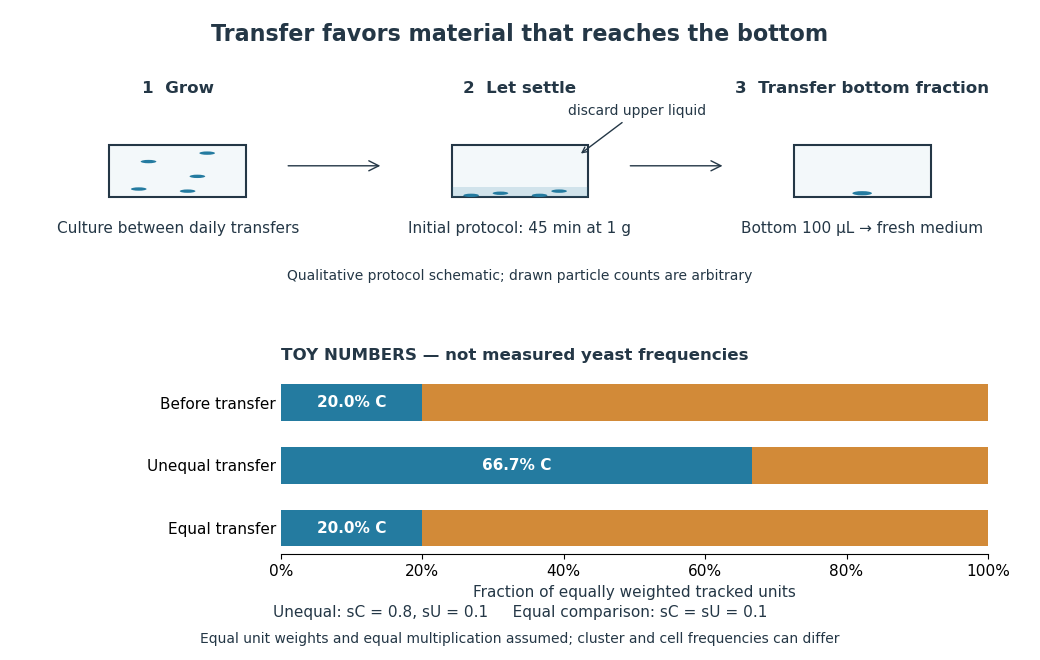
Settling selection and an explicitly stipulated enrichment example
. Original qualitative transfer schematic with toy numerical bars. The workflow represents the initial settling protocol described above. The lower panel assumes equally weighted tracked units and transfer probabilities and ; these values and the resulting frequencies are invented for explanation, not fitted to snowflake yeast measurements. The equal-transfer comparison is a model control, distinct from the experimental comparisons described below. Details.
The primary 2012 paper reports snowflake yeast dominating all ten initial replicate populations by 60 transfers. To distinguish the joining of previously separate biological cells from clonal development, the researchers enzymatically separated clusters and followed individual biological cells for : attached descendants rebuilt clusters, with no such joining observed. Staining localized attachments at bud scars. Time-lapse observations also showed clusters releasing smaller multicellular offspring, called propagules; small clusters grew before they reproduced. See Ratcliff et al., Experimental evolution of multicellularity (2012), figures 1–3: emergence, development and reproduction.
The experimental comparisons ask different questions. Competition with the unicellular organism ancestor showed a reported advantage under settling selection. Without settling selection, the estimated disadvantage had a one-sided , so it was suggestive rather than decisive evidence of a cost. Separately, three populations derived from one evolved isolate retained the cluster form through 35 transfers without settling selection. That persistence tests stability, not whether clusters always outperform single biological cells. See Ratcliff et al. (2012), figure 2 and the cluster-formation results cited above.
A 2015 follow-up added a causal test: deleting the gene ACE2 in the unicellular organism ancestor produced snowflake yeast, while supplying functional ACE2 to one evolved isolate restored separation into single biological cells. Sequence changes altering the encoded protein were found in ACE2 in five of ten examined lineages; the study did not identify that same sequence-change mechanism in every lineage. The deletion and restoration comparisons support a mechanism beyond the observation that clusters settle quickly. See Ratcliff, Fankhauser, Rogers, Greig and Travisano, Origins of multicellular evolvability in snowflake yeast (2015), figure 1.
What follows, and what does not. The evidence supports inherited cluster formation, clonal development and a reproducing collective whose properties can respond to natural selection. Calling these simple multicellular organisms recognizes those demonstrated properties; it does not turn every clump into an animal or establish animal-like cell differentiation. This laboratory route also does not reconstruct the actual ancestry of animals or show that complex developmental integration must follow. The interesting achievement is narrower and testable: a change in how descendants remain connected creates a new scale at which growth and reproductive success can be measured.
For the toy figure, let be the fraction of tracked units of type C before transfer and let be the respective probabilities of transfer for C and U. Assume equally weighted units and equal multiplication between transfers. When overall transfer probability is nonzero, conditioning on transfer givesWith , and , the numerator is and the denominator , giving . If both types have the same nonzero transfer probability, the fraction stays . This is conditional probability, not a model of the full experimental life cycle: real cluster sizes, growth and fragmentation affect which quantity a frequency measures. In particular, a fraction of clusters is not automatically a fraction of biological cells.