Source paper: www.whatdotheyknow.com/request/oxford_physics_past_papers_2/response/2340696/attach/4/Physics%20Papers%202015.pdf?cookie_passthrough=1. The dated cover identifies Hilary Term 2016, 15 March; the annual bundle filename says 2015. All nine optional prompts are addressed below.
The relevant letter is dated 12 April 1615; the paper's 1616 date conflates it with the subsequent restriction of Copernican teaching. Robert Bellarmine addressed Paolo Antonio Foscarini's defence of heliocentrism by distinguishing a useful mathematical supposition from an established account of the world's physical arrangement. That distinction determines the conditions of his limited permission. It is not a general licence to teach the Earth's motion as an already demonstrated fact.[ref]
Letter to Foscarini by Robert Bellarmine. 12 April 1615, first and third numbered arguments; the reproduced document gives its date explicitly
First, a mathematician could work conditionally: assume that the Earth moves and the Sun is stationary, and investigate whether the resulting astronomical model accounts for the observed appearances. Successful calculation would establish what follows from those assumptions. It would not, merely by succeeding, demonstrate that the assumptions describe the true causes and arrangement of the heavens. This was a recognizable distinction between mathematical treatment and natural philosophy, although it should not be made into a complete description of what all early modern mathematicians believed. A person might be licensed to use a computational scheme without being authorized to assert its physical truth.
Second, Robert Bellarmine treated interpretation of Scripture as an institutional constraint. His appeal to the Council of Trent and the claimed agreement of earlier commentators meant that an individual investigator could not simply replace the received reading on the strength of an attractive astronomical model. He also rejected the answer that a claim about the Earth was irrelevant to faith just because its subject was not a central Christian doctrine: the authority of the scriptural speaker mattered to him. These are his grounds for caution, not neutral rules of astronomy which every participant was obliged to accept.
Third, he conceded an important conditional. If a genuine demonstration of the Earth's motion were available, apparently contrary scriptural passages would require careful reinterpretation; it would be better to admit that their meaning had not been understood than to deny a demonstrated conclusion. Nevertheless, he denied that such a demonstration had been supplied. Thus the concession does not amount to contemporary acceptance of heliocentrism, and the acceptable hypothetical discourse must be distinguished from this more demanding route to physical affirmation.[ref]
Letter to Foscarini by Robert Bellarmine. Second argument on interpretive authority; third argument distinguishing an actual demonstration from saving appearances
The distinction had a genuine evidential setting. Galileo Galilei's observations challenged parts of the inherited celestial picture. Bodies accompanying Jupiter showed that not every celestial circuit had the Earth as its immediate centre. The full sequence of phases of Venus was incompatible with the traditional arrangement that always kept Venus on the near side of the Sun. Yet neither observation alone selected a moving Earth: a Tychonic system could have the planets circle the Sun while the Sun circled a stationary Earth. The relevant distinction is between refuting one geocentric model and proving every premise of a particular heliocentric model.[ref][ref]
Phases of Venus by Museo Galileo. Competing Ptolemaic, Copernican and Tychonic geometries; the Venus observations followed the publication of Sidereus Nuncius
The defensible reading is therefore a conditional permission accompanied by a restrictive burden of proof. Robert Bellarmine allowed mathematical use without an absolute assertion, and envisaged reconsidering interpretation if physical demonstration compelled it. He neither declared all mathematical accounts fictional nor recognized an unrestricted freedom to announce new physical truths regardless of theological jurisdiction. The 1615 letter and the later proceedings belong to a developing controversy, rather than one timeless pronouncement about the relation of science and theology.
A mathematician in Galileo Galilei's world was a practitioner situated within a particular division of knowledge and work. The word could embrace demonstrative geometry and arithmetic, but also astronomy, optics, mechanics, surveying, calendar calculation and the design or use of scientific instruments. Such mixed mathematics treated features of natural or practical objects through mathematical relations. It was neither identical to a present-day university department nor confined to calculation without claims about nature.
The distinction from a natural philosopher was important. Within a traditional university hierarchy, natural philosophy investigated the causes and principles of physical change. Mathematics could establish a relation between abstract quantities with great certainty, while opponents doubted whether it captured the constitution of a real body. Showing what follows for an ideal inclined plane, for example, leaves a further question about whether a particular apparatus realizes the assumptions closely enough. That question is not an objection which can be answered merely by producing a longer geometrical proof. The relation of abstraction, measurement and physical explanation was itself contested.[ref]
There were also several routes to employment. A university teacher, an scientific instrument maker and someone serving a court or military patron might all perform mathematical work while possessing different income, status and audiences. Practical expertise in fortification, surveying or optics could bring rewards without establishing that its holder had authority over every question of natural philosophy. Conversely, a learned author could rely on the skills of people whose work was not credited equally in print. The important historical questions are what tasks were recognized, who paid for them, and whose testimony carried weight. A modern boundary between theoretical research and technical service would obscure these connections.
Galileo Galilei's career makes the contested boundary visible. The Sidereus Nuncius by Galileo Galilei communicated new observations through a manufactured telescope, successive drawings and an account intended to make unfamiliar objects credible. The work also addressed a courtly audience: naming the bodies accompanying Jupiter was part of presenting an achievement to a patron, not an incidental ornament added after a purely private discovery. The title and dedication situate mathematical work within relationships of employment and reputation.[ref]
Sidereus Nuncius by Galileo Galilei. Title, dedication and sequence of observations: the telescope, lunar surface and Medicean bodies
His mathematical treatment of motion likewise pressed beyond the role of calculating celestial appearances. In Two New Sciences by Galileo Galilei, a definition of uniform acceleration leads to a geometrical result in which travelled distance varies as the square of elapsed time. An inclined plane stretches the time of descent, making a comparison more manageable. In modern notation the relationship is for release from rest. The notation is ours; the historically significant combination is an idealized proof, a proposed physical regularity and a reported experimental test.[ref]
Two New Sciences by Galileo Galilei. Third Day: definition of uniformly accelerated motion, Theorem II and the inclined-plane trials
The label mathematician therefore cannot be read as a declaration that Galileo Galilei made no physical claims. Nor does his insistence on mathematical explanation prove that other occupations or disciplinary standards were irrelevant. His 1610 transition into Tuscan service, with the combined style of mathematician and philosopher, is evidence of the status being sought, rather than proof that the existing hierarchy had already disappeared. The case shows an investigator using scientific instruments, patronage and mathematical demonstration to enlarge the jurisdiction of his expertise. It also explains why a seemingly terminological distinction could become consequential in disputes over heliocentrism.[ref]
Galileo's Tuscan appointment by Museo Galileo. Chief Mathematician and Philosopher to the Grand Duke of Tuscany, 1610–1611
Francis Bacon's originality lay chiefly in the reconstruction and coordination of inquiry, rather than in the invention of observation or experiment. Earlier natural philosophy, practical crafts and natural history already contained empirical knowledge. Aristotle's investigations of nature, for example, cannot be reduced to drawing conclusions from words without reference to living things or physical change. What requires explanation is why Francis Bacon thought established practices were failing and what he proposed to alter.
The methodological target was a premature leap from a few familiar cases to very general principles, followed by deductions protected from serious revision. His alternative was a graduated movement from particulars through intermediate generalizations. This was more demanding than collecting favourable examples. Negative and contrasting instances had to constrain the proposed account. The comparison of conditions in which a phenomenon appears, is absent, or varies was intended to exclude unsuitable candidates for its underlying nature.[ref]
Novum Organum by Francis Bacon. Book I, aphorisms 19–22; Book II, tables of presence, absence and degrees, followed by exclusion
A useful example is heat. Merely finding several hot substances does not establish which property explains their temperature. A candidate property has to survive comparisons with cold cases and with cases where one feature changes while others do not. These requirements point toward a disciplined search for causal explanation. They should not be equated with a modern randomized trial or with the claim that every successful science follows a single mechanical rule. The construction of the categories and the assessment of a comparison already require judgment. Francis Bacon's preliminary interpretation of heat was an attempt within a particular research programme, not a complete anticipation of present thermodynamics.
He also made intellectual habits part of the problem. His account of the idols of the mind directed attention to recurrent distortions associated with human tendencies, individual training, language and accepted systems. This is a programme for correcting inquiry, rather than a story in which the investigator simply empties the mind and thereafter reads facts without interpretation. His comparison of the investigator with a bee, combining collected material with active transformation, is especially awkward for the familiar caricature of Baconian inquiry as indiscriminate fact accumulation.[ref]
Novum Organum by Francis Bacon. Book I, aphorisms 38–44 and 95: the idols and the comparison of empirical collection with rational reconstruction
The institutional proposal was equally consequential. New Atlantis by Francis Bacon presents organized work distributed among collectors of information, experimenters and interpreters. Scientific instruments, gardens, workshops, records and travel supply the material of inquiry. The imagined institution aims at useful operations, not simply the production of elegant arguments. However, it also has an internal hierarchy and controls disclosure. It is not a straightforward prospectus for today's open research university. Its religious language and political organization belong to the vision and must not be removed to turn it into a secular manifesto.[ref]
New Atlantis by Francis Bacon. Concluding description of Salomon's House: collections, experimental facilities, offices and decisions about publication
There are substantial continuities. Craftspeople already altered materials and procedures to obtain desired effects; natural history already collected and compared particulars; learned reformers already criticized authority. There are also distinctions from other contemporary innovators: giving mathematics and idealization the central role found in Galileo Galilei's treatment of motion was not the same programme as Bacon's organized natural and experimental histories. A history of one uniform seventeenth-century method would lose that difference.
The strongest judgment is that Francis Bacon offered a distinctive reform of the scale, discipline, purpose and organization of knowledge. His work combined inherited resources in an ambitious programme which could be used to legitimate later collaborative inquiry. Later invocation of his name, however, does not prove that a particular discovery was produced by following his prescriptions. Originality in proposing a reform, effectiveness of a procedure, and influence of a public ideal are three historical claims requiring different evidence.
The seventeenth-century transformation extended well beyond astronomy and mathematical physics, but it was neither simultaneous nor uniform across every field. An answer limited to new planetary arrangements and laws of motion would miss changes in the study of living bodies, small structures, materials and the organization of inquiry. Calling these changes a Scientific Revolution should introduce a problem of explanation rather than decide in advance that they formed one event.
William Harvey's On the Motion of the Heart and Blood in Animals by William Harvey provides a clear counterexample to a narrow account. His argument for blood circulation combined observation of cardiac action, the direction of flow indicated by valves, and interventions using ligatures. It also employed a quantitative constraint: if the amount propelled at each beat is multiplied by the number of beats, the throughput soon exceeds the amount that could plausibly be freshly produced and consumed as nourishment. In modern symbols, throughput is . This is an argument about a repeatedly circulating stock, not a requirement that all that volume be present at once. The book's chapter IX explicitly develops the comparison.[ref]
On the Motion of the Heart and Blood in Animals by William Harvey. 1628 work, chapters VIII–IX and XIII: the circulation hypothesis, quantitative throughput and venous valves
The intervention was not simply an application of a completed mechanical worldview to physiology. It drew on medical and anatomical problems and retained explanatory commitments which do not coincide with later accounts of the body. A historian can recognize the force of the circulation argument without making its author an advocate of every subsequent development in medicine. Nor did a circulation argument by itself supply microscopic observation of the entire connecting pathway.
Microscopy offers a second case. Robert Hooke's Micrographia by Robert Hooke made minute structures available to a new audience through selected observations and elaborate images. His examination of cork described the small compartments for which he used the word cells; this was not yet a general modern cell theory. The work ranged across biological specimens and manufactured objects, including the point of a needle. Its preface made the improvement of the senses through scientific instruments a programme of inquiry. Preparation, illumination and representation were consequently part of making an observation, rather than optional matters outside it.[ref]
Micrographia by Robert Hooke. Preface; Observation I on a needle; Observation XVIII on cork and its compartments
The investigation of air supplied another transformation. Robert Boyle's pneumatic programme varied the conditions surrounding a specimen by using an air pump. A claim about pressure, burning or sound could be pursued by operating an apparatus and reporting what happened as air was removed or admitted. This joined work on materials to questions about experimental evidence and the acceptability of explanations. It does not follow that every old chemical practice disappeared or that experimental facts selected one complete account of matter without further reasoning.[ref]
New Experiments Physico-Mechanical by Robert Boyle (1682 edition). The apparatus and the experiments originally published in 1660; linked collected edition dated 1682
These cases also direct attention to institutions and labour. The Royal Society and the printing of experimental reports created ways of advertising findings, soliciting responses and establishing reputations. Skilled construction, preparation and repair supported claims associated in print with learned authors. A new society did not automatically make everyone a witness on equal terms, and access to a costly scientific instrument was not universal access to its results.
The breadth of change therefore strengthens the case for studying more than a sequence of theories. It does not justify treating every innovation from 1600 to 1700 as one inevitable step toward the present. Different investigations retained different parts of inherited natural philosophy; some techniques were older than their new settings, and changes in public credibility differed from changes in explanation. The useful conclusion is a plural one: significant transformations in physiology, microscopy, experimental work on matter, and knowledge-making institutions accompanied developments in astronomy and mechanics. Their connections have to be demonstrated through particular practices, not inferred solely from sharing a century.
The strongest immediate explanation of Antoine Lavoisier's execution is his position within the former system of royal revenue collection and the revolutionary prosecution of its personnel. He was executed on 8 May 1794 as one of the condemned former farmers-general. The proceedings were not a judicial assessment of whether his account of combustion or oxygen was correct. Nevertheless, a simple opposition between a private scientist and a separate public official would misdescribe how his work had been organized.
The Ferme générale was a contracted system of revenue collection under the monarchy. Its members advanced resources and collected specified taxes under financial arrangements with the Crown. This made them prominent beneficiaries and agents of an unpopular structure. Its official character should not be confused with a modern salaried civil service: private financial interests and public fiscal power were intertwined. Such a position made a person vulnerable when revolutionary authorities treated the old financial establishment as a political danger.
A contemporary official report provides a better starting point than the later image of a scientist killed for revealing a natural truth. The Convention's report of 5 May 1794 concerned the administration and accounts of the former farmers-general and led to their referral to the Revolutionary Tribunal. Its subject and procedural setting locate the accusation in public finance. The subsequent conviction treated the defendants as a group implicated in counter-revolutionary wrongdoing. The existence of accusations is evidence for what authorities alleged, not by itself proof that every disputed calculation or allegation of fraud was true.[ref]
Report on the former farmers-general to the National Convention. 5 May 1794, Archives parlementaires, volume XC, pp. 74–80; referral to the Revolutionary Tribunal
[ref]Lavoisier arrest and conviction print held by Library of Congress. Contemporary or near-contemporary print, dated between 1794 and 1810, presenting the conviction through his membership of the tax-collecting company
The wording of the central causal claim matters. A person might suffer because his scientific work made enemies, because a scientific institution was attacked, because an unrelated political category included him, or because the same resources supported both his research and the office under attack. These are distinct mechanisms. In this case membership of the fiscal establishment explains why he stood with the other defendants. Merely observing that he was an eminent chemist does not establish persecution for a chemical doctrine.
Yet his scientific activities were not socially detached from State affairs. Wealth, official responsibilities, access to equipment and relations with other skilled workers helped make large experimental projects possible. His Elements of Chemistry by Antoine Lavoisier presents a programme in which the handling of materials and exact accounting are central. The practice of weighing substances before and after a transformation depended on specifying what entered and left the experimental system. Such disciplined material accounting had a public and administrative setting as well as an intellectual one. That connection helps explain why the two sides of his career could coexist; it does not turn an accusation about financial accounts into a refutation of conservation of mass.[ref]
Elements of Chemistry by Antoine Lavoisier. 1789 work, Part I on the composition and decomposition of substances and Part III on experimental apparatus
There is also a danger in reading the Revolution as a single actor uniformly opposed to knowledge. Demands for practical expertise and attacks on established privileges could coexist. Scientific achievement might be invoked in a request for protection without succeeding in removing a political classification. Failure to protect one practitioner does not establish that all practitioners, all disciplines or all institutions were being treated alike.
Later stories often condense the event into a striking declaration that the Republic had no use for learned investigators. An unverified dramatic sentence cannot carry the explanation. The evidence needed would be a traceable contemporary record of the words, their speaker and their procedural role; even that would not replace analysis of why the prosecution occurred. A careful answer can explain the execution without repeating the anecdote as an established quotation. Antoine Lavoisier was a scientist whose official and financial connections placed him in a targeted political group. His case demonstrates the vulnerability of knowledge-making to struggles over State power, rather than a tribunal executing a chemical theory.
Jean-Baptiste Lamarck regarded geology and the study of living bodies as connected parts of a terrestrial natural philosophy. His Hydrogéologie by Jean-Baptiste Lamarck and Zoological Philosophy by Jean-Baptiste Lamarck sought lawful explanations of the Earth's changing surface and of changing organic organization. The connection was stronger than the commonplace that organisms live on land and in water: fluids and material transformations were supposed to make both the surface of the globe and living structures intelligible over immense periods.
One important starting point was the replacement of an explanation by exceptional events with a sustained investigation of ordinary causes and their accumulated consequences. Moving water could erode, transport and redeposit material. Over a sufficiently long interval, relatively small actions could change the relation between sea and land. This supplied a way of understanding a surface whose present arrangement need not be its original one. The explanatory appeal was to continuing physical operations plus duration, not to a modern theory of moving lithospheric plates. Calling his programme a fully formed modern uniformitarianism would obscure its distinctive mechanisms and assumptions.[ref]
Hydrogéologie by Jean-Baptiste Lamarck. 1802, programme of terrestrial physics and the concluding discussion, including printed p. 188 on accumulated fluid action and long duration
A related model operated within the organism. Jean-Baptiste Lamarck distinguished containing tissues from contained fluids, with moving fluids altering the structures through which they passed. More sustained or differently directed activity could strengthen or develop a part, while changing circumstances altered an animal's habits and the employment of its organs. The visible result was to be explained through a material history, rather than through a separate intention directly constructing each useful feature. This is why reducing his whole programme to the slogan that an animal wished for a new organ is misleading. Need, behaviour, fluid movement and organization occupied different places in the proposed causal sequence.[ref]
There were also chemical connections between living and nonliving nature. In the 1809 work he argued that organisms formed their own compound substances and that their remains supplied materials subsequently transformed and simplified outside life. He expressly connected this discussion with Hydrogéologie by Jean-Baptiste Lamarck. Geology was consequently not a wholly independent history of an inert stage on which organisms later appeared. Organisms helped produce the materials of that stage; those materials, their environment and their transformations in turn conditioned living activity.[ref]
Philosophie zoologique, organic and inorganic productions by Jean-Baptiste Lamarck. Volume I, printed pp. 91–92: formation of substances by living bodies, their remains and the explicit reference to Hydrogéologie, p. 112
The unity of explanation must nevertheless be stated carefully. Sharing physical and chemical causes did not mean that a crystal and an animal were indistinguishable. His comparison of inorganic and living bodies emphasized the organized, heterogeneous, bounded individual, with internal nutrition, development and eventual death. An inorganic aggregate did not acquire those capacities merely by becoming large. The special arrangement and circulation of matter therefore mattered to the explanation of life even when the causes acting on that arrangement were natural. There is no contradiction in claiming lawful material causes while also identifying organizational differences which require explanation.[ref]
Philosophie zoologique, living and inorganic bodies by Jean-Baptiste Lamarck. Part II, chapter I: molecular individuality of inorganic bodies contrasted with organization and contained fluids in living bodies
Nor should his chemistry be silently translated into modern biochemistry. His fluid and heat-based explanations, his conjectures about the formation and subsequent simplification of materials, and his accounts of the origin of simple living forms belonged to a particular early nineteenth-century system. To show why they fitted together is not to show that each is now accepted. Modern observations that organisms alter soils and sediments support some broad connections between life and the Earth's surface, but they do not establish his claim that all compound inorganic materials ultimately derived from living activity.
Finally, the integration helps explain his account of changing species. If environments have histories, their inhabitants encounter changing conditions. If habits and organization can respond, and acquired changes can persist through heredity, stable-looking forms need not be permanently fixed. His additional tendency toward more complex organization and the modifying effects of circumstances were not identical processes. The natural unity he sought was a framework for explaining both continuity of causes and diversity of outcomes. It was neither Darwinian natural selection avant la lettre nor a merely metaphorical comparison between rocks and animals. The conviction followed from a connected programme of material causation, long time and the historical production of structure.
Charles Darwin was neither the first nor the only pre-1859 advocate of changing species. The claim needs a second qualification: believing that species have histories is not the same as identifying natural selection, and neither entails that every lineage changes continuously at a constant rate. Several rival explanations were available before the publication of On the Origin of Species by Charles Darwin.
Jean-Baptiste Lamarck's 1809 programme is an unambiguous earlier example. In Zoological Philosophy by Jean-Baptiste Lamarck, forms which appear stable over a short interval can change through the accumulated effects of circumstances, altered habits, use and disuse, and transmission of acquired modifications. His separate account of increasing organizational complexity also mattered. This was a substantial causal programme, rather than a passing acknowledgment that individuals differ. It was not, however, an anticipation of every feature of Charles Darwin's explanation: an internally ordered tendency toward complexity and a response produced through an organism's activities differ from the sorting of heritable differences through unequal reproductive success.[ref]
Zoological Philosophy by Jean-Baptiste Lamarck. 1809, Part I, chapters III, VI and VII: species, organization and the influence of circumstances
Robert Chambers's anonymously published Vestiges of the Natural History of Creation by Robert Chambers supplied another public alternative in 1844. It placed the succession of living forms within a law-governed history extending from the formation of the heavens to human beings. Its treatment of development was speculative and did not contain the developed selection mechanism of On the Origin of Species by Charles Darwin. Nevertheless, its very existence rules out an intellectual landscape in which an isolated Charles Darwin first introduced the possibility of organic change to an otherwise uniformly fixist audience. The difference between a privately developed theory and a book circulating publicly is especially important here.[ref]
Vestiges of the Natural History of Creation by Robert Chambers. 1844 edition, General Considerations respecting the Origin of the Animated Tribes and Hypothesis of the Development of the Vegetable and Animal Kingdoms
Alfred Russel Wallace provides the decisive counterexample even to the narrower claim of unique possession of natural selection. His 1858 essay argued that varieties could persist and depart progressively from their original type through differences in their capacity to survive under particular conditions. The materials jointly communicated to the Linnean Society on 1 July 1858 included his essay, extracts from Charles Darwin's earlier work and an account of his thinking in correspondence. The introductory communication explicitly presented the two as independent originators. This public event preceded the 1859 book and is stronger evidence than an attempt to infer influence from a loose resemblance between two later texts.[ref]
On the Tendency of Species to Form Varieties by Charles Darwin and Alfred Russel Wallace. 1858, introductory communication dated 30 June and the materials read on 1 July; printed in the Linnean Society journal
There were also resources and disagreements beyond professed transformists. Geology supplied evidence of a long history; palaeontology documented succession and extinction; geographical distribution raised questions about affinities between inhabitants of neighbouring regions. Yet a commitment to extinction did not logically entail common descent, and an appeal to slowly acting geological causes did not oblige an author to accept changing species. The historical question is which inferences particular investigators drew from shared evidence, not whether a predecessor can be recruited to a modern camp merely because one premise resembles a later one.
What distinguished the 1859 synthesis was the scale and integration of the argument. Variation, heredity, the multiplication of organisms and limited opportunities for reproduction made unequal success consequential across generations. Branching descent could then connect adaptation, classification, geographical distribution and the fossil record. The theory did not require a breeder intentionally choosing the direction of change. At the same time, the first edition discussed other possible causes of variation and acknowledged serious difficulties. It should not be retrospectively equipped with a later genetic account of heredity.[ref]
On the Origin of Species by Charles Darwin. First edition, Introduction and chapters III–V, IX–XIII: the mechanism, acknowledged difficulties and the convergence of evidence
The appropriate judgment separates novelty of a general possibility, novelty of a mechanism and persuasiveness of a synthesis. Earlier and contemporary transformists defeat the first claim of solitary originality; the 1858 communication defeats the strongest version of the second. Neither fact erases Charles Darwin's achievement in constructing a sustained case. Equally, the premise of constant change is too crude: stable conditions, unequal rates and lineages persisting with little visible modification are compatible with a history of descent. Historical priority is best assessed by identifying the actual claim and evidence, rather than allocating one indivisible discovery called evolution.
A rejection of inevitable, universal warfare between science and religion is well supported; a claim that there has never been conflict is not. Those propositions have different logical forms. Evidence of collaboration or of a religious investigator doing important work defeats a claim of necessary hostility. It does not negate a documented instance of coercion over a claim about nature. A useful historiography of science must be able to describe both kinds of case without forcing them into a universal pattern.
The categories themselves require historical care. Early modern investigators did not generally choose between membership of a modern scientific profession and membership of a religious community. Natural philosophy, theology, medicine and practical arts overlapped in personnel, education and sources of support. To call a dispute one between science and religion can therefore conceal disagreement among people who all regarded themselves as religious, or a struggle over which institution had authority to settle a particular question. This warning changes the explanation of a controversy; it does not show that the controversy never occurred.
Galileo Galilei's case makes the difference concrete. Robert Bellarmine's 1615 letter both allowed hypothetical calculation and restricted absolute affirmation of heliocentrism. Its conditional acceptance of a future demonstration complicates an account of simple hostility to reasoning. Yet in June 1633 the official sentence judged Galileo Galilei vehemently suspected of heresy for holding and defending the condemned position, prohibited his dialogue and imposed punishment and abjuration. This is a documented conflict over a natural claim and the authority to defend it, even if political relationships, procedural history and standards of proof also help explain the outcome.[ref]
Letter to Foscarini by Robert Bellarmine. 1615, conditional mathematical permission and the burden of demonstration
[ref]Sentence of Galileo by the Roman Inquisition. 22 June 1633: finding, prohibition of the Dialogue, imprisonment and prescribed penance
His own Letter to the Grand Duchess Christina by Galileo Galilei further resists the binary. He argued that Scripture could not be false when rightly understood and that demonstrated physical conclusions should assist its interpretation. He was contesting a use of religious authority from within a religious account of truth, rather than declaring all religious commitments meaningless. Two parties can agree in principle that truths must be compatible while disagreeing sharply over what has been demonstrated and who may reinterpret an authoritative text. A shared commitment to ultimate harmony can coexist with an immediate institutional conflict.[ref]
Letter to the Grand Duchess Christina by Galileo Galilei. 1615, passages distinguishing scriptural truth from literal interpretation and discussing sense experience and necessary demonstrations
There is equally clear evidence against necessary warfare. The very programme of Robert Boyle's The Christian Virtuoso by Robert Boyle was to argue that experimental natural philosophy could assist Christian belief. Its 1690 title states that purpose explicitly. That is evidence of a participant understanding religious and experimental commitments as mutually supportive; it is not proof that no tension ever affected his reasoning or that all religious institutions agreed with him. It also does not make his experimental conclusions true merely because they served an apologetic purpose.[ref]
The Christian Virtuoso by Robert Boyle. 1690 title and declared project: experimental philosophy as assistance to Christian commitment
A historian should therefore specify the object and mechanism of a conflict. Was it a claim about the Earth, a rule of biblical interpretation, access to an office, the use of funds, or a restriction on publishing? What actions followed, and which sources document them? Likewise, a claim of support should identify an actual contribution: training, scientific instruments, funding, an explanatory commitment or an argument. Broad labels lose value when they substitute for those causal particulars.
The strongest revision of a warfare narrative is thus methodological rather than a reverse universal. It rejects the assumption that two permanent, internally homogeneous forces have always confronted one another. It permits intellectual cooperation, personally integrated commitments, and episodes of real suppression. The 1633 sentence is a counterexample to never; The Christian Virtuoso by Robert Boyle is a counterexample to necessarily. Neither single case provides the whole history. This position preserves the explanatory gains of contextual history while refusing to make contextual complexity a reason to deny what the surviving documents actually record.
The material culture of science comprises the objects, spaces and skilled practices through which inquiry is carried out and made credible. It includes scientific instruments and specimens, but also the workshop which produces them, the arrangements for storing and moving them, the paper on which observations are recorded, and the bodies trained to operate and inspect them. Its history asks how these things helped make a claim possible. It is not merely a catalogue of old apparatus attached to a history whose explanations are otherwise complete.
A telescope is a useful starting point. Galileo Galilei's celestial reports depended on shaped glass, an arrangement of lenses, pointing and focusing, and a practised interpretation of a small, unstable visual field. A potential witness needed reasons to trust that an unfamiliar appearance was celestial rather than an instrumental artefact. His repeated records of the changing positions near Jupiter supplied an evidential pattern: a sequence was more persuasive than a single spectacular image. The printed drawings and account carried an experience beyond the small group able to look through that particular scientific instrument.[ref]
Sidereus Nuncius by Galileo Galilei. Description of the instrument and the successive dated observations of Jupiter's companions
Microscopy illustrates why seeing is an activity rather than a passive delivery of facts. A specimen has to be selected, prepared, lit and brought into focus. Robert Hooke's Micrographia by Robert Hooke discusses improving sensory capacities and presents observations through text and engraving. Its enlarged structures are reasoned representations intended to communicate salient features; a reader cannot assume that an engraving is an unmediated view identical to every observer's sight. The modern question is not whether every historical drawing could be mistaken for a photograph, but how its production and circulation supported particular claims.[ref]
Micrographia by Robert Hooke. Preface; Observation I on a needle; Observation XXXIV on the eyes and head of a fly, including the problems of preparation and illumination
The air pump brings construction and maintenance into the explanation. A receiver, piston, connecting passage and valves create a setting in which air can be progressively withdrawn. Leaks, imperfect seals and the size of the pumping chamber affect what a trial actually achieves. In a modern idealized isothermal model with receiver volume and fresh evacuated pump space , connecting the two changes the receiver pressure by the factor . After such ideal cycles,This reconstructive model is not being attributed as Robert Boyle's own derivation. It shows why an instruction to use a pump cannot specify an experimental condition without information about the apparatus and procedure. Nor does a practical pump produce an exact vacuum merely because its operator uses that word.[ref]
New Experiments Physico-Mechanical by Robert Boyle (1682 edition). Apparatus description and reported pneumatic experiments; later collected edition of the work first issued in 1660
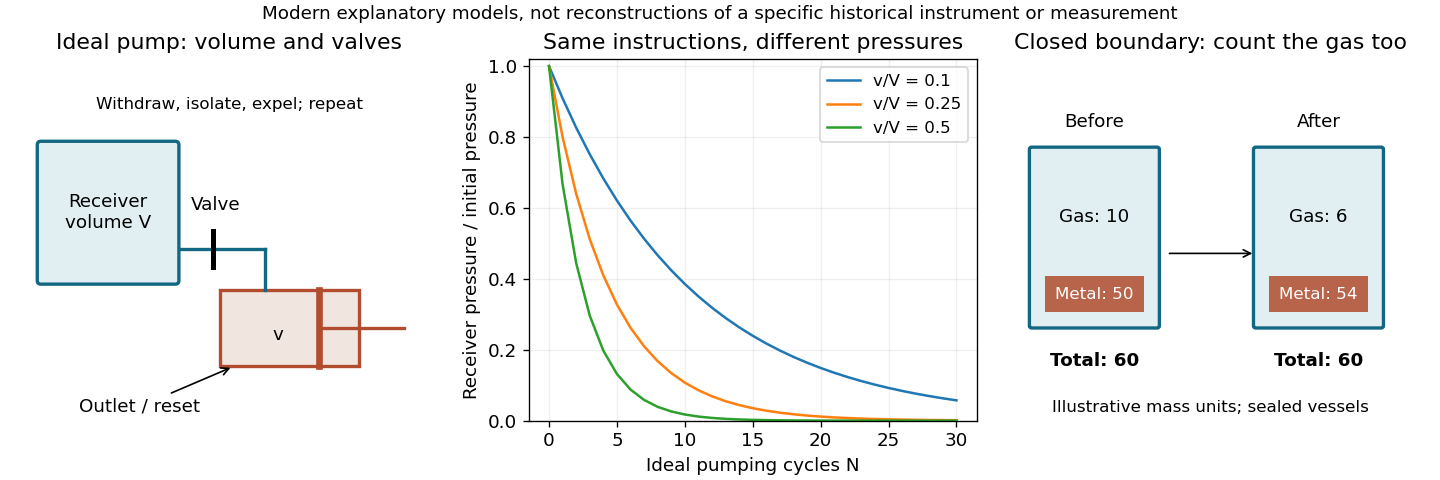
Material arrangements determine the conditions and records of an experiment
. Original explanatory schematics of an ideal pump and a closed-system mass accounting; not reproductions of historical apparatus or measurements. Details.
The second panel makes the same point about a balance. In a closed vessel, the mass of all contents can remain constant even while a heated metal gains mass by incorporating material from the gas. Weighing only the metal, or opening the vessel before the final weighing, defines a different comparison. Antoine Lavoisier's experimental accounting therefore involved vessels, gases, transfer procedures and the choice of system boundary as well as a numerical reading. Knowing that an investigator owned an accurate balance is insufficient to reconstruct what a particular weighing established.[ref]
Elements of Chemistry by Antoine Lavoisier. Part I on combination with oxygen and Part III on experimental apparatus and manipulation
Material culture also makes overlooked contributors visible. Glassworking, engraving, machining, collecting and carrying specimens can be prerequisites for a result whose printed account names only a learned author. Differences in access to workshops, money and audiences affect whose observations can circulate and be repeated. Such dependence does not entail that observations are arbitrary: failure of a seal or disappearance of a specimen can impose a quite definite physical constraint. Social organization and the resistance of materials are both relevant.
Finally, surviving objects have their own source problems. An scientific instrument in a museum may have been repaired, combined with later parts or removed from the room and working routines which made it useful. A printed plate may depict an ideal arrangement rather than an object that existed in exactly that form. Linking an object to notebooks, accounts and published reports can recover the relation between design and use. The explanatory aim is to understand how material arrangements, skilled action and records made claims testable and transportable. It complements intellectual history by showing what an argument required people actually to build, handle and do.
Articles by others on the same topic
There are currently no matching articles.