Source bundle pages 92–93. The cover establishes Hilary Term 2022; the attachment filename uses 2021. The following are independently argued solutions to all eight questions.
There is no convincing single birthplace of science unless the definition is narrowed in advance. Systematic astronomy and mathematics preceded classical Greece; Greek natural philosophy developed distinctive explanatory and demonstrative ambitions; early modern Europe transformed the relationship between mathematics, experiment and institutions. These are different historical achievements. Treating any one of them as the creation of everything now called science confuses a particular form of inquiry with inquiry's entire history.
A good test begins with surviving practices rather than a list of supposed founding geniuses. The Babylonian astronomical diary VAT 4956 records positions of the Moon and planets relative to named stars, together with other observations, for 568–567 BCE. Such a record requires trained observers, a conventional vocabulary and a means of accumulating observations over time. Its intellectual value is not annulled because astronomy was entangled with divination and royal administration. However, this particular diary should not be credited with everything achieved by later Babylonian predictive astronomy: an observational record is evidence of systematic recording, not by itself evidence of a particular predictive algorithm.[ref]
Babylonian astronomical diary VAT 4956. Obverse and reverse: dated lunar and planetary observations; the modern edition identifies the recorded year as 568–567 BCE
Egyptian mathematics provides a different kind of evidence. Problem 50 of the Rhind mathematical papyrus gives a procedure for the area of a circular field: remove one ninth of its diameter and square the remainder. Written in modern algebraic notation, the procedure isComparing this with the modern circle formula gives the effective approximation . This is our reconstruction of the rule's accuracy, not a claim that its author used our symbol or formulated an abstract theory of that constant. A worked numerical procedure is mathematical knowledge even when it is not presented as a Greek-style proof.[ref]
Rhind mathematical papyrus. Problem 50: circular field with diameter nine, reduced to eight, giving area sixty-four
The case for Greece therefore needs a more specific claim. In Physics by Aristotle, nature is investigated through principles of motion and change, and explanation requires identifying different kinds of cause. His distinctions between material, formal, moving and final causes constitute an explicit programme of explanation, not merely a collection of useful recipes. Greek mathematics, exemplified by Euclid's Elements, made the organization of results into chains of proof unusually prominent. These traditions help explain why later European scholars gave Greek texts such authority. They do not establish that earlier or non-Greek practitioners lacked reasoning, nor that all Greek explanations were correct.[ref]
Physics by Aristotle. Book II, chapters 1–3: nature as an internal principle of change, mathematical abstraction and the different senses of cause
[ref]The European sixteenth and seventeenth centuries nevertheless deserve attention as more than the recovery of ancient truths. Galileo Galilei's Two New Sciences by Galileo Galilei joins precise definitions of motion to geometrical demonstrations and reported tests. An inclined plane lengthens a descent sufficiently to compare its distance and time; a mathematical dependence becomes something an apparatus can discriminate. Francis Bacon's Novum Organum by Francis Bacon instead urges a disciplined reconstruction of inquiry through ordered experience and the correction of intellectual prejudices. Their programmes differ, but both show participants deliberately contesting how knowledge should be made. Neither text authorizes the claim that observation or reasoning had only just been invented.[ref]
Two New Sciences by Galileo Galilei. Third Day: definition of uniformly accelerated motion, Theorem II and the reported inclined-plane trials
[ref]Novum Organum by Francis Bacon. Book I, aphorisms 19 and 38–44: methods of inquiry and the idols affecting understanding
Institutional criteria also change the answer. If science means a modern profession with specialized laboratories, credentials and journals, even sixteenth-century Europe is too early for much of it. If it means any successful craft technique, the category becomes so broad that the first surviving written text cannot identify its beginning. If it means public, revisable claims about nature supported by disciplined observation and reasoning, several ancient traditions qualify, with different strengths and social settings. Each definition selects different evidence; none should be smuggled into a geographical verdict.
The strongest conclusion is consequently plural but discriminating. Greece was a major centre of explanatory natural philosophy and demonstrative mathematics; early modern Europe was a major site of their reorganization; neither was the unique beginning of systematic knowledge of nature. This conclusion recognizes real differences in standards of explanation without using proximity to present-day science as the sole measure of past achievement. It also leaves open the historical work of tracing transmission and transformation rather than imagining isolated civilizations independently possessing, or wholly lacking, a timeless scientific essence.
Steven Shapin's challenge is persuasive as a criticism of a single, uniform founding event; it is much less persuasive if read as denying substantial changes in knowledge. His opening provocation introduces an argument about the diversity of early modern practices, purposes and standards. It should be assessed as a historical interpretation, rather than treated as a literal assertion that nothing happened. The useful question is whether the Scientific Revolution names an explanatory pattern or imposes an artificial unity on unlike developments.[ref]
The Scientific Revolution by Steven Shapin. Introduction: the opening challenge to a single Scientific Revolution and discussion of the diversity of practices conventionally grouped under that name
There is a strong case for retaining the category in a qualified form. Compare Aristotle's programme of explaining natural motion through the nature of bodies and different kinds of cause with Isaac Newton's organization of classical mechanics around definitions, Newton's laws of motion and mathematical consequences of specified forces. Newton's law of universal gravitation brought terrestrial falling bodies and planetary motion into one quantitative framework. That changed both the content of explanations and the problems they could solve: the same relation could constrain orbits, lunar motion and terrestrial gravitational acceleration. This is a substantial transformation even though Newtonian mechanics was later revised.[ref][ref]
The Mathematical Principles of Natural Philosophy by Isaac Newton (1846 edition). Definitions and Laws of Motion; Book III, propositions I–VIII, connecting celestial motion and terrestrial gravity
Instrumentation likewise altered what could count as evidence. Robert Boyle's air pump attached a transparent receiver to a mechanical means of removing air. Its value was not merely that an observer saw an unusual event. Successive operations could vary the condition of the enclosed gas, while observers compared such effects as the expansion of a partly inflated bladder and changes in combustion or animal breathing. The apparatus made contrasts that ordinary unaided observation could not easily produce. Yet its results depended on the quality of seals, the operator's skill and decisions about whether a trial had worked. Experiment was an organized achievement rather than nature speaking without mediation.[ref]
New Experiments Physico-Mechanicall by Robert Boyle. 1660: apparatus description and experiments on the spring of air, combustion and respiration, including experiments 40–41
The difficulty for an unqualified revolution narrative is that these changes did not have one method. Francis Bacon emphasized the disciplined ordering of instances and cautioned against premature generalization. Galileo Galilei deliberately reasoned about idealized motion, then connected its mathematical relations to particular trials. Isaac Newton built geometrical arguments concerning forces and used astronomical phenomena to select their application. These are related challenges to inherited authority, but not interchangeable versions of a universal method introduced on one date. Nor does a successful mathematical treatment of planetary motion establish an equally sudden transformation of all biology or medical practice.[ref]
Novum Organum by Francis Bacon. Book I, aphorisms 19 and 95–105: routes from experience to axioms and the proposed reform of induction
[ref]Two New Sciences by Galileo Galilei. Third and Fourth Days: mathematical treatment of acceleration and projectile motion
[ref]The Mathematical Principles of Natural Philosophy by Isaac Newton (1846 edition). Book I, opening sections; Book III, phenomena and propositions I–VIII
Continuities also matter. Euclid's Elements furnished a demonstrative tradition that early modern authors could adapt rather than invent. Existing astronomy supplied observations and problems without which a new celestial mechanics would have had little to explain. The Philosophiae Naturalis Principia Mathematica by Isaac Newton itself is predominantly geometrical in presentation: identifying modernity solely with replacement of geometry by symbolic calculus would misdescribe a central work of the supposed revolution. Equally, an investigator's religious commitments need not have disappeared for mathematical or experimental work to develop. The Philosophiae Naturalis Principia Mathematica by Isaac Newton's General Scholium combines claims about the limits of physical explanation with natural theology.[ref]
Euclid's Elements. Book I: the demonstrative organization later mathematical natural philosophy inherited
[ref]The Mathematical Principles of Natural Philosophy by Isaac Newton (1846 edition). Book I: geometrical propositions; General Scholium, added in the 1713 edition
These qualifications expose a geographical and social selection problem. If the historian defines the event by a few successful European texts in astronomy and classical mechanics, then concludes that Europe suddenly acquired the scientific mentality, the selection has already determined much of the result. Robert Boyle's apparatus depended on skilled construction and operation; printed demonstrations depended on readers able to understand and assess them. A history of disembodied ideas misses the work that made claims credible. Conversely, locating that work in a social setting does not invalidate the measured relationships or make every contemporary theory equally successful.
The Scientific Revolution is defensible as a retrospective name for interconnected, uneven transformations, especially in astronomy, classical mechanics and experimental practice. It is misleading as a single moment when a universal scientific essence replaced ignorance. Steven Shapin's provocation improves the category by forcing its boundaries and assumptions into view. Abandoning the capitalized label is optional; abandoning the expectation of one origin, one method and one uniformly affected society is the more important historical correction.
Isaac Newton made the greater contribution if the criterion is the scope and explanatory integration of mathematical natural philosophy; Galileo Galilei has the stronger claim if the criterion is the formative transformation of how terrestrial motion could be investigated. The first criterion gives a defensible overall verdict for Isaac Newton, but a serious comparison must show what each changed rather than award credit according to who worked later.
Galileo Galilei's contribution was not simply to attach numbers to familiar events. In the Third Day of Two New Sciences by Galileo Galilei, he defines uniformly accelerated motion by equal additions of speed in equal intervals of time, then derives consequences. Starting from rest, the modern notation is ; the mean speed over the interval is , soHence distances in successive equal intervals have the ratios . The novelty lies in making a precisely specified kind of motion the subject of mathematical demonstration, with observed falls assessed against its consequences. This is not the same as deriving the underlying physical cause of gravity.[ref]
Two New Sciences by Galileo Galilei. Third Day: definition of naturally accelerated motion, Theorem I on mean speed and Theorem II with its corollaries
The reported apparatus shows how such an idealization could be investigated. A smooth bronze ball descended in a straight grooved wooden channel, raised at one end. Water discharged through a small opening into a vessel during the descent; its collected mass served as a measure of elapsed time. Repeating runs over different portions of the channel compared the predicted squared dependence of time on distance. The inclined plane slowed the event, while repetition and weighing made a temporal comparison possible without a modern stopwatch. The published report is evidence of Galileo Galilei's experimental presentation, not a surviving raw-data archive from which every reported precision can now be reconstructed.[ref]
Two New Sciences by Galileo Galilei. Third Day, discussion following Theorem II: grooved channel, bronze ball, water timing and repeated trials
A necessary physical qualification is often missed. A ball in rolling without slipping is not a point particle sliding without friction. For a solid sphere on an ideal inclined plane, modern rigid body dynamics gives , rather than . Both are constant accelerations, so both give . The trial can therefore test the temporal form without directly establishing the free-fall coefficient. This distinction makes the experiment more intelligible: the evidence supports a specified relation under approximations, rather than every detail of a modern idealization.
The Fourth Day extends this approach to projectile motion. Combine uniform horizontal velocity with constant downward acceleration , taking downward displacement positive. Then and . Eliminating time givesa parabola. Actual projectiles experience air resistance, but the ideal curve organizes the effects that need separate treatment. Galileo Galilei thus gave a powerful example of how mathematical abstraction and physical observation could cooperate.[ref]
Two New Sciences by Galileo Galilei. Fourth Day, Theorem I: the parabolic trajectory formed by uniform horizontal and naturally accelerated vertical motion
Isaac Newton went further by connecting kinds of motion through a general account of force. Newton's second law links the change of momentum to the impressed force; for constant mass, its modern differential expression is . Newton's third law makes interaction reciprocal, enabling a consistent analysis of interacting bodies. The Philosophiae Naturalis Principia Mathematica by Isaac Newton develops consequences of central forces and then asks which laws fit astronomical phenomena. Mathematical deduction now connects measurable orbits to an underlying force law, rather than just describing each trajectory separately.[ref]
The Mathematical Principles of Natural Philosophy by Isaac Newton (1846 edition). Definitions, Laws II–III; Book I, section II, propositions I–III; section III, propositions XI–XIII
A simple modern reconstruction shows the increase in explanatory reach. For a circular orbit of radius and orbital period about a much more massive central body, centripetal acceleration is . Kepler's third law, , therefore implies an acceleration proportional to . This circular argument is illustrative; Isaac Newton's treatment of elliptical orbits is more general. With Newton's law of universal gravitation,the two-body orbital period is tied to the semimajor axis and both masses. The same theory connects the Moon's orbital acceleration with terrestrial gravity, and supports further investigations of tides, comets and departures from a simple two-body orbit.[ref]
The Mathematical Principles of Natural Philosophy by Isaac Newton (1846 edition). Book I, proposition XV and section XI; Book III, proposition IV and the subsequent treatment of universal gravitation
This achievement depended on more than two individuals. Johannes Kepler's relations supplied crucial astronomical constraints, and both authors inherited geometry, observational records and technical practices. Nor should the Philosophiae Naturalis Principia Mathematica by Isaac Newton be described simply as the first application of symbolic calculus: its published arguments are largely geometrical. What distinguishes Isaac Newton is the demonstrative network uniting terrestrial and celestial problems, together with explicit idealizations whose failures generated further calculable questions.
On breadth, quantitative unification and the inference from motion to force, Isaac Newton's contribution was greater. Galileo Galilei's work supplied an exemplary way to mathematize terrestrial motion and test its idealized relations. Giving the former the overall verdict should therefore acknowledge the latter's distinct foundational achievement, not portray the Philosophiae Naturalis Principia Mathematica by Isaac Newton as a creation without predecessors.
Carl Wilhelm Scheele and Joseph Priestley independently prepared and investigated the gas now called oxygen; Antoine Lavoisier was central to interpreting it within a new account of combustion and chemical composition. Assigning a unique discoverer requires deciding whether discovery means first preparation, first public report, recognition of a distinct kind of gas, or a successful theoretical interpretation. The historical controversy is largely about why one of these achievements should be privileged over the others.
Carl Wilhelm Scheele's investigations, generally dated to the early 1770s, preceded publication of Chemical Treatise on Air and Fire by Carl Wilhelm Scheele in 1777. His work distinguished the component that sustained burning from the remainder of ordinary air. He obtained the active component through several chemical preparations, including heating suitable substances, and interpreted the results in terms of phlogiston. Delayed publication matters to public priority, but it does not show that the experimental work had not occurred. Equally, a publication date alone does not establish the precise date of every earlier trial.[ref]
Chemical Treatise on Air and Fire by Carl Wilhelm Scheele. Experimental sections on the two constituents of air and preparations of fire-air; publication in 1777, distinct from the earlier experimental chronology
Joseph Priestley's 1775 account is unusually revealing because it records hesitation and revision. On 1 August 1774 he heated red mercury(II) oxide with a large burning lens and collected the released gas. A candle burned particularly strongly in it; later trials involving animals and comparison with nitric oxide helped him distinguish its properties from ordinary air. He initially lacked a settled understanding of what he had obtained. Calling the product dephlogisticated air eventually made it intelligible within his own framework: it had an unusually great capacity to accept the phlogiston supposedly released in burning and animal breathing.[ref]
Experiments and Observations on Different Kinds of Air by Joseph Priestley (1775). Volume II, section III: experiment of 1 August 1774, initial uncertainty and subsequent trials of the new air
The modern chemical equation,is a useful reconstruction, but it must not be passed off as Joseph Priestley's own explanation. In modern terms, heating decomposes mercury(II) oxide into mercury and molecular oxygen. The eighteenth-century experimenter instead worked with such categories as calces and differently modified airs. The material operation can be recognized across the change in theory while the meaning of its product remains historically contested.
Antoine Lavoisier made a different contribution. His programme tracked what entered and left substances in calcination and combustion, placing gases within quantitative material balances. In the mercury experiment described in Elements of Chemistry by Antoine Lavoisier, a retort communicated with an enclosed supply of air over mercury. Prolonged heating formed a red calx and diminished the enclosed air. Stronger heating of the recovered calx released an especially combustion-supporting gas; adding it back to the residual air restored the properties of the original mixture. The persuasive feature was the linked decomposition and reconstruction, not just a single spectacular flame.[ref]
Elements of Chemistry by Antoine Lavoisier. Part I, chapter III: apparatus, twelve-day mercury calcination, examination of residual air and recombination with the gas released from the red calx
That sequence supported the claim that air was a mixture and that calcination involved combining a metal with part of it. A metal could gain mass because material entered it from the air, without requiring an invisible substance to leave with anomalous properties. Conservation of mass made the weighing scale a constraint on the explanation. However, Antoine Lavoisier's entire system was not modern chemistry. He treated caloric as an explanatory principle and associated the newly named oxygen with the formation of all chemical acids. The latter universal claim is false: hydrochloric acid is an chemical acid whose solute, hydrogen chloride, contains hydrogen and chlorine but no oxygen. This concrete counterexample prevents us from defining discovery as possession of today's complete theory.[ref]
There are consequently several legitimate allocations of credit. An investigator concerned with earliest preparation may emphasize Carl Wilhelm Scheele; one concerned with the well-documented 1774 experiment and its rapid communication may emphasize Joseph Priestley; one concerned with the explanatory reconstruction of combustion may emphasize Antoine Lavoisier. The last achievement depended on experimental results that the others had produced. Correct interpretation was neither a substitute for preparing the material nor an achievement wholly independent of communication between investigators.
Historians disagree because their accounts embody different pictures of scientific change. A simple accumulation story can make discovery look like identifying one additional item in a ready-made list of chemical elements. A conceptual-change story emphasizes that the list and its criteria were themselves changing: oxygen was not just another variety of modified air in the new chemistry. National priority narratives and the dramatic reputation of the Chemical Revolution can further encourage a single heroic winner. Yet replacing that winner with a collective label is insufficient unless the different experimental and theoretical contributions are explained.
The most defensible answer distributes credit while specifying the achievement. Carl Wilhelm Scheele and Joseph Priestley deserve independent experimental discovery credit; Antoine Lavoisier deserves central credit for the chemical interpretation and reorganization that gave oxygen its place in a new system. Discovery was a sequence of preparation, discrimination, communication and reinterpretation, rather than one instantaneous encounter with a theory-free fact.
Nineteenth-century embryology transformed knowledge of reproduction from an account of fluids and visible growth into an increasingly cellular account of fertilization and biological development. It did not end with a complete mechanism of heredity. The century must be treated as a changing sequence: what was established by the 1890s cannot be attributed without qualification to an investigator in 1800. The key changes concerned the material contributions of the parents, the origin of embryonic structures and the evidential power of observation versus intervention.
An early problem was identifying the mammalian ovum. A large ovarian follicle is not itself the ovum, and failure to distinguish the two could confuse the material starting point of biological development. In 1827 Karl Ernst von Baer described the mammalian ovum, notably from the dog, in De ovi mammalium et hominis genesi by Karl Ernst von Baer. Dissection located the relevant structures; optical microscopy distinguished the small ovum within the follicle. The evidence was therefore a combination of anatomical placement and magnified appearance. The work's title must not be taken as proof that he directly observed every corresponding stage in human reproduction.[ref]
De ovi mammalium et hominis genesi by Karl Ernst von Baer. 1827 account and accompanying plate of the mammalian ovum, including the observations on the dog
This mattered to the contest between preformationism and epigenesis. If the embryo were already a tiny formed individual, growth would chiefly enlarge structures already present. Successive observations of incubated eggs instead showed structures appearing and differentiating over time. Serially examining embryos at different stages made an ordered developmental account possible; it did not normally follow the same opaque mammalian embryo continuously from beginning to end. Nor did rejection of a miniature adult settle every question about invisible inherited organization. An investigator could accept the visible emergence of structures yet propose pre-existing determinants below the resolving power of the optical microscope.[ref]
The Cell by Oscar Hertwig. Chapter IX, sections I–II: older and more recent theories of development and reproduction
During the century, cell theory and improved techniques made cell division a central explanatory object. Lenses, illumination, thin sections, fixation and staining helped observers distinguish cell nuclei, chromosomes and patterns of division. These were achievements of preparation as well as magnification: a preparation could preserve a fleeting structure but also distort it. Comparing preparations and checking fixed material against living specimens were therefore important safeguards. By the late century, a developmental sequence could be described as successive divisions and rearrangements of cells, rather than the spontaneous appearance of a fully organized body from undifferentiated fluid.[ref]
The Cell by Oscar Hertwig. Chapters I–II on investigating and organizing the cell; chapter VI on cell multiplication and nuclear division
Fertilization became a particularly revealing test. External fertilization in transparent marine eggs allowed investigators to mix sperm and unfertilized ova at a known time and watch the sequence under an optical microscope. Oscar Hertwig's sea-urchin investigations in the 1870s connected sperm entry with the appearance and union of the male and female nuclear contributions before the first cleavage division. His later The Cell by Oscar Hertwig presents these events as central to the process. Separating eggs from sperm, observing them before mixing, and comparing the sequence after mixing could distinguish fertilization from ordinary changes in an ageing egg. Serial nuclear observations supplied evidence about what entered and what happened next, not merely a correlation between mating and later offspring.[ref]
Nevertheless, fusion of parental nuclear material did not reveal the modern molecular mechanism of heredity. Chromosomes supplied observable structures whose behavior could be compared across cell divisions, and the contributions of the two gametes could be investigated. This is different from knowing that DNA encodes information in a particular nucleotide sequence, or knowing how that information directs development. Even the apparent continuity or disappearance of a cell nucleus during division was a historically difficult observational problem. The distinction between a visible structure and the theoretical function assigned to it is essential.[ref]
The Cell by Oscar Hertwig. Chapter VI, account of competing earlier interpretations of nuclear division; chapters VII and IX on fertilization and theories of heredity
The final decades added experimental embryology. In 1888 Wilhelm Roux injured one of the first two blastomeres of a frog embryo with a heated needle; partial development of the survivor appeared to support a mosaic theory of development, in which early divisions distribute distinct developmental capacities. In 1891 Hans Driesch separated early sea-urchin blastomeres by shaking and found that an isolated blastomere could form a small complete larva. That showed a regulatory capacity inconsistent with an exclusively rigid allocation of half the future organism to each of the first two cells.[ref]
The Science and Philosophy of the Organism by Hans Driesch. Part I, section B.1, Experimental Morphology: The Work of Wilhelm Roux and The Experiments on the Egg of the Sea-urchin; retrospective account explicitly dating the experiments to 1888 and 1891
The comparison requires care: killing a cell and leaving it attached is not the same intervention as removing it, and a frog is not a sea urchin. The results therefore did not establish that all embryos develop identically or that every early cell can make an entire organism. They did establish that a normal developmental fate cannot automatically be equated with an irreversible developmental capacity. Hans Driesch's later commitment to vitalism was one interpretation of this capacity, not something a complete larva logically proved. His 1908 retrospective account is valuable participant evidence, but it is later than the nineteenth-century trials it describes.[ref]
The Science and Philosophy of the Organism by Hans Driesch. Part I, section B.1: discussion of isolated blastomeres, regulation and the limits of the mosaic interpretation; Preface identifies the lectures as a personal philosophical account
By the century's end, investigators had strong evidence for the cellular starting points of sexual reproduction, parental nuclear participation in fertilization and active organization during biological development. They knew these things through dissection, prepared and living microscopic observations, comparison of stages, and increasingly discriminating interventions. Their continuing uncertainty about heredity and developmental organization was productive: it concerned mechanisms that their best observations had made more precisely questionable, rather than a simple absence of facts.
Charles Darwin's theory was political in its sources, conditions of production, implications and uses, but natural selection did not logically prescribe a unique political programme. An adequate answer should distinguish those senses. Otherwise the presence of a social analogy becomes an alleged refutation of evolution, or a description of differential reproduction becomes an unwarranted moral command.
The clearest connection is with Thomas Robert Malthus. In his retrospective Autobiography of Charles Darwin, Charles Darwin recalled reading the population argument in 1838 and recognizing how a struggle under limited resources could preserve favorable variations. Thomas Robert Malthus's argument belonged to a debate about human subsistence and social provision, not originally to an experimentally established law of all species. Moving it into natural history was a creative transfer: if more offspring are produced than can persist, then small heritable differences can affect whose offspring contribute to later generations.[ref]
Autobiography of Charles Darwin. Section on the formation of the theory of natural selection: recollection of reading Malthus in October 1838
[ref]An Essay on the Principle of Population by Thomas Robert Malthus. 1798 edition, chapters I–II: contrast between population increase and subsistence
The transfer was not simply an assertion that nature is a competitive market. Chapter III of On the Origin of Species by Charles Darwin explains the struggle for existence broadly, including dependence between organisms and difficulty surviving physical conditions. A plant at the edge of its range can struggle against drought without fighting another plant. Chapter IV makes the explanatory connection: inherited differences that affect survival and reproduction change what is represented in later generations. Competition is one possible relation within the explanation, not its only mechanism.[ref]
On the Origin of Species by Charles Darwin. 1859 edition, chapters III–IV: broad sense of struggle, dependence, checks on increase and preservation of useful variations
The distinction can be stated precisely without pretending that Charles Darwin possessed modern population genetics. Suppose a heritable type initially has relative frequency and contributes an average of descendants, while the alternative contributes . Under a simple faithful-inheritance mathematical model,Thus, when the denominator is positive and ,This modern reconstruction identifies a conditional relation between heredity, reproductive success and changing relative frequency. It contains no statement that a successful type is morally superior, that it is physically strongest, or that governments ought to remove aid. Those conclusions would require additional premises that are absent from the mathematical model.
The production of the theory nevertheless had social conditions. Charles Darwin's natural history drew on travel, collections, correspondence and the expertise of practical breeders. His voyage was part of a naval surveying expedition, so the geography of observation depended partly on the state's maritime resources and access to distant places. That helps explain the production of his evidence without implying that a naval expedition could dictate the eventual theory.[ref]
Autobiography of Charles Darwin. Account of the Beagle voyage and its importance in his scientific life
Artificial selection in pigeons and domestic plants provided concrete evidence that inherited variation could accumulate, making an initially unfamiliar mechanism intelligible through familiar practices. A breeder's deliberate choice, however, was an analogy for some consequences of differential reproduction, not proof that natural selection has foresight or a public-policy goal. The evidence and its presentation were historically situated even when the resulting claim concerned processes outside Victorian society.[ref]On the Origin of Species by Charles Darwin. 1859 edition, chapter I: variation and selection under domestication; chapter IV: the analogy and differences between human selection and natural selection
Human applications created more direct political stakes. Common descent challenged rigid accounts of human separation from other animals, while The Descent of Man by Charles Darwin extended evolutionary explanations to human mental, social and moral capacities. It also contained hierarchical judgments about peoples that must be recognized as historical assertions, not adopted as scientific facts. An account of universal ancestry could be used to contest fixed human divisions, while assumptions about unequal advancement could support their reconstruction in evolutionary language. The same broad theory therefore entered arguments pulling in different directions.[ref]
Charles Darwin's discussion of sympathy illustrates why a simple laissez-faire label is inadequate. He worried that medicine and assistance might affect processes of selection, yet argued that suppressing sympathy would damage a noble part of human nature. This passage neither removes the troubling assumptions surrounding it nor supports the claim that he straightforwardly prescribed abandoning vulnerable people. It shows a tension within his own reasoning between evolutionary speculation and moral commitments. A historically responsible reading must retain both.[ref]
The Descent of Man by Charles Darwin. 1871 edition, volume I, chapter V: discussion of assistance to the weak and the moral consequences of checking sympathy
Later social Darwinism and eugenics therefore require separate histories of selection and transformation of claims. Invoking natural selection does not establish that a policy follows from the biological theory; equally, calling an application a misuse should not hide how readily some contemporary language of hierarchy encouraged it. Historical explanation needs both the available scientific vocabulary and the institutions and interests that put it to work. A political genealogy alone does not settle whether the biological mechanism operates: that issue must also be assessed through evidence about genetic variation, heredity, adaptation and reproduction.
The theory was politically situated and politically consequential, but politically underdeterminate. Its Malthusian stimulus, its practical evidential resources and its human applications belong inside its history. The direction of a social policy cannot be read straight off the fact that inherited differences sometimes produce differential reproductive success.
Mid-twentieth-century environmental and population concerns converged around limits to growth, but disagreed over what caused environmental damage and what intervention followed. More people could increase pressure on land, food and water; that did not establish that numbers alone explained depletion or pollution. A strong account follows the transition from resource conservation to chemical contamination and then to explicit global mathematical models, distinguishing observations from conditional projections.
The resource argument was already prominent in 1948. William Vogt's Road to Survival by William Vogt linked human numbers to the productive capacity and degradation of land. Soil loss could reduce future food production, while further population increase enlarged the demands placed on the same resource base. The relevant constraint was not simply the size of the planet: it was the maintenance of the ecological processes on which agricultural production depended. This linked population dynamics with a changing carrying capacity. The argument's policy implications depended on whether one emphasized birth limitation, restoration of land or changes in resource use.[ref]
Road to Survival by William Vogt. 1948 text, reproduced extract in The Future of Nature, pp. 187–194: population pressure, land degradation and ecological productive capacity
The mechanism can be clarified with modern notation. If is biological population, a constant net per-capita rate gives the idealization , hence . A finite food supply cannot support that positive exponential growth indefinitely. But the premise is conditional: observed birth rates, mortality and food production need not remain fixed. A logistic growth equation, , represents one kind of density limitation; it does not prove that human carrying capacity is a fixed measurable number independent of technology, diet or distribution. Resource arguments needed empirical work on both population change and the systems supplying people.
The postwar problem was also about the consequences of attempts to sustain human welfare. Increasing agricultural output and suppressing insect-borne disease could reduce mortality or enlarge food supply, while chemical interventions created further ecological effects. Rachel Carson's Silent Spring by Rachel Carson made that feedback concrete. Its Clear Lake example followed DDD through plankton, fish and fish-eating birds: small environmental concentrations could become large tissue residues through exposure and feeding relationships. The account connected intended pest control with unintended damage to other biological populations. It did not depend on proving that the number of human inhabitants alone had caused the damage.[ref]
The distinction between bioaccumulation within an organism and biomagnification along a food chain matters here. Neither follows simply from dividing a pesticide dose by the number of people. Persistence, uptake, elimination and feeding relations determine exposure. Rachel Carson's 1963 response to critics listed continuing wildlife losses under officially organized spraying and protests by farmers themselves. The historical conflict was therefore over the evidential adequacy and distribution of an intervention's costs, not merely a choice between caring about people and caring about nature.[ref]
Rachel Carson Answers Her Critics. 1963 speech, reproduced by Audubon: examples of official spraying campaigns, continuing wildlife losses and objections from farmers
Paul R. Ehrlich and John P. Holdren's 1971 paper explicitly defended the importance of population growth while addressing consumption and technology. Its decomposition of total impact into numbers of people and impact per person also made clear why density alone is inadequate. A useful accounting identity for one specified pollutant iswhere is output or consumption per person and is impact per unit of that activity. For a waste stream measured in mass per year, the units multiply consistently to mass per year. This three-factor notation is an analytical extension of the debate, not a quotation of every equation in the 1971 article. It identifies separate questions about abundance, consumption and production techniques; it is not by itself an independently tested causal law.[ref]
Impact of Population Growth by Paul R. Ehrlich and John P. Holdren. Science 171 (1971), opening discussion and decomposition of total impact as population multiplied by per-capita impact; subsequent discussion of technological constraints
For example, doubling while halving at fixed leaves this defined impact unchanged. Conversely, constant is compatible with rising impact if increases or production becomes dirtier. These counterexamples do not show that population is irrelevant. They show why an explanation must state what else is changing. They also explain a political disagreement within environmentalism: concentrating on fertility can obscure high consumption and harmful production, while concentrating exclusively on cleaner technology can overlook the scale of demand.
The Limits to Growth by Donella H. Meadows and others in 1972 joined population, industrial production, food, resources and pollution in a computer computer simulation. Its importance lay in their interaction and in delays: a system could overshoot a sustainable level before feedback sufficiently changed investment or demographic behavior. The resulting curves were conditional scenarios generated by assumptions about those relations, not direct observations of the future. The authors examined changed assumptions and possible stabilization; the report should not be summarized as one unconditional prediction of a uniquely dated collapse.[ref]
The Limits to Growth by Donella H. Meadows and others. Chapters I and III–V: exponential growth, the world model, alternative technological assumptions and stabilization scenarios
The 1972 Stockholm Declaration exposed the need to connect these global concerns to unequal circumstances. Principle 8 treated economic and social development as necessary to environmental improvement, while principle 16 discussed demographic policies subject to human rights and governmental judgment. Their coexistence matters: a global population total did not erase differences in poverty, consumption or responsibility.[ref]
Declaration of the United Nations Conference on the Human Environment. Stockholm, 1972, principles 8–9 and 16
Environmental and population concerns were linked through demands on ecological systems, through the unintended effects of welfare technologies, and through models of interacting growth and limits. They never established one agreed diagnosis. The enduring historical issue was which variables, mechanisms and distributions of responsibility an apparently simple claim about too many people concealed.
Scientific knowledge is deeply shaped by historical context in the questions asked, evidence available and standards of credibility, but context does not make results arbitrary or determine their truth by itself. The strongest argument identifies mechanisms through which context enters inquiry and then examines what experimental or mathematical constraints can resist it. This avoids both the claim that facts emerge untouched by human activity and the opposite claim that a social explanation is a substitute for testing them.
First, inherited conceptual resources determine what an investigator initially thinks an observation might be. Joseph Priestley's experiments on oxygen illustrate this directly. Heating mercury(II) oxide produced an unusually combustion-supporting gas, but the experiment did not arrive labelled with a modern chemical formula. Phlogiston supplied an available vocabulary: the gas could be interpreted as exceptionally dephlogisticated air rather than a newly isolated chemical element. His own account acknowledges the difficulty of revising expectations even when striking observations appeared. This is specific evidence that interpretation has a history, rather than a general accusation that past investigators were irrational.[ref]
Experiments and Observations on Different Kinds of Air by Joseph Priestley (1775). Volume II, section III, opening methodological reflections and the subsequent interpretation of the new air
Antoine Lavoisier's material balances reorganized the same field by treating the air consumed during calcination as a constituent incorporated into the product. The retort, enclosed air supply and quantitative examination of products made some interpretations more difficult to maintain. Yet his identification of oxygen as the universal acidifying principle was itself wrong: hydrogen chloride gives an chemical acid without containing oxygen. The example establishes two distinct conclusions. An interpretive framework helps make observations intelligible; further observations and successful alternative explanations can expose its limits. Historical situatedness is compatible with correction.[ref]
Elements of Chemistry by Antoine Lavoisier. Part I, chapters III–V: mercury experiment, naming oxygen and proposed composition of acids
Second, instruments and techniques shape what can become an observable object. In nineteenth-century embryology, an optical microscope did not simply magnify a transparent miniature adult. Investigators needed suitable organisms, controlled access to eggs and sperm, ways of preparing thin or fixed material, and conventions for ordering developmental stages. Transparent sea-urchin eggs and external fertilization made processes accessible that were much harder to observe in opaque mammalian material. Such a choice was productive but selective: knowledge gained from one organism needed further work before it could be generalized to others.[ref]
The Cell by Oscar Hertwig. Chapters I–II on investigation and cell organization; chapter VII, Echinoderm Eggs, on observing fertilization
The Wilhelm Roux–Hans Driesch comparison shows why the details of an intervention matter. Killing an attached frog blastomere and separating a living sea-urchin blastomere differ both in material and operation. Partial development in one setting and a complete small larva in another cannot honestly be flattened into an experiment with one obvious answer. Nevertheless, the second outcome constrains the universality of an exclusively fixed mosaic theory of development. A capacity for regulation is empirically established in the tested conditions even if disagreement remains about its explanation. Technical and theoretical contexts shape the result's significance without allowing the observer simply to choose its outcome.[ref]
The Science and Philosophy of the Organism by Hans Driesch. Part I, section B.1: accounts of Roux's experiment and the author's separated-blastomere experiments
Third, social interests can supply a problem or analogy without fully fixing the resulting theory. Charles Darwin's adaptation of Thomas Robert Malthus's population argument is a clear case. A discussion of human subsistence helped him formulate a mechanism for changes among organisms. However, his broad struggle for existence includes dependence and physical conditions, not only direct competition. The resulting natural selection explanation must be evaluated through genetic variation, heredity and differential reproduction, not accepted or rejected merely because a stimulus came from political economy. The route by which a hypothesis is formed is a historical question; the evidence sustaining its application is a connected but distinct question.[ref]
Autobiography of Charles Darwin. Recollection of reading Malthus during the formation of the natural-selection theory
[ref]On the Origin of Species by Charles Darwin. 1859 edition, chapters III–IV: senses of struggle and the proposed mechanism of selection
Fourth, conventions of demonstration affect what a community can reliably criticize. Galileo Galilei's definitions of accelerated motion let readers derive a squared time relation and compare it with repeated descents on an inclined plane. A reader can dispute whether the apparatus sufficiently approximates the model, distinguish a rolling ball from a freely falling body, or check whether the mathematical conclusion follows. The idealization is historically chosen, but its consequences are not whatever the author wishes. For a constant acceleration from rest, the distance ratio for elapsed times in the ratio must be ; changing that conclusion requires changing the assumptions or the mathematics.[ref]
Two New Sciences by Galileo Galilei. Third Day: definition of uniformly accelerated motion, Theorem II and discussion of its experimental test
These cases support degrees rather than a single all-purpose answer. Historical context strongly affects research priorities, available specimens, instruments, vocabularies and access to credibility. It also affects which uncertainties become urgent and which applications receive resources. Its influence on a particular measured relation or mathematical entailment must be demonstrated rather than presumed. The same social setting can sustain competing interpretations, and a mathematical framework can travel beyond the setting in which it was first developed. Conversely, the ability to reproduce a result elsewhere does not erase the historical work needed to make that reproduction possible.
Scientific knowledge is historically produced and materially constrained. Context helps explain why a claim was thinkable, testable and persuasive at a particular time; it does not alone tell us whether the claim survives comparison, intervention and criticism. A convincing history therefore traces both the circumstances that make knowledge possible and the resistant evidence through which those circumstances can themselves be challenged.
All eight essays are covered. Both alternatives in question 6 are discussed within its single source-numbered solution. Historical arguments distinguish mathematical reconstructions from claims about original notation or surviving evidence.
A useful distinction is between preserving an inherited text, correcting a particular prediction, and changing the standards by which an explanation is judged. Work in the medieval Islamic world did all three. It did not form one homogeneous programme, and its significance should not be measured only by how nearly it anticipated later European theories. Mathematical astronomy provides a particularly clear example of critical development within, rather than simple abandonment of, an inherited physical framework.
Aristotle's account of celestial motion privileged uniform circular movements, whereas the computational models associated with Ptolemy used constructions whose physical interpretation was contested. An astronomical device could reproduce observed positions yet leave a question about whether the corresponding arrangement of celestial bodies could actually execute those motions. The dispute therefore concerned the relation between mathematical prediction and physical explanation, not merely improved arithmetic.
The Tusi couple, associated with Nasir al-Din al-Tusi, demonstrates the resources of this tradition. In modern Cartesian notation, combine two equal-radius uniform circular motions with opposite angular rates:Their resultant is a straight oscillation. Thus circular component motions need not produce a circular resultant. The plane construction offers a way of representing a required oscillatory displacement using circular components; it does not itself establish a new force law or the actual constitution of the heavens. The distinction between plane and spherical versions also matters: one should not transfer the planar identity to a sphere without a separate geometric argument.[ref]
The Spherical Case of the Tūsī Couple by George Saliba and E. S. Kennedy. research abstract and discussion of the distinction between plane and spherical constructions
Ibn al-Shatir went beyond transmitting a computational recipe by producing revised planetary models. The surviving treatise and its manuscript differences are material evidence of active theoretical construction, not a fixed body of knowledge passing unchanged through translators. The critical edition of his work also distinguishes the extant exposition from a lost work to which it refers for observations and demonstrations. That limits what can responsibly be claimed about the surviving text: a modern mathematical reconstruction is not a newly discovered original experimental record.[ref]
Kitāb nihāya al-sūl fī taṣḥīḥ al-uṣūl by Ibn al-Shatir. Erwan Penchèvre's critical edition, introduction: the exposition, the lost observational work, and the manuscript witnesses
These cases show enrichment and modification through new geometry and models, and dispute over the adequacy of inherited physical assumptions. They do not justify labeling every participant anti-Aristotelian. A demand for physically admissible uniform component motions could itself be motivated by Aristotelian commitments. Nor does a geometrical resemblance between a model and a later one prove direct transmission or establish that their authors shared the same cosmology. The historical achievement is more precise: inherited authority supplied resources and problems, while astronomers developed new constructions and criticized the relation between prediction and physical explanation. That is a substantive transformation of a research tradition, even where geocentric assumptions remained.
Astronomical instruments do more than make an existing observation more accurate. They select measurable quantities, embody mathematical assumptions and create new classes of evidence. The astrolabe and the telescope illustrate two different relationships between a mathematical model and observation.
A planispheric astrolabe represents the celestial sphere on a flat plate by stereographic projection. A rotating star map is fitted over a plate appropriate to the observer's latitude; the back carries a sighting rule, or alidade, and an angular scale. A measured stellar altitude can be matched to the engraved geometry to infer the celestial configuration and hence the time. The instrument combines an observation with a physical analogue calculation. Its geometry is indispensable to the inference: the sighting alone does not tell the time.[ref]
Astrolabe by Silke Ackermann. Epact instrument description: rete, latitude plates, alidade and time-telling procedure
This also explains why manufacture, calibration and users' knowledge mattered. An unsuitable latitude plate or an inaccurate sighting produces a systematic error rather than a philosophical refutation of celestial geometry. Conversely, engraved scales and repeatable settings allow predictions and observations to be compared in an organized way. The astrolabe belongs to a history of practical calculation as well as cosmological ideas. Its use to represent apparent sky rotation does not establish that its user had independently proved every physical claim of a geocentric cosmology.
The early telescope changed what could be included in an astronomical description. In Sidereus Nuncius by Galileo Galilei, the Moon's changing light and shadow supports an interpretation of surface relief, the Milky Way resolves into many stars, and repeated observations distinguish small bodies accompanying Jupiter from ordinary fixed stars. Temporal sequences were crucial: a few points in one image are ambiguous, whereas their changing configurations around the same bright body support an orbital interpretation.[ref]
Sidereus Nuncius by Galileo Galilei. 1610 account: lunar surface, the Milky Way and the sequence of observations near Jupiter
There were physical reasons not to accept every magnified appearance immediately. Lens defects, limited resolution, stray light and imperfect alignment can create or distort features. Consistency under repeated observations, comparison with familiar terrestrial objects and a successful account of how the instrument forms images help distinguish an optical artefact from a celestial object. An instrument extends sight only through a chain of physical inferences; it does not remove that chain.
The discoveries also had discriminating, rather than unlimited, theoretical force. A visibly irregular Moon challenged the doctrine of perfectly smooth celestial bodies. Moons accompanying Jupiter showed that not every visible revolution had the Earth as its immediate centre. Neither observation alone proved that the Earth moves around the Sun: a different system could allow Jupiter's moons while retaining a stationary Earth. Later observations such as the phases of Venus must also be distinguished chronologically from the observations published in the March 1610 book.
The two instruments thus shaped astronomy in complementary ways. The astrolabe made a mathematical sky model operational, whereas the telescope exposed phenomena that demanded changes to parts of the accepted model. In both cases, reliable knowledge depended on geometry, material workmanship, repeated observations and explicit limits on what the observations entailed.
The case for a Chemical Revolution is strongest if it concerns a reorganization of chemical explanation, measurement and classification. It is much weaker if it means that one isolated observation immediately overthrew a unified older theory. The production of the gas later called oxygen and the acceptance of an oxygen-based chemistry were related but distinct developments.
Carl Wilhelm Scheele and Joseph Priestley investigated an unusually combustion-supporting gas, yet interpreted their results within the resources of phlogiston theory. Priestley's term dephlogisticated air was not simply an incorrect label on an otherwise complete modern explanation: it expressed a different account of what combustion did. Scheele's preparations and Priestley's work also make a single-person priority story inadequate. Experimental preparation, publication, recognition of a material's properties and a new interpretation need not occur together.[ref]
Chemical Treatise on Air and Fire by Carl Wilhelm Scheele. experiments on fire air and its relation to ordinary air
[ref]Antoine Lavoisier's programme connected the gas with the quantitative study of combustion and metallic calces. On the oxygen account, a metal's conversion into an oxide involves incorporation of material from the surrounding gas. The increase in the solid's mass is therefore compatible with conservation of mass for the whole vessel and its contents. Simply weighing only the metal is not the same experiment as accounting for the gaseous reactant as well. This change in what must be measured helped make the explanatory alternatives testable.
The shift also concerned chemical language. A nomenclature organized around composition made new relations among substances expressible and teachable. In Elements of Chemistry by Antoine Lavoisier, the treatment of simple substances and compounds is part of a systematic programme rather than an appendix to one gas experiment. Methods, instruments, names and explanations reinforced one another.[ref]
Elements of Chemistry by Antoine Lavoisier. preliminary discourse and Part I: combustion, simple substances and the organization of chemical explanation
There are important qualifications. Older investigators were not incapable experimenters, and phlogiston accounts could be adjusted in response to new results. The newer chemistry also contained commitments subsequently rejected: caloric theory and the claim that oxygen was universally essential to acidity were not permanent truths. Hydrogen chloride provides a later counterexample to a universal oxygen-based account of acids. A theory can be a major advance without every element of its programme surviving.
Accordingly, calling the episode revolutionary need not deny continuity in apparatus, experiments or personnel. It identifies a substantial change in how chemical processes were described and coordinated. Conversely, oxygen preparation by itself does not establish a sharp boundary between rational and irrational chemistry. The explanatory achievement depended on interpreting material exchanges, connecting them to measurements and building a coherent working system. The discovery of the gas contributed to that transformation, but the historical revolution cannot be reduced to its first preparation.
Isaac Newton's achievement was not to introduce mathematics into a previously nonmathematical study of nature. Astronomy, optics and mechanics already had substantial mathematical traditions; Two New Sciences by Galileo Galilei, for example, connects geometrical reasoning with accelerated motion. The distinctive achievement of the Philosophiae Naturalis Principia Mathematica by Isaac Newton was to connect mathematical results about motion and forces with an ambitious, quantitatively constrained account of terrestrial and celestial phenomena.
The method separates a conditional mathematical proposition from its application. Given a specified force law and initial conditions, determine a trajectory. Conversely, given a suitably idealized trajectory and time law, infer what force would produce it. This makes the explanation more demanding than fitting a geometrical curve to positions: the timing and dynamical assumptions matter as well.
A modern calculation illustrates the connection. For a planar orbit under a central force, let be the conserved specific angular momentum and put . An ellipse with the attracting point at a focus has . Thus , and Binet's equation gives the radial accelerationThe orbit and equal-area timing therefore imply an inverse-square acceleration under the stated assumptions. The modern notation is explanatory; it is not an assertion that Newton wrote this particular differential-equation derivation. The geometrical treatment of central forces in Book I and its astronomical application in Book III supply the historical connection.[ref]
The Mathematical Principles of Natural Philosophy by Isaac Newton (1846 edition). Book I, central-force propositions, and Book III, application to planetary and satellite motions
The programme also joined apparently different domains. Newton's law of universal gravitation connects orbital motion with terrestrial falling motion through the same inverse-square dependence, with distance and time scales accounted for. That unification produced further tests rather than merely attaching one name to two phenomena. Departures from a perfect two-body ellipse, including disturbances by other gravitating bodies, became quantitative problems for the theory instead of automatic refutations of it.
Measurement did not disappear into deduction. Astronomical observations provide imperfectly known inputs; assumptions about mass distribution and neglected interactions restrict an ideal model. A discrepancy can expose a mistaken approximation, an observational error or a deficiency in the dynamical account. The mathematical proof alone does not decide which. The laws and initial data therefore create a disciplined relationship between measurement and explanation, not a proof of all nature from definitions.
Newton also did not claim that successfully describing a force mathematically supplied a complete mechanical account of its ultimate cause. Distinguishing a quantitative law from a speculative mechanism allowed a powerful programme of prediction while leaving explanatory questions open. The achievement was a new integration of mathematical demonstration, empirical inference and common dynamical principles. Its strength lies in the constraints this integration places on physical explanations, rather than in a simple opposition between mathematics and experiment.
Images and models were not merely illustrations added after embryological knowledge had been obtained. They organized observations, allowed stages and species to be compared, and made hidden structures available for argument. Their usefulness also created a risk: a clear-looking picture could give an interpretation an apparent certainty that the observational preparation did not warrant.
An embryo changes through time, while a drawing or preserved specimen ordinarily shows one stage. Arranging images in a developmental series makes a temporal process visible by combining observations of different specimens. Such a series can reveal orderly changes, but it already assumes that the specimens are comparable and correctly staged. Differences of orientation, growth rate or species cannot safely be treated as consecutive moments in one individual history. Embryology therefore depended on standards for identifying structures and developmental stages, not only on better artistic technique.
Optical microscopy and section images added a second inferential problem. A two-dimensional section is not the entire three-dimensional embryo. A cavity, a fold and two separate surfaces can produce similar profiles in an isolated section. Three-dimensional reconstruction from serial sections combines aligned sections to constrain a spatial interpretation. In a simplified quantitative version, sections of area give volume , approximated by . That mathematical reconstruction does not make section thickness, deformation or alignment errors vanish.
Images also mediated theoretical disputes. Karl Ernst von Baer's comparative embryology connected developmental organization with relations among groups rather than treating every embryo as a miniature adult. Cell theory and studies of fertilization changed the structures that investigators looked for and drew. Oscar Hertwig's account of the cell makes nuclear organization and its relation to reproduction central objects of observation. These were arguments about what visible structures meant, as well as improvements in magnification.[ref]
De ovi mammalium et hominis genesi by Karl Ernst von Baer. 1827 account of the mammalian ovum
[ref]The Cell by Oscar Hertwig. discussion of fertilization and the role of nuclei
Experimental outcomes supplied a check on a purely pictorial account. The contrast between mosaic development and regulative development concerns what cells can produce after intervention, not just the positions assigned to them in a normal embryo's diagram. Hans Driesch's separated-blastomere results challenged a simple allocation of fixed developmental parts to early cells. Comparing them with Wilhelm Roux's experiments also requires noticing that leaving a damaged cell in place is not the same condition as removing it. A schematic diagram which treats those interventions as equivalent can conceal the decisive experimental difference.[ref]
The Science and Philosophy of the Organism by Hans Driesch. Part I, section B: the experiments of Roux and isolated blastomeres
Physical models and reconstructed images could make complex relations easier to teach and inspect, yet their apparent completeness had to remain answerable to specimens and interventions. The historical role of images was consequently productive and selective: they made certain questions possible and certain explanations persuasive. Good embryological use of images required a chain from preparation through representation to inference, with independent observations and experiments testing that chain.
Darwin's evolutionary argument. Thomas Robert Malthus's population argument supplied Charles Darwin with a way of making the excess production of offspring explanatory. In the first edition of An Essay on the Principle of Population by Thomas Robert Malthus, potential population increase is contrasted with the growth of subsistence. Darwin's autobiographical account identifies his reading of Malthus in 1838 as important to his account of selection. That is evidence for a particular intellectual connection, not a claim that Malthus had already formulated Darwinian evolution.[ref]
An Essay on the Principle of Population by Thomas Robert Malthus. 1798 edition, chapters I–II: population and subsistence
[ref]Autobiography of Charles Darwin. account of reading Malthus in 1838 and developing the selection explanation
The biological inference needs additional premises. Organisms vary, some differences are heritable, and those differences can affect persistence and reproduction under particular conditions. Producing more offspring than can all leave equivalent descendants creates an opportunity for differential reproductive success. Natural selection then changes the representation of heritable variants across generations. Malthusian pressure without heritable variation does not by itself give this evolutionary mechanism.
In On the Origin of Species by Charles Darwin, the struggle for existence includes dependencies and physical conditions as well as direct competition. A plant failing to survive drought is relevant without a literal fight between organisms. Nor does the argument establish that a population always sits exactly at a fixed carrying capacity: environments and population sizes fluctuate. The key claim is a difference between potential reproductive increase and realized descendant contributions.[ref]
On the Origin of Species by Charles Darwin. 1859 edition, chapters III–IV: broad use of struggle and selection of heritable variation
The wider environmental movement. Population pressure could instead organize arguments about land, resources and environmental damage. Road to Survival by William Vogt connects human numbers with ecological productive capacity and its degradation. Later debates connected population with consumption and technology rather than treating head count as the only variable.[ref]
Road to Survival by William Vogt. population, land degradation and ecological productive capacity
[ref]Impact of Population Growth by Paul R. Ehrlich and John P. Holdren. opening decomposition of total impact into population and impact per person
The elementary identity makes the distinction explicit: total impact is population times mean impact per person . It does not establish that is constant or that every impact scales identically. If both are differentiable and positive, . A fall in one component can offset growth in the other. Likewise, agricultural output can change through technology, institutions and resource use; a food limit is not automatically an immutable natural constant.
Malthus therefore influenced different explanatory and political projects through a shared concern with limits and reproduction. Darwin transformed the argument into a mechanism requiring heritable differences; environmental writers applied it to interacting resource and population systems. Neither the biological mechanism nor a population–impact identity alone entails a moral or policy prescription. Their historical influence should be analyzed together with the extra scientific assumptions that gave each application its content.
The controversy around Silent Spring by Rachel Carson was partly a disagreement about evidence and partly a disagreement about who should decide how chemical benefits and harms were compared. Rachel Carson addressed a public accustomed to hearing successful pest control described as an uncomplicated application of scientific progress. Her ecological argument enlarged the system being assessed: a chemical could affect non-target organisms, move through water and food webs, and remain relevant long after its immediate application.
That made establishing causation a real scientific challenge. A dead bird or a declining population does not by itself identify the cause. Relevant evidence includes exposure, toxicity, timing, persistence, effects on reproduction and comparisons with alternative causes. Conversely, absence of immediate visible mortality is not proof of absence of a delayed population effect. Her account drew attention to the difference between a short laboratory endpoint and a continuing ecological process. The Clear Lake example in the book, involving DDD rather than DDT, also makes the food-web dimension of the argument concrete.[ref]
Silent Spring by Rachel Carson. chapter 4: the Clear Lake DDD case and transfer through the aquatic food web
Critics could therefore raise legitimate questions about generalizing from particular incidents, distinguishing exposure from demonstrated harm and weighing chemical control against its agricultural or disease-control benefits. Those questions required comparative evidence. They did not justify treating every ecological warning as an argument that no pesticide could ever be used. Carson's 1963 congressional testimony acknowledged a continuing role for pesticides while calling for stronger control and research; that position must be distinguished from an indiscriminate prohibition.[ref]
Statement before Congress by Rachel Carson (1963). 1963 congressional testimony, contemporary published summary: continued need for pesticides, tighter controls and stronger research
The public conflict also concerned credibility. Chemical expertise, field biology and observations reported by affected people did not always command equal authority. An argument framed solely in terms of immediate effectiveness could omit costs borne outside the treated site. An argument framed solely in terms of alarming anecdotes could omit dose, exposure and alternatives. The appropriate response was not to declare one camp inherently scientific, but to make the competing claims and standards of inference explicit.
Publication and communication intensified these difficulties. A book for a broad audience had to convey mechanisms and uncertainty without reproducing an entire technical literature. Memorable prose could make neglected evidence visible, while also allowing critics to contest the balance of examples. The historical significance of the dispute is not that every statement in the book became permanently correct. It is that ecological effects and the burden of investigating them became central to the public assessment of chemical interventions.
Carson's challenge was consequently both evidential and institutional: show why effects outside the target organism counted, support causal claims with more than coincidence, and argue that benefits did not remove the need to investigate wider consequences. A sound answer recognizes genuine scientific uncertainties while distinguishing them from objections that simply excluded ecological questions from the assessment.
Norman Borlaug's response to fears of overpopulation was neither that food shortages were inevitable nor that a new crop variety would permanently solve them. He presented increased agricultural production as a way of gaining time while demographic and social problems were addressed. His 1970 lecture explicitly linked food supply, population growth and peace, while warning that production gains could be overtaken by continuing growth.[ref]
The Green Revolution, Peace, and Humanity by Norman Borlaug. 1970 Nobel lecture, conclusion: food production and the continuing population problem
That urgency shaped the experimental programme around performance in actual farming environments. Plant breeding had to be judged through crop yield, adaptation and stability, rather than a desirable trait viewed in isolation. Short-straw wheat helped address the structural problem of crops falling over under heavy growth, or lodging. The useful comparison was therefore not simply tall versus short plants under one condition, but the performance of varieties with the management and environmental conditions required to express their potential.
The lecture itself rejects the idea of a universally miraculous variety. Borlaug describes the new wheat as part of a package involving adaptation, nutrient response, disease resistance, agronomy and the conditions under which farmers could adopt it. He also describes international testing rather than assuming that a result at one experimental site would transfer unchanged. These are claims made in his account of the programme; they are not a claim that every later environmental or distributive criticism was thereby answered.[ref]
The Green Revolution, Peace, and Humanity by Norman Borlaug. sections on dwarf wheat and its introduction in India and Pakistan; rejection of a miracle-variety explanation
A simple accounting relation clarifies what the experiments could establish. If cropped area is , mean harvested yield is and population is , output per person is . With area fixed, yield must grow at least as quickly as population merely to maintain that ratio. This does not establish adequate nutrition, because storage losses, prices, access and the composition of diets matter. Nor does it show that measured trial yield equals a national mean yield. Those additional steps are central to evaluating claims about a technological answer to population pressure.
Fear of shortages also shaped communication. A successful field demonstration could make improved production tangible to officials and farmers, whereas an abstract estimate of genetic potential could not. The language of urgency supported a case for research capacity and coordinated action. It could also compress difficult questions about inputs, unequal access and environmental costs into an overly simple story of more production. The distinction is analytical: demonstrating a yield advantage is a narrower result than proving that the entire social and ecological programme is optimal.
Borlaug's public position thus combined technological confidence with a warning about limits. Population fear encouraged rapid, internationally relevant experimentation and the communication of visible production gains. It also made buying time a central justification. That is different from claiming that population growth automatically defeats all innovation, or that innovation removes the need to examine demographic, ecological and institutional conditions.
Acceptance was conditional, selective and historically constructed. Christian university authorities could employ Aristotelian natural philosophy because it offered a powerful account of an intelligible natural order and a teachable framework for reasoning about it. They did not thereby endorse every conclusion of Aristotle. The distinction between adopting an intellectual framework and granting its author unlimited authority is essential across this long period.
The attraction was partly explanatory. Aristotle treated natural objects as things with characteristic capacities for change, rather than as arbitrary collections of appearances. His distinctions between matter and form, potentiality and actuality, and the four causes supplied a connected vocabulary for discussing living bodies, physical change and explanation. Final cause could make the regular organization of nature intelligible in terms of ends. Such an ordered world was compatible with a creator whose works could be investigated through reason. Compatibility did not require identifying Aristotle's own conception of divinity with Christian doctrine.[ref]
There were also institutional advantages. A curriculum organized around authoritative texts provided a common sequence of study, established questions for commentary, and standards for evaluating an argument. Aristotelian logic was useful in theology and other learned disciplines as well as in natural philosophy. Training students to distinguish a valid inference from an unsupported assertion could serve religious education. The university did not have to choose between intellectual discipline and religious authority: authorities could present disciplined reasoning as part of the preparation required for higher study.
The Paris statutes of 1215 nevertheless provide a decisive counterexample to any claim of uninterrupted acceptance. They prescribed the teaching of Aristotle's logical works while prohibiting his books of natural philosophy and metaphysics. The same document therefore exhibits both appropriation and restriction. A ban on particular books at one institution is not evidence that every Christian institution rejected all reasoning associated with Aristotle; conversely, later prominence does not erase the earlier prohibition.[ref]
Statutes for the University of Paris by Robert de Courçon. 1215: prescribed logical texts and prohibited books of natural philosophy and metaphysics
Thomas Aquinas illustrates a different strategy from wholesale prohibition. An argument could be philosophically valuable while failing to establish a revealed article of faith. Discussing the world's beginning, he rejected a necessary eternal world but also denied that reason could demonstrate its temporal beginning. Creation's dependence on God and a demonstrable beginning in time were distinct claims. This allowed extensive use of philosophical reasoning without letting an allegedly Aristotelian demonstration override revelation. It was not a doctrine that two contradictory propositions become true in separate compartments: the point was to distinguish the powers and limits of different kinds of justification.[ref]
The resulting scholastic natural philosophy was consequently an interpreted tradition. Commentators could alter an explanation, distinguish its senses or deny that a particular conclusion followed, while retaining the questions and much of the vocabulary. This made the tradition more adaptable than a picture of students merely repeating an ancient book suggests. It also made departures possible from within university learning rather than only from outside it.
Its persistence into the seventeenth century should not be mistaken for scientific immobility or universal agreement. Galileo Galilei's telescopic account of lunar irregularities challenged a familiar contrast between terrestrial change and perfect celestial bodies. Yet the very argument addressed inherited problems about the constitution of the heavens. New observations could undermine particular Aristotelian claims without instantly replacing every part of a university curriculum.[ref]
Sidereus Nuncius by Galileo Galilei. 1610: observations and interpretation of lunar relief
The best explanation of acceptance is therefore a combination of explanatory usefulness, institutional entrenchment and selective theological accommodation. None establishes that acceptance was complete throughout 1200–1650.There were major transformations worth calling revolutionary, but not one event that created a single modern method everywhere at once. The term Scientific Revolution is useful if it identifies a connected set of changes in problems, instruments, explanations and intellectual authority. It becomes misleading when it substitutes a sudden victory of reason over an undifferentiated earlier ignorance for an explanation of those changes.
One substantial transformation concerned the relation between mathematics and physical explanation. Newton's laws of motion and Newton's law of universal gravitation connected terrestrial and celestial motion within the same quantitative framework. The importance of this achievement was not simply a more accurate table of planetary positions. Kepler's laws of planetary motion could become consequences of a dynamical account, while deviations from simple planetary paths became problems of interacting bodies. A theory could now generate further quantitative questions about the Moon, comets and the figure of the Earth. This was a change in what an adequate physical explanation might accomplish.[ref]
The Mathematical Principles of Natural Philosophy by Isaac Newton (1846 edition). Laws of Motion and Book III, propositions 1–8; distinguish the later English edition from the original 1687 publication
A second transformation concerned evidence. In 1610 Galileo Galilei presented a telescope as a means of investigating objects that ordinary unaided observation could not resolve. The changing appearances of bodies near Jupiter supported the existence of satellites accompanying that planet; the disposition of light and shadow on the Moon supported an irregular surface. These observations challenged the claim that all celestial bodies displayed a uniquely perfect constitution. They also required arguments about the reliability of the instrument and the interpretation of what appeared through it.[ref]
Sidereus Nuncius by Galileo Galilei. lunar observations and the successive observations of Jupiter's companions
They did not, by themselves, uniquely establish the Earth's motion: a system in which planets circled the Sun while the Sun circled the Earth could accommodate satellites of Jupiter. Distinguishing a result from the stronger worldview later associated with it prevents a misleading account of instant conversion.Programmes for producing knowledge also changed. Francis Bacon criticized premature generalization and proposed organized movement between observations, experiments and increasingly general claims. His comparison of the ant, spider and bee rejected both the mere accumulation of facts and reasoning spun entirely from the mind. The ambition was a cooperative, productive investigation of nature, with procedures for correcting habitual intellectual mistakes.[ref] This programme is evidence for a methodological reform movement, not proof that every successful seventeenth-century investigator followed one Baconian algorithm.
The discontinuities were nevertheless built from inherited resources. Aristotelian natural philosophy already asked about causes and systematic knowledge; astronomy had long depended on demanding mathematical and observational practices. Instrument making depended on craft skills. Galileo Galilei's discovery claims also depended on patronage: his dedication and naming of the newly observed bodies in Sidereus Nuncius by Galileo Galilei explicitly linked celestial investigation to the Medici court. A socially situated discovery need not be scientifically false, but its circulation cannot be explained solely by the logical content of a theory.[ref]
Nor did change imply a uniform retreat of religion. The General Scholium by Isaac Newton coupled the rejection of Cartesian vortices with an argument about divine government. That addition first appeared in 1713, so it should not be silently placed in the 1687 first edition. Its combination of physical argument and theology nevertheless rules out a simple narrative in which successful mathematical physics necessarily became religiously indifferent.[ref]
General Scholium by Isaac Newton. opening discussion of vortices and subsequent discussion of divine dominion; linked English translation published in 1729
Steven Shapin's challenge to a single, self-evident Scientific Revolution is therefore a useful warning about the historian's category, rather than a reason to deny every substantial change.[ref]
The Scientific Revolution by Steven Shapin. Introduction: the problem of treating diverse historical transformations as one event
The strongest qualified verdict is that a revolutionary reorganization occurred in several influential European traditions, especially mathematical natural philosophy and instrumental observation. Its chronology, geographical reach and relation to other disciplines must be demonstrated separately. The category explains something only when those differences remain visible.The Newtonian achievement combined a dynamical framework, a universal gravitational interaction and a distinctive standard of physical explanation. It was problematic partly because its mathematical successes exceeded what it supplied as a physical mechanism. Calling it a system should not conceal the difference between Isaac Newton's own writings, their later development and simplified versions promoted by his followers.
The Philosophiae Naturalis Principia Mathematica by Isaac Newton began with definitions and the Newton's laws of motion. Inertia distinguished persistence in uniform rectilinear motion from changes requiring impressed force. Newton's second law related such changes to impressed force; Newton's third law required reciprocal interactions. The account also distinguished absolute and relative quantities, raising questions about the meaning of true motion. In modern notation, a central part of the programme is expressed byHere momentum, force, masses and separation have their modern notation, and is the gravitational constant; the display is not a quotation of Isaac Newton's symbols. Combining Newton's laws of motion with Newton's law of universal gravitation made it possible to explain a wide range of terrestrial and celestial phenomena together.[ref]
The Mathematical Principles of Natural Philosophy by Isaac Newton (1846 edition). Definitions, scholium on time and space, Laws of Motion, and Book III propositions 1–8
The quantitative content matters. For an ideal circular orbit of a small body around a much larger mass , centripetal acceleration gives, in modern notation,This restricted illustration recovers the period–radius relation in Kepler's third law. It is not a reconstruction of the full original proof for an elliptical orbit. More generally the same interaction could account for the Moon's departure from a straight path, the paths of comets and mutual perturbations. Universal attraction made celestial irregularities potential consequences of a common law rather than reasons to assign a separate nature to each class of object.
The associated Newtonian programme extended beyond gravity. In optics, experiments on refraction supported the heterogeneous composition of white light: a prism could separate constituents with different refrangibilities rather than manufacture colours from a previously homogeneous ray. This challenged accounts that treated colour primarily as a modification introduced by the medium. It belongs to the broader Newtonian programme, although the 1704 Opticks by Isaac Newton must not be conflated with the content or publication date of the 1687 Philosophiae Naturalis Principia Mathematica by Isaac Newton.[ref]
Opticks by Isaac Newton. book I, part I, propositions on different refrangibility and the composition of light; linked fourth edition, 1730, retains the 1704 advertisement
The greatest conceptual difficulty concerned action at a distance. For a defender of a contact mechanism, the mutual attraction of bodies through empty space appeared to reintroduce an occult quality instead of explaining an interaction. Cartesian vortices offered at least a material picture of how bodies might be carried around, whereas an inverse-square force law did not specify what transmitted the influence. Isaac Newton could point to the difficulties of reconciling such vortices with planetary periods and the varied paths of comets, but defeating that particular mechanism did not itself furnish an alternative mechanical cause.[ref]
General Scholium by Isaac Newton. opening paragraphs: orbital periods, comets and the vortex hypothesis
It is particularly important that Isaac Newton did not simply identify unmediated attraction as an essential property of matter. In his letter to Richard Bentley of 25 February 1692/3, he rejected that attribution and left open whether the relevant agent was material or immaterial. In the General Scholium by Isaac Newton, he distinguished establishing how gravity acts from assigning a cause not warranted by the phenomena.[ref]
Letter to Richard Bentley of 25 February 1693 by Isaac Newton. Trinity College manuscript, folios 7r–7v: innate gravity and the unspecified agent
[ref]General Scholium by Isaac Newton. closing gravitational discussion: mathematical law and the cause of gravity
Other difficulties followed from the standard of demonstration itself. The demanding geometry made the work hard to master; approximations and mutual interactions meant that apparent agreement had to be earned through calculation, not assumed from a slogan about universal attraction. Absolute motion and divine government also raised philosophical questions that a successful orbital calculation could not settle. Initial resistance thus included reasonable disputes about mechanism, evidence and explanatory adequacy. The system's later authority came from its capacity to sustain successful investigation despite those unresolved foundations, not from having answered every foundational question at publication.
The new chemistry prevailed because it coordinated experimental accounting, a persuasive interpretation of gases and a reproducible language of composition. Its success cannot be reduced to the isolated discovery of oxygen, to the first use of a balance, or to the claim that every part of Antoine Lavoisier's system was correct.
The crucial experimental change was to treat gases as material participants that must enter the account of a chemical reaction. In a simple version of phlogiston theory, a metal lost phlogiston when it became a calx. Yet the calx could weigh more than the original metal. This was a serious explanatory challenge, although it did not make every contemporary version of phlogiston theory logically identical or instantly untenable. The question was how to organize changes in solid material, gas volume and the properties of the surrounding air into one consistent account.
Antoine Lavoisier's sustained heating of mercury under a connected air reservoir provides a concrete example. Red calx formed while part of the confined air disappeared; the residual gas no longer supported ordinary combustion or respiration. Heating the red material more strongly released a gas that supported these processes exceptionally well, while restoring the metal. Recombining the released gas with the residual gas recovered the behaviour of ordinary air. The explanatory advantage was a connected cycle of transformations, rather than a single unexplained weighing. Importantly, his own narrative acknowledges combining results from repeated trials into its presentation: the textbook sequence should not be mistaken for one effortless, perfectly complete performance.[ref]
Elements of Chemistry by Antoine Lavoisier. part I, chapter III, mercury experiment, especially the account of repeated trials and subsequent heating of the calx
The oxygen theory of combustion interpreted the increase in the mass of a calx as addition of a constituent of air. A closed material account could then relate consumed gas to the transformed solid. Conservation of mass served as a rule for experimental reasoning: one had to examine all the reactants and products, including otherwise easily missed gases. Antoine Lavoisier stated this accounting principle explicitly in his discussion of fermentation. It was not necessary to claim that he invented every earlier practice of weighing or all previous ideas about material conservation to recognize the power of making such accounting central to a system.[ref]
Elements of Chemistry by Antoine Lavoisier. part I, chapter XIII: equality of matter before and after an operation and accounting for fermentation products
The new account also supplied a language that trained its users to recognize composition. In the 1787 nomenclature collaboration, Louis-Bernard Guyton de Morveau, Claude Louis Berthollet, Antoine-François de Fourcroy and Antoine Lavoisier linked related names to related substances. The 1789 textbook organized a route from relatively simple substances to compounds and then to operations and apparatus. Thus chemical nomenclature was not merely a convenient set of labels attached after an experimental victory. It made the proposed system easier to learn, communicate and extend, while requiring a reader to adopt some of its theoretical distinctions.[ref]
Elements of Chemistry by Antoine Lavoisier. Preliminary Discourse: facts, ideas and words; acknowledgment of the 1787 collaborators; ordering of the treatise
This was a collective and contested transition. Joseph Priestley and Carl Wilhelm Scheele had independently investigated the gas subsequently interpreted as oxygen. Joseph Priestley's description of unusually respirable air did not entail adopting the same explanation of it as Antoine Lavoisier. A shared experimental object could therefore support competing theoretical descriptions. The achievement was the construction and dissemination of a coherent explanatory package, not the possession of a gas inaccessible to every rival.[ref]
Experiments and Observations on Different Kinds of Air by Joseph Priestley (1775). volume II, section III: preparation and properties of the air obtained from mercurial preparations
[ref]Chemical Treatise on Air and Fire by Carl Wilhelm Scheele. numbered experiments distinguishing fire-air from the remaining air
The limits of the victory are equally instructive. The caloric theory remained part of the system, and the table of simple substances was explicitly related to the available means of decomposition. Antoine Lavoisier's universal association of acidity with oxygen was false: hydrochloric acid, with formula , is a concrete oxygen-free counterexample. The permanence of the new chemical nomenclature did not require retaining all the assumptions embedded in its first construction.[ref]
Elements of Chemistry by Antoine Lavoisier. part I, chapter V, acidifying principle; part II, table of simple substances and accompanying observations
The system triumphed through explanatory and practical advantages that survived correction. Neither its errors nor the rationality of some contemporary objections makes that achievement disappear.Geological inquiry weakened the Bible's standing as a sufficient technical chronology of the Earth, while producing several different religious responses. The authority of a text to date rocks, its authority as a record of human events and its religious authority were distinguishable. Between 1780 and 1850 they did not necessarily rise or fall together, and Christian readers did not all defend the same interpretation.
The difficulty was not simply that someone proposed an exceptionally large number for the Earth's age. Stratigraphy could establish a succession of events for which a short, single catastrophic history was inadequate. At Jedburgh, James Hutton described steeply inclined older beds truncated beneath much more nearly horizontal younger deposits. Rounded fragments of the older material occurred in an intervening conglomerate. A natural reconstruction required deposition of the older beds, their consolidation and disturbance, exposure and removal of material, and later deposition. The fragments supplied evidence that the older material had already become rock before it was worn down and incorporated into the younger formation. The unconformity was therefore an argument about an ordered history, not merely an impressive landscape.[ref]
Theory of the Earth by James Hutton (1795). volume I, chapter VI, section II: the vertical and horizontal strata of the Jed and intervening pudding-stone
Such sequences supported deep time without supplying a radiometric age. No radiometric dating was available in this period, and a modern numerical age of the Earth must not be put into these authors' mouths. The accumulation of many independently inferred episodes instead changed what counted as a plausible timescale. James Hutton's cycles of destruction and renewal also belonged to a vision of an inhabitable, ordered Earth. His opening appeal to wisdom and purpose shows why the investigation cannot simply be equated with an intention to abolish religious explanation.[ref]
Theory of the Earth by James Hutton (1795). volume I, chapter I, sections I and IV: habitability and the system of decay and renovation
Fossils created a related difficulty. Comparisons of fossil and living animals supported extinction, and differing fossil assemblages could mark successive conditions. Georges Cuvier's reconstruction of lost animals thus made the geological past different from the present. Yet catastrophic change did not necessarily mean a recent creation of the whole Earth. In the 1827 English Essay on the Theory of the Earth by Georges Cuvier (1827), a recent major revolution was distinguished from earlier revolutions and earlier populations of animals. A chronology assigned to the latest event was not automatically the age of every underlying formation.[ref]
Essay on the Theory of the Earth by Georges Cuvier (1827). main essay, concluding account at printed pp. 239–240: latest revolution and preceding animal populations
This distinction also complicates a simple opposition between biblical catastrophism and irreligious uniformitarianism. Robert Jameson's additions to that English edition explicitly related geological revolutions to the Mosaic deluge. Those additions must be identified as editorial material rather than silently attributed to Georges Cuvier. The volume demonstrates an attempt to make geological evidence corroborate sacred history even while recognizing a more extended sequence of changes. Disagreement therefore concerned which event a biblical account described and how its historical testimony should be compared with physical evidence.[ref]
Essay on the Theory of the Earth by Georges Cuvier (1827). separately headed Geological Illustrations by Jameson, On the Universal Deluge, printed pp. 417–418
Charles Lyell's Principles of Geology by Charles Lyell (1830) made explanation by causes now in operation a programme stated in its very title. This shifted authority toward comparison with observable processes rather than using a scriptural narrative as a ready-made geological mechanism. But uniformitarianism contains separable commitments: continuity of natural laws does not logically imply an unchanging rate for every process, and neither claim by itself determines the interpretation of a biblical text. Conversely, acceptance of major catastrophes does not logically require accepting a universal Noachian flood as the explanation of every deposit.[ref]
Religious accommodation remained a live response. The title and purpose of William Buckland's 1836 Geology and Mineralogy Considered with Reference to Natural Theology by William Buckland are themselves evidence that a leading geological work could present the new knowledge as material for natural theology, rather than treat the subject as intrinsically hostile to religion.[ref]
Geology and Mineralogy Considered with Reference to Natural Theology by William Buckland. 1836 title page and stated subject
What became harder to sustain was an interpretation that required all geological formations and their organic succession to fit one short chronology and one flood. The result by 1850 was a redistribution and contestation of interpretive authority, not the uniform disappearance of the Bible's cultural or religious authority.Originality lay chiefly in an explanatory mechanism and a sustained evidential synthesis, rather than in the first suggestion that living forms might change. Charles Darwin combined existing problems and resources in a new way, while Alfred Russel Wallace's independent work prevents the mechanism of natural selection from being assigned to a wholly solitary origin.
Jean-Baptiste Lamarck had already offered a connected account of the transformation of living forms. His explanation gave substantial roles to changed circumstances, altered habits, use and disuse, and the transmission of acquired modifications. This was a serious attempt to explain organic change, not simply the absurd proposition that an animal obtains anything it wishes for. Nevertheless, a process that transforms individuals through altered activity differs from differential persistence and reproduction among variants. Recognizing that difference allows comparison without pretending that every earlier idea of evolution was already natural selection.[ref]
Zoological Philosophy by Jean-Baptiste Lamarck. part I, chapter VII: circumstances, needs, habits, use and disuse, and the preservation of acquired changes
Charles Darwin also drew on practices that were not inventions of an isolated theorist. Breeders' artificial selection demonstrated that cumulative choice among inherited differences could alter domestic forms. Thomas Robert Malthus's population argument made unrestricted multiplication and limited subsistence a problem requiring explanation. Geology, the fossil record and the geographical distribution of organisms supplied historical and spatial patterns that a theory of species had to address. None of these ingredients alone entailed Charles Darwin's conclusion. A population check might eliminate individuals without producing cumulative adaptive change; breeding involved a human chooser whose intentions could not simply be projected into nature.[ref]
On the Origin of Species by Charles Darwin. first edition, chapters I and III: domestic selection, multiplication and the extended meaning of struggle
The distinctive inference joined inherited differences to unequal success in leaving descendants. If some variants leave more surviving offspring under particular conditions, and some relevant differences recur in their descendants, the composition of a population can change over successive generations. Natural selection consequently requires neither an organism's foresight nor a breeder intentionally specifying its destination. Competition also has a wider meaning than physical combat: it includes dependence on other organisms and on conditions necessary for reproduction. In this way an apparently purposive fit between organism and environment could be given a historical explanation.[ref]
On the Origin of Species by Charles Darwin. first edition, chapters III–IV: struggle used metaphorically and the preservation of favourable differences
Charles Darwin's larger contribution was to make that process part of a theory of branching common descent. Divergence, extinction, the affinities used in classification, the distribution of organisms on islands and continents, and similarities of structure could be treated as connected consequences of a history of descent with modification. The argument accumulated partially independent kinds of evidence. It did not rest on displaying one adaptation and declaring that the rest of organic history must follow. It also openly discussed difficulties, including complex organs, hybridism and imperfections in the fossil record.[ref]
On the Origin of Species by Charles Darwin. first edition, chapters IV, VI, VIII–XIII and the concluding recapitulation
The case of Alfred Russel Wallace is decisive for judging intellectual priority. In the Introduction to the 1859 On the Origin of Species by Charles Darwin, Charles Darwin explicitly acknowledged the arrival of Alfred Russel Wallace's memoir and the publication of their materials together. Alfred Russel Wallace's essay on varieties departing from the original type argued that struggle could favour particular variants and permit continuing divergence. Its later reprint identifies the 1858 publication and distinguishes that essay from subsequent additions to the collected volume.[ref]
On the Origin of Species by Charles Darwin. first-edition Introduction: Wallace's memoir and the extracts from Darwin's manuscripts
[ref]Contributions to the Theory of Natural Selection by Alfred Russel Wallace. 1871 second-edition preface and essay II, originally published in 1858
Independent convergence shows both that the mechanism was a real intellectual achievement and that the surrounding problems and observations were not private possessions.Finally, the historical theory must be distinguished from later genetics. Charles Darwin did not possess a Mendelian explanation of heredity, and the 1859 book allowed roles for use and disuse and other causes of variation. It is therefore inaccurate to identify its entire content with a modern opposition between strictly genetic natural selection and a wholly separate Lamarckian alternative.[ref] The qualified judgment is that Charles Darwin produced an unusually powerful synthesis and a major new causal argument, independently paralleled by Alfred Russel Wallace. Dependence on predecessors limits a claim of creation from nothing; it does not reduce the theory to the repetition of those predecessors.
Literal miniature-organism theories had lost their former standing, but the explanatory problem had been transformed rather than abolished. By 1900, arguments about inherited organization, cellular differentiation and the response of an embryo to intervention were central to embryology. These were recognizably related to the older contrast between preformationism and epigenesis, even though neither eighteenth-century label could be carried unchanged into the new work.
The basic distinction concerned how organization arose. In preformationism, development unfolded organization already present in the germ; an increase in visible size did not require the original construction of the organism's arrangement. Epigenesis treated organs and differentiated structures as arising progressively. These broad positions left many further questions open. A claim that new visible organs appeared did not itself explain the material conditions that generated them, while a claim about inherited organization did not necessarily require a fully formed microscopic adult. Failure to separate these levels makes an apparent victory over the crudest miniature-organism picture look like the solution of every developmental problem.
August Weismann's discussion supplies contemporary evidence that the old opposition remained analytically useful in altered form. In the 1889 Essays upon Heredity and Kindred Biological Problems by August Weismann, he distinguished older miniature-animal preformationism from more recent accounts involving organized hereditary material. He discussed Charles Darwin's pangenesis under the latter category. That classification is not a claim that Charles Darwin literally believed in a tiny complete adult: it identifies a theory in which material representatives of parts contribute to the germ. The same discussion contrasted this with an epigenetic process in which an initial material constitution generates successive developmental states.[ref]
Essays upon Heredity and Kindred Biological Problems by August Weismann. discussion of the explanation of acquired characters and note 224 on old and renewed preformation
August Weismann's germ plasm also relocated the problem of continuity between generations. A continuity of hereditary material could distinguish reproduction of the lineage from changes acquired by the body. But identifying continuity did not by itself establish how different parts of an embryo received different developmental capacities. A hypothesized partition of hereditary determinants during successive divisions offered one possible explanation. That possibility could be investigated by intervening on an embryo, rather than only inspecting it with an optical microscope.
The contrast between Wilhelm Roux and Hans Driesch makes the continuing issue concrete. In the frog experiment published in 1888, Wilhelm Roux killed one of the first two blastomeres with a heated needle and observed development of a partial embryo from the survivor. The result suggested mosaic development: an early part might possess a restricted developmental contribution. It did not, without further assumptions, identify a particular material in the nucleus as the cause. Nor was killing a cell and leaving it in place equivalent to cleanly separating the two living cells.
In trials begun in 1891, Hans Driesch separated or isolated early sea-urchin blastomeres; some developed into smaller but whole larvae. This supported regulative development and contradicted the claim that the first division universally and irreversibly partitioned the capacities required for different halves of the animal. The different animal, manipulation and surviving material mattered. One could not infer from the contrasting outcomes alone that one investigator had simply observed correctly and the other incorrectly.[ref]
The Science and Philosophy of the Organism by Hans Driesch. 1908 participant retrospective, part I, section B.1, The Work of Wilhelm Roux: the 1888 experiment, the experiments three years later and their contrasting outcomes
These experiments did not prove an absence of structure in the egg, and they did not establish that every embryonic cell retained every developmental possibility at every stage. Regulative development can depend on existing organization and interactions. Equally, Hans Driesch's eventual advocacy of vitalism was an interpretation of the findings, not an observation directly forced by a whole larva. The source cited here is his 1908 retrospective of pre-1900 work; its later philosophical formulation must not be silently treated as the precise position held at the original trials.
The debate had therefore become irrelevant only in a narrow sense: the old binary, if taken to mean a tiny complete organism versus the production of organization from wholly unstructured matter, no longer adequately described the best questions. In a broader sense it remained active as a dispute over what was inherited, what became progressively determined and how parts depended on the whole. The emergence of experimental embryology changed the evidence by which those claims could be tested. It did not make the relation between heredity and biological development disappear, and it should not be redescribed using modern epigenetics as though that were simply a new name for historical epigenesis.
Selection is unavoidable in historical writing, but selecting only eventual winners corrupts the explanation of how scientific knowledge developed. A defensible account can judge a theory false while still asking why capable investigators accepted it, what it enabled them to do and how its rejection became justified. Historical explanation and endorsement are different activities.
The first problem is circularity. If significance means contribution to what is now accepted, the account first chooses its endpoint and then discovers a past that appears to have been moving toward it. Historical presentism substitutes later categories and standards for the questions available to the participants. Whig history of science then turns the selected sequence into a story of foreseen progress. The process looks inevitable because alternatives have been removed from the narrative, not because their historical impossibility has been demonstrated.
Phlogiston theory provides an instructive example. Rejecting it as an accurate modern account of combustion does not explain the experiments on different airs that were conducted within it. Joseph Priestley investigated a gas through its production, its effect on a flame and its respiratory properties. His description of dephlogisticated air records an important experimental achievement even though its theoretical name differs from the later account of oxygen. If his framework is omitted as merely foolish, the history loses both the investigator's reasons and part of the evidence on which the competing chemistry depended.[ref]
Experiments and Observations on Different Kinds of Air by Joseph Priestley (1775). volume II, section III: experimental preparation and tests of the newly investigated air
The winner's side also resists tidy retrospective sorting. Antoine Lavoisier's Elements of Chemistry by Antoine Lavoisier integrated caloric theory and an erroneous universal acidifying role for oxygen with influential practices of material accounting and chemical nomenclature. Calling the entire package modern and therefore correct would be just as inaccurate as discarding all of Joseph Priestley's work. A historian needs to follow which practices, concepts and commitments were retained, modified or rejected, rather than assigning a single final truth value to a whole person.[ref]
Elements of Chemistry by Antoine Lavoisier. Preliminary Discourse, part I chapter V and part II table of simple substances
The second problem is causal omission. Published theories depended on instrument makers, assistants, collectors, translators, teachers and readers able to repeat or adapt operations. Restricting attention to celebrated authors treats these conditions as if they supplied themselves. The dedication in Sidereus Nuncius by Galileo Galilei demonstrates that even a canonical discovery claim was situated in patronage and reputation. Examining that setting explains part of its form and audience; it need not imply that the satellites of Jupiter were merely a social invention.[ref]
Sidereus Nuncius by Galileo Galilei. dedication to Cosimo II and the presentation of the Medicean stars
The third problem is that an unsuccessful explanation can generate a productive investigation. Wilhelm Roux's interpretation of an injured frog embryo helped make controlled intervention central to embryology. Hans Driesch disagreed with important conclusions while explicitly crediting the experimental programme. A history that retained only the eventual lesson of regulative development would struggle to explain why the decisive manipulation was attempted, why its controls mattered or why the result was surprising.[ref]
This is not an argument that all theories are equally good, or that a historian must reconstruct every discarded speculation in equal detail. Selection should be justified by the explanatory problem. An account of a particular measurement may concentrate on calibration and instruments; an account of a theory's acceptance may require rivals, teaching practices and institutional settings. Scientific evaluation can ask how well competing theories answered the evidence then available and how later tests altered the balance. Historical judgment can also identify unjustified claims. What it cannot do is use later success as a substitute for evidence about the earlier process.
The same caution applies to very large labels. Steven Shapin's discussion of the Scientific Revolution makes the category itself an object of investigation rather than an unquestioned starting point.[ref]
The Scientific Revolution by Steven Shapin. Introduction: the unity and retrospective construction of the event
A good history can explain genuine advances and unequal achievements while keeping lost alternatives visible. Its aim is neither a procession of heroes nor a refusal to distinguish better from worse explanations, but an account of how particular judgments became possible and persuasive.Source paper: www.whatdotheyknow.com/request/oxford_physics_past_papers_2/response/2340696/attach/4/Physics%20Papers%202015.pdf?cookie_passthrough=1. The dated cover identifies Hilary Term 2016, 15 March; the annual bundle filename says 2015. All nine optional prompts are addressed below.
The relevant letter is dated 12 April 1615; the paper's 1616 date conflates it with the subsequent restriction of Copernican teaching. Robert Bellarmine addressed Paolo Antonio Foscarini's defence of heliocentrism by distinguishing a useful mathematical supposition from an established account of the world's physical arrangement. That distinction determines the conditions of his limited permission. It is not a general licence to teach the Earth's motion as an already demonstrated fact.[ref]
Letter to Foscarini by Robert Bellarmine. 12 April 1615, first and third numbered arguments; the reproduced document gives its date explicitly
First, a mathematician could work conditionally: assume that the Earth moves and the Sun is stationary, and investigate whether the resulting astronomical model accounts for the observed appearances. Successful calculation would establish what follows from those assumptions. It would not, merely by succeeding, demonstrate that the assumptions describe the true causes and arrangement of the heavens. This was a recognizable distinction between mathematical treatment and natural philosophy, although it should not be made into a complete description of what all early modern mathematicians believed. A person might be licensed to use a computational scheme without being authorized to assert its physical truth.
Second, Robert Bellarmine treated interpretation of Scripture as an institutional constraint. His appeal to the Council of Trent and the claimed agreement of earlier commentators meant that an individual investigator could not simply replace the received reading on the strength of an attractive astronomical model. He also rejected the answer that a claim about the Earth was irrelevant to faith just because its subject was not a central Christian doctrine: the authority of the scriptural speaker mattered to him. These are his grounds for caution, not neutral rules of astronomy which every participant was obliged to accept.
Third, he conceded an important conditional. If a genuine demonstration of the Earth's motion were available, apparently contrary scriptural passages would require careful reinterpretation; it would be better to admit that their meaning had not been understood than to deny a demonstrated conclusion. Nevertheless, he denied that such a demonstration had been supplied. Thus the concession does not amount to contemporary acceptance of heliocentrism, and the acceptable hypothetical discourse must be distinguished from this more demanding route to physical affirmation.[ref]
Letter to Foscarini by Robert Bellarmine. Second argument on interpretive authority; third argument distinguishing an actual demonstration from saving appearances
The distinction had a genuine evidential setting. Galileo Galilei's observations challenged parts of the inherited celestial picture. Bodies accompanying Jupiter showed that not every celestial circuit had the Earth as its immediate centre. The full sequence of phases of Venus was incompatible with the traditional arrangement that always kept Venus on the near side of the Sun. Yet neither observation alone selected a moving Earth: a Tychonic system could have the planets circle the Sun while the Sun circled a stationary Earth. The relevant distinction is between refuting one geocentric model and proving every premise of a particular heliocentric model.[ref][ref]
Phases of Venus by Museo Galileo. Competing Ptolemaic, Copernican and Tychonic geometries; the Venus observations followed the publication of Sidereus Nuncius
The defensible reading is therefore a conditional permission accompanied by a restrictive burden of proof. Robert Bellarmine allowed mathematical use without an absolute assertion, and envisaged reconsidering interpretation if physical demonstration compelled it. He neither declared all mathematical accounts fictional nor recognized an unrestricted freedom to announce new physical truths regardless of theological jurisdiction. The 1615 letter and the later proceedings belong to a developing controversy, rather than one timeless pronouncement about the relation of science and theology.
A mathematician in Galileo Galilei's world was a practitioner situated within a particular division of knowledge and work. The word could embrace demonstrative geometry and arithmetic, but also astronomy, optics, mechanics, surveying, calendar calculation and the design or use of scientific instruments. Such mixed mathematics treated features of natural or practical objects through mathematical relations. It was neither identical to a present-day university department nor confined to calculation without claims about nature.
The distinction from a natural philosopher was important. Within a traditional university hierarchy, natural philosophy investigated the causes and principles of physical change. Mathematics could establish a relation between abstract quantities with great certainty, while opponents doubted whether it captured the constitution of a real body. Showing what follows for an ideal inclined plane, for example, leaves a further question about whether a particular apparatus realizes the assumptions closely enough. That question is not an objection which can be answered merely by producing a longer geometrical proof. The relation of abstraction, measurement and physical explanation was itself contested.[ref]
There were also several routes to employment. A university teacher, an scientific instrument maker and someone serving a court or military patron might all perform mathematical work while possessing different income, status and audiences. Practical expertise in fortification, surveying or optics could bring rewards without establishing that its holder had authority over every question of natural philosophy. Conversely, a learned author could rely on the skills of people whose work was not credited equally in print. The important historical questions are what tasks were recognized, who paid for them, and whose testimony carried weight. A modern boundary between theoretical research and technical service would obscure these connections.
Galileo Galilei's career makes the contested boundary visible. The Sidereus Nuncius by Galileo Galilei communicated new observations through a manufactured telescope, successive drawings and an account intended to make unfamiliar objects credible. The work also addressed a courtly audience: naming the bodies accompanying Jupiter was part of presenting an achievement to a patron, not an incidental ornament added after a purely private discovery. The title and dedication situate mathematical work within relationships of employment and reputation.[ref]
Sidereus Nuncius by Galileo Galilei. Title, dedication and sequence of observations: the telescope, lunar surface and Medicean bodies
His mathematical treatment of motion likewise pressed beyond the role of calculating celestial appearances. In Two New Sciences by Galileo Galilei, a definition of uniform acceleration leads to a geometrical result in which travelled distance varies as the square of elapsed time. An inclined plane stretches the time of descent, making a comparison more manageable. In modern notation the relationship is for release from rest. The notation is ours; the historically significant combination is an idealized proof, a proposed physical regularity and a reported experimental test.[ref]
Two New Sciences by Galileo Galilei. Third Day: definition of uniformly accelerated motion, Theorem II and the inclined-plane trials
The label mathematician therefore cannot be read as a declaration that Galileo Galilei made no physical claims. Nor does his insistence on mathematical explanation prove that other occupations or disciplinary standards were irrelevant. His 1610 transition into Tuscan service, with the combined style of mathematician and philosopher, is evidence of the status being sought, rather than proof that the existing hierarchy had already disappeared. The case shows an investigator using scientific instruments, patronage and mathematical demonstration to enlarge the jurisdiction of his expertise. It also explains why a seemingly terminological distinction could become consequential in disputes over heliocentrism.[ref]
Galileo's Tuscan appointment by Museo Galileo. Chief Mathematician and Philosopher to the Grand Duke of Tuscany, 1610–1611
Francis Bacon's originality lay chiefly in the reconstruction and coordination of inquiry, rather than in the invention of observation or experiment. Earlier natural philosophy, practical crafts and natural history already contained empirical knowledge. Aristotle's investigations of nature, for example, cannot be reduced to drawing conclusions from words without reference to living things or physical change. What requires explanation is why Francis Bacon thought established practices were failing and what he proposed to alter.
The methodological target was a premature leap from a few familiar cases to very general principles, followed by deductions protected from serious revision. His alternative was a graduated movement from particulars through intermediate generalizations. This was more demanding than collecting favourable examples. Negative and contrasting instances had to constrain the proposed account. The comparison of conditions in which a phenomenon appears, is absent, or varies was intended to exclude unsuitable candidates for its underlying nature.[ref]
Novum Organum by Francis Bacon. Book I, aphorisms 19–22; Book II, tables of presence, absence and degrees, followed by exclusion
A useful example is heat. Merely finding several hot substances does not establish which property explains their temperature. A candidate property has to survive comparisons with cold cases and with cases where one feature changes while others do not. These requirements point toward a disciplined search for causal explanation. They should not be equated with a modern randomized trial or with the claim that every successful science follows a single mechanical rule. The construction of the categories and the assessment of a comparison already require judgment. Francis Bacon's preliminary interpretation of heat was an attempt within a particular research programme, not a complete anticipation of present thermodynamics.
He also made intellectual habits part of the problem. His account of the idols of the mind directed attention to recurrent distortions associated with human tendencies, individual training, language and accepted systems. This is a programme for correcting inquiry, rather than a story in which the investigator simply empties the mind and thereafter reads facts without interpretation. His comparison of the investigator with a bee, combining collected material with active transformation, is especially awkward for the familiar caricature of Baconian inquiry as indiscriminate fact accumulation.[ref]
Novum Organum by Francis Bacon. Book I, aphorisms 38–44 and 95: the idols and the comparison of empirical collection with rational reconstruction
The institutional proposal was equally consequential. New Atlantis by Francis Bacon presents organized work distributed among collectors of information, experimenters and interpreters. Scientific instruments, gardens, workshops, records and travel supply the material of inquiry. The imagined institution aims at useful operations, not simply the production of elegant arguments. However, it also has an internal hierarchy and controls disclosure. It is not a straightforward prospectus for today's open research university. Its religious language and political organization belong to the vision and must not be removed to turn it into a secular manifesto.[ref]
New Atlantis by Francis Bacon. Concluding description of Salomon's House: collections, experimental facilities, offices and decisions about publication
There are substantial continuities. Craftspeople already altered materials and procedures to obtain desired effects; natural history already collected and compared particulars; learned reformers already criticized authority. There are also distinctions from other contemporary innovators: giving mathematics and idealization the central role found in Galileo Galilei's treatment of motion was not the same programme as Bacon's organized natural and experimental histories. A history of one uniform seventeenth-century method would lose that difference.
The strongest judgment is that Francis Bacon offered a distinctive reform of the scale, discipline, purpose and organization of knowledge. His work combined inherited resources in an ambitious programme which could be used to legitimate later collaborative inquiry. Later invocation of his name, however, does not prove that a particular discovery was produced by following his prescriptions. Originality in proposing a reform, effectiveness of a procedure, and influence of a public ideal are three historical claims requiring different evidence.
The seventeenth-century transformation extended well beyond astronomy and mathematical physics, but it was neither simultaneous nor uniform across every field. An answer limited to new planetary arrangements and laws of motion would miss changes in the study of living bodies, small structures, materials and the organization of inquiry. Calling these changes a Scientific Revolution should introduce a problem of explanation rather than decide in advance that they formed one event.
William Harvey's On the Motion of the Heart and Blood in Animals by William Harvey provides a clear counterexample to a narrow account. His argument for blood circulation combined observation of cardiac action, the direction of flow indicated by valves, and interventions using ligatures. It also employed a quantitative constraint: if the amount propelled at each beat is multiplied by the number of beats, the throughput soon exceeds the amount that could plausibly be freshly produced and consumed as nourishment. In modern symbols, throughput is . This is an argument about a repeatedly circulating stock, not a requirement that all that volume be present at once. The book's chapter IX explicitly develops the comparison.[ref]
On the Motion of the Heart and Blood in Animals by William Harvey. 1628 work, chapters VIII–IX and XIII: the circulation hypothesis, quantitative throughput and venous valves
The intervention was not simply an application of a completed mechanical worldview to physiology. It drew on medical and anatomical problems and retained explanatory commitments which do not coincide with later accounts of the body. A historian can recognize the force of the circulation argument without making its author an advocate of every subsequent development in medicine. Nor did a circulation argument by itself supply microscopic observation of the entire connecting pathway.
Microscopy offers a second case. Robert Hooke's Micrographia by Robert Hooke made minute structures available to a new audience through selected observations and elaborate images. His examination of cork described the small compartments for which he used the word cells; this was not yet a general modern cell theory. The work ranged across biological specimens and manufactured objects, including the point of a needle. Its preface made the improvement of the senses through scientific instruments a programme of inquiry. Preparation, illumination and representation were consequently part of making an observation, rather than optional matters outside it.[ref]
Micrographia by Robert Hooke. Preface; Observation I on a needle; Observation XVIII on cork and its compartments
The investigation of air supplied another transformation. Robert Boyle's pneumatic programme varied the conditions surrounding a specimen by using an air pump. A claim about pressure, burning or sound could be pursued by operating an apparatus and reporting what happened as air was removed or admitted. This joined work on materials to questions about experimental evidence and the acceptability of explanations. It does not follow that every old chemical practice disappeared or that experimental facts selected one complete account of matter without further reasoning.[ref]
New Experiments Physico-Mechanical by Robert Boyle (1682 edition). The apparatus and the experiments originally published in 1660; linked collected edition dated 1682
These cases also direct attention to institutions and labour. The Royal Society and the printing of experimental reports created ways of advertising findings, soliciting responses and establishing reputations. Skilled construction, preparation and repair supported claims associated in print with learned authors. A new society did not automatically make everyone a witness on equal terms, and access to a costly scientific instrument was not universal access to its results.
The breadth of change therefore strengthens the case for studying more than a sequence of theories. It does not justify treating every innovation from 1600 to 1700 as one inevitable step toward the present. Different investigations retained different parts of inherited natural philosophy; some techniques were older than their new settings, and changes in public credibility differed from changes in explanation. The useful conclusion is a plural one: significant transformations in physiology, microscopy, experimental work on matter, and knowledge-making institutions accompanied developments in astronomy and mechanics. Their connections have to be demonstrated through particular practices, not inferred solely from sharing a century.
The strongest immediate explanation of Antoine Lavoisier's execution is his position within the former system of royal revenue collection and the revolutionary prosecution of its personnel. He was executed on 8 May 1794 as one of the condemned former farmers-general. The proceedings were not a judicial assessment of whether his account of combustion or oxygen was correct. Nevertheless, a simple opposition between a private scientist and a separate public official would misdescribe how his work had been organized.
The Ferme générale was a contracted system of revenue collection under the monarchy. Its members advanced resources and collected specified taxes under financial arrangements with the Crown. This made them prominent beneficiaries and agents of an unpopular structure. Its official character should not be confused with a modern salaried civil service: private financial interests and public fiscal power were intertwined. Such a position made a person vulnerable when revolutionary authorities treated the old financial establishment as a political danger.
A contemporary official report provides a better starting point than the later image of a scientist killed for revealing a natural truth. The Convention's report of 5 May 1794 concerned the administration and accounts of the former farmers-general and led to their referral to the Revolutionary Tribunal. Its subject and procedural setting locate the accusation in public finance. The subsequent conviction treated the defendants as a group implicated in counter-revolutionary wrongdoing. The existence of accusations is evidence for what authorities alleged, not by itself proof that every disputed calculation or allegation of fraud was true.[ref]
Report on the former farmers-general to the National Convention. 5 May 1794, Archives parlementaires, volume XC, pp. 74–80; referral to the Revolutionary Tribunal
[ref]Lavoisier arrest and conviction print held by Library of Congress. Contemporary or near-contemporary print, dated between 1794 and 1810, presenting the conviction through his membership of the tax-collecting company
The wording of the central causal claim matters. A person might suffer because his scientific work made enemies, because a scientific institution was attacked, because an unrelated political category included him, or because the same resources supported both his research and the office under attack. These are distinct mechanisms. In this case membership of the fiscal establishment explains why he stood with the other defendants. Merely observing that he was an eminent chemist does not establish persecution for a chemical doctrine.
Yet his scientific activities were not socially detached from State affairs. Wealth, official responsibilities, access to equipment and relations with other skilled workers helped make large experimental projects possible. His Elements of Chemistry by Antoine Lavoisier presents a programme in which the handling of materials and exact accounting are central. The practice of weighing substances before and after a transformation depended on specifying what entered and left the experimental system. Such disciplined material accounting had a public and administrative setting as well as an intellectual one. That connection helps explain why the two sides of his career could coexist; it does not turn an accusation about financial accounts into a refutation of conservation of mass.[ref]
Elements of Chemistry by Antoine Lavoisier. 1789 work, Part I on the composition and decomposition of substances and Part III on experimental apparatus
There is also a danger in reading the Revolution as a single actor uniformly opposed to knowledge. Demands for practical expertise and attacks on established privileges could coexist. Scientific achievement might be invoked in a request for protection without succeeding in removing a political classification. Failure to protect one practitioner does not establish that all practitioners, all disciplines or all institutions were being treated alike.
Later stories often condense the event into a striking declaration that the Republic had no use for learned investigators. An unverified dramatic sentence cannot carry the explanation. The evidence needed would be a traceable contemporary record of the words, their speaker and their procedural role; even that would not replace analysis of why the prosecution occurred. A careful answer can explain the execution without repeating the anecdote as an established quotation. Antoine Lavoisier was a scientist whose official and financial connections placed him in a targeted political group. His case demonstrates the vulnerability of knowledge-making to struggles over State power, rather than a tribunal executing a chemical theory.
Jean-Baptiste Lamarck regarded geology and the study of living bodies as connected parts of a terrestrial natural philosophy. His Hydrogéologie by Jean-Baptiste Lamarck and Zoological Philosophy by Jean-Baptiste Lamarck sought lawful explanations of the Earth's changing surface and of changing organic organization. The connection was stronger than the commonplace that organisms live on land and in water: fluids and material transformations were supposed to make both the surface of the globe and living structures intelligible over immense periods.
One important starting point was the replacement of an explanation by exceptional events with a sustained investigation of ordinary causes and their accumulated consequences. Moving water could erode, transport and redeposit material. Over a sufficiently long interval, relatively small actions could change the relation between sea and land. This supplied a way of understanding a surface whose present arrangement need not be its original one. The explanatory appeal was to continuing physical operations plus duration, not to a modern theory of moving lithospheric plates. Calling his programme a fully formed modern uniformitarianism would obscure its distinctive mechanisms and assumptions.[ref]
Hydrogéologie by Jean-Baptiste Lamarck. 1802, programme of terrestrial physics and the concluding discussion, including printed p. 188 on accumulated fluid action and long duration
A related model operated within the organism. Jean-Baptiste Lamarck distinguished containing tissues from contained fluids, with moving fluids altering the structures through which they passed. More sustained or differently directed activity could strengthen or develop a part, while changing circumstances altered an animal's habits and the employment of its organs. The visible result was to be explained through a material history, rather than through a separate intention directly constructing each useful feature. This is why reducing his whole programme to the slogan that an animal wished for a new organ is misleading. Need, behaviour, fluid movement and organization occupied different places in the proposed causal sequence.[ref]
There were also chemical connections between living and nonliving nature. In the 1809 work he argued that organisms formed their own compound substances and that their remains supplied materials subsequently transformed and simplified outside life. He expressly connected this discussion with Hydrogéologie by Jean-Baptiste Lamarck. Geology was consequently not a wholly independent history of an inert stage on which organisms later appeared. Organisms helped produce the materials of that stage; those materials, their environment and their transformations in turn conditioned living activity.[ref]
Philosophie zoologique, organic and inorganic productions by Jean-Baptiste Lamarck. Volume I, printed pp. 91–92: formation of substances by living bodies, their remains and the explicit reference to Hydrogéologie, p. 112
The unity of explanation must nevertheless be stated carefully. Sharing physical and chemical causes did not mean that a crystal and an animal were indistinguishable. His comparison of inorganic and living bodies emphasized the organized, heterogeneous, bounded individual, with internal nutrition, development and eventual death. An inorganic aggregate did not acquire those capacities merely by becoming large. The special arrangement and circulation of matter therefore mattered to the explanation of life even when the causes acting on that arrangement were natural. There is no contradiction in claiming lawful material causes while also identifying organizational differences which require explanation.[ref]
Philosophie zoologique, living and inorganic bodies by Jean-Baptiste Lamarck. Part II, chapter I: molecular individuality of inorganic bodies contrasted with organization and contained fluids in living bodies
Nor should his chemistry be silently translated into modern biochemistry. His fluid and heat-based explanations, his conjectures about the formation and subsequent simplification of materials, and his accounts of the origin of simple living forms belonged to a particular early nineteenth-century system. To show why they fitted together is not to show that each is now accepted. Modern observations that organisms alter soils and sediments support some broad connections between life and the Earth's surface, but they do not establish his claim that all compound inorganic materials ultimately derived from living activity.
Finally, the integration helps explain his account of changing species. If environments have histories, their inhabitants encounter changing conditions. If habits and organization can respond, and acquired changes can persist through heredity, stable-looking forms need not be permanently fixed. His additional tendency toward more complex organization and the modifying effects of circumstances were not identical processes. The natural unity he sought was a framework for explaining both continuity of causes and diversity of outcomes. It was neither Darwinian natural selection avant la lettre nor a merely metaphorical comparison between rocks and animals. The conviction followed from a connected programme of material causation, long time and the historical production of structure.
Charles Darwin was neither the first nor the only pre-1859 advocate of changing species. The claim needs a second qualification: believing that species have histories is not the same as identifying natural selection, and neither entails that every lineage changes continuously at a constant rate. Several rival explanations were available before the publication of On the Origin of Species by Charles Darwin.
Jean-Baptiste Lamarck's 1809 programme is an unambiguous earlier example. In Zoological Philosophy by Jean-Baptiste Lamarck, forms which appear stable over a short interval can change through the accumulated effects of circumstances, altered habits, use and disuse, and transmission of acquired modifications. His separate account of increasing organizational complexity also mattered. This was a substantial causal programme, rather than a passing acknowledgment that individuals differ. It was not, however, an anticipation of every feature of Charles Darwin's explanation: an internally ordered tendency toward complexity and a response produced through an organism's activities differ from the sorting of heritable differences through unequal reproductive success.[ref]
Zoological Philosophy by Jean-Baptiste Lamarck. 1809, Part I, chapters III, VI and VII: species, organization and the influence of circumstances
Robert Chambers's anonymously published Vestiges of the Natural History of Creation by Robert Chambers supplied another public alternative in 1844. It placed the succession of living forms within a law-governed history extending from the formation of the heavens to human beings. Its treatment of development was speculative and did not contain the developed selection mechanism of On the Origin of Species by Charles Darwin. Nevertheless, its very existence rules out an intellectual landscape in which an isolated Charles Darwin first introduced the possibility of organic change to an otherwise uniformly fixist audience. The difference between a privately developed theory and a book circulating publicly is especially important here.[ref]
Vestiges of the Natural History of Creation by Robert Chambers. 1844 edition, General Considerations respecting the Origin of the Animated Tribes and Hypothesis of the Development of the Vegetable and Animal Kingdoms
Alfred Russel Wallace provides the decisive counterexample even to the narrower claim of unique possession of natural selection. His 1858 essay argued that varieties could persist and depart progressively from their original type through differences in their capacity to survive under particular conditions. The materials jointly communicated to the Linnean Society on 1 July 1858 included his essay, extracts from Charles Darwin's earlier work and an account of his thinking in correspondence. The introductory communication explicitly presented the two as independent originators. This public event preceded the 1859 book and is stronger evidence than an attempt to infer influence from a loose resemblance between two later texts.[ref]
On the Tendency of Species to Form Varieties by Charles Darwin and Alfred Russel Wallace. 1858, introductory communication dated 30 June and the materials read on 1 July; printed in the Linnean Society journal
There were also resources and disagreements beyond professed transformists. Geology supplied evidence of a long history; palaeontology documented succession and extinction; geographical distribution raised questions about affinities between inhabitants of neighbouring regions. Yet a commitment to extinction did not logically entail common descent, and an appeal to slowly acting geological causes did not oblige an author to accept changing species. The historical question is which inferences particular investigators drew from shared evidence, not whether a predecessor can be recruited to a modern camp merely because one premise resembles a later one.
What distinguished the 1859 synthesis was the scale and integration of the argument. Variation, heredity, the multiplication of organisms and limited opportunities for reproduction made unequal success consequential across generations. Branching descent could then connect adaptation, classification, geographical distribution and the fossil record. The theory did not require a breeder intentionally choosing the direction of change. At the same time, the first edition discussed other possible causes of variation and acknowledged serious difficulties. It should not be retrospectively equipped with a later genetic account of heredity.[ref]
On the Origin of Species by Charles Darwin. First edition, Introduction and chapters III–V, IX–XIII: the mechanism, acknowledged difficulties and the convergence of evidence
The appropriate judgment separates novelty of a general possibility, novelty of a mechanism and persuasiveness of a synthesis. Earlier and contemporary transformists defeat the first claim of solitary originality; the 1858 communication defeats the strongest version of the second. Neither fact erases Charles Darwin's achievement in constructing a sustained case. Equally, the premise of constant change is too crude: stable conditions, unequal rates and lineages persisting with little visible modification are compatible with a history of descent. Historical priority is best assessed by identifying the actual claim and evidence, rather than allocating one indivisible discovery called evolution.
A rejection of inevitable, universal warfare between science and religion is well supported; a claim that there has never been conflict is not. Those propositions have different logical forms. Evidence of collaboration or of a religious investigator doing important work defeats a claim of necessary hostility. It does not negate a documented instance of coercion over a claim about nature. A useful historiography of science must be able to describe both kinds of case without forcing them into a universal pattern.
The categories themselves require historical care. Early modern investigators did not generally choose between membership of a modern scientific profession and membership of a religious community. Natural philosophy, theology, medicine and practical arts overlapped in personnel, education and sources of support. To call a dispute one between science and religion can therefore conceal disagreement among people who all regarded themselves as religious, or a struggle over which institution had authority to settle a particular question. This warning changes the explanation of a controversy; it does not show that the controversy never occurred.
Galileo Galilei's case makes the difference concrete. Robert Bellarmine's 1615 letter both allowed hypothetical calculation and restricted absolute affirmation of heliocentrism. Its conditional acceptance of a future demonstration complicates an account of simple hostility to reasoning. Yet in June 1633 the official sentence judged Galileo Galilei vehemently suspected of heresy for holding and defending the condemned position, prohibited his dialogue and imposed punishment and abjuration. This is a documented conflict over a natural claim and the authority to defend it, even if political relationships, procedural history and standards of proof also help explain the outcome.[ref]
Letter to Foscarini by Robert Bellarmine. 1615, conditional mathematical permission and the burden of demonstration
[ref]Sentence of Galileo by the Roman Inquisition. 22 June 1633: finding, prohibition of the Dialogue, imprisonment and prescribed penance
His own Letter to the Grand Duchess Christina by Galileo Galilei further resists the binary. He argued that Scripture could not be false when rightly understood and that demonstrated physical conclusions should assist its interpretation. He was contesting a use of religious authority from within a religious account of truth, rather than declaring all religious commitments meaningless. Two parties can agree in principle that truths must be compatible while disagreeing sharply over what has been demonstrated and who may reinterpret an authoritative text. A shared commitment to ultimate harmony can coexist with an immediate institutional conflict.[ref]
Letter to the Grand Duchess Christina by Galileo Galilei. 1615, passages distinguishing scriptural truth from literal interpretation and discussing sense experience and necessary demonstrations
There is equally clear evidence against necessary warfare. The very programme of Robert Boyle's The Christian Virtuoso by Robert Boyle was to argue that experimental natural philosophy could assist Christian belief. Its 1690 title states that purpose explicitly. That is evidence of a participant understanding religious and experimental commitments as mutually supportive; it is not proof that no tension ever affected his reasoning or that all religious institutions agreed with him. It also does not make his experimental conclusions true merely because they served an apologetic purpose.[ref]
The Christian Virtuoso by Robert Boyle. 1690 title and declared project: experimental philosophy as assistance to Christian commitment
A historian should therefore specify the object and mechanism of a conflict. Was it a claim about the Earth, a rule of biblical interpretation, access to an office, the use of funds, or a restriction on publishing? What actions followed, and which sources document them? Likewise, a claim of support should identify an actual contribution: training, scientific instruments, funding, an explanatory commitment or an argument. Broad labels lose value when they substitute for those causal particulars.
The strongest revision of a warfare narrative is thus methodological rather than a reverse universal. It rejects the assumption that two permanent, internally homogeneous forces have always confronted one another. It permits intellectual cooperation, personally integrated commitments, and episodes of real suppression. The 1633 sentence is a counterexample to never; The Christian Virtuoso by Robert Boyle is a counterexample to necessarily. Neither single case provides the whole history. This position preserves the explanatory gains of contextual history while refusing to make contextual complexity a reason to deny what the surviving documents actually record.
The material culture of science comprises the objects, spaces and skilled practices through which inquiry is carried out and made credible. It includes scientific instruments and specimens, but also the workshop which produces them, the arrangements for storing and moving them, the paper on which observations are recorded, and the bodies trained to operate and inspect them. Its history asks how these things helped make a claim possible. It is not merely a catalogue of old apparatus attached to a history whose explanations are otherwise complete.
A telescope is a useful starting point. Galileo Galilei's celestial reports depended on shaped glass, an arrangement of lenses, pointing and focusing, and a practised interpretation of a small, unstable visual field. A potential witness needed reasons to trust that an unfamiliar appearance was celestial rather than an instrumental artefact. His repeated records of the changing positions near Jupiter supplied an evidential pattern: a sequence was more persuasive than a single spectacular image. The printed drawings and account carried an experience beyond the small group able to look through that particular scientific instrument.[ref]
Sidereus Nuncius by Galileo Galilei. Description of the instrument and the successive dated observations of Jupiter's companions
Microscopy illustrates why seeing is an activity rather than a passive delivery of facts. A specimen has to be selected, prepared, lit and brought into focus. Robert Hooke's Micrographia by Robert Hooke discusses improving sensory capacities and presents observations through text and engraving. Its enlarged structures are reasoned representations intended to communicate salient features; a reader cannot assume that an engraving is an unmediated view identical to every observer's sight. The modern question is not whether every historical drawing could be mistaken for a photograph, but how its production and circulation supported particular claims.[ref]
Micrographia by Robert Hooke. Preface; Observation I on a needle; Observation XXXIV on the eyes and head of a fly, including the problems of preparation and illumination
The air pump brings construction and maintenance into the explanation. A receiver, piston, connecting passage and valves create a setting in which air can be progressively withdrawn. Leaks, imperfect seals and the size of the pumping chamber affect what a trial actually achieves. In a modern idealized isothermal model with receiver volume and fresh evacuated pump space , connecting the two changes the receiver pressure by the factor . After such ideal cycles,This reconstructive model is not being attributed as Robert Boyle's own derivation. It shows why an instruction to use a pump cannot specify an experimental condition without information about the apparatus and procedure. Nor does a practical pump produce an exact vacuum merely because its operator uses that word.[ref]
New Experiments Physico-Mechanical by Robert Boyle (1682 edition). Apparatus description and reported pneumatic experiments; later collected edition of the work first issued in 1660
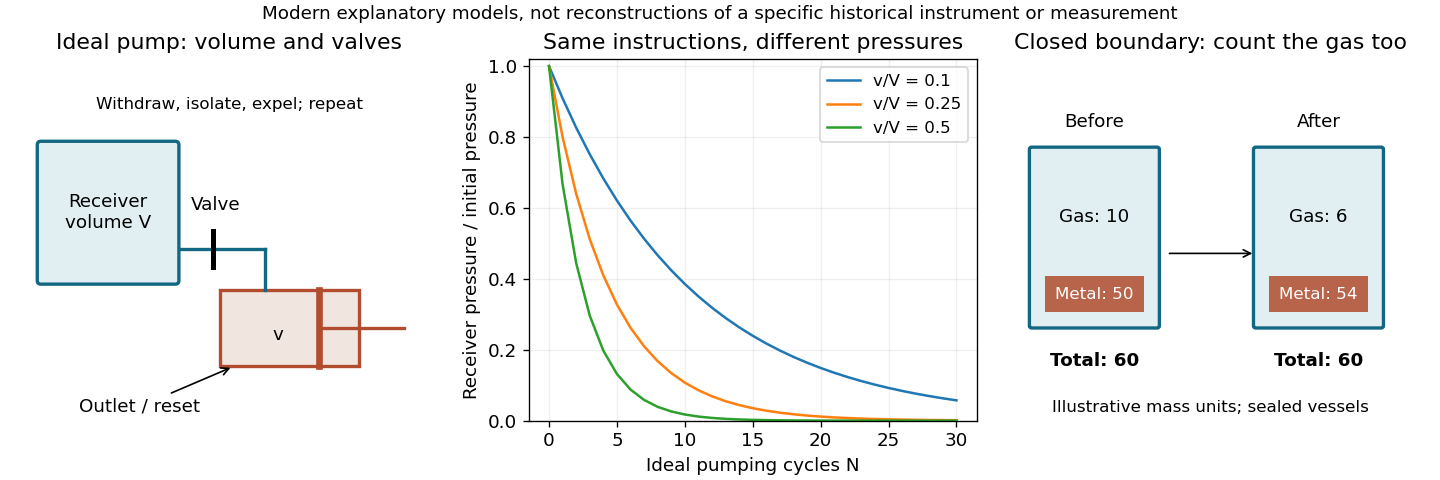
Material arrangements determine the conditions and records of an experiment
. Original explanatory schematics of an ideal pump and a closed-system mass accounting; not reproductions of historical apparatus or measurements. Details.
The second panel makes the same point about a balance. In a closed vessel, the mass of all contents can remain constant even while a heated metal gains mass by incorporating material from the gas. Weighing only the metal, or opening the vessel before the final weighing, defines a different comparison. Antoine Lavoisier's experimental accounting therefore involved vessels, gases, transfer procedures and the choice of system boundary as well as a numerical reading. Knowing that an investigator owned an accurate balance is insufficient to reconstruct what a particular weighing established.[ref]
Elements of Chemistry by Antoine Lavoisier. Part I on combination with oxygen and Part III on experimental apparatus and manipulation
Material culture also makes overlooked contributors visible. Glassworking, engraving, machining, collecting and carrying specimens can be prerequisites for a result whose printed account names only a learned author. Differences in access to workshops, money and audiences affect whose observations can circulate and be repeated. Such dependence does not entail that observations are arbitrary: failure of a seal or disappearance of a specimen can impose a quite definite physical constraint. Social organization and the resistance of materials are both relevant.
Finally, surviving objects have their own source problems. An scientific instrument in a museum may have been repaired, combined with later parts or removed from the room and working routines which made it useful. A printed plate may depict an ideal arrangement rather than an object that existed in exactly that form. Linking an object to notebooks, accounts and published reports can recover the relation between design and use. The explanatory aim is to understand how material arrangements, skilled action and records made claims testable and transportable. It complements intellectual history by showing what an argument required people actually to build, handle and do.
Articles by others on the same topic
There are currently no matching articles.