For a linear map with finite-dimensional, the rank-nullity theorem statesTo prove it, choose a basis of the kernel of a linear map and use basis extension to obtain as a basis of . The vectors span the image of a linear map: applying to a basis expansion kills the first terms. They are also linearly independent. Indeed, if , then , so it is a combination of . Independence of the full basis forces every . Consequently , proving the theorem.
Here the image of a linear map has dimension , since it lies in . ThusEvery possibility occurs: for , map to . This map has rank and kernel dimension .
An even permutation in the alternating group has one of the cycle types listed below. In the symmetric group, a type with cycles of length has centralizer order and class size : commuting permutations can rotate each cycle and exchange equal-length cycles.
An conjugacy class remains one class if its centralizer contains an odd permutation. Otherwise it splits into two equal classes, since the centralizer is already contained in the index-two subgroup . This is the alternating conjugacy class splitting criterion. For the nonsplitting nonidentity types here, odd commuting permutations are respectively a constituent transposition, a transposition of fixed points, the interchange of two 3-cycles, and the constituent 4-cycle. For a 5-cycle with one fixed point, the centralizer is its cyclic group of order five and contains only even permutations.
Thus the conjugacy classes of the alternating group on six letters are:The two 5-cycle representatives lie in different classes. A relabelling that conjugates a 5-cycle to its square acts on its five positions as multiplication by two modulo five, a 4-cycle on the nonzero positions, hence is odd. Every other such conjugator differs by an even centralizer element. The sizes sum to , so the list is exhaustive.
For simplicity of the alternating group on six letters, let be a normal subgroup. It contains the identity and is a union of full conjugacy classes; also divides by Lagrange's theorem. A proper subgroup has order at most .
If the class of size 45 is absent, is odd. The odd divisors of are . A nontrivial union has order at least 41, but no selection of the even class sizes sums to , so order 45 is impossible. Thus in this case.
If the size-45 class is present, write with and . The possible values at most are , none dividing . Hence no proper nontrivial normal subgroup exists:
A function has uniform continuity if for every there is a such that, for all , implies . The same must work everywhere in .
The product need not be uniformly continuous. Both and are Lipschitz continuous, hence uniformly continuous on , but their product is . For and , the input separation tends to zero whileThis contradicts uniform continuity. The issue is captured by products of unbounded uniformly continuous functions; bounded factors would give a uniform product estimate.
A uniformly continuous function on is bounded. Take for output tolerance one and cover by finitely many intervals of radius less than , centred at points in . Every is within of some , so . This proves the general principle that a uniformly continuous function on a totally bounded set is bounded.
The reciprocal-cosine function is not uniformly continuous. TakeBoth sequences lie in , , but the two function values are and . Their difference is always two, violating the sequential criterion for uniform continuity.
For topological spaces, continuity means that is open in for every open set in . Equivalently, inverse images of closed sets are closed. A homeomorphism is a bijection for which both the map and its inverse are continuous.
False. The constant continuous function , , sends the open set to , which is not open. Therefore continuity alone does not imply an open map.
False. Give the discrete topology and its usual topology. The identity bijection is continuous because every inverse image is a subset of the discrete space and hence is open. But is not continuous: the open set of has inverse image , not open in . Thus a continuous bijection need not be a homeomorphism.
True. Let . For every open ,which is open in because is an open map. Thus is continuous. Together with the given continuity and bijectivity of , this establishes a homeomorphism. This is inverse continuity from an open bijection.
Use the real Fourier series conventionThe constant coefficient is . Reflection about changes the sine factor's sign and preserves the quadratic, giving . Two integrations by parts, with , giveConsequently the Fourier series of a periodically extended quadratic arch isThe periodic function is continuous, including at integers where its value is zero. Its piecewise smoothness gives pointwise Fourier series convergence everywhere, and the summable coefficient bound gives uniform and absolute convergence.
The endpoint agreement makes the boundary terms vanish when integrating the Fourier coefficients of by parts. If denote these coefficients, thenThese are exactly the coefficients obtained by differentiating the preceding Fourier series:On every compact subinterval of the differentiated series converges uniformly by the Dirichlet test, since partial sums of the sine factors are uniformly bounded there. The Termwise differentiation of a Fourier series is therefore valid away from integers and gives on . At an integer the periodic original has a corner, so the differentiated series is not asserting the existence of an ordinary derivative there.
Every sine term vanishes at zero, so . The one-sided values of the periodic extension of are and . The Fourier series converges at this jump to their midpoint,This midpoint need not equal the arbitrarily assigned value of the periodic derivative at the endpoint.
Use compatible orientations for the loop and spanning surface. The relevant Maxwell equations areThe magnetic flux transport for a moving circuit separates the change of the field from the motion of its boundary. To see the boundary term, freeze at time . Orient the closed swept surface as . Its side element isto first order. Hence its flux is . By the divergence theorem and , the sum of the three fluxes is zero, giving the purely geometric changeAdding the temporal field change and applying Stokes theorem yieldsThusThe boundary contribution is the motional electromotive force; the field contribution is Faraday's law.
For the linear planar flow with strain and rotation, , proving incompressibility. The Cartesian streamfunction convention gives , , and direct integration givesup to an irrelevant additive constant. Along a streamline, . Sincethe stated quadratic expression is constant along each streamline. The three cases below distinguish strain, rotation and their degenerate shear limit.
Here , . The streamlines are , rectangular hyperbolas, together with the coordinate axes as separatrices. Particles satisfy , : the flow stretches along the axis and compresses along the axis, with a saddle stagnation point at the origin. The left panel shows the flow directions.
Here , . The streamlines are . This is rigid rotation counterclockwise with angular velocity one; the origin is a stagnation point and all other trajectories are circles. The middle panel shows their orientation.
Here . The streamlines are , straight lines parallel to . The entire line is stationary. On the side the motion is northeast, and on the side it is southwest. In orthonormal coordinates , , the velocities are , : this is simple shear flow. The right panel shows both moving families and the stationary line.
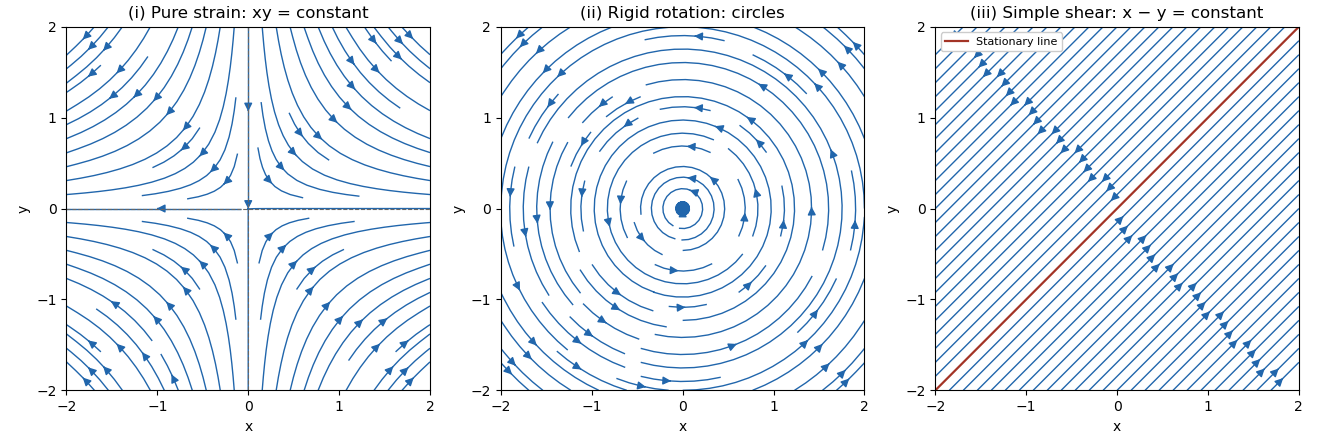
Planar strain, counterclockwise rigid rotation and diagonal simple shear, with arrows showing the three streamline directions
. Let and be the underlying full-recovery probabilities. The two-sided statistical hypothesis test isUse the Pearson chi-squared test of homogeneity for the two independent groups. Under , the pooled recovery estimate is , so each row has expected counts 28 recovered and 22 not recovered. All expected counts comfortably exceed five. The Pearson chi-squared statistic for contingency tables isThe asymptotic reference distribution is a chi-squared distribution with degree of freedom. Since , do not reject equal recovery probabilities at the 5% level. The observed recovery proportions, 0.50 and 0.62, do not provide statistically significant evidence of a difference in this trial. This conclusion does not prove that the procedures have identical recovery probabilities.
In a two-player zero-sum game, the row player chooses a row, the column player chooses a column, and the row player's gain is the column player's loss. If their independent mixed strategies are probability vectors , , the row player's expected payoff is .
The optimal mixed strategies solveThe minimax theorem equates these two guaranteed values. Equivalently, for a value , and componentwise.
For a row strategy , the payoffs against the two pure columns are and . Their minimum is maximized at their intersection, , where both are . Symmetrically the column player's maximum of the two row payoffs is minimized at . HenceThese probabilities are unique: moving either probability away from worsens that player's guaranteed payoff.
Define the determinant by the signed permutation sumIt is multilinear and alternating in the rows, and likewise in the columns. Row multilinearity follows because every product contains exactly one entry from each row; a swap changes the permutation sign, and equal rows give cancellation in pairs. Applying the same argument to the transpose proves the column properties.
Consequently, for either rows or columns, a swap multiplies the determinant by ; multiplication of one row or column by multiplies it by ; addition of a multiple of another row or column leaves it unchanged. For the last rule, multilinearity separates the original determinant and a determinant with two equal rows or columns, which is zero. These arguments also cover singular matrices and zero scaling.
In the determinant expansion of the block upper triangular matrix, a nonzero product must assign each of the bottom rows to one of the last columns, because the lower-left block is zero. Those rows therefore occupy all the last columns, leaving the first columns for the top rows. The contributing permutations are precisely independent permutations within the two blocks. Their signs multiply, so the sum factors:The off-diagonal block contributes to no surviving term.
For the determinant of a complex block representation, putThe change-of-basis matrix is invertible, and direct block multiplication givesThus is block diagonal. Using multiplicativity of the determinant and the preceding block formula,The identity follows from this constant change of basis for arbitrary complex .
Let be a finite integral domain. For any , multiplication is injective: implies , hence because there are no zero divisors. An injective map of a finite set to itself is surjective, so for some . Every nonzero element is invertible; therefore a finite integral domain is a field.
For an irreducible polynomial , consider a nonzero class in the quotient ring . Since does not divide , irreducibility gives . The Euclidean algorithm in the polynomial ring gives polynomials with . Modulo , . Thus the quotient by an irreducible polynomial is a field.
For a field with four elements, useThe quadratic has no root in , so is irreducible. Write . Polynomial division shows the elements are , with . Its multiplication table is
For a field with nine elements, useThe values of at are , so the quadratic is irreducible. Every class is uniquely , , with . These nine classes form a finite field; multiplication is , with coefficients modulo three.
True. Boundedness follows from . To prove closedness of the Minkowski sum, let converge to . By the Bolzano-Weierstrass theorem, the bounded sequence has a subsequence converging to . Closedness gives . Along that subsequence, , which belongs to by closedness. Thus . This proves that the sum is bounded and closed.
True. The same subsequence argument applies to the sum of a compact set and a closed set. For a convergent sequence , boundedness of provides a convergent subsequence of , with limit . Then along that subsequence. Consequently . No boundedness of is needed.
False. In , letEach is closed: its distinct points escape to infinity, so it has no finite accumulation point. Their Minkowski sum contains , tending to zero. However zero is not in the sum. If with positive integers , then . For the right side is strictly between zero and one, while the left side is an integer; for the equation would require . Thus the sum of two closed sets need not be closed. The same counterexample embeds along a coordinate axis in .
True, and the closedness assumption on is unnecessary. The Minkowski sum has the representationEach translate of the open set is open, and an arbitrary union of open sets is open. If is empty the union is empty, which is also open.
Use the rectangular contour for an exponential beta integral. For , integrate counterclockwise around the rectangle with vertices . Its only pole is at , withThe right vertical side is bounded in modulus by , and the left by . Both tend to zero because . On the top edge , and that edge is traversed right to left. The residue theorem therefore givesSince ,The same inequalities establish convergence at both real infinities. With , this integral becomes . Taking gives
First obtain the hyperbolic circle in the upper half-plane. For centre , the fractional-linear map takes the Poincare half-plane model isometrically to the Poincare disc model, sending to zero. Direct differentiation transforms the metric to . A radial segment from zero to modulus has length . Any path to that modulus has at least this length, by ; thus it is the hyperbolic distance.
A circle of hyperbolic radius therefore satisfiesSquaring and rearranging givesHence it is a circle in Euclidean geometry, with Euclidean centre and radius . Its lowest point has height , so it stays entirely in the upper half-plane. The centres differ whenever : for example, the hyperbolic circle centred at has Euclidean centre , rather than .
For hyperbolic side-side-side congruence, use the standard fact that hyperbolic isometries act transitively on ordered point pairs with the same positive separation, and that reflection in a hyperbolic line is an isometry. Map to . The image of has prescribed distances from and from , just as does. There are at most two such points, interchanged by reflection in the line .
For completeness, normalize to points on the positive imaginary axis. Their distance circles are Euclidean circles with centres on that axis by the formula above. Subtracting their equations determines one height , and then the abscissa is determined up to its sign. Reflection interchanges these choices. Therefore either the chosen isometry or its composition with that reflection maps all three labelled vertices correctly. Equal three side lengths imply a hyperbolic isometry between the triangles.
Two sides and an unspecified equal angle do not suffice. Here is an explicit hyperbolic side-side-angle ambiguity. Fix the angle at to be , let and , and chooseBoth are positive and distinct. The hyperbolic cosine rule at becomesSetting , the condition is , whose two roots are . Construct each triangle from sides meeting at angle ; its opposite side is the same by the cosine rule. The triangles therefore share but have different third sides and cannot be isometric. If the common angle is specifically the included angle between the two given sides, the cosine rule determines the third side and side-side-side congruence does apply.
For fixed endpoints, the Euler-Lagrange equation isLet the sphere have radius and write the speed as , with . The infinitesimal travel time in the interior isThis is the flat-cylinder travel metric for sine-latitude speed. IntroduceThe travel-time metric becomes , an ordinary Euclidean metric on a cylinder because is periodic. After choosing a lift of , shortest paths are straight segments in . For a route that is a graph over , the Euler-Lagrange equation for readsThus is constant and . Transforming back,This proves the requested form for nonmeridional routes, including the equator when . It is also globally minimizing for its chosen azimuthal lift: Euclidean arc length is at least the straight-line separation, and the shortest lift minimizes that separation among angular differences differing by .
There is a coordinate exception to the printed universal form. When the shortest angular separation is zero, the fastest path is the meridian ; it is a vertical straight line on the cylinder and cannot be represented by finite as a graph over . The poles correspond to and cannot be reached in finite time with this speed law.
Take the Fourier transform in . The transform of the source is , so the Green function equation becomesChoose the causal Green function, zero for . Away from the solution is a decaying exponential, and integrating across gives the jump . ThereforeThe phase shifts the kernel's centre to . Applying the inverse Fourier transform and the Fourier transform of a Gaussian with givesFor positive elapsed time this heat kernel solves the homogeneous diffusion equation and has unit integral; as elapsed time tends to zero it approaches the spatial delta distribution, supplying the required impulse.
The Duhamel principle superposes the response to source impulses:This expression uses the source at the origin, is causal, and has zero initial data in the distributional sense. Its integral over the plane is , consistent with the injected total amount.
For the finite-duration source and , set . The causal diffusion from a finite-duration planar point source becomesWith , or by differentiating the supplied exponential integral, this isIf , both arguments are small. Their logarithmic constants and cancel, leavingAt the origin this logarithmic expression is exact for , obtained as the limit . The leading spatial correction is . If also , the leading value is .
The normalized spherical harmonics separate the angular variables. The Radial Schrodinger equation for the hydrogen atom isWrite . ThenSubstitution separates a constant term and a term. The latter vanishes precisely when . With this determines the Bohr radiusThe constant term determinesThese are the maximal-angular-momentum hydrogen states, with principal quantum number .
Because the angular integral is one, normalization requiresThereforeThe phase of remains arbitrary.
For the near-origin probability in a maximal-angular-momentum hydrogen state, integrate the normalized radial probability density:Throughout this small interval the exponential is for fixed . HenceUsing the normalization above,The high power of the small radius reflects the near-origin behavior of the hydrogen atom state.
For a conductor in electrostatic equilibrium, the interior field is zero and the surface is equipotential. The tangential exterior field is zero. A thin Gaussian pillbox gives the normal jump . Thus, in vacuum and with pointing out of the conductor,These are the electrostatic boundary conditions at a conductor.
To obtain electrostatic energy in field form, integrate over the space outside the conductors, cutting it off first at a large sphere. From the Maxwell equations, and , soOn a conductor boundary, the outward normal of the integration region points into the conductor, so its flux contribution is . At the remote outer boundary the flux integral tends to zero: for a localized charge distribution, and . The divergence theorem therefore givesSince the field vanishes inside conductors,The field integral is over all space, although the charges occupy a finite volume. For a finite outer integration boundary there is additionally the term .
For the electrostatic energy of alternating-charge concentric shells, the total enclosed charge after shell isBy spherical symmetry and Gauss's law, the field is zero for , and in every subsequent gap, including outside the last shell,Although its direction alternates, its squared magnitude is the same in every gap. ConsequentlyThe coefficient of is , independent of the other radii and of the number of shells.
For the Peano kernel theorem, the integral Taylor remainder isHere . The error functional must be linear, vanish on every polynomial of degree at most , and permit its action to be interchanged with this remainder integral. The last regularity condition holds for the finite combinations of point evaluations and derivative evaluations used below, by applying the corresponding differentiated remainder formula. Under these conditions the polynomial terms vanish, yielding
For the three-point asymmetric second-derivative formula, choose the error convention . Exactness on giveshenceApplying to , for almost every , gives the Peano kernelThe value at is immaterial to the integral. The sketch rises from zero through at one to the left limit at two, jumps down to the right limit , and then rises to zero at three.
The sharp error constants for a Peano kernel are the corresponding integral-operator norms. HereAs ,Indeed, and . They are best possible even for : for , choose continuous nonnegative third derivatives concentrated just left of two with unit integral; for , approximate the sign of by continuous functions of supremum norm one. Integrating any such third derivative three times supplies an admissible , and the resulting ratios approach the stated constants.
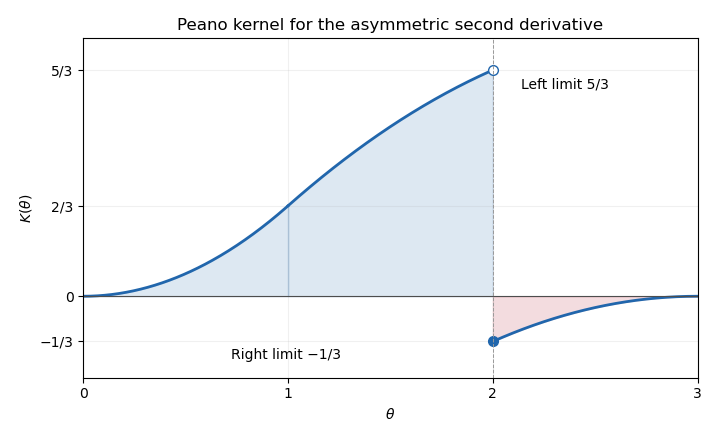
Peano kernel for the asymmetric three-point second derivative, showing its jump at two and the positive and negative regions controlling sharp error bounds
. Write . For , . For , conditioning on the first step and using the Markov property gives . This establishes the required equations for the hitting probability.
To prove the hitting probability is the minimal nonnegative harmonic extension, let . Then andIf is any nonnegative solution of the same boundary equations, . Positivity of the transition probabilities implies by induction for every . The events increase to , so and . Therefore is the minimal nonnegative solution.
For the tournament won by two consecutive victories, a transient pair , with and third player , moves with equal probabilities to the absorbing state or the transient pair . Thus the two transient cycles arewith probability of absorption at each step. A full cycle without absorption has probability , so absorption occurs almost surely.
Starting from , the successive absorption winners are , with first-cycle probabilities . Summing the geometric repetitions givesStarting from , the order is , giving .
Because the first game is between and , the initial ordered pair of winners is , each with probability . Combining the immediate wins with the transient hitting probabilities,Their sum is one, consistent with almost-sure absorption.
Articles by others on the same topic
There are currently no matching articles.