The Steinitz exchange lemma says that if are linearly independent and span the same vector space, then and, after reordering the , the list still spans it.
To prove this, suppose have already replaced of the spanning vectors. Express in that spanning list. At least one coefficient of an unreplaced is nonzero: otherwise lies in the span of , contradicting linear independence. Solve this expression for that and replace it by . The new list still spans. If all vectors were replaced before the were exhausted, the next would be dependent on its predecessors. Hence , and the replacement can continue through .
For two bases of sizes , apply the Steinitz exchange lemma in both directions to get . Thus every basis has the same size. Given a linearly independent set and any finite basis, the replacement procedure produces a finite spanning list containing that set. Successively delete any remaining vector dependent on the others; none of the prescribed independent vectors need be deleted, since one can instead delete a dependent supplementary vector. Equivalently, greedily retain only supplementary vectors outside the span already built. The resulting list is a basis containing the prescribed set.
For the three-dimensional example, the columns have matrixTherefore the three vectors are a basis. For the four-dimensional example,This is a nontrivial linear dependence, so the four vectors are not a basis. The distinction is an instance of the adjacent sums of a cyclic basis criterion: alternating coefficients close consistently around an even cycle, but not an odd one.
Let the regular curves be with and nonzero tangent vectors . By the chain rule, their transformed tangents are . Multiplication by the nonzero complex number scales both tangent lengths by and rotates both directions by . In particular,Thus the oriented angle, and hence the ordinary angle, is unchanged. This proves that the holomorphic function is a local conformal map at ; the nonzero derivative prevents a degenerate tangent.
A suitable conformal inversion of a quadrant isIf with and , then has modulus greater than one and argument strictly between zero and . The inverse is again , so every point of the desired exterior quadrant is attained uniquely. The origin is outside the open source region, and there.
Write . The tangent vectors areTheir squared lengths and inner product give the first fundamental formThe unit normal determined by this ordered parametrization isTaking inner products of with , and yields , , . Consequently the second fundamental form of a ring torus isThis normal points into the tube. Choosing the outward unit normal reverses both coefficients and gives ; the choice must therefore accompany an answer for the second fundamental form.
The Gaussian curvature is unchanged by that reversal:Since the denominator is positive, on the outside of the torus, where , and on its inner side, where . It vanishes on the two circles . This is the Gaussian curvature of a ring torus.
The convex Legendre transform, or convex conjugate, isFor a differentiable strictly convex function, an attained maximum is characterized by , and then at that maximizing .
For the affine covariance of the convex conjugate, assume and substitute :HencePositive scaling is necessary for this supremum definition, although the printed formula does not specify it. For example, and give , not the finite expression . If the transform is instead defined as a stationary value using a locally invertible gradient, the same algebraic identity holds for any : the critical-point relation is , and substitution of that stationary gives the displayed formula. That extension does not assert a supremum for negative scaling.
For the positive-definite quadratic form, symmetry and positive eigenvalues of giveThe second term is nonpositive and vanishes exactly at . Therefore
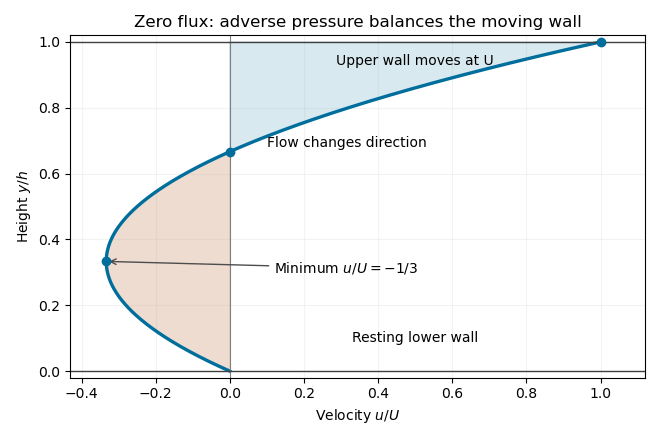
Take a steady parallel velocity and interpret the specified gradient as . The horizontal Navier-Stokes equation reduces to : the pressure force opposes positive motion. The no-slip boundary condition imposes , . Integrating twice givesThe velocity gradient is , an increasing function of . It is negative somewhere in the channel exactly when its lower-wall limit is negative:Under this condition the negative-gradient interval is .
The volume flux per unit span isThus the zero-flux Couette-Poiseuille flow requiresThe profile starts at zero, reaches at , crosses zero at , and reaches at the moving wall. Negative and positive flux contributions cancel, even though the local velocity is nonzero.
Insert an exact smooth solution into the linear multistep method and define its unscaled local truncation error byIts Taylor expansion has coefficientsThe method has order at least exactly when , since then for every sufficiently smooth . Necessity can be checked by inserting polynomials of successive degrees. This also corresponds to the usual truncation error .
On the other hand, expansion of the characteristic polynomials of a linear multistep method givesThus the exponential-symbol order criterion for a multistep method isIf “order ” is meant to be the exact rather than guaranteed order, one additionally requires . The first two vanishing conditions are the usual consistency of a numerical method relations , .
The relevant one of the characteristic polynomials of a linear multistep method isThe coefficients on the right are chosen to give third order, so consistency of a numerical method is already available. By the Dahlquist equivalence theorem, convergence with convergent starting values is equivalent to zero-stability: every root of must satisfy , and every root on the unit circle must be simple.
If , the quadratic is negative at and tends to as , so it has a root less than . If , its root product is , so at least one root has modulus greater than one. For , its real roots lie in . For , its conjugate roots have modulus .
At , the three roots are , with the unit-modulus roots simple. At , they are , again simple. The repeated quadratic root at is , strictly inside the unit circle, which the root condition for a multistep method permits. ThereforeThis is the root stability of a cubic multistep polynomial; oscillatory parasitic roots at the endpoints do not invalidate convergence when their starting amplitudes tend to zero.
For an estimator with finite second moment, its bias and mean squared error areWrite . On squaring and taking expectations, the cross term vanishes. This proves the bias-variance decomposition of mean squared error:For the sample mean, independence gives , . Thus has bias . Unbiasedness throughout the parameter family requiresAt the single parameter value , all these estimators are zero almost surely; that special value does not change the requirement of unbiasedness for all .
By the bias-variance decomposition of mean squared error,For , comparison with the unbiased estimator reduces toIts roots are and , soEquality at either endpoint gives the same risk as . At , every risk is zero, so no strict improvement is possible. This illustrates shrinking a sample mean with variance proportional to mean squared: allowing a small bias can reduce variance enough to improve total risk. The best constant is , whose mean squared error is .
A useful form of the Lagrangian sufficiency theorem is as follows. For minimization of subject to and , formIf is feasible, , , and globally minimizes over the ambient domain for these fixed multipliers, then is a global constrained minimizer. Indeed, for every feasible ,The first inequality uses multiplier signs; the last equality uses feasibility and complementary slackness. Equality constraints alone require no sign restriction on their multipliers. A stationary point of a differentiable convex Lagrangian is a global minimum, which is a common way to verify the theorem's hypothesis.
Here takeStationarity gives . Feasibility then gives and . For that multiplier,The Lagrangian has its unique global minimum at , so the sufficiency theorem proves
If , the generated subspace is zero and invariant. Otherwise, let be the first index for which are linearly dependent. Such an index exists with , since there are vectors. The preceding vectors are independent, so the coefficient of in this first relation cannot vanish. HenceThe linear operator sends each of the first generators to the next and sends the last into their span. This proves that their span is an invariant subspace. Every later iterate lies in the same subspace by induction, so it equals the span of the first iterates. Therefore the indicated subspace is -invariant. This proof of a cyclic subspace uses only finite dimension and linear dependence.
The spanning vectors form a basis. WriteIn this cyclic basis the matrix is the companion matrixExpanding along its last column givesFor example, the term containing has minor and the signs from the subdiagonal cancel the cofactor sign; the diagonal term supplies . The defining relation says . Every polynomial in commutes with , soIt therefore vanishes on a basis, provingThis direct argument for a cyclic vector does not assume the Cayley-Hamilton theorem.
Since the first basis vectors span the invariant subspace , their images have no components in the last coordinates. ThusHere is the matrix of , is the matrix of the induced map on the quotient vector space , and is unrestricted. The chosen complementary span need not itself be invariant, so should not in general be called a restriction to that complement. The block-triangular determinant gives
Induct on . The one-dimensional assertion is immediate, and the zero-dimensional case is vacuous. If has a cyclic vector spanning all of , the direct proof in part (ii) applies. Otherwise choose and let be its cyclic subspace. Part (i) makes invariant; the absence of a cyclic vector makes it proper and nonzero.
By induction, the restriction to is annihilated by , and the induced map on is annihilated by . The quotient assertion means . Applying the restriction assertion next givesBy the characteristic factorization in part (iii), this is precisely . HenceThis is the Cayley-Hamilton theorem from cyclic subspaces; using the quotient map is what makes the argument valid even when the block is nonzero.
If with , a Sylow subgroup for is a subgroup of order . The Sylow theorems assert: such subgroups exist; every -subgroup is contained in a Sylow subgroup; all Sylow -subgroups are conjugate; and their number divides and satisfies .
For groups of order p squared q are not simple, if , then and force . Its unique Sylow subgroup is a nontrivial proper normal subgroup. Suppose instead . If either Sylow count is one, the conclusion already follows. Otherwise , while is either or . The value is impossible because . Thus , and . Primality and imply , hence . The only consecutive primes are .
In that exceptional order- case, four distinct Sylow -subgroups contribute eight distinct nonidentity elements: their intersections are trivial. Only three nonidentity elements remain. Every subgroup of order four must contain exactly those remaining three, so there can be only one Sylow -subgroup, contradicting the assumption that both counts were nontrivial. Therefore no group of order with distinct primes is simple.
For the final factorization, normality of ensures is a Sylow -subgroup of . By Sylow conjugacy within , choose such that . Then satisfiesThus and . We have proved the Frattini argumentThe normaliser factorization includes the case , when its normalizer is all of .
Two Lipschitz equivalent norms satisfy for all , for constants . These inequalities give the same convergent sequences in both norms. A subset of a metric space is closed exactly when it contains the limits of all convergent sequences from that subset. Therefore closedness is the same in the two norms.
For finite dimension, fix a basis and let . For any norm ,The reverse triangle inequality then makes continuous in the Euclidean coordinate norm. If no positive lower bound existed on the Euclidean unit sphere, choose there with . By the Bolzano-Weierstrass theorem, a subsequence converges to on the unit sphere. Continuity would give , although , a contradiction. Thus is bounded below by a positive multiple of the Euclidean norm. Comparing any two norms through that coordinate norm proves all norms in finite dimension are Lipschitz equivalent.
On , nonnegativity, absolute homogeneity and the triangle inequality for follow from the corresponding real-number properties and integration. If a continuous is nonzero at a point, it has absolute value bounded below by a positive constant on a nontrivial one-sided or two-sided interval around that point. Its integral is then positive. Hence implies , completing the norm axioms.
For , put and . Then , butThe limit function is not in the indicated point evaluation kernel. Consequently that set is not closed in the integral norm. This is the point-evaluation kernel is not closed in the integral norm phenomenon.
Finally while . Thus no constant can bound the uniform norm by a multiple of the integral norm. Although on this unit interval, the converse comparison fails: the two norms are not Lipschitz equivalent. The finite-dimensional theorem cannot be applied to this infinite-dimensional function space.
A compact space is one for which every open cover has a finite subcover. A Hausdorff space has disjoint open neighbourhoods of any two distinct points.
Let be a compact subspace of a Hausdorff space , and let . For each , choose disjoint open neighbourhoods of and of . Finitely many cover . Their corresponding intersection is an open neighbourhood of disjoint from . Thus is open, proving compact subspaces of a Hausdorff space are closed.
In particular, is closed as a subspace of compact . A closed subset of a compact space is compact: add its open complement to an open cover, apply compactness to the whole space, and discard that extra open set. Hence is compact.
In the cocountable topology on , two nonempty open sets always intersect. Their two countable complements have countable union, which cannot exhaust the uncountable real line. Therefore this space is not Hausdorff.
Every finite subset is compact in any topology. Conversely, from any infinite subset select distinct points and defineEach is cocountable and open; the sets increase and their union is all of . They therefore cover , but a finite selection is contained in some , which misses the infinitely many with . No finite subcover exists. Thus the compact subsets of a cocountable space are
Use the positively oriented unit circle and . Writing , the contour integral for a sine-squared trigonometric quotient becomesThere is a double pole at zero and simple poles at . Since , and . The coefficient of at zero is . At , the residue isbecause . The residue theorem consequently givesFor the second integral, use with . The square root is , and reversing the integration limits givesThe last factor uses the symmetry of the integrand about over a full period. Therefore
Substitute into the Legendre differential equation. Matching the coefficient of givesChoose the parity of : start with nonzero for even , or nonzero for odd , and set the other parity to zero. The numerator is nonzero for every preceding index of that parity below , so , but at it vanishes. All higher coefficients are zero. This constructs a nonzero polynomial solution of degree exactly .
Its value at cannot be zero. If it had a zero there of multiplicity , write with . The lowest-order term of would be , whereas starts at order . The differential equation could not hold. Hence the polynomial can be scaled to satisfy .
The resulting Legendre polynomials beginEach satisfies both the differential equation and the specified normalization.
Set in the Laplace equation, multiply by , and separate:Putting turns the angular equation into the Legendre differential equation. For a solution smooth on the whole spherical axis, the allowed eigenvalues are with angular functions . The radial equation has the two solutions . Superposition yields the regular axisymmetric expansionThe coefficients and convergence region are set by the domain and boundary data. Without regularity at the poles, singular Legendre functions and more general separated degrees would also be possible; they are excluded for this exterior spherical field.
The far-field matching fixes and all other growing coefficients to zero. The radial Neumann boundary condition at isIndependence of the angular modes gives and all other decaying coefficients zero. Thus the exterior harmonic potential with no flux through a sphere isIts derivative vanishes on the sphere and its difference from tends to zero at infinity. A spatial constant may be added if the far-field condition is intended only to specify the gradient or the leading growing term; matching the potential difference to zero fixes that constant to zero.
The squared sine has integral over the interval of length , since it contains an integer number of half-wavelengths. A real positive phase convention therefore givesInside the infinite square well, the Time-independent Schrodinger equation is . The wavenumber is , soThe stationary states vanish at both walls and form an orthonormal basis of the square-integrable state space. A common arbitrary phase on each basis function does not alter any energy or measurement probability.
Choose the prepared wavefunction real and positive on its support. Its normalization isIn the ramp-state expansion in a symmetric infinite well, write . Orthogonality givesFor , a primitive is . Evaluating both endpoints givesAn equivalent parity-separated form isThese formulas with are the requested explicit expansion. The convergence is in the square-integrable norm; at the idealized discontinuity at the right wall, a pointwise boundary value does not change the quantum state or its probability amplitudes.
The original PDF threshold contains , not . It is , so the energies strictly above it are exactly those with . By the Born rule, the required probability is . The two excluded amplitudes areConsequentlyThus, in increasing powers of ,The threshold lies strictly between and , so no equality-at-threshold convention affects the answer.
The Parseval identity for the orthonormal stationary-state expansion is . Splitting the amplitudes into even and odd indices givesMultiply by to obtain the requested identity. Its integer constants areThe series converges absolutely, since both parity contributions are . This derivation uses the normalization of the prepared state and completeness of the well stationary states, rather than a separate summation trick.
An ideal conductor in electrostatic equilibrium has zero field in its interior and constant potential on its surface. Grounding fixes that potential to zero. The tangential field is continuous and therefore vanishes; the normal field has the jump fixed by the induced surface charge density :Here the normal points upward out of the conductor. The normal field is not generally zero; grounding prescribes the potential, not the induced charge density.
The method of images places an image charge at the reflected position below the plane. The candidate potential in the physical upper half-space isAt the two terms cancel, so and . Direct differentiation givesThus the upper-side field satisfies exactly the conductor boundary conditions from part (i). The fictitious pair does have a field below the plane, but that part of its solution is not used for the physical conductor.
In , the potential has the correct real point source, the correct zero Dirichlet boundary condition, and the required decay at infinity. By Uniqueness of the Dirichlet problem, it is the physical potential there. This is why the artificial charge can represent the induced conductor response without being a second physical charge.
As the real charge descends to height , its instantaneous image charge is at . The force is thereforeThe image is not kept at its initial position. Multiplying by and using , givesFor the falling charge above a grounded conducting plane, the arrival time isPut ; the integral becomes . HenceThis is the finite arrival time in the specified ideal force model, for . The field-force derivation also avoids incorrectly using the full real-image pair interaction energy: the conductor's effective energy is , with the factor one-half appropriate to induced charge.
The steady Euler equations for an inviscid fluid with no body force are . Use the convective acceleration identityto obtainFor the question's streamfunction convention, , so . Constant therefore gives the Bernoulli function for planar constant-vorticity flowon the connected fluid region.
For circular streamlines, write . The cylindrical curl gives , so . The outer wall condition gives . Choose the positive azimuthal orientation so that , as implicit in the requested sign for . ThenReversing the circulation reverses but leaves the speed and pressure difference unchanged. For this uniform-vorticity circular flow in an annulus, one convenient streamfunction is .
The radial component of the Euler equations for an inviscid fluid is . Thus pressure increases outwards, andTherefore
For a nonzero real vector , the Householder transformation isWriting gives , , so and . Thus is orthogonal. It reverses the component along and fixes its orthogonal complement.
For Householder QR decomposition, successively choose a reflector on each trailing row block to send its current column to a multiple of the first coordinate vector. Each step annihilates the subdiagonal entries without disturbing earlier columns. The reflector product gives an upper-trapezoidal and its transpose gives an orthogonal with .
Here the first column has norm four. Taking gives andThe second column already has no unwanted entries. On the last two rows, reflect using :This maps to . Therefore a full QR factorization isBoth displayed factors arise from the explicit reflectors; in particular and .
The first three diagonal entries of are nonzero, so the column rank is three and a consistent system has a unique solution. Consistency requires the last component of to vanish. For the given right side this component isHenceFor this value the transformed right side is . Back substitution also gives . This illustrates the Householder reduction of an overdetermined consistent system.
Put . Independence gives a likelihood ratioSince , this is strictly increasing in . A threshold chosen between its values at and gives precisely the stated upper-tail critical region, so it is a likelihood-ratio test.
The sum has a Poisson distribution with mean . Thus the size of a statistical test and its statistical power at are
For the grouped-area problem, let , , . The null log likelihood, up to data-only constants, isThe maximum-likelihood estimate is , giving fitted means and in the two groups. Under the alternative, the fitted group means are and .
Use the increasing generalized likelihood-ratio test convention , consistent with the printed positive . The exponential and factorial factors cancel, yielding the likelihood-ratio test of area-proportional Poisson meansTerms with zero count are interpreted as ; if , take . If the inverse ratio is used, the reported test statistic is instead .
Under the null, the regular large-sample Wilks theorem approximation is : the alternative has two rate parameters and the null one. The value far exceeds the usual critical value, about , and has approximate tail probability . Thus reject proportionality of the expected counts to area: the two groups show evidence of different territory densities. The statistic alone does not say which group has greater density; that requires versus . For small counts, an exact conditional test uses under the null instead of the asymptotic calibration.
For a state , its period is ; the condition defines aperiodicity. It is a positive recurrent state if return occurs almost surely and its first strictly positive return time has finite expectation. An ergodic state of a Markov chain is positive recurrent and aperiodic.
The PDF specifies for ; the TeX aid drops the essential value one. Consequently every positive state reaches zero deterministically. From zero, every positive state is reached in one step with probability . Paths through zero connect any pair of states, proving irreducibility.
Let be the jump out of zero. It has for , after which exactly downward steps return to zero. Therefore , givingThese probabilities sum to one andReturns of lengths two and three both have positive probability, so the period is one. Hence state zero is ergodic, and by irreducibility all states are positive recurrent and have the same period.
For this geometric-jump countdown Markov chain, the invariant equations give and for . Summing the tail, or counting visits in a regeneration cycle, yields . Normalization givesThis is the stationary distribution of a regenerative countdown chain. The standard recurrence identity for an irreducible positive recurrent Markov chain is , so
The convergence theorem for an irreducible aperiodic positive recurrent Markov chain says for every pair of states. Apply it to and take the complement:Although , the chain is aperiodic because its possible return lengths have greatest common divisor one; a self-loop is sufficient but not necessary for aperiodicity.
For a linear map with finite-dimensional, the rank-nullity theorem statesTo prove it, choose a basis of the kernel of a linear map and use basis extension to obtain as a basis of . The vectors span the image of a linear map: applying to a basis expansion kills the first terms. They are also linearly independent. Indeed, if , then , so it is a combination of . Independence of the full basis forces every . Consequently , proving the theorem.
Here the image of a linear map has dimension , since it lies in . ThusEvery possibility occurs: for , map to . This map has rank and kernel dimension .
An even permutation in the alternating group has one of the cycle types listed below. In the symmetric group, a type with cycles of length has centralizer order and class size : commuting permutations can rotate each cycle and exchange equal-length cycles.
An conjugacy class remains one class if its centralizer contains an odd permutation. Otherwise it splits into two equal classes, since the centralizer is already contained in the index-two subgroup . This is the alternating conjugacy class splitting criterion. For the nonsplitting nonidentity types here, odd commuting permutations are respectively a constituent transposition, a transposition of fixed points, the interchange of two 3-cycles, and the constituent 4-cycle. For a 5-cycle with one fixed point, the centralizer is its cyclic group of order five and contains only even permutations.
Thus the conjugacy classes of the alternating group on six letters are:The two 5-cycle representatives lie in different classes. A relabelling that conjugates a 5-cycle to its square acts on its five positions as multiplication by two modulo five, a 4-cycle on the nonzero positions, hence is odd. Every other such conjugator differs by an even centralizer element. The sizes sum to , so the list is exhaustive.
For simplicity of the alternating group on six letters, let be a normal subgroup. It contains the identity and is a union of full conjugacy classes; also divides by Lagrange's theorem. A proper subgroup has order at most .
If the class of size 45 is absent, is odd. The odd divisors of are . A nontrivial union has order at least 41, but no selection of the even class sizes sums to , so order 45 is impossible. Thus in this case.
If the size-45 class is present, write with and . The possible values at most are , none dividing . Hence no proper nontrivial normal subgroup exists:
A function has uniform continuity if for every there is a such that, for all , implies . The same must work everywhere in .
The product need not be uniformly continuous. Both and are Lipschitz continuous, hence uniformly continuous on , but their product is . For and , the input separation tends to zero whileThis contradicts uniform continuity. The issue is captured by products of unbounded uniformly continuous functions; bounded factors would give a uniform product estimate.
A uniformly continuous function on is bounded. Take for output tolerance one and cover by finitely many intervals of radius less than , centred at points in . Every is within of some , so . This proves the general principle that a uniformly continuous function on a totally bounded set is bounded.
The reciprocal-cosine function is not uniformly continuous. TakeBoth sequences lie in , , but the two function values are and . Their difference is always two, violating the sequential criterion for uniform continuity.
For topological spaces, continuity means that is open in for every open set in . Equivalently, inverse images of closed sets are closed. A homeomorphism is a bijection for which both the map and its inverse are continuous.
False. The constant continuous function , , sends the open set to , which is not open. Therefore continuity alone does not imply an open map.
False. Give the discrete topology and its usual topology. The identity bijection is continuous because every inverse image is a subset of the discrete space and hence is open. But is not continuous: the open set of has inverse image , not open in . Thus a continuous bijection need not be a homeomorphism.
True. Let . For every open ,which is open in because is an open map. Thus is continuous. Together with the given continuity and bijectivity of , this establishes a homeomorphism. This is inverse continuity from an open bijection.
Use the real Fourier series conventionThe constant coefficient is . Reflection about changes the sine factor's sign and preserves the quadratic, giving . Two integrations by parts, with , giveConsequently the Fourier series of a periodically extended quadratic arch isThe periodic function is continuous, including at integers where its value is zero. Its piecewise smoothness gives pointwise Fourier series convergence everywhere, and the summable coefficient bound gives uniform and absolute convergence.
The endpoint agreement makes the boundary terms vanish when integrating the Fourier coefficients of by parts. If denote these coefficients, thenThese are exactly the coefficients obtained by differentiating the preceding Fourier series:On every compact subinterval of the differentiated series converges uniformly by the Dirichlet test, since partial sums of the sine factors are uniformly bounded there. The Termwise differentiation of a Fourier series is therefore valid away from integers and gives on . At an integer the periodic original has a corner, so the differentiated series is not asserting the existence of an ordinary derivative there.
Every sine term vanishes at zero, so . The one-sided values of the periodic extension of are and . The Fourier series converges at this jump to their midpoint,This midpoint need not equal the arbitrarily assigned value of the periodic derivative at the endpoint.
Use compatible orientations for the loop and spanning surface. The relevant Maxwell equations areThe magnetic flux transport for a moving circuit separates the change of the field from the motion of its boundary. To see the boundary term, freeze at time . Orient the closed swept surface as . Its side element isto first order. Hence its flux is . By the divergence theorem and , the sum of the three fluxes is zero, giving the purely geometric changeAdding the temporal field change and applying Stokes theorem yieldsThusThe boundary contribution is the motional electromotive force; the field contribution is Faraday's law.
For the linear planar flow with strain and rotation, , proving incompressibility. The Cartesian streamfunction convention gives , , and direct integration givesup to an irrelevant additive constant. Along a streamline, . Sincethe stated quadratic expression is constant along each streamline. The three cases below distinguish strain, rotation and their degenerate shear limit.
Here , . The streamlines are , rectangular hyperbolas, together with the coordinate axes as separatrices. Particles satisfy , : the flow stretches along the axis and compresses along the axis, with a saddle stagnation point at the origin. The left panel shows the flow directions.
Here , . The streamlines are . This is rigid rotation counterclockwise with angular velocity one; the origin is a stagnation point and all other trajectories are circles. The middle panel shows their orientation.
Articles were limited to the first 100 out of 212 total.
Articles by others on the same topic
There are currently no matching articles.