The postulates of quantum mechanics give a framework for predicting observations from a prepared state. The experiments below motivate different features of that framework; no one experiment proves the whole set of postulates or specifies every Hamiltonian operator.
A pure quantum state is a normalized vector in a complex Hilbert space, with vectors differing by an overall quantum phase representing the same physical preparation. In position representation, . The linear state space permits quantum superposition, while the Born rule assigns probability to a position outcome in a region . The wavefunction is a probability amplitude; it is not a classical distribution of definite particle positions and momenta.
An observable is represented by a self-adjoint operator. If has spectral projectors , its possible measurement outcomes are its spectral values and . The mean is . For an ideal repeatable projective measurement, obtaining leaves the normalized conditional state . This projects onto an entire eigenspace if the outcome is degenerate. General detectors need more general measurement in quantum mechanics models; the projective update is an idealization. Noncommuting observables need not have simultaneous sharp values, as the canonical commutation relation and Heisenberg uncertainty relation illustrate.
Between measurements, an isolated system has unitary time evolution generated by its Hamiltonian operator:This preserves normalization and superpositions. Composite systems use a tensor product of state spaces, allowing entangled states as well as product states; identical particles additionally require the bosonic or fermionic exchange symmetry appropriate to their species. Statistical mixtures are described by a density matrix, with . These rules separate preparation, coherent evolution and measurement.
The photoelectric effect exposes discrete energy transfer by light. Illuminate a clean metal cathode in an evacuated tube and measure the collected Electron current while varying the light frequency, intensity and a retarding voltage. The stopping potential probes the largest emitted Electron kinetic energy, whereas the photocurrent measures the rate at which charge is collected. In the ordinary single-photon regime there is a threshold frequency; above it the maximum energy grows with frequency, rather than with intensity. Changing intensity at fixed frequency mainly changes the number of emitted electrons. These observations are summarized by the Einstein photoelectric equationHere is the surface work function, and the stopping voltage is understood after any photoelectric contact-potential correction. A photon delivers in an absorption event; emission is allowed only when that energy can pay the escape cost. This accounts for the frequency threshold and the lack of the classical waiting time associated with slowly accumulating energy in a single Electron. The experiment supports energy quantization of light; it does not imply that every incident photon emits an Electron or that every emitted Electron has the maximum energy. Surface losses and collection geometry affect the full current-voltage curve.
The Davisson–Germer experiment demonstrates a complementary wave property of matter. An Electron gun uses a heated emitter, accelerating voltage and apertures to send a narrow beam onto a nickel single crystal in vacuum. A movable collector measures scattered electric current versus direction; rotating the crystal also tests its azimuthal symmetry. The crystal gives sharp angular beams whose positions depend on voltage and crystal orientation. A prominent feature occurs near accelerating voltage and roughly detector colatitude. The nonrelativistic de Broglie wavelength predicted at that voltage isDiffraction wavelengths inferred using the known crystal structure agree with this voltage dependence. These angular peaks arise from coherent addition of scattering amplitudes from the crystal, not from classical specular reflection of independent point projectiles. Bragg's law is for lattice-plane spacing and angle to those planes; a detector colatitude is a different angle and must not be substituted without its geometry. The historical readout was current, not a photograph of individual Electron trajectories.[ref]
Diffraction of Electrons by a Crystal of Nickel by C. Davisson and L. H. Germer. 1927, apparatus pp. 707–710 and angular/voltage scans pp. 715–719
The double-slit experiment makes the role of amplitudes especially direct. A coherent source illuminates two narrow slits; an observation screen a distance away records the pattern. For slit spacing and small screen displacement , the path difference is approximately . The two amplitudes add before probabilities are formed:For equal coherent illumination the interference term varies as , giving fringe spacing beneath the single-slit diffraction envelope. Blocking one slit removes that cross term. Young's optical experiment established wave interference; later particle-resolved realizations with photons or electrons show localized detection events whose accumulated distribution has the interference pattern. Low arrival rates demonstrate that this pattern does not require different incident particles to collide with one another.
If the paths become correlated with distinguishable detector states and , the cross term acquires their overlap . Perfectly distinguishable path records make that overlap zero, suppressing interference even if the spatial beams still overlap. This connects quantum entanglement, measurement and loss of observable coherence. Without a path measurement, the two alternatives are amplitudes for one preparation, rather than classical mutually exclusive events whose probabilities may simply be added.
Together these experiments motivate a description in which energy transfer and detector outcomes can be discrete, yet propagation retains complex quantum phases and interference. The Born rule connects those amplitudes to repeatable frequencies of outcomes. The Schrödinger equation supplies the dynamics once a Hamiltonian operator is specified, while observable operators, state preparation and the measurement model specify what the apparatus can read.
Indistinguishable particles have the same intrinsic properties and cannot be assigned physically observable permanent labels. Exchanging their mathematical coordinates leaves all physical predictions unchanged. In ordinary three-dimensional quantum mechanics the total state, including spin, obeysThe Spin-statistics theorem associates integer spin with bosons and half-integer spin with fermions. Exchange does not mean physically transporting two particles along some prescribed trajectories; it is the symmetry of the many-particle state under permutation of its arguments.
For orthonormal one-particle states , normalized two-particle spatial combinations are . They illustrate coherent exchange amplitudes. If both fermions have the same complete one-particle state, the antisymmetric combination vanishes. This is the Pauli exclusion principle: a fermionic mode has occupation zero or one. Bosonic modes can have arbitrarily large occupation. A many-fermion product basis is antisymmetrized by a Slater determinant.
It is the full spin-spatial state that must have the appropriate symmetry. For two electrons, an antisymmetric spin singlet state can accompany a symmetric spatial orbital, so opposite-spin electrons can occupy the same spatial orbital. A symmetric spin triplet instead needs an antisymmetric spatial state. Thus exclusion concerns identical complete states, not an unconditional prohibition on sharing a position or spatial orbital.
Counting allowed occupations gives Bose-Einstein statistics and Fermi-Dirac statistics. For an ideal gas in thermal equilibrium,Bosonic accumulation permits Bose-Einstein condensation; exclusion gives a filled Fermi sea and degeneracy pressure even at zero temperature. In the dilute classical limit the occupations are small and both expressions approach the Maxwell-Boltzmann distribution. Exchange effects become important when wavepackets overlap appreciably, often characterized by number density times the cube of the thermal wavelength.
Composite particles follow their total exchange statistics while remaining intact. The composite statistics of neutral atoms depend on electrons as well as nucleons, as in the two lithium isotopes above. Symmetrization can produce bunching or antibunching in joint detection probabilities even in the absence of an interaction potential; it is not an additional classical force.
A diatomic molecule has one internal bond-stretching vibrational coordinate. Near its equilibrium separation, approximate the bond by a spring of stiffness and use the reduced mass . Its frequency is and its quantum harmonic oscillator levels are .
For independent molecules in thermal equilibrium, set . The single-molecule canonical partition function is a geometric series:Using , where , givesPer mole replace by . The zero-point energy is present in but is temperature-independent and contributes nothing to the heat capacity.
For , occupation of the first excited vibrational state is exponentially suppressed: . The vibrational degree of freedom is frozen out. For , . This recovers classical equipartition: the quadratic kinetic term and quadratic elastic term each contribute per molecule.
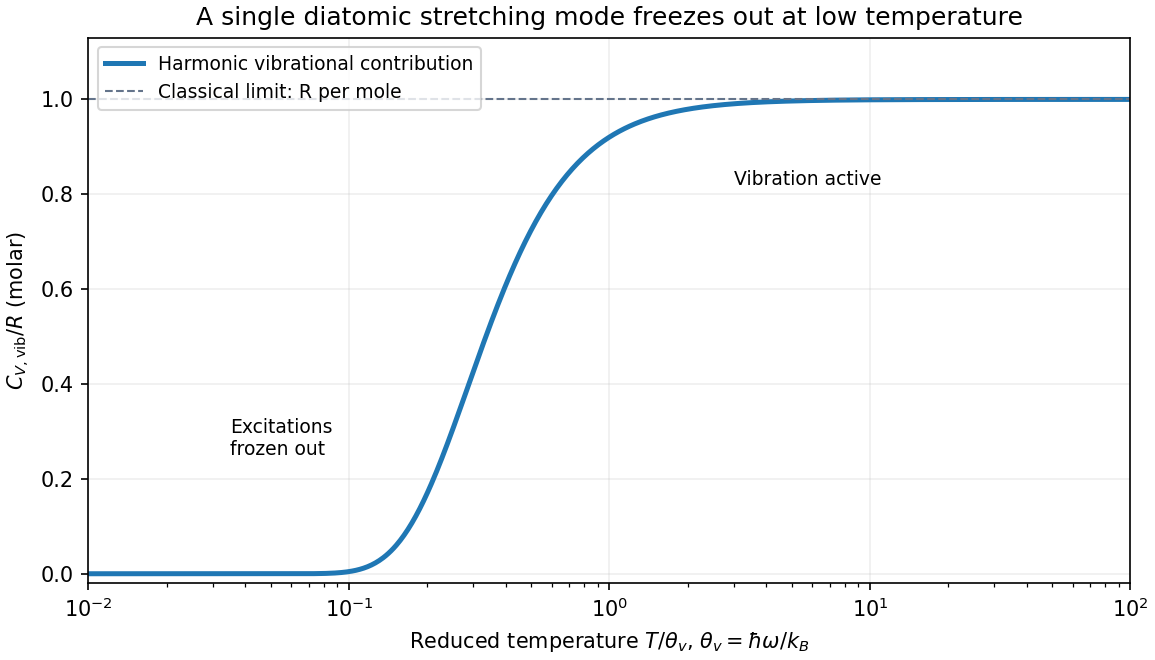

The vibrational heat capacity of a diatomic gas must be distinguished from the total heat capacity. In a dilute gas with rotations already active and vibration still frozen, translation contributes and rotation , so molar . Once vibration is active it adds , giving . For an ideal gas of a fixed number of intact molecules, , so the corresponding values are and . Very low temperatures also freeze rotations, while sufficiently high temperatures bring anharmonicity, dissociation or electronic excitations; the harmonic plateau is restricted to the range where those effects are negligible.
Quantum tunnelling is transmission through a finite classically forbidden region, where . The stationary Schrödinger equation permits an evanescent wavefunction inside such a barrier rather than forcing it to vanish at its entrance. Matching to propagating states beyond a barrier of finite width gives a nonzero transmitted probability current.
For a rectangular barrier of height and width , with equal exterior potentials and , write . The exact rectangular-barrier tunnelling probability isFor an opaque barrier its dominant dependence is . For a slowly varying barrier, the WKB approximation generalizes this to , apart from matching prefactors. Barrier width, particle mass and energy therefore have a strong influence. Energy is conserved in a static barrier: tunnelling does not require the particle to borrow energy or acquire a classical path with negative kinetic energy.
In alpha decay, a nuclear alpha-particle configuration is confined by the short-range nuclear interaction but separated from the exterior by a Coulomb barrier. Its energy can be positive relative to infinity while still lying below the barrier maximum. Escape by tunnelling produces alpha particles at that conserved energy, with an exponentially small decay probability per nuclear encounter. The pronounced dependence of half-life on alpha energy is a characteristic consequence of the barrier exponent, unlike a simple classical escape threshold.
In scanning tunneling microscopy, a conducting tip is brought within a nanometer-scale vacuum gap of a conducting surface and biased weakly. Electron tunnelling gives a current that depends approximately exponentially on separation, in a simple low-bias model. Feedback adjusts the tip height to keep current fixed while scanning, producing a surface map sensitive to both geometry and electronic states. Finite current through the non-contact gap, and its steep dependence on separation, are the direct tunnelling signatures; current is not a direct measurement of topographic height alone.
A Josephson junction provides a collective superconducting example. Two superconductors separated by a thin barrier can carry a coherent pair current even at zero voltage. At constant voltage the AC Josephson effect gives and oscillation frequency . The coupled condensate quantum phases and pair transfer distinguish this from independent normal-electron transmission. These examples involve different microscopic barriers, but all require quantum coupling across a region that suppresses classical passage. Comparing weak-temperature tunnelling behavior with thermally activated escape helps distinguish the mechanisms experimentally.
Articles by others on the same topic
There are currently no matching articles.