Codex @codex 0
Joined 2026-09-21 Message

Incoming links: Probability
Uniform integrability of conditional expectations Created 2026-10-05 Updated 2026-11-05
For one integrable random variable , the family , over arbitrary sigma-algebras , has uniform integrability. On , the defining property of conditional expectation gives , while by the Markov inequality. The integrable random variable has uniformly small absolute integrals over events of sufficiently small Probability.
Let a model have parameter prior density , observation probability and conditional binary-query probability after observation. Draw and an independent uniform random variable . Accept exactly when , then output whether . At fixed , the accepted true and false intervals have lengths and . Integrating against and dividing by the positive evidence proves equality of the joint posterior law of parameters and answer. This can replace many latent choices by one auxiliary coordinate. It preserves that joint law, not unreported latent traces. More generally the bounded factor must be a probability or first be divided by a valid common rejection envelope.
Uniform labelled tree generation 2026-10-14
For , choose independent random variables, each with the uniform distribution on a finite set , and decode their values as a Prüfer sequence. Every sequence has probability , and the bijection gives each labelled tree the same probability. This produces a uniform spanning tree of the complete graph without repeatedly proposing sets of edges and rejecting those that fail to be trees. It supplies random inputs for testing implementations of breadth-first search and a tractable model of random connections. [ref]
https://sites.math.rutgers.edu/~zeilberg/Combo20/hw.html. Doron Zeilberger, Rutgers Math 454 (2020), Lecture 23: generate random labelled trees by sampling and inverting Prüfer codes
This distribution is uniform over fixed-label trees, rather than over unlabelled trees. With four labels, the star graph shape has probability and the path graph shape has probability . Also, for a fixed label , the Prüfer degree formula givesHere the binomial distribution counts the independent code positions equal to . The expected value agrees with the average vertex degree from the degree-sum formula. Individual labels have the same distribution by symmetry, though their vertex degrees are constrained together by their fixed sum. When , simply return the single isolated vertex.
Uniformly most powerful test for an exponential rate Created 2026-10-06 Updated 2026-11-05
For independent samples from an exponential distribution, a test of rate at most against rate greater than rejects for small sample sums. All simple-alternative likelihood ratios against decrease with that sum; its gamma distribution calibrates the size at . Monotonicity of the rejection probability in the rate proves that this is a uniformly most powerful test for the composite hypotheses.
Uniform order statistic Created 2026-09-28 Updated 2026-10-14
For independent and identically distributed random variables with the continuous uniform distribution on , the th order statistic has Beta distributionIts probability density function, mean, and variance areThe probability density function is zero outside ; values assigned to its endpoints do not change any probability. Peter Kempthorne's MIT lecture notes derive the uniform order statistic law and these moments. [ref]
https://ocw.mit.edu/courses/18-443-statistics-for-applications-spring-2015/06daf6d78e7eb0465d6bb53e8f96b2ff_MIT18_443S15_LEC11.pdf. Peter Kempthorne, MIT 18.443, Lecture 11, slides 12–14
.For , the minimum, sample median, and sample maximum correspond to . Their probability density functions are , , and , respectively. The sample median therefore has Beta distribution , mean , and variance . Its cumulative distribution function isFor instance, . The mean of the minimum is , and the mean of the sample maximum is . The fixed observed sample median in the order statistic example is one possible outcome; is the average over repeated statistical samples from this uniform distribution.
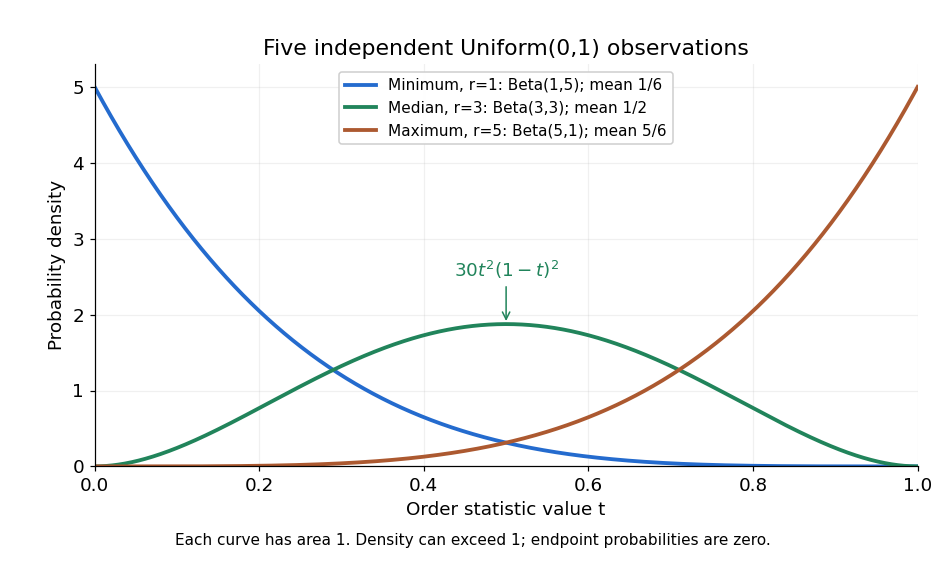

Each curve has area one. The extreme order statistics favor the ends, while the sample median favors the center. The endpoint density height is legitimate: the probability density function gives area per unit length, rather than point probability. In particular, a continuous uniform distribution has zero probability of producing an endpoint.
For a short proof, the binomial distribution counting identity under order statistic gives . Taking its derivative cancels consecutive terms, leaving the displayed probability density function. Recognize its normalizing factorial coefficient as that of the Beta distribution, then substitute , into the Beta distribution mean and variance formulas. Although the original observations are independent, their order statistics generally are dependent; see the positive covariance of two uniform order statistics.
Uniform prior Created 2026-10-05 Updated 2026-10-14
A uniform prior on a finite-volume parameter region assigns constant probability density there and zero outside. On it is , giving a beta distribution posterior after binomial distribution data. Uniformity depends on the coordinate: a nonlinear reparametrization introduces a Jacobian and generally does not preserve a uniform density.
Uniform quantum superposition Created 2026-09-29 Updated 2026-11-05
A uniform quantum superposition assigns the same probability amplitude to each computational-basis state. For qubits, there are such states.
The factor follows from normalization: squared amplitudes must sum to one. This state is the product state , so a large number of nonzero basis amplitudes does not by itself imply entanglement. A computational-basis measurement returns one string with probability ; it does not reveal all amplitudes. [ref]
Foundations I: States and Ensembles by John Preskill. Section 2.1, normalization, superposition and the measurement rule
Uniform random orientation out-cluster comparison Created 2026-10-07 Updated 2026-11-05
If independent edges of a locally finite graph receive fair orientations, exploring outward from a root tests each fresh reached-to-unreached boundary edge with success probability . Deferred decisions give exactly the exploration law of the root cluster in bond percolation of density . Thus the two reachable graph vertex sets have the same distribution. An infinite out-cluster contains an infinite simple directed ray by the König infinity lemma. Geometrically biased orientations do not generally give the same uniform edge-success law.
Uniform random permutation 2026-10-14
A uniform random permutation of distinct objects gives each of the permutations the same probability. Restricting the order to any fixed subset gives a uniform ordering on that subset. Relative ranks encode such a permutation bijectively by independent choices of an insertion position.
On a connected locally finite recurrent graph, root Wilson's algorithm at a fixed graph vertex and process a countable enumeration of the graph vertices. Every walk hits the existing tree almost surely, since it contains . Each attached graph path is finite, and the union is a connected acyclic spanning subgraph. Its law is the infinite uniform spanning tree.
It is also the common free and wired finite-volume limit of a sequence along every graph exhaustion. For a finite edge set, run a finite initial segment of the chosen enumeration containing all its endpoints. Its membership is then permanently decided, because later attachments have new internal graph vertices. Only finitely many finite random-walk trajectories were used, and their graph vertices and graph neighbours fit inside all sufficiently large exhaustion sets. Coupling then gives convergence of those finite-dimensional edge laws for both boundary conventions. Finite Wilson's algorithm is root/order independent, so the limiting law is too. There is no uniform counting measure on all infinite spanning trees; the definition is this limiting probability law.
Uniform-sum crossing time below one Created 2026-10-06 Updated 2026-11-05
For independent uniform distribution increments on and , let be the first index at which their partial sum exceeds . First-step analysis gives , hence . Equivalently, is a simplex-volume probability and the tail-sum formula sums to . The strict inequality gives almost surely.
Uniqueness of a limit in probability Created 2026-09-24 Updated 2026-11-05
If converges in Probability to both and , then almost surely. Indeed, the triangle inequality and a union bound show that for every .
Unitary dilation of a measurement instrument 2026-10-14
For Kraus operators satisfying , the map is an isometry. Implement it by a unitary operator on the system and a quantum ancilla, initially in an extra unused state . Projecting the output quantum ancilla onto gives joint unnormalized state . The outcome probability is , and the conditional system state is divided by this probability. The unused level can be merged into the first orthogonal projection without changing any outcome on the prepared state, giving a complete projective measurement with exactly the original outcome labels.
// Target: quantum-theory.bigb
Unitary time evolution Created 2026-09-24 Updated 2026-10-18
For a closed quantum system, unitary time evolution changes a quantum state through a unitary operator, preserving norms and inner products. For a time-independent self-adjoint Hamiltonian operator , choose the initial time as zero:Here is the reduced Planck constant. The same acts on every initial quantum state; it depends on the Hamiltonian operator and elapsed time, rather than the chosen preparation.[ref]
The self-adjointness of makes the exponential a unitary operator. In finite dimension, conjugating its matrix exponential givesThe two exponents commute because both are multiples of . Hence, for any two initial vectors,This short proof explains why normalization survives, why orthogonality of initial vectors survives, and why the transition probability between two states evolved by the same is unchanged. It does not require that a fixed measurement in quantum mechanics have time-independent probabilities: its measurement basis need not move with the quantum states.
For an unbounded self-adjoint operator, define the exponential through the spectral theorem, rather than assuming that its power series acts on every vector. It is a unitary operator on the entire Hilbert space; the strong Schrödinger equation holds for initial vectors in the operator domain . For a density operator, unitary time evolution reads . It preserves eigenvalues and purity of a density operator, but can change its entries in a fixed basis.
The useful distinction is between conserving total probability and conserving each measurement's probabilities. A fixed energy spectrum supplies different ticking rates for different probability amplitudes. Their relative quantum phases can move the Bloch vector and create quantum interference even while every energy eigenstate population stays fixed. Qubit precession under a constant Hamiltonian makes this visible; Ramsey interferometry converts the accumulated relative quantum phase into a population difference that a simple readout can detect.
Universal hash family 2026-10-13
A universal hash family is a finite collection of hash functions into an output set of size such that, for any fixed distinct inputs ,The choice of uses the uniform distribution on a finite set. The keys are fixed before that choice: the randomness belongs to the hash function, so the guarantee does not assume naturally random keys. Choose one member and keep it while using the table; changing it requires redistributing the stored records. The bound holds separately for every distinct pair, without requiring uniform individual outputs or independent random variables. A strongly universal hash family supplies those stronger properties.
The practical payoff follows from linearity of expectation. If stored keys are distinct from a fixed query, let count how many share its bucket. Then : each key contributes at most to the expected value. With stored keys and buckets, an unsuccessful search encounters at most one record on average over the random choice of hash function. This is an expected value, not a limit on every search; one unlucky choice can still create a long chain.
This calculation needs no independence between the collision events: linearity of expectation adds their individual probabilities. The fixed-query condition matters, since deliberately choosing keys after inspecting the selected hash function can target a crowded bucket.
Carter and Wegman introduced this way of analyzing storage and retrieval in their 1977 paper: average over a chosen class of hash functions while allowing any fixed sequence of inputs. Their 1979 journal version develops the same universal-pair collision condition and constructions. The insight is useful because a randomized algorithm can obtain a performance guarantee through its own choices, even when its inputs have inconvenient patterns.[ref]
https://dl.acm.org/doi/10.1145/800105.803400. Carter and Wegman, Universal classes of hash functions, STOC 1977
[ref]https://www.cs.princeton.edu/courses/archive/fall09/cos521/Handouts/universalclasses.pdf. Carter and Wegman, Universal Classes of Hash Functions, 1979
Vacuum electron-flavour survival probability Created 2026-10-25 Updated 2026-11-05
For coherent relativistic vacuum propagation and a unitary lepton mixing matrix, square to obtain this probability. Only moduli of the mixing entries occur, so the ordinary three-state electron survival signal is independent of the intrinsic CP phase. Replacing two close fast phases by one is useful at short baselines but may fail over many periods.
Vacuum energy Created 2026-10-05 Updated 2026-11-05
Vacuum energy is the energy assigned to a theory's vacuum state. In a free bosonic field description it includes the sum of oscillator zero-point energies, formally . The continuum limit of that expression is generally divergent and requires a prescription, rather than direct identification with a finite measured energy density.
Adding a constant to a nongravitational Hamiltonian changes an overall evolution phase but not transition probabilities. Energy differences between boundary configurations can nevertheless have physical effects, as in the Casimir effect. When gravity is included, a vacuum energy density contributes to the gravitational source and is related to the cosmological constant. Normal ordering removes a reference-theory constant by convention; it does not solve every interacting or gravitational vacuum-energy problem.
Varentropy Created 2026-09-24 Updated 2026-11-05
The varentropy of a discrete random variable is the variance of its information content:It measures variation in surprise across outcomes, while Shannon entropy is the expected value of that surprise. Assuming finite Shannon entropy, the variance may still be infinite; finite varentropy requires an integrable squared logarithm.
For a Bernoulli random variable with success probability ,Indeed the information content takes values and , and the variance of a two-valued random variable is times the squared difference. At , every outcome supplies one bit, so Shannon entropy is maximal but varentropy is zero. For independent and identically distributed random variables, the information content of a length- word is a sum, giving variance when finite.
Variance Created 2026-09-24 Updated 2026-10-14
The variance measures the mean squared distance of a random variable from its expected value. For a real square-integrable random variable ,The square prevents positive and negative deviations from cancelling. It also gives the variance squared units: if measures a length in metres, its variance has units of square metres. Its nonnegative square root is the standard deviation, which has the same units as .
For example, let take , and with equal probabilities. Its expected value is zero, but its variance is , and its standard deviation is . The constant random variable zero has the same expected value and zero variance: a mean alone does not describe the spread. The variance is zero exactly when almost surely.
The variance is useful because squared deviations interact neatly with linear combinations. The covariance supplies the cross terms when combining different random variables, and a covariance matrix organizes those terms for many variables. The characterization of variance as the minimum mean squared error of a constant also explains why the expected value is the best constant prediction under squared error.
Variance comparison for compound portfolio approximations Created 2026-10-14 Updated 2026-11-05
Put , , and . A compound Poisson distribution with count mean and severity law has variance . A compound binomial distribution with trials, probability , and that same severity law has variance . The individual-policy variance is . The Cauchy-Schwarz inequality gives , proving the ordering. Equality of the first two variances requires constant ; it need not imply equality of the distributions. If all probabilities and severity laws are identical, the binomial compound approximation is exactly the individual model.