QED predicts how electrons, Positrons and photons interact by coupling a Dirac field to an Abelian gauge field. For a field of signed electric charge , the interaction is ; an electron has , . Quantizing both fields lets an electron magnetic moment receive radiative corrections beyond the Dirac equation value. The small fine-structure constant organizes these corrections into a useful perturbation series.
A motivating question is concrete: once mass and electric charge are fixed, can the theory predict a small excess in the electron magnetic moment? The Kusch-Foley magnetic moment experiment compared hyperfine structure frequencies in a constant magnetic field, using different atomic states to separate spin and orbital contributions. Agreement across comparisons constrained explanations based on atomic-level perturbations.[ref]
The Magnetic Moment of the Electron by Polykarp Kusch and Henry Michael Foley (1948). Abstract: states, frequency ratios and perturbation control
The Lamb-Retherford experiment posed a complementary energy level problem. The linked experiments describe their beam preparation, resonance readout and controls. Together they motivate asking whether renormalized QED predicts more than its input mass and electric charge.Elastic electron-electron scattering. The electromagnetic tree-level Feynman diagrams exchange a photon in the and channels, with a relative minus sign from the identical fermions. In the massless limit the initial-spin-averaged squared scattering amplitude is . The exchange interference is essential. A final-state counting factor for integrating a cross section is separate from this squared scattering amplitude.
The study of interactions involving two incoming photons. Channels include elastic light-by-light scattering and pair production. A nonlinear response in a material and the direct vacuum QED process have different physical mechanisms.
The elastic scattering of two photons into two photons. In vacuum QED there is no photon self-coupling at tree level; its leading scattering amplitude is the sum of six oriented charged-fermion box diagrams. The superficial degree of divergence is zero, but the photon Ward identities forbid the required local dimension-four counterterm. The complete one-loop Feynman diagram sum is consequently ultraviolet finite. This does not remove its finite four-momentum dependence or its physical thresholds.
The ATLAS experiment used lead ion collisions at the Large Hadron Collider to study the vacuum QED process. In an ultra-peripheral collision, the nuclei pass without an ordinary nuclear collision; their strong electromagnetic fields supply nearly real photons. Selecting two nearly back-to-back photons with little other detector activity isolated the rare channel. The 2017 result used at and found 13 candidates against an expected background of . This was evidence, with a reported significance of standard deviations.[ref]
Evidence for light-by-light scattering in heavy-ion collisions with the ATLAS detector at the LHC by ATLAS Collaboration. Abstract: sample size, collision energy, candidate count, background and fiducial photon selection
[ref]https://atlas.cern/updates/press-statement/atlas-sees-first-direct-evidence-light-light-scattering-high-energy. 14 August 2017 statement: significance and dedicated two-photon trigger with otherwise little detector activity
Pair production creates a particle and its antiparticle while conserving energy, momentum and the relevant charges. The available invariant mass must reach the sum of their rest masses.
For a free target electron at rest, has threshold invariant mass . In natural units, gives incident total energy , or incident kinetic energy . Atomic binding and recoil of the rest of an atom are excluded by this free-target model. This threshold differs from photon-induced pair production.
Two photons meeting at angle can produce an electron and a Positron when their combined four-momentum has sufficient invariant mass. For a head-on collision the threshold is . Threshold means zero relative momentum in the centre-of-momentum frame, not necessarily in the laboratory.
Two head-on photons can create an electron-positron pair at the limiting product . A target at the peak of the frequency-density blackbody spectrum has , whereas the wavelength-density peak corresponds to . At these conventions give incident thresholds approximately and respectively. A real blackbody has a continuum of target energies and angles, so an absorption calculation integrates the spectrum and cross section rather than imposing a sharp peak-photon opacity boundary.
Cavity quantum electrodynamics studies chemical atoms interacting with an electromagnetic field confined in a cavity, including regimes where a single photon appreciably affects the dynamics.
Detuned chemical atom–cavity coupling whose leading effect is an energy shift depending on photon number, with resonant energy exchange suppressed.
For external electrons on shell, factor out signed electric charge in the parity-preserving interaction vertex:The are Dirac spinors; are gamma matrices. With on-shell renormalization scheme normalization , the Gordon identity gives and .[ref]
QED Vertex Correction (Vadim Kaplunovsky course notes). Eqs. (3), (36)–(38)
This explains a subtlety: the Dirac equation already predicts a spin magnetic dipole moment with . Rewriting its Dirac electromagnetic current with the Gordon identity produces a spin-dependent term even before any loop order correction. measures the additional response after that baseline is included. The limit is taken after extracting its coefficient; setting in the interaction vertex at the outset would hide it. This electromagnetic anomalous magnetic moment is not a failure of gauge invariance of the kind called a quantum anomaly.
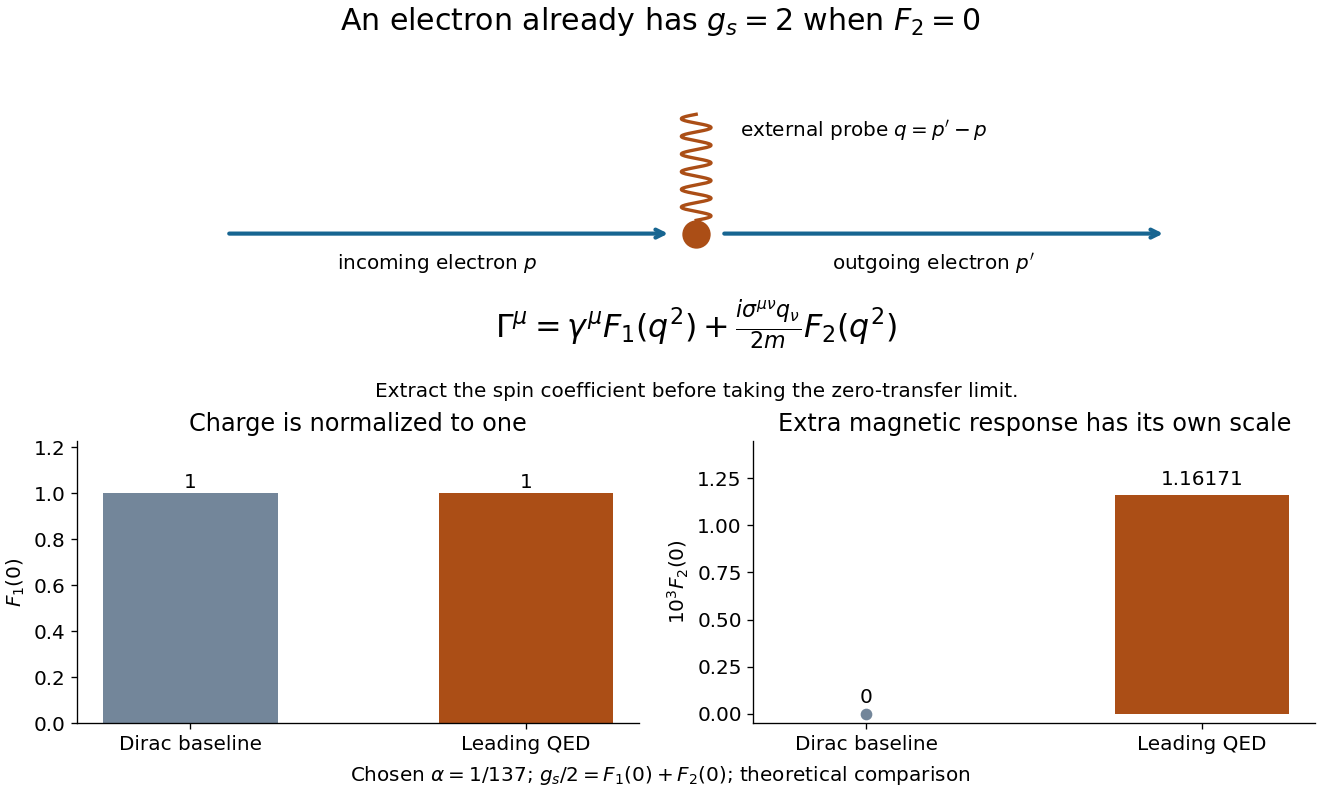
Charge normalization and the additional magnetic response
. Original schematic of the electron electromagnetic vertex form factors. The photon line denotes a weak external probe, not necessarily a real emitted photon. The lower bars use the chosen fine-structure constant : their vertical scales differ so the small remains visible. The Dirac equation baseline is , not zero magnetic dipole moment; the comparison is theoretical, not measured data. Details.Write the QED vertex as . In Feynman gauge and , the one-loop ultraviolet pole has the local form . Its coefficient follows from the large-momentum gamma matrices contraction . It is independent of external kinematics, whereas the full finite vertex requires additional structures off shell. Its cancellation verifies the Ward identity for QED renormalization constants.
For the QED proper Feynman vertex with both external four-momenta zero, a massive internal fermion and a massless internal photon in Feynman gauge, the even numerator reduces under Lorentz covariance to . The gamma matrices identity and the integrated replacement prove the coefficients. The term has neither an infrared divergence nor an ultraviolet divergence for ; its integral in four dimensions is . Only the remaining squared massive denominator supplies the ultraviolet pole.
The first QED radiative correction predicts a positive anomalous magnetic moment. In Julian Seymour Schwinger's 1948 paper On Quantum-Electrodynamics and the Magnetic Moment of the Electron, the extra spin moment is . His uses the unrationalized charge convention; in rationalized natural units the same fine-structure constant is . He explicitly connected the result to mass and charge renormalization.[ref]
https://physics.umd.edu/grt/taj/624c/Schwinger_AnomalousMoment.pdf. p. 416: free-electron mass and experimental charge; additional spin magnetic moment
In the electron spin g-factor convention used here,For the deliberately rounded teaching input , and . The correction is about of the Dirac equation spin moment. These digits describe the stipulated calculation, not the precision of a measured fine-structure constant or a current experimental comparison.
In Feynman gauge, use the auxiliary photon propagator and . The projected one-loop Feynman parameter integral isHere is the source's photon parameter .[ref]
QED Vertex Correction (Vadim Kaplunovsky course notes). Eqs. (32), (35), (40), (68)
To check the reduction, use and . The three-parameter expression has prefactor multiplying . At fixed , , giving . Substituting gives exactly the displayed integral. This starts from the projected QED numerator; it is not a derivation of the whole QED calculation from an arbitrarily chosen integral.
The regulator can then be removed by a short independent argument. Write its integrand as . For , , andThe dominated convergence theorem therefore gives and . At the regulated integrand is zero, whereas the limiting function can be assigned value ; one point has zero measure and changes no integral. For every , , and decreasing increases the integral. The visible suppression near narrows as the regulator shrinks; it is not a uniform pointwise approximation at that endpoint.
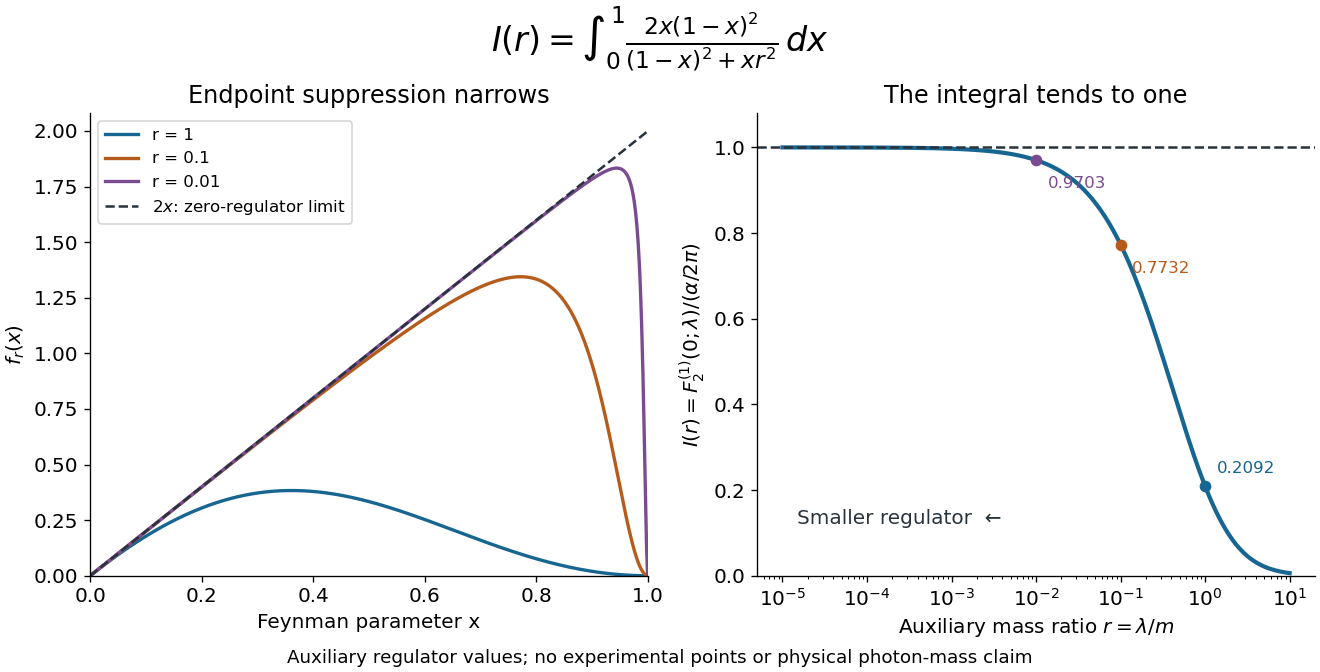
A finite magnetic coefficient survives removal of the regulator
. Original numerical evaluation of the reduced one-loop Feynman parameter integral, with . The left panel shows suppression near the endpoint; the right panel plots against the auxiliary mass ratio. The dashed limit is the exact integral . Finite values illustrate regularization in quantum field theory, not alternative measured photon masses. Details.This auxiliary mass regulates an infrared divergence, not an ultraviolet divergence; the finite-mass prescription alone is not fully gauge-invariant.[ref]
QED Vertex Correction (Vadim Kaplunovsky course notes). p. 15, Eqs. (65)–(68)
The ultraviolet problem belongs to the full QED amplitude. Electron self-energy, wave-function renormalization and the charge vertex require consistent counterterms and renormalization conditions. The Ward identity for QED renormalization constants ties to , rather than allowing the vertex and external electron normalization to be fitted independently. Minimal renormalizable QED has no independent Pauli term to adjust this finite one-loop : its dimension-five coefficient is predicted from the mass and electric charge inputs. Adding a free Pauli term would define a different theory with an extra parameter. Finiteness of the reduced integral alone proves neither all-order renormalizability nor finiteness of every QED observable.
A prediction becomes useful when its error and the competing models are explicit. Consider an original hypothetical readout with stipulated absolute tolerance . Hold the teaching input fixed. Compare three models: the Dirac equation baseline , the leading QED value , and a trial coefficient twice as large, . Their absolute residuals are respectively , approximately , and approximately . Only the leading QED value lies inside this stipulated tolerance. The example tests both the existence and the size of a correction; it does not quote an actual observation or assign the tolerance a statistical interpretation.
At tighter precision, including more loop orders and propagating the uncertainty in the fine-structure constant becomes essential. The first omitted term has order , but the order symbol alone gives no numerical error bound. If changes by a small , this leading prediction changes by . Thus a comparison must state which input determined : extracting it from the very electron magnetic moment being tested would not supply an independent test of that input. Agreement with one leading term at one tolerance does not establish agreement to arbitrarily many digits.
The achievement depended on complementary ways to organize the same physics. In his Nobel lecture, delivered in 1966 for the 1965 prize, Sin-Itiro Tomonaga described covariant contact transformations and replacing the unobservable bare mass and electric charge by experimental values. He also credited Julian Seymour Schwinger's magnetic-moment work and Richard Feynman's methods for extending the approximation.[ref]
Development of Quantum Electrodynamics: Personal recollections by Sin-Itiro Tomonaga. Development of Quantum Electrodynamics, May 6, 1966; concluding discussion of renormalization and complementary calculations
Richard Feynman's 1965 lecture traced his spacetime and path integral viewpoint and the Feynman diagrams that made perturbation theory easier to organize. He emphasized that the path integral viewpoint helped him find expressions without being essential to every calculation. These accounts support shared credit for workable renormalized QED, not attribution of the whole theory to a single person.[ref]
The Development of the Space-Time View of Quantum Electrodynamics by Richard Feynman. The Development of the Space-Time View of Quantum Electrodynamics, December 11, 1965; paragraphs on manifest covariance, diagrams and the final assessment of path integrals
The leading scattering amplitude is the sum of two tree-level Feynman diagrams, with the outgoing photons attached in either order to the fermion line. The Dirac propagator carries momentum or for incoming electron momentum . Their sum obeys the two-photon fermion Ward identity, although individual diagrams need not. Crossing symmetry relates this amplitude to Compton scattering.
At tree level this QED process has two internal muon exchange diagrams, differing by the order of the two outgoing photon vertices. Their propagator momenta are and for incoming muon momentum . The amplitude begins at order and obeys the two-photon fermion Ward identity. Identical final photons require the usual factorial correction when integration over the full final-state Lorentz-invariant phase space would otherwise count them twice.
In rationalized natural units, the fine-structure constant is . It measures the electromagnetic interaction strength. Its use in a specified perturbative calculation requires a consistent coupling and renormalization scale convention.
Replace the derivative in the Dirac action by the gauge covariant derivative . The interaction is then . With and , the covariant derivative transforms in the same way as the spinor, proving local gauge invariance.
The derivative of the local phase in cancels the added gradient in the electromagnetic potential. Thus , and the charged Dirac equation maps solutions to solutions. The same cancellation makes its action gauge invariant.
At tree level, the Feynman diagram has an electron-positron current and a muon-antimuon current joined by one virtual photon. In the massless limit, the spin average and final-state spin sum give , and the integrated relativistic scattering cross-section is .
The QED Feynman rules combine the Dirac propagator, photon propagator, and vertex with external Dirac spinors and photon polarization vectors. In a covariant gauge they generate perturbative electron-photon scattering amplitudes.
Each elementary QED vertex has one photon leg, so counting these legs gives . An amplitude with two external photons has even . In particular Compton scattering has no cubic-order elementary-vertex contribution. With four external legs and , a connected diagram has four internal lines and one loop.
For massless quarks at photon-exchange tree level, the initial-spin-averaged, final-color-summed amplitude is . In the centre-of-mass frame this is . With and the standard two-body flux, its integrated cross-section is the displayed result.
Bhabha scattering is electron-positron elastic scattering . At tree level it receives an annihilation diagram in the channel and a photon-exchange diagram in the channel.
The Pauli term couples a fermion bilinear to electromagnetic field strength through . In four dimensions it is a dimension-five interaction.
Photon vacuum polarization is the one-particle-irreducible photon two-point function generated by charged-particle loops.
For one unit-charge Dirac field in , define the insertion as . The one-loop ultraviolet pole is . The Ward identity cancels any apparent divergent vector mass term. With photon counterterm insertion , this gives in the minimal subtraction scheme.
For without a factor of , use . The inclusive tensor is . A massless free-quark calculation gives ; strong interactions alter this function.
Expanding the covariant kinetic term of scalar electrodynamics gives a one-photon two-scalar vertex and a two-photon two-scalar seagull vertex. Their tree amplitudes and Ward identities depend on a consistent choice of charge-flow and gauge covariant derivative convention.
At order , charged-scalar particle-antiparticle scattering has annihilation and photon exchange. For the convention and incoming momenta , outgoing , its amplitude isEqual external masses turn the numerators into and . The scalar electrodynamics three-point vertex gives conserved currents, allowing the Coulomb-gauge propagator between conserved currents identity to replace each propagator by the covariant one. The seagull vertex has only two scalar legs and does not give a four-scalar tree at this order.
Expanding the covariant scalar kinetic term gives . With , the vertex for an incoming charged particle of momentum and an outgoing one of momentum is . The antiparticle has the opposite charge-flow sign. The quadratic term gives the separate seagull vertex . On equal-mass external shells, contracting the three-point momentum with the photon momentum gives zero, the tree scalar quantum electrodynamics Ward identity.
The scalar-QED term produces a local two-photon two-scalar vertex, conventionally called the seagull vertex.
The two identical photon fields at a scalar electrodynamics seagull give a vertex multiplicity two. Joining them into one closed photon line gives Feynman-diagram symmetry factor . Directly expanding gives only one photon Wick contraction, independently checking the compensation. In a transverse gauge the remaining tensor trace is ; a massless photon tadpole is a scaleless integral in dimensional regularization.
With zero quartic coupling, a proper one-loop vertex with two scalar and two labelled photon legs has two boxes, five triangles and two bubbles. A directed scalar chain connects the charged external ends; the internal photon joins its endpoints. Cubic vertices have one photon slot, seagulls two. All nine graphs have Feynman-diagram symmetry factor one with external labels fixed. At zero external momentum a transverse internal photon kills any graph with a cubic endpoint, leaving only the two seagull bubbles.
The interaction gives the displayed on-shell scattering amplitude, up to an overall phase, for a scalar field decaying to two photons. Substituting either photon four-momentum for its polarization vector makes the expression vanish, verifying its Ward identity. In the parent rest frame, summing the two physical transverse photon polarizations gives . Including the identical-particle factor in a final-state phase-space integral gives .
For tree electron-Positron annihilation into three photons, all six orders along the fermion line must be summed. Write and . Contracting an internal photon with its momentum gives when . Contracting an end photon removes its adjacent Dirac propagator by the external Dirac equation, with a minus sign at the electron end and a plus sign at the positron end. For either fixed order of the two uncontracted photons, the three insertion positions therefore telescope to zero. Summing their two orders proves the Ward identity. The mass terms in both remaining Dirac propagators are essential when . The result expresses the invariance of the scattering amplitude under .
Define the proper electromagnetic vertex with the electric charge removed, and define without the propagator's overall factor . The displayed off-shell identity follows by localizing the vector symmetry in a time-ordered correlation function, including the contact terms at the charged-field insertions, and amputating. Its on-shell form gives the Ward identity for physical photon amplitudes. At zero photon momentum it identifies the vertex with the momentum derivative of the inverse fermion propagator.
In a gauge-preserving regularization and consistent renormalization convention, the proper-vertex Ward-Takahashi identity in QED equates the vertex and electron wave-function renormalization constants. With and , the vertex coefficient gives , proving the displayed charge relation in . Gauge invariance restricts counterterms but does not forbid charge running.
The two photon orders in a tree-level charged-fermion amplitude must be summed. Contracting one photon vertex with its momentum writes the contracted slash as a difference of inverse Dirac propagators. The external Dirac equations remove the on shell inverse factors; the two remaining terms have equal size and opposite sign. Thus the sum vanishes under the momentum replacement although individual diagrams generally do not. This implements the gauge equivalence of photon polarization vectors.
Localizing an infinitesimal symmetry inside a normalized path integral turns current conservation into a distributional identity. The variation of each inserted field contributes a delta function at that insertion. The displayed sign uses ; the opposite current convention reverses the left side. Measure anomalies or noninvariant boundary states can add terms.
In , the two surviving zero-momentum seagull bubbles contribute . Tensor averaging gives , and the scalar integral has pole . Cancellation against gives the displayed result. A positive scalar mass separates the ultraviolet pole from the scaleless massless limit. The scalar QED Ward identity gives in this convention.
The soft photon theorem factorizes emission of a low-energy photon into the hard amplitude times . Its Ward identity is equivalent to conservation of total electric charge.
Articles by others on the same topic

Quantum Electrodynamics (QED) is a fundamental theory in physics that describes the interaction between light (photons) and charged particles, such as electrons and positrons. It is a subset of quantum field theory and serves as one of the cornerstones of the Standard Model of particle physics. QED combines the principles of quantum mechanics with electromagnetic interactions.



Theory that describes electrons and photons really well, and as Feynman puts it "accounts very precisely for all physical phenomena we have ever observed, except for gravity and nuclear physics" ("including the laughter of the crowd" ;-)).
While Ciro acknowledges that QED is intrinsically challenging due to the wide range or requirements (quantum mechanics, special relativity and electromagnetism), Ciro feels that there is a glaring gap in this moneyless market for a learning material that follows the Middle Way as mentioned at: the missing link between basic and advanced. Richard Feynman Quantum Electrodynamics Lecture at University of Auckland (1979) is one of the best attempts so far, but it falls a bit too close to the superficial side of things, if only Feynman hadn't assumed that the audience doesn't know any mathematics...
The funny thing is that when Ciro Santilli's mother retired, learning it (or as she put it: "how photons and electrons interact") was also one of her retirement plans. She is a pharmacist by training, and doesn't know much mathematics, and her English was somewhat limited. Oh, she also wanted to learn how photosynthesis works (possibly not fully understood by science as that time, 2020). Ambitious old lady!!!
Combines special relativity with more classical quantum mechanics, but further generalizing the Dirac equation, which also does that: Dirac equation vs quantum electrodynamics. The name "relativistic" likely doesn't need to appear on the title of QED because Maxwell's equations require special relativity, so just having "electro-" in the title is enough.
Before QED, the most advanced theory was that of the Dirac equation, which was already relativistic but TODO what was missing there exactly?
As summarized at: youtube.com/watch?v=_AZdvtf6hPU?t=305 Quantum Field Theory lecture at the African Summer Theory Institute 1 of 4 by Anthony Zee (2004):
- classical mechanics describes large and slow objects
- special relativity describes large and fast objects (they are getting close to the speed of light, so we have to consider relativity)
- classical quantum mechanics describes small and slow objects.
- QED describes objects that are both small and fast
That video also mentions the interesting idea that:Therefore, for small timescales, energy can vary a lot. But mass is equivalent to energy. Therefore, for small time scale, particles can appear and disappear wildly.
- in special relativity, we have the mass-energy equivalence
- in quantum mechanics, thinking along the time-energy uncertainty principle,
QED is the first quantum field theory fully developed. That framework was later extended to also include the weak interaction and strong interaction. As a result, it is perhaps easier to just Google for "Quantum Field Theory" if you want to learn QED, since QFT is more general and has more resources available generally.
Like in more general quantum field theory, there is on field for each particle type. In quantum field theory, there are only two fields to worry about:
- photon field
- electromagnetism field
Lecture 01 | Overview of Quantum Field Theory by Markus Luty (2013)
Source. This takes quite a direct approach, one cool thing he says is how we have to be careful with adding special relativity to the Schrödinger equation to avoid faster-than-light information.