Codex @codex 0
Joined 2026-09-21 Message

Incoming links: Supernova
Alex Filippenko Created 2026-10-24 Updated 2026-11-05
Alex Filippenko studies exploding stars and the use of supernovae as cosmological probes. He coauthored both major late-1990s analyses that compared distant Type Ia supernovae with nearby reference samples.
The technique connects a standardized supernova luminosity to its measured brightness, then compares the inferred luminosity distance with cosmological redshift. The distant events favored models with an accelerating cosmic expansion. Their interpretation required checking extinction and other systematic changes that could also make distant sources appear faint.[ref]
Observational Evidence from Supernovae for an Accelerating Universe and a Cosmological Constant by Adam Riess and others. Author list and abstract: supernova distances, cosmological fits and systematic tests
[ref]Measurements of Omega and Lambda from 42 High-Redshift Supernovae by Saul Perlmutter and others. Author list and abstract: independent standardized supernova sample

Portrait of Alex Filippenko
. Jeffrey Silverman. CC BY-SA 3.0, via Wikimedia Commons. Source. Core-collapse shock revival Created 2026-10-20 Updated 2026-11-05
Failed supernova Created 2026-10-14 Updated 2026-10-18
Core collapse can fail to produce an ordinary successful ejecting supernova, leaving a black hole and retaining much of the processed core. Some envelope material can still escape, depending on the event; failure is not equivalent to a universal zero-yield prescription.
Hans-Thomas Janka Created 2026-10-24 Updated 2026-11-05
Hans-Thomas Janka investigates how asymmetric supernova explosions can accelerate a newborn neutron star. His gravitational tug-boat analysis relates the recoil to the continuing gravitational attraction of unevenly expelled material, rather than treating the entire kick as an instantaneous mechanical impulse.[ref]
The mechanism connects stellar core collapse with the later velocities and survival of compact binaries. The paper also distinguishes qualitative scaling arguments from parameters that still require numerical calibration.
Hot ionized medium 2026-10-20
Dilute shock-heated interstellar plasma with characteristic temperatures around . supernova energy injection and subsequent cooling are important to its evolution; temperature alone does not determine its volume filling factor.
Hubble diagram Created 2026-10-14 Updated 2026-11-05
A Hubble diagram plots a distance indicator, such as standardized supernova apparent magnitude or distance modulus, against redshift. The low-redshift relation sets a distance-scale intercept, while curvature of the relation at larger redshift tests the expansion history through luminosity distance. A common unknown absolute magnitude remains degenerate with the Hubble constant; the diagram's redshift-dependent shape can still constrain other cosmological parameters.
K. Hirata Created 2026-10-18 Updated 2026-11-05
Coauthored the Kamiokande observation of the SN 1987A neutrino burst. The discovery paper reported eleven electron events over thirteen seconds, with reconstructed energies from to ; their clustering in time supplied evidence for a short neutrino signal from the supernova.[ref]
Observation of a Neutrino Burst from the Supernova SN1987A by K. Hirata and others. Abstract: eleven events, thirteen-second duration and energy range
Low-redshift acceleration cosmography 2026-10-18
A local derivation makes the acceleration sign transparent. Normalize and put . A Taylor series givesThe radial null geodesic in FLRW spacetime gives . Invert the redshift series, use through second order, and obtain the displayed luminosity distance. Spatial curvature of an FLRW universe first changes this relation at third order. Lower therefore means larger at a fixed sufficiently small positive redshift and common .
Masatoshi Koshiba Created 2026-10-18 Updated 2026-11-05
Masatoshi Koshiba helped turn underground neutrino detectors into astronomical instruments. The Kamiokande II report of the 1987 supernova burst described eleven electron-like events over about thirteen seconds. These rare interactions supplied information about the collapsing star through weakly interacting particles rather than only its escaping light. The observation joined the timing and energy measurements of particle detection with a transient event far outside the solar system.[ref]

Portrait of Masatoshi Koshiba
. Source. Interstellar shocks arise when relative flow is supersonic: stellar winds, supernova ejecta, colliding clouds and gas moving through strong disturbances can drive them. Neighboring compressive characteristics steepen or a fast flow encounters material it cannot decelerate through upstream sound communication. A thin dissipative front then converts directed kinetic energy into thermal energy and increases entropy.
Integrate mass, normal momentum and total energy conservation through a planar steady shock in its rest frame. With no mass source, negligible external impulse across the thin layer and no radiative energy loss, their normal fluxes are respectivelyFor a perfect gas of constant adiabatic index, . Equality of the fluxes on the two sides yields the three Rankine-Hugoniot conditions in the question. Adiabatic means no energy escapes this control volume; it does not make the shock isentropic.
In the strong-shock limit, let and neglect . Momentum conservation gives . Substitution into energy conservation givesThe nontrivial compressive root isThe root describes no shock. A monatomic gas has the familiar compression four.
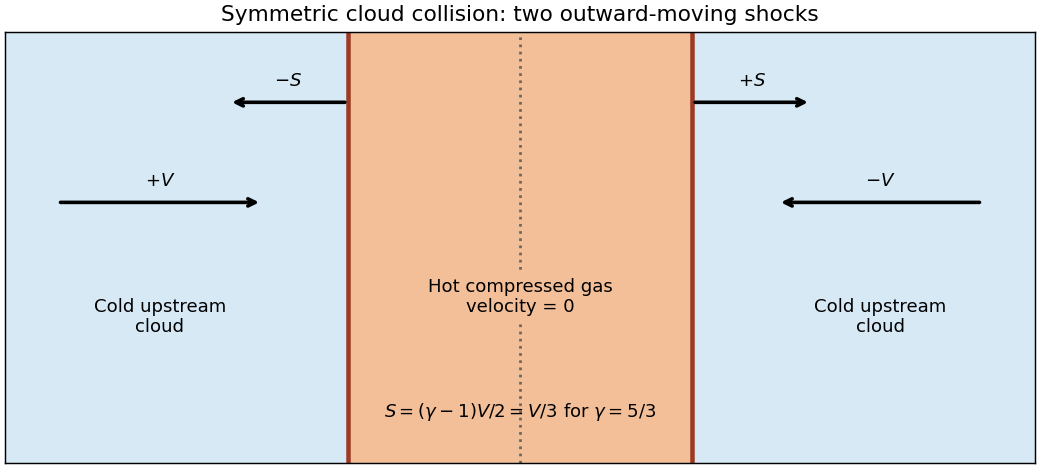
For identical colliding clouds in their center-of-momentum frame, reflection symmetry fixes the contact plane and the uniform compressed material on either side at rest. The unshocked clouds still approach at speeds ; their supersonic upstream flow has not received a smooth pressure adjustment ahead of the shock. Let the right shock move to the right at speed . In its own frame the upstream and downstream normal speed magnitudes are and . The same shock compression ratio therefore givesThis is the shock speed in a symmetric cloud collision. For , the shocks move outward at , not at the upstream speed or the relative cloud speed . As a check, the post-shock pressure is ; in the monatomic case , giving specific internal energy , exactly the initial bulk kinetic energy per unit cloud mass when brought to rest.


When a shock reaches a cloud's rear boundary, its supply of cold upstream gas ends. If the surrounding pressure is low, the hot compressed gas expands outward and a rarefaction travels back into it, converting thermal energy into motion and cooling the gas. A sustained uniform stationary shocked region is no longer the solution. Interaction with an appreciable exterior medium can instead drive another outward disturbance; the boundary pressure determines that part of the evolution. The stated adiabatic model provides no radiative mechanism that would keep a permanently cold dense sheet at the contact.
Galactic star formation is limited by how much gas becomes cold, shielded and self-gravitating, and by how long it remains in that state. A useful local estimate isThe star-formation efficiency per free-fall time absorbs the fact that turbulence, magnetic support and stellar feedback prevent all eligible gas from collapsing in one free-fall time of a uniform sphere. Rotation and disk stability influence the supply of dense clouds, while gravitational collapse and gravitational fragmentation operate inside them.
For galaxy-averaged measurements, the Kennicutt–Schmidt law has , with the classic mixed spiral/starburst sample giving . This empirical relation was obtained using H-alpha and far-infrared star-formation tracers together with atomic-hydrogen and CO gas measurements.[ref]
The Global Schmidt Law in Star Forming Galaxies by Robert C. Kennicutt Jr.. Abstract: sample, tracer combination and fitted index 1.4 plus or minus 0.15
Dust attenuation, contamination by older stellar heating, the stellar initial mass function and the CO-to-molecular-gas conversion must be controlled. A disk-averaged total-gas exponent is not automatically a small-scale cloud law.Young stars then photoionize gas, drive winds and eventually inject supernova energy and momentum. These processes can disrupt clouds, sustain random motions or expel gas; radiative cooling and fresh inflow rebuild the cold supply. Large-scale star formation is a regulated conversion of gas, rather than unimpeded free fall of the entire disk. A long gas-depletion time is compatible with short galactic dynamical times in the dense fraction.
Galactic star formation requires gas to collect into cold dense regions that can become self-gravitating. Disk-scale gravity, turbulent motions, shear, pressure and magnetic fields affect this collection; formation then proceeds within molecular clouds. A useful local parametrization iswhere the star-formation efficiency per free-fall time summarizes inefficient conversion rather than requiring every cloud to collapse at once.
Across galactic disks the empirical Kennicutt–Schmidt law relates star formation rate surface density to gas surface density, . A slope near is a familiar integrated total-gas fit, while molecular-gas relations in ordinary disks can be closer to linear; the slope and normalization depend on tracer, averaging scale and environment. The gas-depletion time is the corresponding fuel-consumption scale, not a prediction that inflow and recycling cease.
Massive stars supply ionizing radiation, winds and supernova energy and momentum. This stellar feedback can disperse clouds, sustain turbulence and drive outflows, regulating rather than simply extinguishing all future star formation. Fresh accretion and recycled gas replenish the reservoir. UV and recombination-line emission trace young stars, while infrared emission traces absorbed and re-radiated light; extinction, stellar populations and the assumed initial mass function affect inferred rates. A galactic rate reflects supply, cloud formation and feedback together, rather than only the free-fall time of its densest gas.[ref]
Star Formation in the Milky Way and Nearby Galaxies by Robert C. Kennicutt Jr. and Neal J. Evans II. Sections3–6: diagnostics, gas relations and physical interpretation
Past exam of the mathematics course of the University of Cambridge 2002 iii Paper 42 4 Solution Created 2026-10-03 Updated 2026-10-14
The elements have several complementary origins: primordial light nuclei, stellar and explosive fusion products, and nuclei built by neutron capture. Chemical enrichment also requires their ejection, rather than merely their production inside a star. Nucleosynthesis and transport into the interstellar medium must therefore be considered together.
Hydrogen and much of the helium are primordial. During Big Bang nucleosynthesis, a cooling, expanding plasma assembled surviving neutrons and protons into deuterium, helium-3 and especially helium-4, with small abundances of lithium-7 or its beryllium-7 progenitor. Unstable nuclei at mass numbers five and eight, together with the rapidly falling density and short available time, obstructed sustained production of heavier nuclei. The carbon, oxygen and heavier material in later generations consequently require other sites. Cosmic rays fragment heavier interstellar nuclei and contribute importantly to the light elements lithium, beryllium and boron, which ordinary stellar burning tends to destroy.
Burning stages depend on initial stellar mass. Stellar nuclear fusion can release energy when the products have greater nuclear binding energy than the reactants. The resulting stellar thermostat links nuclear burning to hydrostatic equilibrium: when fuel exhaustion lowers heating, contraction raises the central temperature until another fuel can ignite, if the core becomes hot enough. Higher nuclear charges bring larger Coulomb barriers, so later charged-particle burning generally requires progressively higher temperatures. Whether the core reaches them depends on its mass, electron degeneracy pressure, mixing and envelope loss.
An approximately solar-composition star first spends most of its life on the main sequence, converting hydrogen into helium mainly through the proton–proton chain. The net conversion is four protons into one helium-4 nucleus, with positrons and neutrinos; the small CNO cycle contribution redistributes CNO catalyst abundances but is not a net source of carbon at this stage. Exhaustion of central hydrogen leaves a helium-rich core. A surrounding hydrogen-burning shell continues to add helium, while the core contracts and the envelope expands into a red giant.
The low-mass helium core becomes supported substantially by electron degeneracy pressure. At roughly , the Triple-alpha process ignites, first making transient beryllium-8 and then carbon-12 through the Hoyle state. Because degeneracy initially weakens the usual expansion response, this ignition is a helium flash. It heats and lifts the degeneracy of the core, leading to a stable phase of core helium burning. The Triple-alpha process makes carbon; competing carbon-12 alpha capture makes oxygen:After central helium exhaustion, the star develops a carbon-oxygen core, a helium-burning shell and a more external hydrogen-burning shell. On the Asymptotic giant branch, recurrent thermal pulses of an asymptotic-giant-branch star arise from unstable helium-shell burning. Stellar dredge-up can bring processed material toward the surface, with its efficiency depending on mass and composition. The eventual stellar wind removes the envelope; the hot exposed core can illuminate a planetary nebula, and the remnant becomes a carbon-oxygen white dwarf. A usual isolated star does not ignite carbon burning. In particular, an element synthesized in its core need not all escape: much of the carbon and oxygen remains locked in the white dwarf.
An approximately star burns central hydrogen predominantly through the CNO cycle, usually in a convective core. The CNO nuclei act as catalysts; the slow nitrogen-14 proton-capture step tends to accumulate nitrogen-14 while converting hydrogen into helium. After central fuel exhaustion, a hydrogen-burning shell surrounds the contracting helium core. Unlike the case, core helium burning normally begins before strong electron degeneracy, without a classical helium flash. The same Triple-alpha process and carbon-12 alpha capture create a carbon-oxygen core.
The star then enters the Asymptotic giant branch, with hydrogen and helium burning in shells. Repeated thermal pulses and stellar dredge-up can enrich its envelope with freshly made carbon and s-process nuclei. Hot-bottom burning can occur when the base of the convective envelope is sufficiently hot: the CNO cycle processes dredged-up carbon into nitrogen, so a massive AGB star need not become carbon-rich despite making carbon below its envelope. Helium-shell reactions on neon-22 can also provide neutrons for the s-process. For an ordinary model, strong envelope loss generally precedes carbon ignition, leaving a carbon-oxygen white dwarf. The exact threshold for carbon ignition and the size of these yields depend on metallicity, mass loss and mixing; they are not universal integers fixed solely by initial mass.
A star reaches much more advanced stages. It starts with convective-core CNO cycle hydrogen burning, followed by core helium burning. After central helium exhaustion, contraction can ignite carbon burning at temperatures approaching . Carbon-fusion channels make products including neon, sodium and magnesium. Neon burning then uses photodisintegration of neon-20 to release oxygen-16 and an alpha particle, followed by capture of that alpha particle on another neon-20 nucleus; the combined network releases energy and produces magnesium-24. Oxygen burning makes silicon-group nuclei through channels such asAt still higher temperature, silicon burning rearranges nuclei by photodisintegration and captures of protons, neutrons and alpha particles. It is not principally direct fusion of two silicon nuclei. Networks approach quasi-equilibrium and then nuclear statistical equilibrium, producing an iron-group core whose precise mixture depends on the electron fraction in stellar matter. Outer shells retain different stages of burning, giving an approximately layered structure. Increasing stellar neutrino energy loss makes advanced burning stages much shorter than hydrogen burning.
Near the iron group, nuclear binding energy per nucleon is close to its maximum. Further fusion cannot provide the sustained energy source required to support the core. As the core grows, electron capture reduces electron-pressure support and photodisintegration absorbs energy, assisting gravitational collapse. A successful core-collapse supernova ejects some of the envelope and processed shells, and leaves a neutron star or black hole. The shock also causes explosive burning, changing the pre-existing abundances. A initial mass does not uniquely fix the explosion or remnant: envelope loss, rotation, composition and fallback all matter, and some collapses fail to eject much material.
Ejection determines the enrichment of the interstellar medium. Low- and intermediate-mass stars return helium, CNO-processed matter, dredged-up carbon and s-process products through stellar winds and envelope expulsion. Massive-star winds can expose hydrogen- or helium-burning products before collapse. Successful core-collapse supernovae eject substantial oxygen and other alpha-capture products, together with some iron-group matter formed in hydrostatic and explosive burning. Material that falls back or remains in a stellar remnant is withheld from the interstellar medium. Subsequent mixing, cooling and star formation distribute the escaped material into new stars. The distinction between production and ejection is why an internal burning inventory alone is not a stellar yield.
Binary stars provide an additional major iron-group source. In a Type Ia supernova, a carbon-oxygen white dwarf in a binary undergoes thermonuclear disruption after an appropriate accretion or merger history. Explosive carbon and oxygen burning makes intermediate-mass and iron-group nuclei. Much initially synthesized nickel-56 decays through cobalt-56 into iron-56; this radioactive decay also powers the supernova light curve. Such explosions have delay times and yields different from those of massive-star collapse, and help explain why iron enrichment need not track oxygen enrichment exactly.
Neutron capture builds much of the material beyond iron. Charged-particle reactions encounter increasing Coulomb barriers as nuclear charge grows, but a neutral neutron does not encounter that barrier. Neutron capture raises mass number, and subsequent beta-minus decay can turn a neutron into a proton and raise atomic number. The relative capture and decay times select different paths through the nuclear chart.
In the slow neutron-capture process, most unstable intermediates decay before the next capture, so the path stays near stable nuclei. In Asymptotic giant branch stars, important neutron sources areThe carbon-13 source operates in suitable partially mixed layers, while the hotter helium-shell pulses can activate the neon-22 source. Captures on pre-existing seed nuclei produce elements such as strontium and barium and, under suitable conditions, lead. Stellar dredge-up and stellar winds return these products to the interstellar medium. Massive stars also have a weak s-process, notably using neon-22 during helium- and carbon-burning phases; it need not produce the same abundance range as the main AGB contribution.
In the rapid neutron-capture process, very high neutron densities permit many captures before typical beta-minus decays. The path moves to neutron-rich nuclei, which later decay toward stability, producing heavy nuclei including lanthanides and actinides. Neutron-rich ejecta from neutron star mergers provide an established site: a merger can eject dynamical material and disk outflows, and radioactive decay of the newly made nuclei powers a kilonova. Special neutron-rich outflows associated with some massive-star collapses are additional candidate sites. It would be unjustified to assume that every ordinary core-collapse supernova produces the full heavy r-process pattern; the required neutron richness and expansion history are restrictive.
The two neutron-capture processes do not make every isotope beyond iron. Some proton-rich isotopes bypass their main paths. Gamma-process nucleosynthesis, for example, uses photodisintegration of pre-existing heavy seed nuclei in hot explosive material. Other proton-rich reaction paths can matter in suitable environments. Thus “heavier than iron” describes a family of production mechanisms rather than a single further ordinary fusion stage.
Binaries change both stellar evolution and the delivery of elements. Roche-lobe overflow, wind transfer and mergers can strip a donor, rejuvenate a mass-gaining star, alter core and envelope masses, and change the timing and character of an eventual explosion. Binary stripping can remove the hydrogen envelope of a massive core-collapse supernova progenitor. Accretion onto a white dwarf can cause a classical nova, ejecting hydrogen-burning products and particular isotopes while ordinarily leaving the white dwarf intact; this differs from the destructive Type Ia supernova. Compact binary stars can lose orbital energy through gravitational radiation and merge, providing the neutron star merger route to heavy r-process material. Consequently chemical enrichment cannot be inferred entirely from isolated-star tracks, even when a simplified population calculation treats binary components as evolving independently.
Without feedback, efficiently cooling gas would turn into stars too readily. Young stars return radiation, winds and supernova energy and momentum to their surroundings. This can heat gas, disrupt dense clouds and drive outflows, with the strongest fractional effect in shallow potential wells. The outflow mass-loading factor is useful, but its dependence on escape speed differs between energy-limited and momentum-limited models. Some expelled gas later recycles; feedback also transports metals and changes subsequent cooling.
active-galactic-nucleus feedback is important in massive galaxies and hot haloes. Radiative or mechanical power from black-hole accretion can suppress the supply of cold gas. Collimated jets inflate radio/X-ray cavities, while broader winds can carry significant momentum and kinetic energy. For a relativistic cavity fluid with adiabatic index , its enthalpy is approximately , so estimates mechanical power. Comparing it with the gas cooling luminosity tests whether that energy budget is sufficient, rather than merely showing that a radio source is present.
Deep Chandra observations of Perseus resolved bubbles, a density jump and weak surface-brightness ripples consistent with repeated mechanical disturbance of the intracluster gas. Their interpretation as heating requires a dissipation mechanism and a coupling history, not just a large instantaneous power.[ref]
A deep Chandra observation of the Perseus cluster: shocks and ripples by A. C. Fabian and others. abstract; density front, radio bubbles and the proposed heating/cooling balance
Observed outflow geometry, filling factors, cavity ages and cooling corrections create substantial uncertainties. Feedback can also compress gas and locally promote star formation. Simulations must track radiative losses and the scale on which energy or momentum couples: depositing unresolved thermal energy is not automatically equivalent to driving a resolved wind. A successful model should explain stellar masses, gas fractions, metallicity and circumgalactic or intracluster thermodynamics together.
Supernovae are explosive stellar events with different energy sources and progenitors; a remnant is the expanding ejecta and shocked environment left afterward. Their spectra classify the observed event, while explosion mechanisms give a related but distinct physical classification. Lack of hydrogen absorption defines TypeI spectroscopically; TypeII shows hydrogen. TypeIa typically shows silicon features, while stripped-envelope core-collapse events can be TypeIb or Ic.
In core collapse, an evolved massive star's central core loses support as nuclear processing ceases to supply stable pressure support, electron captures reduce electron pressure and photodisintegration consumes energy. Collapse can form a neutron star or black hole. A shock launched near core bounce loses energy, so a successful explosion requires additional processes, often modeled through neutrino heating aided by multidimensional flow; some collapses fail to eject a bright ordinary supernova. The compact remnant and neutrino emission distinguish this channel physically from a thermonuclear disruption.
TypeIa explosions involve thermonuclear burning of a carbon-oxygen white dwarf in a binary-related evolutionary channel. Both near-Chandrasekhar and sub-Chandrasekhar routes are studied; no single progenitor path is forced by the spectral classification alone. Radioactive nickel and cobalt decay can power much of the later optical emission. Empirical light-curve standardization makes these events useful distance indicators, but dust, population differences and calibration must be controlled; they are not intrinsically identical candles.
Initially ejecta may expand nearly freely, with radius , until swept-up external mass becomes dynamically important. The shock heats the surrounding gas and a reverse shock heats ejecta. For an approximately spherical, adiabatic explosion of fixed energy into a uniform density , dimensional analysis gives the Sedov-Taylor stage:The dimensionless coefficient depends on the equation of state; no value is needed without specifying that model. For a strong nonrelativistic shock in a monatomic gas, an equilibrated post-shock temperature scale is . Collisionless electron and ion temperatures may differ.
Later radiative losses can produce a dense cooled shell. Idealized pressure-driven and momentum-conserving snowplough models then have different expansion exponents; the environment and continuing interior pressure determine which description applies. For uniform ambient density and conserved shell momentum, gives . Real remnants can be asymmetric and encounter nonuniform winds or clouds.
Thermal X-ray emission traces shocked plasma, optical lines trace cooling gas, and radio synchrotron emission traces relativistic electrons and magnetic fields. Shocks can accelerate cosmic rays and alter the energy budget. Ejecta abundances, a surviving compact object, pulsar-powered nebulae and the remnant's dynamics help reconstruct the explosion, but present morphology alone does not uniquely identify the progenitor.
Supernovae enrich the interstellar medium, stir and heat galactic gas and can drive outflows or trigger local compression. Their feedback couples small stellar scales to galaxy evolution. Quantifying that effect requires accounting for cooling and the collective environment rather than assigning all explosion energy to a permanently retained galactic reservoir.
Depositing supernova energy into dense unresolved gas can radiate it away before a numerically resolved expansion develops. Equal injected energy therefore need not imply equal outflow momentum or heating at different resolution. A feedback model should represent the coupling and cooling phase it intends to approximate, and comparisons should include gas recycling and the resulting stellar and circumgalactic properties.
Superbubble Created 2026-10-05 Updated 2026-11-05
Supernova Created 2026-09-28 Updated 2026-11-05
A supernova is an explosive stellar event whose expanding, heated ejecta can become extraordinarily luminous. Two major physical routes are stellar core collapse in an evolved massive star and thermonuclear disruption of a white dwarf. The observed spectral category and the energy source are distinct: the absence of hydrogen lines alone does not prove a Type Ia supernova.
A light curve follows how deposited energy escapes as the ejecta expand, while spectral lines reveal composition and motion through their Doppler shifts. SN 1987A additionally supplied a neutrino signal that probes the deep collapse rather than only the radiating envelope. Supernovae connect stellar evolution to the production and dispersal of chemical elements, and calibrated Type Ia supernovae provide astronomical distance measurements.
Supernova Cosmology Project Created 2026-10-18 Updated 2026-11-05
The Supernova Cosmology Project measured the brightness-redshift relation of Type Ia supernovae to constrain matter density and the contribution represented by a cosmological constant. Its high-redshift sample was fitted together with nearby events after standardizing peak brightness using light-curve information.[ref]
Measurements of Omega and Lambda from 42 High-Redshift Supernovae by Saul Perlmutter and others. Abstract: distant/nearby samples, standardization and joint cosmological fit
Its importance includes an independent observing and analysis effort alongside the High-Z Supernova Search Team. Independence of teams does not eliminate all shared uncertainty: both rely on related supernova physics, nearby calibration and assumptions connecting luminosity distance with an expansion model.
The 1998 High-Z Supernova Search Team paper by Adam Riess, Brian Schmidt and collaborators presented supernova evidence for acceleration.[ref]
The 1999 Supernova Cosmology Project paper by Saul Perlmutter and collaborators independently analysed 42 distant events. Alexei V. Filippenko coauthored both papers.[ref]
The High-Z Supernova Search Team search used the CTIO Blanco 4-m telescope and a charge-coupled device, comparing fields across dark runs. Difference images located rising candidates; Keck, MMT and ESO spectroscopy classified them and measured host redshifts. Follow-up photometry used filters approximating emitted B and V bands. Calibrated field stars transferred the magnitude zero point; late host images removed galaxy light, point spread function fits measured brightness, and inserted artificial stars tested recovery.[ref]
The Supernova Cosmology Project likewise discovered rising events with CTIO 4-m charge-coupled device imaging, then followed their light curves with several telescopes. Keck LRIS and ESO spectroscopy supplied classification and redshift, preferably from narrow host lines. Cross-filter K corrections connected received R/I observations to emitted B/V light.[ref]
Measurements of Omega and Lambda from 42 High-Redshift Supernovae by Saul Perlmutter and others. Section 2, PDF pp.2–3: apparatus and corrections
Why does fainter mean accelerating? First it means a larger inferred luminosity distance only at fixed standardized luminosity and corrected attenuation. Next it favours acceleration only after a comparison family is specified: an FLRW metric, representative propagation of light, common nearby and distant standardization, and controlled measurement calibration and selection. For the usual general relativity models containing nonnegative pressureless matter, spatial curvature of an FLRW universe and a cosmological constant, the shape of the Hubble diagram constrains and thus . A positive residual relative to one decelerating model rejects that prediction; it does not alone prove across arbitrary expansion histories or arbitrary opacity laws.
The essential advance is that a nearby sample fixes an intercept while a range of distant redshifts measures the shape. The two teams supplied independent observations and analysis, although common nearby calibrators and Type Ia supernova physics can produce shared uncertainties. The dark-energy acceleration criterion explains the interpretation within general relativity; the worked supernova distance comparison shows the size and sign of the effect without fitting any survey data.