Topics (384k) Articles (398k) Users (410) Discussions (242) Comments (383) Files (13k) New article

For a Fourier multiplier , define using a unitary Fourier transform on L2 space. Its operator norm is exactly the essential supremum of :The unitary normalization matters when writing the intermediate integrals. For example, has this normalization. The Plancherel theorem then turns the bound into multiplication of functions:The required extension of the Fourier transform to all of L2 space is the unitary extension in the Plancherel theorem.[ref]
To prove sharpness, write . For every , the measurable set where has positive Lebesgue measure. Choose a subset of finite positive Lebesgue measure and prescribe , using an indicator function. The inverse Fourier transform gives and . Letting tend to zero proves the equality of operator norms. The case is immediate.
For example, is an ideal low-pass filter: it is an orthogonal projection onto the signals with Fourier transform supported in that interval, and has operator norm one. In contrast, also has operator norm one on , but no nonzero signal attains equality: except on a set of Lebesgue measure zero. Changing a Fourier multiplier at one frequency cannot change this operator norm.
A sentential form of a formal grammar is any word derivable from the start symbol: . It may contain both terminal symbols and nonterminal symbols. A terminal-only sentential form is a word of the generated formal language.
For productions and , the derivation contains four sentential forms. The intermediate is not a sentence of the terminal language because remains. An arbitrary word over need not be a sentential form: it must actually be reachable by a grammar derivation.
A context-sensitive grammar has productions of the form , where is a nonterminal symbol and is a nonempty word. The surrounding words specify the context in which replacement is permitted. Every such step is length-nondecreasing.
An equivalent language-class description uses arbitrary noncontracting production rules with and a nonterminal in . If the empty word is included, the customary exception is with start symbol absent from every right side. Individual noncontracting rules need not have the displayed context-preserving form, although the generated language classes agree.
For example, replaces only when its immediate context is on the left and on the right. The language is context-sensitive and is not a context-free language. The associated computational model is a linear bounded automaton, whose usable tape is bounded by a constant times input length.
Early termination bias in forced vital capacity occurs when a recording misses late expired gas but its incomplete total is treated as FVC. If the first second was validly measured, FEV1 can remain unchanged while the denominator of the FEV1 to FVC ratio becomes too small. This can make the ratio appear larger without any change in early emptying.
An original algebraic model writes true total expired volume as , measured first-second volume as , and lost tail volume as , with . ThenFor positive , the relative ratio inflation is . Losing 10% of the total volume raises the ratio by about 11.1%; losing 25% raises it by one third. For stipulated L and L, losing 1 L changes the ratio from 0.60 to 0.80.
Tail-volume loss and ratio inflation in truncated expiration can also be studied as a function of time. In a constructed exponential model , a stop at s loses fraction . Keeping the ratio inflation below a chosen positive fraction requiresAt stipulated s and , this model needs about 9.23 s. This is a mathematical illustration of tail capture, not a prescribed clinical expiration duration. Different time constants give different uncollected tails at the same clock time.
The primary technical statement assesses end of forced expiration and distinguishes FEV1 from FVC acceptability rather than treating one fixed duration as universally sufficient.[ref]
Standardization of Spirometry 2019 Update by Brian L. Graham and others. End of forced expiration; Table 7 and Figure 2
If the stop also invalidates the first second, the assumption that is unchanged no longer holds, and the ratio's error cannot be inferred from denominator loss alone.Repeatability does not remove this bias. Repeated equally incomplete traces can agree closely while missing the same late gas. Timing quality, maneuver completeness and reproducibility are separate observations.
Mechanical susceptibility is the linear frequency response converting applied force into displacement. With the convention , the steady response of a forced harmonic oscillator is , whereSubstitution into verifies the formula. The opposite Fourier time convention changes the sign of the imaginary term, so the convention must accompany the expression.
Its magnitude is , and its argument gives the phase shift relative to the drive. At zero frequency, is the static compliance. At high frequency, reflects inertia. Measuring response amplitude and phase while varying the drive frequency therefore separates stiffness, mass and viscous damping.
Flow-history ambiguity of a timed expiratory volume arises because integrating volumetric flow rate retains the total gas moved but discards its detailed time ordering. If a timed measurement is , then every admissible perturbation satisfyingproduces the same from . Nonnegative flow restricts the possibilities, but generally does not leave a unique waveform. This is an integral null-space ambiguity in expiratory measurements.
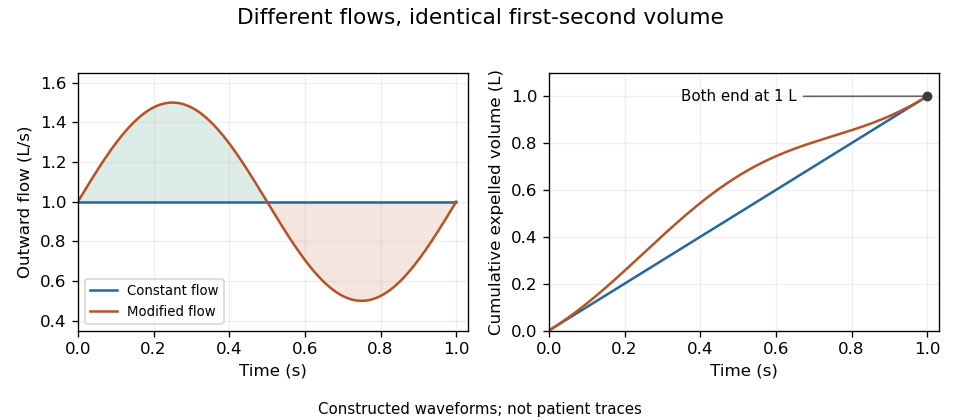
An original example preserves both FEV1 and FVC. Let a constant baseline flow continue for 4 s. Modify only the first second, with s, byand set afterward. The modified flow stays between 0.5 and 1.5 L/s during the first second. Its cumulative difference from the baseline isAt one second the difference returns to zero. Both traces therefore have FEV1 of 1 L, FVC of 4 L and FEV1 to FVC ratio of 0.25. Their peak expiratory flows differ: 1 versus 1.5 L/s. At half a second, the modified trace has expelled approximately 0.159 L more than the baseline, before the later flow difference cancels it.
These artificial waveforms isolate information loss; they are not physiological reference curves. A timed volume is not interchangeable with a peak value or an entire flow-volume history. The 2019 technical statement requires inspection of both volume-time and flow-volume displays because the displays expose different features of a maneuver.[ref]
Adding more timed integrals can constrain the waveform more strongly, but finitely many such summaries still leave many possible continuous histories unless a restrictive model is imposed. Report which waveform features were actually measured rather than inferring all of them from one scalar volume.
Grid fitting adjusts scaled glyph geometry relative to a target pixel grid before rasterization. TrueType font hinting can move outline points to preserve important strokes and alignment at small sizes. The result depends on the requested resolution and transformation.[ref]
TrueType Fundamentals by Microsoft. From Font File to Paper; instructions and grid-fitting distortions
A simple area-coverage antialiasing model shows the problem. A vertical stroke from horizontal coordinate 0.4 to 1.6 covers 60 percent of each of two neighboring pixel columns. An equal-width stroke from 3.9 to 5.1 covers 10 percent, 100 percent and 10 percent of three columns. Both geometries have width 1.2 pixels, yet their darkest columns differ. Snapping their boundaries to give each stroke one full column changes the outlines but gives consistent displayed stroke weights.
This is a tradeoff between geometric fidelity and small-size legibility, rather than a change to the stored Unicode text. Grid fitting operates on the geometry supplied to the rasterization step; glyph substitution and glyph positioning address the forms and layout that precede it.
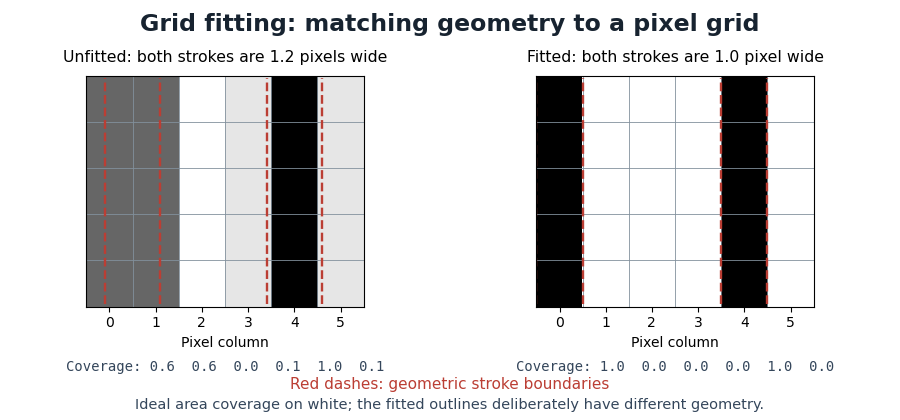
Pixel coverage before and after grid fitting
. Original ideal area-coverage antialiasing model of rectangular strokes, not measurements of a particular computer font. The unfitted strokes both have width 1.2 pixels, but their placements give different column coverage. The fitted strokes each occupy one full column; their changed geometry is explicit. Red dashed lines mark the geometric stroke boundaries. Details.The FSH beta subunit is the hormone-specific protein subunit of follicle-stimulating hormone. The active hormone is a heterodimer: its beta chain associates with an alpha chain shared with related glycoprotein hormones, including luteinizing hormone and thyroid-stimulating hormone. The isolated beta chain and the assembled protein complex are therefore different experimental objects.[ref]
Follicle stimulating hormone is required for ovarian follicle maturation but not male fertility by T. R. Kumar and others. Abstract, common alpha chain, specific beta chains and heterodimer-dependent activity
A 1997 gene knockout experiment removed production of the FSH beta subunit in mice, producing deficiency of follicle-stimulating hormone. Females could not complete normal ovarian follicle development and were infertile; males retained fertility despite reduced testis size. The contrast shows how disrupting one component can test a proposed requirement for the assembled signal.[ref]
Follicle stimulating hormone is required for ovarian follicle maturation but not male fertility by T. R. Kumar and others. Abstract, targeted beta-subunit deficiency and sex-dependent outcomes
This result concerns a particular genetic perturbation and measured outcomes in mice. It does not imply that every function of follicle-stimulating hormone is dispensable in males, nor that a shared alpha chain makes these hormones interchangeable.
Excitation-band selectivity in nail fluorescence corrections describes how well the detection system distinguishes transmitted illumination from light emitted by the nail plate. Selecting the illumination with a monochromator does not force every detected photon to remain in that spectral band: fluorescence can contribute at other wavelengths.
For an original linear detection model, write the transmitted and emitted spectral powers as and , where both spectral shapes integrate to one. If an optical filter has transmission and a detector has spectral responsivity , its current after subtraction of dark current isThe coefficients are spectrum-weighted responsivities, with units of amperes per watt. A selective filter can reduce while also reducing , so an uncorrected smaller current does not establish lower specimen transmittance.
For stipulated , , and , current is . Assigning all of it to transmitted illumination gives , a 1.67% relative overestimate. These chosen coefficients illustrate leakage; they are not measured filter characteristics for nails.
Emission-spectrum mismatch in nail fluorescence subtraction matters when the assumed differs from the specimen's emission. If analysis subtracts while the true coefficient is , thenAt the same powers and , using instead of 0.020 leaves a positive bias. A precisely known total emitted power would not eliminate this spectral mismatch.
The historical nail-transmission experiment explicitly corrected for fluorescence.[ref]
The transmission of optical radiation through human nails by S. G. Parker and B. L. Diffey. Abstract, fluorescence correction
The integral above is an explanatory extension, not a reconstruction of its unpublished correction coefficients. An experimental test would characterize detector/filter response and compare detection bands while keeping illumination and collection geometry in nail-transmission measurements fixed. Spectral rejection and angular collection constrain different parts of the measurement.Resonance fluorescence is light emitted by a quantum emitter driven near one of its resonant transitions. The scattered field can contain both an elastic component at the drive frequency and inelastic components arising from the driven atomic dynamics.
For a strongly driven two-level emitter, the inelastic spectrum develops the Mollow triplet, with sidebands related to the drive-induced splitting. Photon-counting correlations can also show photon antibunching, distinguishing the emission statistics from a classical coherent field. Spectrum and counting statistics probe different features of the same emitter.[ref]
A fluorescent microsphere is a small spherical particle containing or carrying fluorescent material. Excitation light produces a detectable emission signal, allowing the particle to serve as a tracer, positional marker or calibration object.
For imaging resolution measurements, the bead should be small relative to the instrument's point spread function; otherwise the recorded image includes the bead's finite size as well as the optical blur. In flow experiments, its motion tracks the fluid only when buoyancy, inertia and surface interactions do not materially bias the trajectory. The same bright signal can therefore support different measurements with different assumptions.
A receptacle is the end of the floral plant stem on which the parts of a flower are borne. It can be a small platform or an enlarged structure. Its position explains the distinction from an ovary: the receptacle supports the floral organs, while an ovary encloses ovules within a carpel.[ref]
The strawberry makes the distinction visible. Its enlarged fleshy receptacle carries many small achenes on the outside; each achene is a dry fruit containing a seed. Thus the red flesh and the individual seed-bearing fruits develop from different parts of the flower. In a rose, the small dry fruits instead lie inside the enlarged hypanthium of the rose hip.[ref]
For a simple dissection, follow a flower's stalk upward and identify where sepals, petals, stamens and carpels attach. Comparing this arrangement before and after fruit development helps trace a mature structure back to its origin. A receptacle can contribute to an accessory fruit, but it is not itself a synonym for every fleshy fruit.
3-Hydroxyflavone is the unsubstituted parent molecule of the flavonol class: flavone with a hydroxy group at position3. Its neutral molecular formula is . The position-3 hydroxyl lies next to the position-4 carbonyl group, allowing an internal hydrogen bond and providing a useful system for studying proton transfer after optical excitation.[ref]
Pradeep K. Sengupta and Michael Kasha investigated why its green fluorescence was far to the red of its first absorption band. Their 1979 paper compared absorption and emission in solution with emission from a rigid matrix at . The room-temperature green emission, near in their illustrated solvent, contrasted with violet emission from the normal form at low temperature. The apparatus included an absorption spectrophotometer and a fluorometer.[ref]
Excited state proton-transfer spectroscopy of 3-hydroxyflavone and quercetin by Pradeep K. Sengupta and Michael Kasha. Printed pp.382–383, Figures1–3 and captions
The interpretation involved an emitting tautomer produced by excited-state intramolecular proton transfer, rather than a change in elemental composition.An original branching model illustrates the difference between spectral intensity and molecular abundance. Let a normal excited state fluoresce at rate , decay without emission at rate , or transfer to a tautomeric excited state at rate . If each rate is constant, the transfer probability isand the normal-form fluorescence quantum yield is . If the transferred state emits with conditional probability , its photon yield isWith chosen rates in the ratio and , the normal and tautomer photon yields are 0.10 and 0.40. The ratio of emitted photon counts is therefore 4 under equally efficient detection, although the transfer probability is 0.80. These are illustrative rates, not fits to the historical data.
Different solvent interactions, competing decay and detector response can change an observed band ratio. Fluorescence spectroscopy therefore combines spectral positions, excitation conditions and timing or environmental comparisons when testing a molecular mechanism; one bright band is not an unqualified population measurement.
The classification of finite simple groups states that every finite simple group is isomorphic to a cyclic group of prime order, an alternating group with , a finite simple group of Lie type, or one of twenty-six sporadic simple groups. In the Lie-type families one takes the appropriate simple groups, respecting the exceptional small parameters and quotient constructions.[ref]
For example, is a simple abelian group, while is a simple nonabelian group of order sixty. The symmetric group is not simple: its subgroup is a proper nontrivial normal subgroup. The theorem lists the simple building blocks that occur as composition factors. It does not classify all finite groups: different group extensions can assemble the same factors into nonisomorphic groups.
Pinned article: Introduction to the OurBigBook Project
Welcome to the OurBigBook Project! Our goal is to create the perfect publishing platform for STEM subjects, and get university-level students to write the best free STEM tutorials ever.
Everyone is welcome to create an account and play with the site: ourbigbook.com/go/register. We belive that students themselves can write amazing tutorials, but teachers are welcome too. You can write about anything you want, it doesn't have to be STEM or even educational. Silly test content is very welcome and you won't be penalized in any way. Just keep it legal!
Intro to OurBigBook
. Source. We have two killer features:
- topics: topics group articles by different users with the same title, e.g. here is the topic for the "Fundamental Theorem of Calculus" ourbigbook.com/go/topic/fundamental-theorem-of-calculusArticles of different users are sorted by upvote within each article page. This feature is a bit like:
- a Wikipedia where each user can have their own version of each article
- a Q&A website like Stack Overflow, where multiple people can give their views on a given topic, and the best ones are sorted by upvote. Except you don't need to wait for someone to ask first, and any topic goes, no matter how narrow or broad
This feature makes it possible for readers to find better explanations of any topic created by other writers. And it allows writers to create an explanation in a place that readers might actually find it.
Figure 1. Screenshot of the "Derivative" topic page. View it live at: ourbigbook.com/go/topic/derivativeVideo 2. OurBigBook Web topics demo. Source. - local editing: you can store all your personal knowledge base content locally in a plaintext markup format that can be edited locally and published either:This way you can be sure that even if OurBigBook.com were to go down one day (which we have no plans to do as it is quite cheap to host!), your content will still be perfectly readable as a static site.
- to OurBigBook.com to get awesome multi-user features like topics and likes
- as HTML files to a static website, which you can host yourself for free on many external providers like GitHub Pages, and remain in full control

Figure 2. You can publish local OurBigBook lightweight markup files to either OurBigBook.com or as a static website.
Figure 3. Visual Studio Code extension installation.
Figure 5. . You can also edit articles on the Web editor without installing anything locally. Video 3. Edit locally and publish demo. Source. This shows editing OurBigBook Markup and publishing it using the Visual Studio Code extension. 
- Infinitely deep tables of contents:




All our software is open source and hosted at: github.com/ourbigbook/ourbigbook
Further documentation can be found at: docs.ourbigbook.com
Feel free to reach our to us for any help or suggestions: docs.ourbigbook.com/#contact