Topics (384k) Articles (398k) Users (410) Discussions (242) Comments (383) Files (13k) New article

The wind correction angle is the difference between the aircraft heading and the desired ground track needed to compensate for a crosswind. A heading points the vehicle; a track describes horizontal travel over the ground. In the horizontal model here, the air-relative velocity is aligned with the heading. Wind-direction statements below specify where the air moves, not the meteorological direction it comes from.[ref]
Relative Velocity by NASA Glenn Research Center. Ground Reference and Wind Speed, reference-frame relation
Let be true airspeed, let be wind along the desired track, and let be wind to its right. Define a positive correction as heading right of the track. Cancelling cross-track velocity and projecting along the track givesFor the branch with a nonnegative along-track air-relative component,The condition permits crosswind cancellation, but forward progress also requires .
In an original example, take , wind rightward and opposite the intended track. Then and . A constant-condition ground leg takes about . With the same headwind, a rightward component of can still be cancelled, but : the resulting track-line motion is backward.
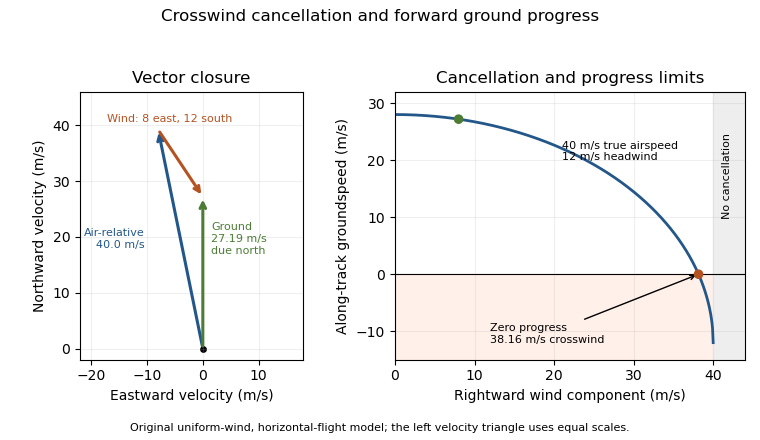
An original wind triangle and forward-progress limit at fixed true airspeed. Cancelling crosswind alone does not guarantee progress against a headwind.
Details. The calculation assumes a uniform horizontal wind and a steady true airspeed. Ground-position measurements can test the resulting groundspeed; they cannot determine the correction from air-relative speed alone without wind information. Wind variation and a difference between heading and air-relative velocity require a fuller vector model.
A clinostat rotates a biological specimen so that the direction of gravity changes continuously relative to it. A horizontal rotation axis is commonly used in experiments on plant gravitropism. Rotation changes the history of directional stimulation; it does not switch off the gravitational field.
For an ideal specimen rotating at angular speed , a body-fixed representation can be . Its average over a full turn is zero, but throughout. A sufficiently slow biological response might integrate the changing directions, while a faster response can distinguish them. A vertical-axis control does not produce the same change in gravity direction relative to the specimen.
Rotation also introduces an acceleration scale at distance from the axis. At , one revolution per minute gives approximately , while sixty revolutions per minute gives about . These are illustrative kinematic calculations, not recommended operating speeds. Moving a specimen farther from the axis also changes this acceleration.
A 1976 experiment combined clinostat rotation with centrifugation. Several developmental outcomes still depended on the applied acceleration, demonstrating incomplete gravity compensation.[ref]
Limitation on the Use of the Horizontal Clinostat as a Gravity Compensator by Allan H. Brown and others. Abstract; centrifuged clinostat-grown plants and morphological endpoints
This motivates comparing orientation history, rotation effects and genuine reduced-gravity conditions rather than labelling every rotating preparation weightless.Gravitational memory is a persistent change in the relative configuration of freely falling bodies after a gravitational-wave burst has passed. In the weak-field transverse-traceless description, an initially separated pair obeys . A nonzero net strain change leaves a displacement rather than only a temporary oscillation.
Memory can arise from changes in the motion of material sources and from the energy carried away by radiation itself. The latter contribution reflects the nonlinear gravitational role of wave energy. Distinguishing this slow or step-like response from detector drift requires more than identifying an oscillatory waveform.[ref]
Gravitational Memory, BMS Supertranslations and Soft Theorems by Andrew Strominger and Alexander Zhiboedov. Introduction and Section 4.2, inertial detector displacement memory
The gravimetric dilution factor is the ratio of final mixture mass to the stock mass used in a gravimetric dilution:Here is added diluent mass and is the retained stock mass fraction. For a diluent containing none of the component being measured, mass conservation gives final component mass fraction . This mass-based relation avoids assuming that liquid volumes are additive. Its uncertainty follows from the same input masses and their covariance as the uncertainty of a gravimetric dilution.[ref]
For an original two-step example, combine of stock with of diluent, giving . After complete mixing, transfer of that mixture and add of diluent, giving . The combined gravimetric dilution factor isIf the original stock has component mass fraction , the first mixture has and the final mixture . The transferred gram contains of the component; dividing by the final checks the result. This calculation requires a representative, homogeneous transferred portion and no component loss.
The uncertainty of a gravimetric dilution describes how uncertain mass measurements propagate into the retained stock fraction . Write , where is stock mass and is added diluent mass. The first-order propagation of uncertainty isThe negative covariance coefficient follows from the opposite signs of and . This is the covariance form of the uncertainty law applied to this specific measurement model.[ref]
For an original sequential-weighing example, let the empty vessel reading be , the reading after adding stock , and the final reading . Then , and . Suppose the three readings have independent standard uncertainties of , with other effects neglected. Both net masses have variance , butThus , a relative standard uncertainty of about . Omitting this shared-reading covariance would give and underestimate the uncertainty. Equivalently, propagate the three independent readings directly through .
A common multiplicative balance scale error instead cancels exactly from , since multiplying both masses by the same positive number leaves their ratio unchanged. Identify which errors are shared before assigning independent terms. If the desired result is final mass fraction , the stock mass fraction and its measurement uncertainty also belong in the measurement model.
Network science studies systems represented by graphs, combining structural measurements, data analysis and models of network formation or dynamics. Vertices represent entities and edges represent a specified relation; directed graphs, weighted graphs and temporal data encode different kinds of interaction.
A transportation network might assign stations to vertices and direct services to edges. Vertex degree counts immediate connections, while shortest-path graph distances measure routes through several stations. These answer different questions: a high-degree station need not minimize all journey times, especially when edge weights represent duration.
Useful models must connect the graph definition to the measured system. A biological network built from physical binding experiments differs from one built from statistical correlation. Comparing an observed statistic with a suitable random graph model helps distinguish a structural pattern from what the vertex and edge counts already imply.
A perfect graph is a finite simple graph for which every induced subgraph satisfieswhere is the chromatic number and is the clique number. A clique always needs distinct colors, so perfection says this lower bound is attained throughout the induced-subgraph family. Equality for alone is not enough.
Every bipartite graph is perfect: any induced subgraph with an edge has clique number and chromatic number two, while a nonempty edgeless induced subgraph has both equal to one. The empty graph uses zero for both. A five-cycle is not perfect, because it needs three colors but has no clique larger than an edge.
The hereditary condition makes perfection useful in coloring and combinatorial optimization: deleting vertices preserves it automatically. It does not say that an arbitrary greedy vertex order will find an optimal coloring.
For a vertex of a finite connected graph , its graph eccentricity is the greatest graph distance to any other vertex:The graph radius is the minimum eccentricity and the graph diameter is the maximum. Eccentricity therefore measures the worst travel distance from a chosen starting point, rather than its average travel distance.
In the four-vertex path graph , the eccentricities are . The two middle vertices are best in this worst-case sense; the radius is two and the diameter three. In a star graph with at least two leaves, the central vertex has eccentricity one and every leaf has eccentricity two. For a disconnected graph, distances across components are usually infinite, so a finite-valued eccentricity requires restricting to a component or stating another convention.
Active voice is the grammatical voice of constructions such as
The technician opened the valve, where the actor is expressed as subject. It contrasts with a corresponding passive voice construction, The valve was opened by the technician, in which that participant is expressed differently.[ref]The contrast holds the described event fixed while changing grammatical organization. In the first example,
the valve is the object; in the second, it occupies the subject position. The actor's presence in a by-phrase does not make that phrase the subject.Separating voice from other features avoids a common classification error.
The technician did not open the valve remains active even though it denies that an opening occurred. Likewise, changing opened to opens can change grammatical tense without changing grammatical voice. A grammatical analysis should identify the construction and its participant relationships, rather than infer voice from whether the sentence sounds energetic or describes a completed action.Follicle-stimulating hormone is a glycoprotein gonadotropin released by gonadotrophs in the anterior pituitary. It supports ovarian follicle growth and acts on granulosa cells in the ovary and Sertoli cells in the testis. Its effects depend on target-cell receptors, not solely on the amount of circulating hormone.[ref]
Anatomy and Physiology 2e by J. Gordon Betts and others. §17.3, pituitary hormone summary and follicular growth
[ref]A 1997 experiment disrupted the gene encoding the hormone's FSH beta subunit, producing mice deficient in follicle-stimulating hormone. Female mice were infertile, with follicle development blocked before antral follicle formation. Males remained fertile despite smaller testes.[ref]
Follicle stimulating hormone is required for ovarian follicle maturation but not male fertility by T. R. Kumar and others. Abstract, targeted deficiency and contrasting reproductive outcomes
The contrast separates several outcomes that a single word like “fertility” can obscure. It demonstrates that loss of the same hormonal signal can affect ovarian development, testicular size and successful reproduction differently in this mouse model. Those endpoints must be measured separately rather than inferred from one another.
Luteinizing hormone (LH) is a glycoprotein gonadotropin released by gonadotrophs in the anterior pituitary under control of gonadotropin-releasing hormone. It participates in ovulation and formation of the corpus luteum, and promotes testosterone production in the testis. The hormone's output is regulated within interacting pituitary and gonadal feedback pathways.[ref]
Anatomy and Physiology 2e by J. Gordon Betts and others. Section 17.3: Luteinizing Hormone and the pituitary hormone summary
The shape of a LH surge can be investigated by measuring several signals through time. In 1983, J. D. Hoff and colleagues studied five women with hormone measurements every two hours for five consecutive days around midcycle. They compared estradiol, progesterone and gonadotropin trajectories, finding an abrupt onset of the LH and follicle-stimulating hormone surges in temporal association with the estradiol peak.[ref]
Hormonal dynamics at midcycle: a reevaluation by J. D. Hoff and others. Abstract: sampling schedule, surge onset and the associated ovarian hormone changes
The report included a doubling of LH within a two-hour interval at surge onset. Such a change illustrates why sampling frequency matters: coarse measurements can blur an abrupt transition or shift the apparent ordering of events. The study describes a measured cohort pattern; it does not turn one isolated hormone measurement into a complete account of the cycle.
The relation to GnRH can also be probed by paired portal and peripheral blood plasma measurements. The hypophyseal portal system makes those two locations physiologically different: one carries the hypothalamic input, while the other records the pituitary's released output.
An ovary is a female gonad supporting oocyte development and reproductive hormone production. In mammalian anatomy, an ovarian follicle combines the developing germ cell with supporting somatic cells; ovulation releases the oocyte from this structure. The animal organ is distinct from an ovary in a flower.
Golgi maturation is a change in the molecular identity of a Golgi cisterna as it progresses from an early to a later functional state. In the cisternal maturation model, cargo can remain within a cisterna while resident processing enzymes are redistributed, including by backward transport. A cisterna's identity is therefore not a permanent label attached to one stationary processing room. Other carriers can still contribute to transport; the model does not require every cargo to follow exactly the same route. [ref]
Molecular Biology of the Cell, 4th edition by Bruce Alberts and others. Chapter 13, Transport from the ER Through the Golgi Apparatus
Live imaging supplied a direct test. In budding yeast, individual Golgi cisternae lost an early fluorescent resident marker and acquired a later one. Following the same object through time distinguishes maturation from simply finding early and late markers in different objects in a fixed image. [ref]
Golgi maturation visualized in living yeast by Eugene Losev and others. 2006, abstract and live-cell imaging of early-to-late marker conversion
In a nucleoside or nucleotide, the glycosidic torsion angle describes rotation of the nucleobase relative to the sugar about their N-glycosidic bond. It is a signed dihedral angle defined by four ordered atoms:The middle two atoms specify the glycosidic bond; the outer atoms define the two reference planes. Thus the atom sequence, not the symbol alone, fixes the angle convention.[ref]
The recommended broad regions are syn glycosidic conformation, centered at with a90degree range on either side, and anti glycosidic conformation, centered at with the corresponding range. For example, lies in the syn region and in the anti region. These describe base–sugar orientation; they do not by themselves specify sugar-ring shape or the complete RNA conformation.[ref]
Abbreviations and Symbols for the Description of Conformations of Polynucleotide Chains. Section2.3, notes(a)–(c), syn and anti conventions
An original angular comparison illustrates periodicity. Measurements of and differ by only2degrees around the circle, not358degrees. A signed shortest difference can be calculated asusing radians inside the trigonometric functions. Interpreting the two near-boundary values as distant conformations would be an artifact of the angle's reporting interval.
The convention is important when comparing structural models or older literature. Alternative choices using C8 for a purine or C6 for a pyrimidine can shift the numerical angle by approximately180degrees. Numerical torsions should therefore be compared only after checking their defining atoms.[ref]
Abbreviations and Symbols for the Description of Conformations of Polynucleotide Chains. Section2.3, note(b), old and new chi definitions
An aglycone is the nonsugar partner recovered when the carbohydrate residue of a glycoside is removed. For the classical oxygen-linked description, IUPAC identifies that partner as the compound . The sugar-derived residue is sometimes called the glycone.[ref]
Nomenclature of Carbohydrates (Recommendations 1996) by Alan D. McNaught. Section2-Carb-33.1, paragraph defining aglycone and glycone
Methyl α-D-glucopyranoside supplies a concrete example. Its glycosidic attachment contains , so is a methyl group, . The corresponding aglycone is methanol, . The fragment and the compound are different chemical objects; a label on a structural drawing should not silently replace the recovered partner molecule.
As original formula bookkeeping, combining free glucose with methanol and subtracting water gives the molecular formula of the methyl glycoside. Reversing that balance accounts for the two partners of formal hydrolysis. It says nothing about reaction speed or the conditions needed for cleavage.
Calling a compound an aglycone describes its relationship to a particular glycoside; it does not by itself identify a biological activity. Oxygen-, nitrogen-, sulfur- and carbon-linked sugar derivatives require their corresponding attachment descriptions, so the example should not be applied indiscriminately to every sugar-containing compound.[ref]
Nomenclature of Carbohydrates (Recommendations 1996) by Alan D. McNaught. Sections2-Carb-33.1 and33.3–33.7: definitions and attachment-specific nomenclature
Pinned article: Introduction to the OurBigBook Project
Welcome to the OurBigBook Project! Our goal is to create the perfect publishing platform for STEM subjects, and get university-level students to write the best free STEM tutorials ever.
Everyone is welcome to create an account and play with the site: ourbigbook.com/go/register. We belive that students themselves can write amazing tutorials, but teachers are welcome too. You can write about anything you want, it doesn't have to be STEM or even educational. Silly test content is very welcome and you won't be penalized in any way. Just keep it legal!
Intro to OurBigBook
. Source. We have two killer features:
- topics: topics group articles by different users with the same title, e.g. here is the topic for the "Fundamental Theorem of Calculus" ourbigbook.com/go/topic/fundamental-theorem-of-calculusArticles of different users are sorted by upvote within each article page. This feature is a bit like:
- a Wikipedia where each user can have their own version of each article
- a Q&A website like Stack Overflow, where multiple people can give their views on a given topic, and the best ones are sorted by upvote. Except you don't need to wait for someone to ask first, and any topic goes, no matter how narrow or broad
This feature makes it possible for readers to find better explanations of any topic created by other writers. And it allows writers to create an explanation in a place that readers might actually find it.
Figure 1. Screenshot of the "Derivative" topic page. View it live at: ourbigbook.com/go/topic/derivativeVideo 2. OurBigBook Web topics demo. Source. - local editing: you can store all your personal knowledge base content locally in a plaintext markup format that can be edited locally and published either:This way you can be sure that even if OurBigBook.com were to go down one day (which we have no plans to do as it is quite cheap to host!), your content will still be perfectly readable as a static site.
- to OurBigBook.com to get awesome multi-user features like topics and likes
- as HTML files to a static website, which you can host yourself for free on many external providers like GitHub Pages, and remain in full control

Figure 2. You can publish local OurBigBook lightweight markup files to either OurBigBook.com or as a static website.
Figure 3. Visual Studio Code extension installation.
Figure 5. . You can also edit articles on the Web editor without installing anything locally. Video 3. Edit locally and publish demo. Source. This shows editing OurBigBook Markup and publishing it using the Visual Studio Code extension. 
- Infinitely deep tables of contents:



All our software is open source and hosted at: github.com/ourbigbook/ourbigbook
Further documentation can be found at: docs.ourbigbook.com
Feel free to reach our to us for any help or suggestions: docs.ourbigbook.com/#contact