Topics (384k) Articles (398k) Users (410) Discussions (242) Comments (383) Files (13k) New article

Gauge block wringing joins suitably finished measuring faces by bringing them into intimate contact with a controlled sliding or twisting motion. The resulting adhesion lets gauge blocks form a composite length standard or contact an auxiliary plane for interferometry. The contact layer is part of the length convention: a calibrated block length includes one wringing-layer contribution.[ref]
The Gauge Block Handbook by Ted Doiron and John S. Beers. §2.2.2, Nomenclature and Definitions; Appendix B, Gauge Block Wringing
Adhesion is not explained adequately by saying that air was removed and atmospheric pressure alone holds the blocks together. NIST's handbook describes multiple surface- and fluid-dependent contributions, including surface tension, and warns that film thickness varies with surface condition and time. It does not supply a universal predictive film model.[ref]
The Gauge Block Handbook by Ted Doiron and John S. Beers. Appendix B, Physics of Wringing Films, printed pp. 138–139
An original bookkeeping model explains the length convention. Let be a block's geometric face separation and let be the effective layer contribution in its calibration, so its defined length is . If a stack of blocks is wrung to an auxiliary plane, it has internal contacts and one base contact. Its top height can be writtenThus compatible contacts can make defined lengths additive without treating every interface as an additional correction beyond the certificates. Differences between calibration and use remain a wringing-film uncertainty.
For three stipulated blocks each carrying an effective calibration contribution, three equivalent contacts contribute the same already counted in their defined lengths. If one actual contact contributes instead, the height in this simplified model differs by . These chosen values illustrate the convention; they are not a measured stack or a universal film specification.
Experimentally, NIST describes viewing a block wrung to a transparent optical flat: a uniform contact appearance supports a satisfactory wring, while coloured or bright regions indicate poor contact. Rewringing and checking the optical result tests an interface contribution that merely adding nominal lengths would miss.[ref] Cleanliness, surface damage and thermal expansion during handling still affect the comparison. A visibly adhering stack is not, by itself, proof of the required dimensional accuracy.
A gauge-block reference uncertainty floor is the component of a comparison's uncertainty that remains when repeated observations still rely on the same uncertain reference value. It is conditional on the stated reference and measurement model, rather than a universal lower bound on every method of measuring the block.
For a corrected comparison, write the unknown reference-temperature length as , where is the assigned reference length and the mean of comparison differences. Suppose the reference has standard uncertainty , the differences have independent repeatability scatter , and these contributions are independent. ThenOnly the repeated-comparison term decreases with . The reference-value contribution is shared by all those observations; it is not newly sampled every time. NIST's comparison uncertainty combines information from the interferometric master history with comparison-process variability.[ref]
For an original example, take and . Four comparisons give . One hundred give about , and the limit in this model is 20 nm. Dividing the entire combined uncertainty by would wrongly treat the reference assignment as independent repeatability noise.
The same shared reference can cancel from another measurand. If and use the same additive reference contribution, thenShared gauge-block reference covariance is what makes that cancellation consistent in uncertainty propagation. An absolute length and a length difference have different uncertainty budgets. Other shared terms, including temperature and comparator corrections, must be modeled on their own merits.[ref]
An independently improved reference assignment or additional independent calibration information can lower the floor; more repetitions with the unchanged reference cannot. State whether a certificate quotes standard or expanded uncertainty before combining values. Improved repeatability is useful, but does not establish improved absolute accuracy by itself.
Gauge-block thermal mismatch is the unequal change in length of a reference and an unknown gauge block caused by different temperatures or thermal expansion coefficients. Bringing both blocks to the same temperature does not cancel the effect when their expansion coefficients differ and that common temperature differs from the reference temperature.
Let the lengths at be and , and let their linear expansion coefficients be . To first order,Thus subtract the final two terms from the observed difference to estimate the difference at . NIST's handbook explicitly treats both temperature and coefficient differences in gauge-block comparisons.[ref]
The Gauge Block Handbook by Ted Doiron and John S. Beers. §5.4.3.1, Temperature Effects, Eq. 5.8 and following comparison discussion
For approximately equal nominal length at common temperature , the differential thermal contribution becomesIn an original example with , , and , the contribution is . Identical temperatures have not made the comparator reading a reference-temperature difference. These are stipulated material coefficients, not certificates for particular blocks.
Even equal coefficients leave an effect if the temperatures differ: at and 100 mm, a temperature difference 0.2 K contributes . Handling and incomplete equilibration can therefore matter before the readout is considered.
Differential thermal-expansion uncertainty must include the temperature measurement, the coefficients and their dependence. A common uncertain temperature is one shared input, not two unrelated thermometer errors. In the common-temperature model its sensitivity is ; if the coefficients agree, that particular common-temperature term cancels. Independent block-temperature differences need separate terms. General propagation retains the appropriate covariance.[ref]
Guide to the expression of uncertainty in measurement by JCGM. §§5.1–5.2, sensitivity coefficients and correlated inputs
A controlled comparison measures or bounds block temperatures, allows equilibration, and records the coefficient assumptions. Comparing unlike materials without that information can turn a thermal contribution into an apparent calibration error.
A-gamma globin is the human HBG1 gene product, a form of gamma-globin with alanine at residue 136. Its name contrasts with G-gamma globin, whose corresponding residue is glycine. Both belong to the gamma-chain class used in fetal hemoglobin.[ref]
Human globin gene records in NCBI Gene. HBG1, Gene 3047, RefSeq Summary, alanine/glycine distinction at residue 136
A-gamma is not hemoglobin A: the latter is the adult assembly containing beta-globin.A single changed amino acid residue can supply a useful analytical signature without changing which general globin class is being measured. Replacing glycine with alanine adds the elemental composition , since their side chains are hydrogen and methyl. In a deliberately nominal-mass calculation this adds about 14 unified atomic mass units. If an otherwise identical diagnostic peptide produces ions with charge number , the expected separation in mass-to-charge ratio is approximatelyFor , that is about seven mass-to-charge units. This is a proposed analytical discrimination, not the experimental method used in the historical paper. Actual mass spectrometry must use the appropriate exact masses and account for other sequence changes, isotope peaks and modifications.
A sequence-selective amount measurement also requires a response model. In an original two-channel example, suppose one pmol of each form produces detector responses and in arbitrary signal units. Signals and correspond to amounts 20 and 60 pmol, giving an A-gamma fractionUsing the raw signal fraction would instead give 0.40. A distinct molecular signature identifies a channel; it does not guarantee equal analytical response between channels.
The 1968 primary study reported the additional alanine-containing form at position 136 in human fetal hemoglobin components.[ref]
Evidence for multiple structural genes for the gamma chain of human fetal hemoglobin by W. A. Schroeder and others. p.537, opening paragraph
That observation motivates distinguishing sequence forms experimentally, while HBG1 supplies their present gene-level identification. Neither an A-gamma amount nor its ratio to G-gamma alone establishes the oxygen-binding properties of every assembled tetramer.G-gamma globin is the human HBG2 gene product, a form of gamma-globin distinguished by glycine at residue 136. The corresponding A-gamma globin, encoded by HBG1, has alanine there. The letter G identifies that amino acid residue; it does not indicate a different oxygenation state or a gamma ray.[ref]
Two gamma chains and two alpha-globin chains form the standard fetal hemoglobin assembly, . Identifying a G-gamma chain is a sequence-level result. It does not by itself determine the identity of the other gamma chain in the same protein complex.
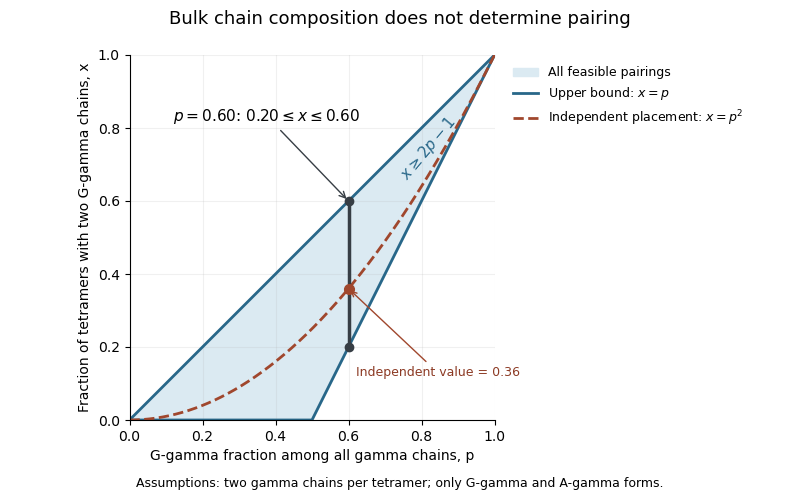
An original accounting example makes this distinction precise. Suppose 100 hypothetical fetal hemoglobin tetramers contain 120 G-gamma and 80 A-gamma chains. Let count tetramers with two G-gamma chains, one of each, and two A-gamma chains, respectively. ThenNonnegative counts imply , with and . Thus a G-gamma chain fraction of 0.60 is compatible with 20% to 60% of tetramers containing two G-gamma chains. Assuming independent placement would select , but independence is additional information, not a consequence of the chain counts.
Gamma-chain pairing bounds from bulk composition therefore matter whenever an assay breaks an assembly into its constituent chains before counting them. Sequence abundance, assembly composition and oxygen-binding behavior answer different questions.
The historical distinction emerged from direct chemical examination of fetal hemoglobin components. The 1968 primary report described glycine and alanine at position 136 in material from 17 additional infants, supporting gamma-chain heterogeneity.[ref]
Evidence for multiple structural genes for the gamma chain of human fetal hemoglobin by W. A. Schroeder and others. p.537, opening paragraph
Modern gene annotations associate the G-gamma form with HBG2; the earlier observation was a protein-sequence result rather than direct sequencing of that locus.Gamma-chain pairing bounds from bulk composition describe what a measured G-gamma globin/A-gamma globin chain ratio can establish about the assemblies containing those chains. Assume every measured gamma chain belongs to a standard fetal hemoglobin tetramer containing exactly two gamma chains. A bulk chain fraction then constrains, but generally does not determine, how the two forms are paired. The molecular distinction between the forms is experimentally established by glycine versus alanine at residue 136.[ref]
Evidence for multiple structural genes for the gamma chain of human fetal hemoglobin by W. A. Schroeder and others. Page 537, opening paragraph
Let be the fraction of gamma chains that are G-gamma, and let be the fractions of tetramers containing respectively two G-gamma chains, one of each form, and two A-gamma chains. Counting assemblies and chains givesHence and . Requiring all three fractions to be nonnegative gives the sharp boundsEvery value in this interval yields nonnegative with the required bulk composition; a finite population additionally requires integral assembly counts.
For an original example, 100 tetramers containing 120 G-gamma and 80 A-gamma chains have . The endpoint compositions and give the same chain counts. Thus the fraction of two-G-gamma tetramers can range from to despite an exactly known bulk composition.
Independent random placement is an additional model. It selects the binomial distribution valuesAt , these are , one feasible point rather than a consequence of the measured chain ratio. The inequalities and show why the random-pairing value always lies within the bounds.
The argument does not infer actual biological pairing preferences. It identifies the information lost when an assay pools chains from many protein complexes. Free chains, other assemblies or unequal analytical responses would require a different input model. A change in bulk sequence proportions is therefore not automatically a measured change in every tetramer's composition or oxygen binding.
A routing game models users choosing paths through a flow network, where each user's travel time depends on the traffic using the selected edges. A nonatomic model treats each user as infinitesimal; at equilibrium, every used path has minimum latency among the available paths. An atomic model instead lets individual players move a nonzero amount of traffic.
Consider one unit of nonatomic demand and two parallel edges with latencies and . Sending all flow on the first edge is an equilibrium: its latency is one, and an infinitesimal user cannot obtain less on the second. If a planner sends fraction on the first edge, total travel cost isThis is minimized at , with cost , below the equilibrium cost one. The example exhibits a price of anarchy of and separates individual latency minimization from minimum total cost.
A search game models a strategic interaction between a searcher and an opponent choosing what is hidden, where it is hidden, or how it moves. The searcher chooses a search policy; the payoff may be detection probability, discovery time or search cost. The information and allowed motion must be stated before solving the game.
For a simple zero-sum game, an object is hidden at one of two locations. Checking either location costs one time unit and always detects the object if present. Searching location one first with probability gives expected discovery times when the object is there and when it is at location two. Minimizing the worst case sets , with value .
The Abel-Ruffini theorem states that there is no formula using finitely many field operations and extraction of radicals that solves the general quintic equation. The same impossibility holds for the general polynomial equation of any degree of a polynomial at least five. It does not say that every individual quintic equation is insoluble by radicals.
In Galois theory, a characteristic-zero polynomial is solvable by radicals exactly when its Galois group is a solvable group. The general degree- polynomial has symmetric group , which is not solvable for . In contrast, has roots , so it is solvable by radicals. Niels Henrik Abel's 1824 memoir established the general quintic impossibility; its title states precisely that goal.[ref]
Mémoire sur les équations algébriques by Niels Henrik Abel. 1824 pamphlet, title and principal impossibility statement
Galaxy formation is the assembly of the matter and stellar populations that make a galaxy. In a standard dark matter framework, dark matter halos provide gravitational potential wells in which gas can collect. Radiative cooling lets gas lose thermal support and contract, while star formation converts some dense gas into stars.
The process is regulated rather than a one-way collapse. Stellar explosions, radiation and accreting central black holes return energy and momentum to the gas; galactic winds can remove some of it. Mergers and angular momentum transport change the geometry. A formation model must therefore explain both how material assembles and why only part of the available gas becomes a long-lived stellar population.
Messier 82, also called M82, is a nearby starburst galaxy used to study how intense star formation drives a large galactic outflow. Its bright stellar disk, obscuring interstellar dust and extended gas emission trace different components; a bright feature in one wavelength band need not represent most of the outflow's mass or energy.
A concrete measurement is to compare diffuse X-ray emission above the disk with compact sources inside it. ROSAT imaging and spectroscopy detected the wind's X-rays to roughly six kiloparsecs from the plane. The observations separated point sources from diffuse emission and found that the latter was not well described as a freely expanding wind: shocked material interacting with the flow could instead account for the emission.[ref]
ROSAT Observations of the Galactic Wind in M82 by Dave Strickland and others. Abstract, spatial/spectral separation and comparison of wind models
This makes M82 an illuminating stellar feedback laboratory. The inference runs from spatially resolved spectra to gas conditions and then to a physical outflow model; a photograph of gas extending away from the disk does not by itself determine its temperature, energy source or escape rate.
Range-overlap calibration establishes or checks the relationship between instrument settings using inputs that both can measure validly. In gain ranging, it tests whether changing sensitivity preserves the inferred measurand. It can determine relative scale and offset between ranges, but agreement between ranges alone does not establish their absolute accuracy or independent metrological traceability.
For an original two-range measurement model, let the same stable electric current produceEliminating givesAn overlap experiment therefore needs enough distinct, stable input levels to distinguish relative gain from offset. One common input gives one equation for and and cannot identify both without additional information.
For example, suppose , , and . Currents of , and give output pairs , and . They satisfy . Dividing raw outputs by their nominal gains without removing the offsets would not give consistent current estimates.
A practical test can drive a switchable transimpedance amplifier from a stable current source, record multiple overlap levels, and alternate the setting order to reveal instrumental drift. Avoid amplifier clipping, allow settling time, and retain the bandwidth and temperature conditions. The manufacturer tables show why range-dependent noise and gain drift must be included rather than assumed equal.[ref]
Datasheet DLPCA-200 by FEMTO. p. 2, gain accuracy, gain drift, input limits and gain-dependent performance
At each level, compare corrected estimates and through their difference . The measurement uncertainty of that difference depends on covariance:A common reference can move both estimates together and disappear from this difference. Thus good overlap agreement checks a relative relationship; it cannot by itself exclude a shared calibration error. The general uncertainty-combination law explicitly retains correlated contributions.[ref]
Range-switching hysteresis uses different thresholds for changing from a more sensitive instrument range to a less sensitive one and for changing back. Within the intervening interval, the current range is retained. The selected range therefore depends on the previous state as well as the present measurement indication. This prevents small fluctuations near a single boundary from repeatedly triggering gain ranging.
A concrete electronic analogue is an electronic comparator with two switching thresholds. The primary circuit example specifies upper and lower thresholds of and and explains why one threshold can produce unwanted transitions with a noisy or slowly changing input. Those are comparator circuit values, not specifications for an autoranging measurement instrument.[ref]
Inverting Comparator With Hysteresis Circuit by Texas Instruments. Design Goals and Design Description, p. 1; switching-threshold analysis, pp. 2–3
For an original two-range current measurement, let denote high sensitivity and low sensitivity. Use an input-current estimate , expressed on the same calibrated scale in either range. Switch when , switch when , and otherwise keep the previous state. The hysteresis interval has width .
Starting in , the indication sequence selects . A single threshold at would instead select and switch at every step after the first. At a steady underlying with bounded readout fluctuations of , neither boundary is crossed; either previous range remains selected.
The thresholds should lie within the usable overlap established by range-overlap calibration. If the two ranges give inconsistent current estimates, a switch can itself move the indication across the opposite threshold and create a cycle. The comparison must therefore use the corrected measurand estimate, not identical raw output voltages from different gains.
Hysteresis is not temporal averaging and does not ensure that the new reading has settled. Reserve headroom for a rapidly rising input, reject readings during the required settling time, and verify that the less sensitive range still meets its noise-limited detection threshold. An input that jumps beyond the current range can cause amplifier clipping before the controller reacts, even when its two-threshold rule is correct.
Pinned article: Introduction to the OurBigBook Project
Welcome to the OurBigBook Project! Our goal is to create the perfect publishing platform for STEM subjects, and get university-level students to write the best free STEM tutorials ever.
Everyone is welcome to create an account and play with the site: ourbigbook.com/go/register. We belive that students themselves can write amazing tutorials, but teachers are welcome too. You can write about anything you want, it doesn't have to be STEM or even educational. Silly test content is very welcome and you won't be penalized in any way. Just keep it legal!
Intro to OurBigBook
. Source. We have two killer features:
- topics: topics group articles by different users with the same title, e.g. here is the topic for the "Fundamental Theorem of Calculus" ourbigbook.com/go/topic/fundamental-theorem-of-calculusArticles of different users are sorted by upvote within each article page. This feature is a bit like:
- a Wikipedia where each user can have their own version of each article
- a Q&A website like Stack Overflow, where multiple people can give their views on a given topic, and the best ones are sorted by upvote. Except you don't need to wait for someone to ask first, and any topic goes, no matter how narrow or broad
This feature makes it possible for readers to find better explanations of any topic created by other writers. And it allows writers to create an explanation in a place that readers might actually find it.
Figure 1. Screenshot of the "Derivative" topic page. View it live at: ourbigbook.com/go/topic/derivativeVideo 2. OurBigBook Web topics demo. Source. - local editing: you can store all your personal knowledge base content locally in a plaintext markup format that can be edited locally and published either:This way you can be sure that even if OurBigBook.com were to go down one day (which we have no plans to do as it is quite cheap to host!), your content will still be perfectly readable as a static site.
- to OurBigBook.com to get awesome multi-user features like topics and likes
- as HTML files to a static website, which you can host yourself for free on many external providers like GitHub Pages, and remain in full control

Figure 2. You can publish local OurBigBook lightweight markup files to either OurBigBook.com or as a static website.
Figure 3. Visual Studio Code extension installation.
Figure 5. . You can also edit articles on the Web editor without installing anything locally. Video 3. Edit locally and publish demo. Source. This shows editing OurBigBook Markup and publishing it using the Visual Studio Code extension. 
- Infinitely deep tables of contents:



All our software is open source and hosted at: github.com/ourbigbook/ourbigbook
Further documentation can be found at: docs.ourbigbook.com
Feel free to reach our to us for any help or suggestions: docs.ourbigbook.com/#contact