Topics (384k) Articles (398k) Users (410) Discussions (242) Comments (383) Files (13k) New article

A repeatability floor from surface-area model discrepancy is the remaining uncertainty when repeated measurements reduce input noise but reuse the same imperfect anatomical predictor. Repeating height and mass measurements does not independently redraw the relationship between those quantities and one person's actual body surface area.
An original local model writes prediction , where is the true area, a shared model discrepancy and independent repeat noise. Represent uncertainty about by variance and repeat noise by variance , assuming independence between them. For the mean of repeats,The correlation is a consequence of reusing the same discrepancy. The GUM requires significant common-input correlations to be included and permits additional model quantities for incomplete knowledge.[ref]
For stipulated and , the mean's standard uncertainty is about after one reading, after four and after one hundred. The lower limit is in this model, not zero. These values illustrate the distinction rather than report a measured error distribution for the Mosteller formula.
Repeat-count targets under shared model error make a useful planning calculation. Requiring the repeat-noise variance to be at most a fraction of the shared variance gives . With the chosen values and , 25 repeats suffice; further repetition changes the total uncertainty little while leaving the dominant model term intact.
The shared term need not fluctuate between actual readings. For a fixed person, an unknown prediction bias can remain fixed while repeatability looks excellent. Its distribution represents uncertainty or variation across the validation population, not a physical mechanism that changes body shape on each measurement.
A useful validation therefore combines repeat measurements with independent reference-area evidence across an appropriate range of individuals. Distinguish within-person repeatability, shared calibration effects and model residuals. If a systematic bias is established, correcting it is a separate step from describing residual uncertainty.
Microplate fill-height optical cancellation is the cancellation between dilution and increasing light-path length when a fixed dissolved amount is measured vertically through an ideal parallel-sided microplate well. It is a geometric limit of the Beer-Lambert law, not a general guarantee that changing liquid volume leaves a microplate reader signal unchanged.
Let be the dissolved amount of formazan, the solution volume, the constant internal area perpendicular to the beam and the liquid height. For a homogeneous solution and a beam traversing that whole height, the background-subtracted absorbance isHere is the molar absorption coefficient, with units compatible with the units of concentration and length. The formazan optical response depends on amount per illuminated well area in this idealization.
For example, increasing volume from to in a well of area increases the ideal path from to . At fixed dissolved amount, concentration halves and path length doubles, leaving their product unchanged. A fixed-path cuvette would instead show half the product absorbance. If concentration is held fixed while adding more solution to the well, amount increases and the cancellation argument does not apply.
A tapered microplate optical path model shows why well shape matters. Suppose horizontal area at height is , with positive area throughout the filled region. ThenFor an outward taper, increasing fill height now reduces the ideal product absorbance at fixed amount. The parallel-sided result is recovered at .
This model assumes absorption by dissolved product. A meniscus, an oblique or finite beam, suspended particles, evaporation and instrument-applied microplate path-length correction can change the measured response. The manufacturer's MTT procedure explicitly separates formation of product crystals, dissolution and multiwell measurement.[ref] A dilution experiment should therefore specify the optical geometry, product recovery and processing rather than treating volume independence as evidence of complete dissolution or unchanged cell viability.
A truth condition specifies what must hold for a declarative expression to be true under an interpretation and context. It is distinct from the expression's actual truth value: someone can understand what would make a statement true without knowing whether those circumstances obtain.[ref]
Essentials of Linguistics (2nd edition) by Catherine Anderson and others. §7.11, The denotation of sentences and If and only if
For a toy example, interpret
Every marked tile is blue using a set of marked tiles and a set of blue tiles. Its truth condition is . If and , it is false; changing to makes it true. The rule remains fixed while the model changes. Truth conditions allow formal semantics to separate an interpretation from the evidence used to assess a particular situation, although pragmatics can contribute further conversational meaning.Compositional semantics explains a complex expression's meaning through the meanings of its parts and the way syntax combines them. It requires a rule of combination, not merely a list of word meanings. This helps explain how a speaker can understand unfamiliar combinations of familiar material.[ref]
In an original toy model, let the red objects be and round objects . Treating
red and round as an intersection gives . Replacing and with or calls for a different combination, giving . This stipulated analysis makes the connective's contribution explicit. Natural expressions require more care: not every adjective combines with a noun by intersection. A proposed formal semantics must specify its rules and check their predictions against interpretations.Static program analysis derives information about a computer program from its representation and programming language semantics, without executing each concrete input case. An analysis commonly approximates many possible executions at once. Data-flow analysis propagates such information between locations in a control-flow graph.[ref]
Data flow analysis: an informal introduction in the Clang documentation. Introduction, symbolic values and joins
For example, after
if c then x=1 else x=2, an analysis can infer that x belongs to at the join and hence is nonzero. More complicated paths may force a less precise answer. A conservative warning can therefore flag a possible failure that no actual input reaches. The guarantee depends on what the approximation includes: failing to model an external call or integer overflow can invalidate an apparent proof.The diencephalon is a division of the forebrain surrounding the third ventricle, deep beneath the cerebral hemispheres. It includes the thalamus, hypothalamus and epithalamus. The anatomical name groups several interacting regions: circuits of the thalamus connect with the cerebral cortex, while the hypothalamus coordinates aspects of homeostasis and regulates signals to the pituitary gland.[ref]
Anatomy and Physiology 2e by J. Gordon Betts and others. §13.2, The Diencephalon, Thalamus and Hypothalamus
The relation to the third ventricle gives a useful way to read a section of the brain. The paired thalami lie beside the narrow midline fluid space; the surrounding neural tissue belongs to the diencephalic region, while cerebrospinal fluid occupies the cavity. Distinguishing the cavity from its walls connects the ventricular system to the organization of the surrounding brain.[ref]
Neuroscience, 2nd edition edited by D. Purves and others. The Ventricular System, Figure 1.17; ventricular spaces as anatomical landmarks
The telencephalon is the anterior subdivision of the embryonic forebrain and the corresponding territory of the mature brain. Its derivatives include the cerebral hemispheres, with cerebral cortex, deeper basal ganglia and associated structures, including the olfactory bulbs. It is an anatomical and developmental division, rather than a name for one behavior or one type of neuron.[ref]
Telencephalon in NLM MeSH. D013687 scope note and anatomy hierarchy: anterior prosencephalic subdivision; cerebral and associated structures.
The forebrain divides into telencephalon and diencephalon. These names should not be treated as interchangeable: the thalamus belongs to the diencephalon, whereas cerebral cortex belongs to the telencephalon. The large cerebral hemispheres can cover deeper regions in a surface view, so apparent position in a photograph alone is a poor guide to developmental membership.[ref]
Prosencephalon in NLM MeSH. D016548 scope note: subdivision into diencephalon and telencephalon.
A practical example is classifying structures in a section through the brain. A region of cerebral cortex and a deep basal ganglia nucleus can both be telencephalic even though one is superficial and the other deep. Conversely, an adjacent thalamus is diencephalic. This distinction makes the telencephalon useful as a map of related structures without assuming that everything within that map performs the same computation.
A contact force is an interaction transmitted between bodies through a region where their material surfaces meet. A support pushing on a resting object and friction acting along a sliding interface are examples. This macroscopic classification does not mean there is a new fundamental interaction of exactly zero range; the underlying material response involves electromagnetic and quantum interactions.
At a surface, resolve the force into a normal contribution and a tangential contribution:For a stipulated nonadhesive contact, describes compression. In a dry static friction model, is a bound, not a claim that friction always equals its maximum. The contact force adjusts to the force and moment balance while that bound and the other model constraints can be met.[ref]
University Physics Volume 1 by William Moebs and others. Section 5.6, normal force and friction; contact-force decomposition
For an original inclined-plane example, a block rests on a plane at . With , the required normal and tangential forces areA chosen permits up to , so this static balance is feasible in the stated model. The actual friction is , not . The resultant contact force balances gravitational weight, although its normal part alone does not.
Nonpenetration constraints describe a further feature of rigid contact. If the gap is , a simple unilateral model imposes and : separated surfaces do not push on one another, while touching surfaces may carry a compressive force. Adhesion, finite deformation and fluid films require different or extended assumptions.
A force sensor between two bodies can measure the transmitted interaction while motion tracking tests the resultant-force balance. The equal and opposite contact force on the other body belongs on that other body's free-body diagram. Those two forces do not cancel within the force sum for just one chosen body.
For a nonzero force applied at position , its line of action is the straight line through that point parallel to the force:The force direction and line position together determine its torque about a chosen origin. They contain more mechanical information than the magnitude alone.
The moment about the origin is . Moving the application point by a displacement parallel to leaves the moment unchanged because . The principle of transmissibility uses this equivalence for the external motion or equilibrium of an ideal rigid body. The lever-arm formulation expresses the same geometry: the torque magnitude is , where is perpendicular distance from the origin to the line.[ref]
For a constructed two-dimensional example, a force acts at . Its line is and its moment is . Moving the application point to changes neither force nor moment. Moving it instead to gives , so the unchanged force magnitude does not imply the same rigid-body effect.
An equal and opposite pair on different parallel lines forms a couple: the resultant force is zero but a moment remains. Consequently, not every loading system can be replaced by one force with one line of action. A free-body diagram should retain the relevant forces and couples.
Transmissibility is an external rigid-body statement. Applying a load at a different location on a deformable object can change internal stress, deformation and local contact even if the resultant and moment are preserved. A static load-cell comparison and a deformation measurement can therefore answer different questions about apparently equivalent loading arrangements.
A wrench represents a system of loads on a rigid body by its resultant force and resultant torque about a stated reference point. In the moment-first convention, writeThe are applied force couples. The six entries package two different physical units: newtons for force and newton-metres for torque. The primary robotics text and its author video use this representation to transform measured forces and moments between reference frames.[ref]
Modern Robotics: Mechanics, Planning, and Control by Kevin M. Lynch and Frank C. Park. §3.4, Wrenches; author video transcript, six-vector and frame transformation
An original example has a force applied at , plus a free couple . Its resultant torque about the origin is . Shift the reference point to without rotating the axes. ThenThe physical loading has not changed, but its torque coordinates depend on the reference point. A rotation of axes additionally rotates the vector components.
The dual velocity object is a rigid-body twist, ordered as . Their pairing is mechanical power:Since , substituting the shifted torque cancels the extra scalar triple product and preserves power. This explains why changing the force-sensor frame must transform torque and force together.
A nonzero resultant force does not always replace the whole wrench by one force alone. Define wrench pitchThen . A force along the central line through leaves the parallel residual couple . For and , and . The remaining axial couple is . If the resultant force is zero, a nonzero pure couple must instead be retained directly.
A proposed check uses a calibrated force-torque sensor and known lever arms to compare the reported six components at two reference points. Agreement tests the transformation and loading model; it does not establish that two externally equivalent loads produce identical internal stress in a deformable part.
Pixels per em specifies the raster scale of one em. If font units make an em and the requested scale is pixels per em, a design length becomes pixels before grid fitting. The value measures the nominal typographic scale rather than the ink height of an individual glyph.[ref]
For output with a stated physical raster resolution of pixels per inch, a font size of digital typographic points givesThe factor 72 comes from the digital typographic point convention. For example, and give 24 pixels per em; a hypothetical glyph advance of 0.6 em then scales to 14.4 pixels. Doubling doubles the pixel count while preserving the requested physical length.
Horizontal and vertical pixel density can differ, in which case the two directions have distinct pixels per em. An application can also impose its own screen-to-physical-unit mapping. One must state which scale is being used rather than infer the physical size from a pixel count alone. Rasterization and grid fitting then determine how the scaled geometry becomes a visible image.
A glyph bearing is a signed offset locating a glyph's ink relative to the reference used for layout. In a simple horizontal metric, the left side bearing measures the offset from the pen position to the left ink edge, and the right side bearing measures the remaining distance from the right ink edge to the advance endpoint.[ref]
Glyph Metrics in the FreeType documentation. §3: bearings and advances
Put the origin at , the glyph advance at , and the ink edges at . ThenFor , and , the bearings are and 3, while the ink width is 11. The negative left bearing records an overhang across the origin. The next nominal pen position remains at .
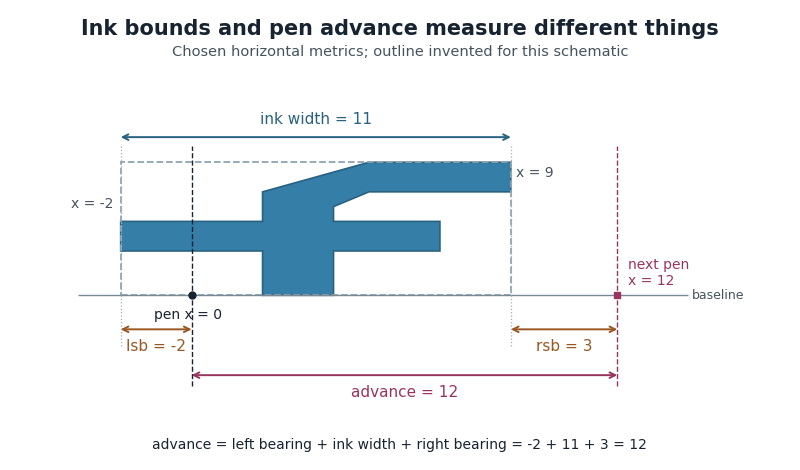
Ink bounds, side bearings and glyph advance
. Original horizontal schematic with an invented outline: left ink edge -2, right ink edge 9, advance 12. The plotted shape is not copied from a font. Horizontal measurements are in consistent arbitrary units. Details.These are measurements of a default horizontal arrangement. Subsequent glyph positioning and kerning can change the rendered relationship between neighbouring glyphs. The reference point and axes must also be checked when applying bearing conventions to vertical layout.
Fluorine-18 is a radioactive isotope of fluorine with 9 protons and 9 neutrons. It decays to oxygen-18, mainly by emitting a Positron and also by electron capture. Its approximately 110-minute half-life makes its radioactivity change appreciably over an ordinary laboratory session. It is used in positron emission tomography.[ref]
https://arxiv.org/abs/1012.3891. Original standardization study, abstract: daughter isotope, competing decay modes, half-life and PET use
The half-life can be measured by following the falling radioactivity, rather than by watching one nucleus wait to decay. A 2010 experiment used ionization chambers, germanium detectors and coincidence counting with fast scintillators, following decay for up to nine half-lives. The combined result was . Comparing different detector systems tests whether the inferred decay rate depends on one measurement technique.[ref]
The half-life of 18F by Eduardo García-Toraño and others. Abstract: apparatus, observation interval and reported result
For a closed sample governed only by radioactive decay, the surviving parent fraction is . Taking 110 minutes as an illustrative rounded half-life, 220 minutes leaves one quarter of the original fluorine-18 nuclei. Four half-lives leave , not zero. This calculation concerns nuclear survival; movement of a labelled molecule into or out of an observed region is an additional process.
A flavonol is a member of the flavonoid class with a flavone framework bearing a hydroxy group at position3 of its oxygen-containing ring. This combines a position-3 hydroxyl with the position-4 carbonyl group and the characteristic unsaturated ring framework. ChEBI distinguishes this structural class from its unsubstituted parent molecule, 3-Hydroxyflavone.[ref]
Flavonols in ChEBI. CHEBI:28802, definition and class-member relations; CHEBI:5078, parent-molecule definition
Kaempferol is an example with additional hydroxy groups at positions5,7 and . The prime distinguishes a position on the attached phenyl group from positions in the fused ring system. A class name specifies a structural pattern; it does not assign a single molecular formula, molar mass or biochemical effect to every member.
An original formula check starts with 3-Hydroxyflavone, . Replacing three further carbon-bound hydrogen atoms by three hydroxy groups adds three oxygen atoms without changing the total hydrogen count: each substitution removes one hydrogen and adds one hydrogen as part of OH. The resulting agrees with the neutral kaempferol record.[ref]
Using rounded molar masses and , respectively, corresponds to of the unsubstituted parent and of kaempferol. Equal amounts of molecules therefore need not mean equal sample masses. The calculation assumes the specified neutral compounds, rather than salts or solvated preparations.
The structural definition is also separate from an antioxidant role. In particular, chemical reduction of an assay reagent by one member is not a universal measure of the class's protective action in living cells. The documented direct MTT reaction of kaempferol illustrates why structure, reaction conditions and biological inference must be kept distinct.[ref]
Flavone is the unsubstituted flavonoid parent molecule with a phenyl group at position2 of an oxygen-containing ring system and a carbonyl group at position4. Its neutral molecular formula is ; its two oxygen atoms are the ring oxygen and the carbonyl oxygen. ChEBI distinguishes this specific molecule from the wider class of substituted flavones.[ref]
The structural distinction matters when reading names. 3-Hydroxyflavone has a hydroxy group at position3, whereas unsubstituted flavone does not. Adding that group by replacing a carbon-bound hydrogen adds one oxygen without changing the total hydrogen count:It changes both molecular identity and possible interactions; an alcohol suffix in a related name is not merely another spelling of the same substance.
An original degree of unsaturation calculation for the neutral parent givesOxygen does not enter this conventional closed-shell formula count. The eleven units are consistent with two benzene-like rings contributing four each, plus a third ring, one further carbon–carbon double bond and the carbonyl double bond. The same total occurs after hydroxyl substitution, showing why this count constrains but does not uniquely determine molecular structure.
For an original amount calculation using rounded molar mass , a amount weighs . Substituted members require their own molecular formulas and molar masses.
NIST archives a mass spectrum and an ultraviolet/visible spectrum for the identified parent compound.[ref]
Flavone in the NIST Chemistry WebBook. Flavone, CAS525-82-6, identity section and linked spectral records
These are complementary observations: composition, fragmentation and optical response test different aspects of a proposed chemical identity. A shared carbon framework does not supply one universal spectrum or biological effect for every flavonoid.A glider is an aircraft designed for sustained flight without continuous engine thrust. Its aircraft wings obtain aerodynamic lift from motion relative to the air. It can descend steadily while its speed remains constant: loss of gravitational potential energy, rather than a continuous reduction of kinetic energy, can supply the work against drag.[ref]
Four Forces on an Airplane by NASA Glenn Research Center. Gliders and the distinction between propulsion and aerodynamic support
In still air and a steady unpowered glide, the mechanical power balance iswhere is airspeed and is downward speed. This follows from and in glide angle. Motion of the surrounding air changes the ground-relative energy account; rising air can offset a glider's descent relative to that air.
Two performance objectives should be distinguished. The minimum sink speed minimizes the downward rate, while the best glide speed maximizes horizontal distance per unit height lost in still air. They need not be the same speed.
For an original comparison, stipulate two steady operating points: with , and with . Their horizontal-distance ratios areAmong these two stipulated points, the slower one stays aloft longer for a given height loss, but the faster one covers more horizontal distance. From , the corresponding times are about and . These invented points illustrate the competing objectives; they are not a measured performance curve.
A simple motivating experiment tracks a small unpowered model's position and height through a nearly steady portion of flight, then compares the vertical and horizontal motion. NASA identifies paper and lightweight model gliders as accessible examples.[ref] Repeating with controlled geometry and launch conditions distinguishes the resulting motion from a claim based solely on a large wing aspect ratio.
The glide angle is the inclination of a descending flight path below the horizontal. A positive will denote descent here. For aerodynamic reasoning it is important to specify motion relative to the air: a steady wind can change the ground track without changing the air-relative glide angle at the same operating condition.
For a steady unpowered descent, resolve gravitational weight perpendicular and parallel to the air-relative velocity. With lift normal to that velocity and drag opposing it,The still-air horizontal distance per unit height lost is therefore . NASA's description connects this geometry with a historical observation: the Wright brothers flew parallel to a dune slope, letting the slope provide an estimate of the flight-path angle.[ref]
For an original constant-velocity model, set and airspeed . Then , horizontal air-relative speed is , and downward speed is . In still air, a stipulated height loss corresponds to horizontally.
If a constant horizontal wind component is positive along the direction of travel, the ground-frame horizontal speed is . With no vertical wind and ,A headwind makes that ratio about ; a tailwind of the same magnitude gives . All three cases retain the same air-relative angle and sink rate. Their groundspeeds and ground-frame path angles differ.
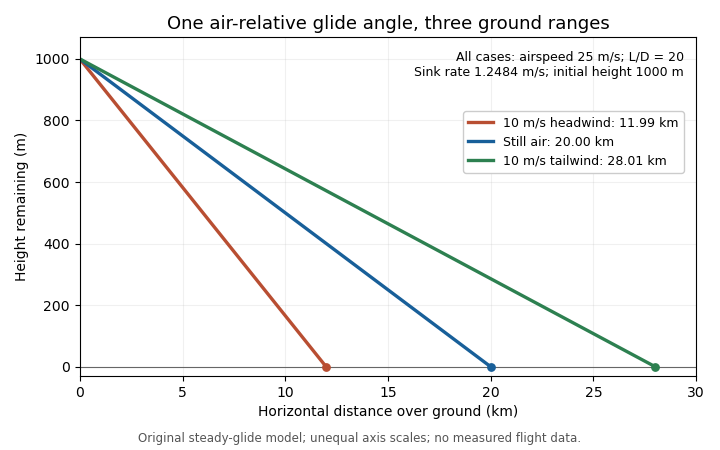
The same air-relative glide condition gives different ground ranges in a stipulated constant headwind, still air and tailwind. Original model; unequal plotting scales mean displayed line angles are not the physical glide angles.
Details. This distinction separates a measured ground trajectory from an aerodynamic lift-to-drag ratio. Estimating the latter from height and horizontal travel requires accounting for air motion and identifying the steady portion of the trajectory.
The bank angle measures an aircraft's lateral tilt relative to a local horizontal reference. In the ideal fixed-wing aircraft turning model, the lift vector tilts with the vehicle. For more general motion, vehicle attitude, flight-path direction and aerodynamic force direction must be distinguished; a banked vehicle need not follow a level circle.[ref]
Aircraft Rotations by NASA Glenn Research Center. Roll axis, wing-tip motion and attitude-control discussion
For steady horizontal circular motion with negligible vertical thrust and lift tilted by , the force balance developed in fixed-wing aircraft gives the aerodynamic load factorAt , the required lift is twice the gravitational weight. If the maximum usable lift coefficient is held fixed, implies the model's limiting airspeed scales asA stipulated wings-level limit of therefore becomes at this loading. This is a comparison at fixed configuration and air mass density, not a claim that a particular aircraft can sustain the required condition. Aerodynamic stall and structural limits constrain the accessible turn.
A banked glider also needs a different loading balance from the shallow straight-glide model used to define minimum sink speed. Increasing bank angle cannot be analyzed merely by rotating a drawing of its still-air trajectory. Measured performance must specify the turn condition as well as airspeed; the FAA's performance discussion illustrates how bank and loading affect glider operation.[ref]
A term graph represents the structure of first-order terms with labelled nodes and ordered argument graph edges. For finite acyclic first-order terms, the representation can be a directed acyclic graph, allowing identical subterms to share nodes rather than being copied into separate branches of a tree.
The first-order term has five occurrences in its ordinary syntax tree: one , two and two . A shared term graph can use only three nodes, with the two argument graph edges of pointing to the same node. Sharing a variable node is also useful: identifications made by a unification algorithm can be represented once and followed from every occurrence.[ref]
An Efficient Unification Algorithm by Alberto Martelli and Ugo Montanari. Section2 and implementation discussion, sharing and the acyclicity test
Sharing changes storage, not the meaning of an acyclic finite first-order term. A cycle is different. A node labelled whose argument points back to itself unfolds to an infinite rational tree; it cannot represent a finite solution to . An implementation must therefore state whether it supports infinite rational trees or enforces the finite-term occurs check.
Pinned article: Introduction to the OurBigBook Project
Welcome to the OurBigBook Project! Our goal is to create the perfect publishing platform for STEM subjects, and get university-level students to write the best free STEM tutorials ever.
Everyone is welcome to create an account and play with the site: ourbigbook.com/go/register. We belive that students themselves can write amazing tutorials, but teachers are welcome too. You can write about anything you want, it doesn't have to be STEM or even educational. Silly test content is very welcome and you won't be penalized in any way. Just keep it legal!
Intro to OurBigBook
. Source. We have two killer features:
- topics: topics group articles by different users with the same title, e.g. here is the topic for the "Fundamental Theorem of Calculus" ourbigbook.com/go/topic/fundamental-theorem-of-calculusArticles of different users are sorted by upvote within each article page. This feature is a bit like:
- a Wikipedia where each user can have their own version of each article
- a Q&A website like Stack Overflow, where multiple people can give their views on a given topic, and the best ones are sorted by upvote. Except you don't need to wait for someone to ask first, and any topic goes, no matter how narrow or broad
This feature makes it possible for readers to find better explanations of any topic created by other writers. And it allows writers to create an explanation in a place that readers might actually find it.
Figure 1. Screenshot of the "Derivative" topic page. View it live at: ourbigbook.com/go/topic/derivativeVideo 2. OurBigBook Web topics demo. Source. - local editing: you can store all your personal knowledge base content locally in a plaintext markup format that can be edited locally and published either:This way you can be sure that even if OurBigBook.com were to go down one day (which we have no plans to do as it is quite cheap to host!), your content will still be perfectly readable as a static site.
- to OurBigBook.com to get awesome multi-user features like topics and likes
- as HTML files to a static website, which you can host yourself for free on many external providers like GitHub Pages, and remain in full control

Figure 2. You can publish local OurBigBook lightweight markup files to either OurBigBook.com or as a static website.
Figure 3. Visual Studio Code extension installation.
Figure 5. . You can also edit articles on the Web editor without installing anything locally. Video 3. Edit locally and publish demo. Source. This shows editing OurBigBook Markup and publishing it using the Visual Studio Code extension. 
- Infinitely deep tables of contents:




All our software is open source and hosted at: github.com/ourbigbook/ourbigbook
Further documentation can be found at: docs.ourbigbook.com
Feel free to reach our to us for any help or suggestions: docs.ourbigbook.com/#contact