Topics (384k) Articles (398k) Users (410) Discussions (242) Comments (383) Files (13k) New article

The peak frequency deviation is the largest absolute value of the instantaneous frequency offset from the chosen carrier wave frequency . For , it is . It is a frequency, measured in hertz, rather than a wave phase or an exact signal bandwidth.
For a signal with a specified differentiable, continuously unwrapped wave phase , its instantaneous frequency isUnwrapping means following successive turns instead of resetting the wave phase at . Differentiating a reset phase would introduce artificial jumps. An arbitrary real signal does not by itself specify a unique amplitude-phase representation; this definition refers to the phase chosen in the model.
For the single-message-frequency FM model,The proof is the chain rule: the derivative of the sine contributes , which cancels the in the definition. In the example, , , and . Although the frequency offset vanishes at , the wave phase offset is then radians; the wave phase offset and its rate of change need not vanish together.
Between times , the accumulated number of cycles is . Thus a crossing-to-crossing measurement yields an average frequency over that interval. Its reciprocal time is only an approximation to the instantaneous frequency at one point when varies slowly over a cycle.
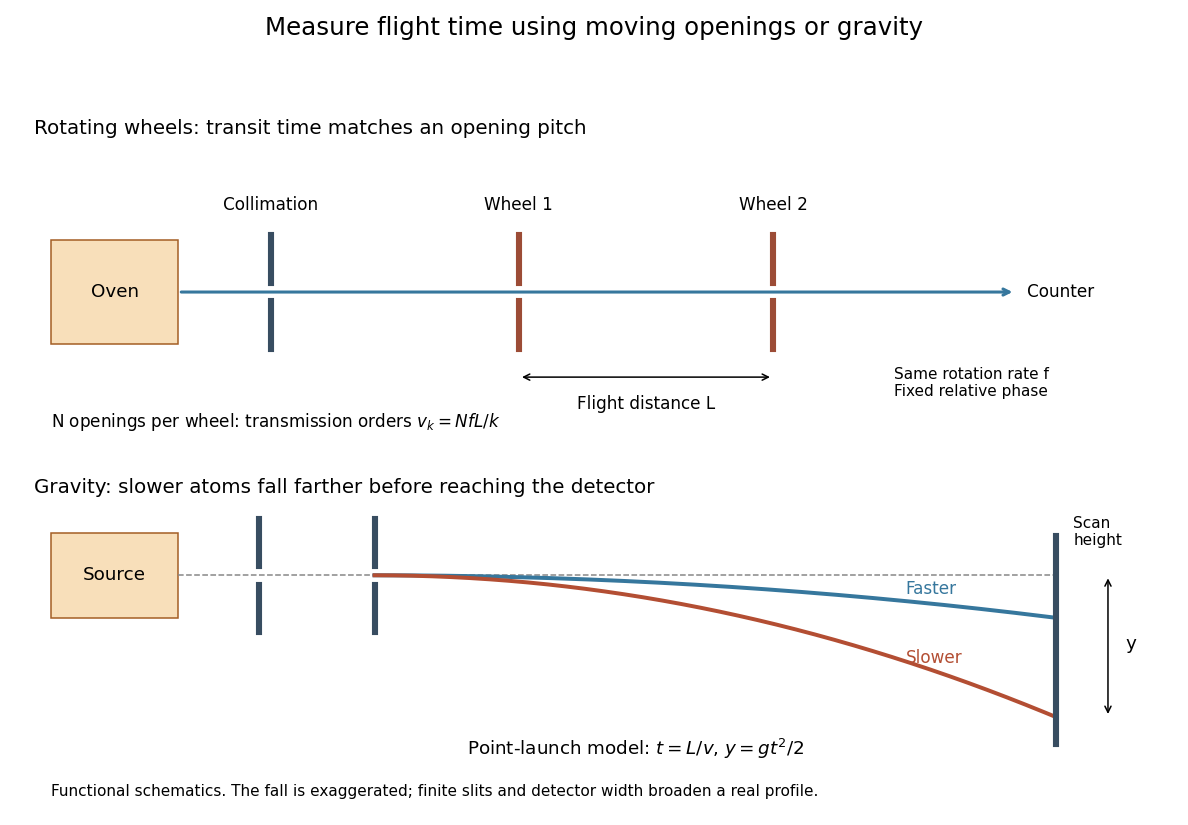
A molecular beam also includes a stream of chemical atoms, then called an atomic beam. An oven supplies particles; aligned slits restrict their directions, and a vacuum limits subsequent collisions. Narrowing the directions does not by itself make every particle's speed equal. This gives a useful separation of tasks: prepare a path, select or measure speed, apply an interaction, and read the resulting particle counts or deflection.
The advantage is unusually tangible. A magnetic field can separate spin components in the Stern-Gerlach experiment; even gravity can sort a beam by flight time. The effusive beam speed distribution explains which particles leave the source, while gravity deflection of an atomic beam explains how that distribution becomes a pattern on a detector.
ATP synthase is a molecular motor that couples downhill proton movement across a cell membrane to formation of ATP from ADP and inorganic phosphate. In oxidative phosphorylation, this is the machinery that makes chemiosmosis productive: an electrochemical gradient becomes reusable chemical driving capacity.[ref]
Rotary catalysis of FoF1-ATP synthase by Rikiya Watanabe. Watanabe, Rotary catalysis of FoF1-ATP synthase, 2013, p. 51, opening paragraphs
Its usefulness is a conversion between currencies. A membrane-spanning proton-motive force can power a local machine, while newly formed ATP can participate in energy coupling elsewhere. The enzyme supplies a route between these forms of free energy; it cannot make an energetically uphill total cycle favourable merely by accelerating its chemistry.
A collagenase is an enzyme capable of cleaving collagen. Substrate range differs between bacterial collagenases and mammalian matrix-remodelling enzymes, so the label does not specify a unique sequence or cleavage pattern. Cleaving the structurally resistant extracellular substrate enables tissue remodelling and can help release cells from a tissue. Activity on one collagen preparation does not establish equal activity on every collagen type. [ref]
Phospholipase C cleaves a phospholipid phosphodiester bond. In a prominent signalling pathway, cleavage of phosphatidylinositol 4,5-bisphosphate produces membrane-associated diacylglycerol and soluble inositol trisphosphate. The latter can stimulate calcium release from intracellular stores, while diacylglycerol regulates selected protein kinase C isoforms. The two products carry information into different cellular locations. [ref]
Effect of inositol-1,4,5-trisphosphate on isolated subcellular fractions of rat pancreas by H. Streb and others. 1983, calcium release from an intracellular store
An instrument that measures electrical resistance by applying a test excitation and observing the response.
A prescribed voltage source or current source used to probe a terminal response. For a suppressed linear resistive circuit, the ratio of terminal voltage to entering electric current determines the Thévenin resistance when finite.
The terminal electric potential difference with zero external electric current, when a finite value exists. A reading from a finite-input-electrical resistance voltmeter approximates it subject to voltmeter loading.
An instrument measuring the rate of repeated electrical events; it supplies the frequency readout when calibrating a voltage-controlled oscillator.
A multimeter combines measurements such as electric potential difference, electric current and electrical resistance in one instrument. Some models also measure capacitance; the supported functions and test conditions depend on the instrument. The dielectric laboratory example uses a multimeter in capacitance mode.
A spectrum analyzer measures signal level as a function of frequency. A swept heterodyne instrument selects frequencies through mixing and filtering; an FFT-based instrument estimates spectral content from sampled time records. Resolution bandwidth, observation time and windowing affect whether close tones are distinguished and how noise appears. A tall spectral peak is not automatically the signal's total power: calibration and integration conventions matter. Compared with an oscilloscope's time trace, the spectrum exposes frequency components, harmonics and out-of-band emissions.
A function generator produces selectable electrical waveforms such as sine, square or triangular signals for testing circuits. Frequency, amplitude, offset and output impedance specify different aspects of the delivered signal. A source calibrated for a matched load can produce a different terminal amplitude when connected to a high-impedance input, so the load convention matters. Finite rise time and bandwidth limit square-wave edges; a mathematically ideal discontinuity is not a physical output. The instrument provides a controlled input for studying a system's response rather than measuring that response itself.
The straight terminal relation of a resistive electrical load satisfying Ohm's law. Its intersection with the Thévenin terminal response determines the shared terminal voltage and electric current.
Official software documentation issued by the LibreOffice project. No individual author or publication date is established.
Cited passages: Addresses and References, Absolute and Relative: Cell references, column letters and row numbers; Addresses and References, Absolute and Relative: Relative Addressing; Absolute Addressing; When to Use Relative and Absolute References, final two paragraphs.
Online text: support.microsoft.com/en-us/excel/switch-between-relative-absolute-and-mixed-references
Official software documentation issued by Microsoft. No individual author or publication date is established.
Cited passages: Switch between relative, absolute, and mixed references: final four-row table, absolute column/row, relative column/absolute row, absolute column/relative row, and relative column/row; Switch between relative, absolute, and mixed references: opening paragraphs and table of reference changes when copying two cells down and two cells right.
Cornell University hosts this course recitation. The inspected page has no verified author byline or document date; no year inferred from its URL.
Cited passages: Recitation 19, The Adjacency List and The Adjacency Matrix: directed and undirected entry totals, linear list storage, and quadratic full-matrix storage; Recitation 19, The Adjacency List: edge-membership question; The Adjacency Matrix: constant-time edge-existence query.
Pinned article: Introduction to the OurBigBook Project
Welcome to the OurBigBook Project! Our goal is to create the perfect publishing platform for STEM subjects, and get university-level students to write the best free STEM tutorials ever.
Everyone is welcome to create an account and play with the site: ourbigbook.com/go/register. We belive that students themselves can write amazing tutorials, but teachers are welcome too. You can write about anything you want, it doesn't have to be STEM or even educational. Silly test content is very welcome and you won't be penalized in any way. Just keep it legal!
Intro to OurBigBook
. Source. We have two killer features:
- topics: topics group articles by different users with the same title, e.g. here is the topic for the "Fundamental Theorem of Calculus" ourbigbook.com/go/topic/fundamental-theorem-of-calculusArticles of different users are sorted by upvote within each article page. This feature is a bit like:
- a Wikipedia where each user can have their own version of each article
- a Q&A website like Stack Overflow, where multiple people can give their views on a given topic, and the best ones are sorted by upvote. Except you don't need to wait for someone to ask first, and any topic goes, no matter how narrow or broad
This feature makes it possible for readers to find better explanations of any topic created by other writers. And it allows writers to create an explanation in a place that readers might actually find it.
Figure 1. Screenshot of the "Derivative" topic page. View it live at: ourbigbook.com/go/topic/derivativeVideo 2. OurBigBook Web topics demo. Source. - local editing: you can store all your personal knowledge base content locally in a plaintext markup format that can be edited locally and published either:This way you can be sure that even if OurBigBook.com were to go down one day (which we have no plans to do as it is quite cheap to host!), your content will still be perfectly readable as a static site.
- to OurBigBook.com to get awesome multi-user features like topics and likes
- as HTML files to a static website, which you can host yourself for free on many external providers like GitHub Pages, and remain in full control

Figure 2. You can publish local OurBigBook lightweight markup files to either OurBigBook.com or as a static website.
Figure 3. Visual Studio Code extension installation.
Figure 5. . You can also edit articles on the Web editor without installing anything locally. Video 3. Edit locally and publish demo. Source. This shows editing OurBigBook Markup and publishing it using the Visual Studio Code extension. 
- Infinitely deep tables of contents:



All our software is open source and hosted at: github.com/ourbigbook/ourbigbook
Further documentation can be found at: docs.ourbigbook.com
Feel free to reach our to us for any help or suggestions: docs.ourbigbook.com/#contact