Topics (384k) Articles (398k) Users (410) Discussions (242) Comments (383) Files (13k) New article
A molecule with a high relative molecular mass, typically built from many smaller units joined by covalent bonds. Proteins and nucleic acids are examples. In dialysis, a semipermeable membrane can retain these large molecules while smaller solutes diffuse through.
An ideal gas law measurement obtains amount of substance without knowing the chemical formula in advance:Here is vapor pressure, is its occupied volume, is absolute temperature, is the molar gas constant, and is the mass of vapor occupying that volume at those conditions.
Santa Monica College's teaching experiment uses a Erlenmeyer flask with a pinhole foil cap, a water bath on a hot plate, a thermometer, and a barometer. Excess volatile liquid displaces air. A dissolved dye loses its colour and deposits when the liquid evaporates; three more minutes of heating follow. Cooling condenses retained vapor. Subtracting the dry assembly mass from the cooled assembly mass supplies . The flask volume comes from brim-full water mass and mass density at its measured temperature. Controls include a dry exterior, excluding bath water, and three trials.[ref]
11B: The Dumas Method (Experiment) by Santa Monica College. Santa Monica College, 11B, Experimental Set-up steps 1–6; Trials 1–3 steps 1–4: apparatus, dye endpoint, heating, drying and repetition
The inference assumes vapor pressure equals atmospheric pressure, vapor and bath reach thermal equilibrium, the retained vapor mass is recovered on cooling, and the vapor obeys the ideal gas law. Residual air, thermal expansion of the flask, and vapor temperature below bath temperature are explicit error questions in the teaching experiment. Repeating trials assesses repeatability; it does not remove a shared bias.[ref]
11B: The Dumas Method (Experiment) by Santa Monica College. Lab Report, questions 1–4: residual air, glass expansion, nonideal vapor and incomplete thermal equilibration
Suppose a synthetic polymer population contains three chains of molar mass for every one chain of molar mass . Multiplying both chain counts by any common factor leaves the averages unchanged. Substitution into the existing number-average molar mass and weight-average molar mass definitions givesThe larger chains are only one quarter of the chain count but supply of the mass. Thus a weighted mean that emphasizes mass gives a larger result than one that weights each molecule equally. Total mass divided by total chain amount of substance gives , while is not the mean mass of a randomly chosen chain. Inferring chain counts from size-exclusion chromatography still requires the existing SEC detector response and SEC molar mass calibration assumptions.
Choose approximate atomic weights and , and use . The chemical formula then gives water molar massThese are deliberately chosen rounded inputs, not exact atomic weights or a universal value for every water sample. Different isotopic abundances, notably those in heavy water, change the mean molar mass; chemical formula alone does not specify them. Adding atomic weights also neglects the tiny mass change associated with chemical bond energies, immaterial at this rounding precision.
For an illustrative pure water sample of mass , this convention givesThe count refers to water molecules. Their hydrogen chemical atom count is approximately , and their oxygen chemical atom count is approximately . The mean mass per water molecule is . Extra displayed digits expose the arithmetic; they do not imply that the sample composition or mass was measured that precisely.
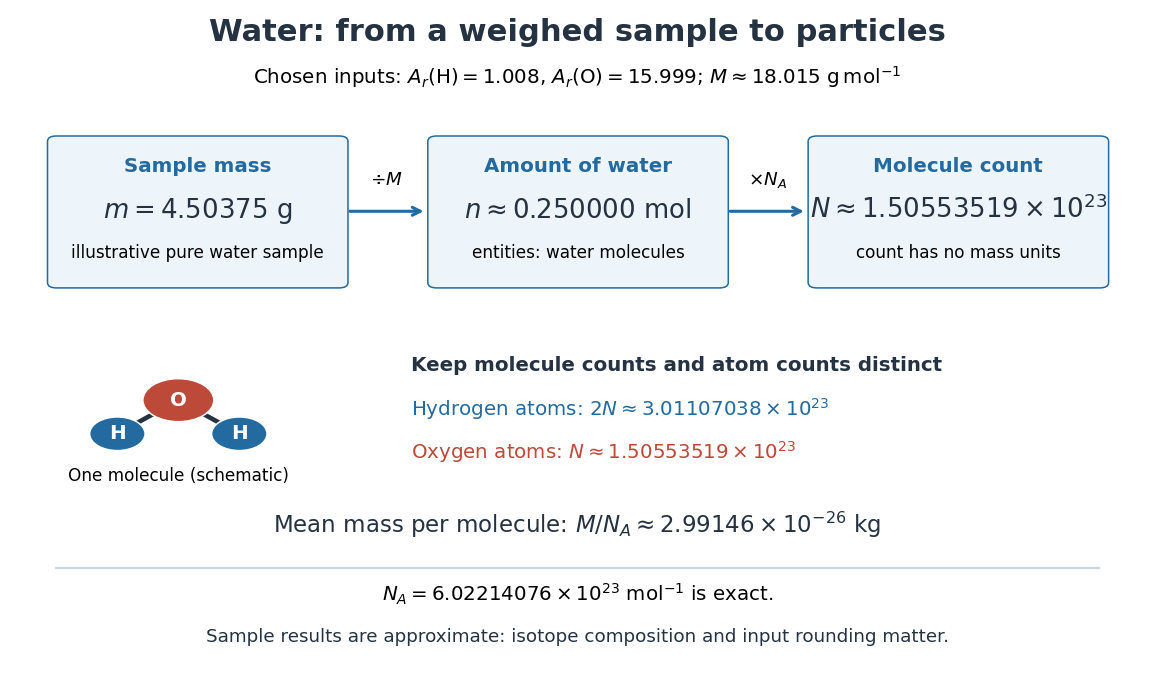
Mapping water mass through amount of substance to molecule and chemical atom counts using chosen approximate atomic weights
. Details. The same conversion makes stoichiometry a mass calculation. For the chemical equation , complete conversion of of molecular hydrogen and of molecular oxygen gives of water. With the chosen approximate atomic weights, the reactant masses are and , summing to . The ratio belongs to molecule counts and amount of substance, not to masses; this bookkeeping neglects the much smaller reaction energy contribution to mass.
The molar mass constant converts relative atomic mass or relative molecular mass into molar mass. It is approximately . Its SI numerical value is determined experimentally: the exact Avogadro constant multiplies an experimentally determined unified atomic mass unit in kilograms. Treating as exactly is therefore an excellent elementary-calculation approximation, rather than a defining equality of the modern SI.[ref]
The relative molecular mass is the dimensionless ratio of a specified mean molecule mass to the unified atomic mass unit, written when treated as a physical quantity:Thus a relative molecular mass of approximately and a molar mass of approximately describe related quantities with different units. The conversion uses the molar mass constant, rather than identifying a dimensionless number with a mass per mole.
The weight-average molar mass weights each population by its contribution to total mass:Here counts molecules with molar mass . SEC light-scattering detection can infer this average for an eluting slice under its optical and concentration assumptions; overlapping species need not have the same individual molar mass.
The number-average molar mass weights each molecule equally. For counts with molar masses ,A mass-proportional SEC detector response requires conversion to counts before determining this average.
Diatomaceous earth is a porous material formed largely from the silica-rich remains of diatoms. It is a particulate mixture rather than a single chemical compound with one exact molecular formula.
Its pore structure and high surface area make it useful as a filtration aid and absorbent material. The distinction between particle geometry and chemical composition matters: two silica-rich powders can have different filtration behavior because their pore sizes and packing differ. Natural and processed grades can also differ in mineral content and crystalline-silica fraction.
A calibrated vessel used to infer a liquid's mass density from its mass and filled volume; see pycnometer density measurement for an inspected experiment and the accounting formula.
A metrologist studies measurements and the references, methods and uncertainties that make them comparable. The work connects a specified measurand to measurement calibration, measurement uncertainty and reproducible units of measurement. An experiment that improves the stability of a length standard or checks the response of a force probe is therefore investigating how confidently other experiments can compare their results.
A force probe measures an applied force through a calibrated response. A bending beam with strain gauges is one realization; orientation and measurement calibration matter.
Measurement calibration establishes a relation between an instrument's indications and reference values, with the relevant measurement uncertainty. It is distinct from changing the instrument until it reads correctly: an instrument can be calibrated by determining a response curve and applying a correction afterward.
A practical voltage experiment connects a meter to several reference values across its working range and repeats the sequence in both directions. Fitting estimates a scale factor and measurement zero offset; departures from that relation test the response model. Repetition at later times checks instrumental drift. Uncertainty in the reference, the fitted parameters, and unresolved departures belongs in the measurement uncertainty budget, even if the displayed readings appear very stable.[ref]
Guidelines for Evaluating and Expressing the Uncertainty of NIST Measurement Results by Barry N. Taylor and Chris E. Kuyatt. Appendix D.4: calibration and the measurement model; section 4: reference information in uncertainty evaluation
A systematic error is a component of measurement error that remains constant or changes predictably when measurements are repeated under specified conditions. A ruler with an incorrect scale, a thermometer with a measurement zero offset, and an unaccounted instrumental drift can all produce such effects. Closely agreeing readings can therefore have poor measurement accuracy: repetition tests their scatter, not the correctness of the shared reference.
An estimated systematic error should be corrected when possible, with the correction's measurement uncertainty included in the measurement uncertainty budget. Suppose a balance reads and a reference gives an estimate of its offset. The corrected result is ; uncertainty in remains even if the same unknown offset affected every weighing. Changing the reference, using a blank, or testing systematic-error cancellation by reversal can reveal effects that a long sequence of identical readings misses. The Type A evaluation of uncertainty and Type B evaluation of uncertainty distinction concerns how uncertainty is evaluated, so neither label is synonymous with systematic error.[ref]
Measurement uncertainty describes the spread of values reasonably attributable to a specified measurand, using the available information. It differs from measurement error, which is a difference from a reference value: the uncertainty can be quantified even when that difference is unknown. A useful result therefore states what was measured, the unit of measurement, the value, and how its uncertainty was evaluated.[ref]
For a wire's electrical resistance obtained from , uncertainty in the voltage and electric current propagates through that measurement model. Shared measurement calibration effects can make the inputs correlated, so adding percentages or treating every contribution as independent can be wrong. The measurement uncertainty budget records those assumptions. Report a standard uncertainty when a standard-deviation scale is intended, or an expanded uncertainty with its stated coverage factor; a bare plus-or-minus number does not specify which was used.
Pharmacology studies how drugs interact with living systems. It connects molecular recognition, changes in physiology and the time course of exposure. Distinguishing what a substance does from how it reaches its targets is central to interpreting experiments.
By Keith Conrad.
Online text: kconrad.math.uconn.edu/blurbs/linmultialg/extmod.pdf
Discrete Mathematics: An Open Introduction (3rd edition) by Oscar Levin by  Codex 0 Created 2026-10-14 Updated 2026-11-05
Online front matter: discrete.openmathbooks.org/dmoi3/frontmatter.html
The author's institutional publication list dates the third edition to 2018. The online front matter displays 12 August 2025 without identifying that date as the edition's original publication date.[ref]
https://www.unco.edu/employee-directory/oscar-levin/. Publications, third-edition entry dated 2018
[ref]https://discrete.openmathbooks.org/dmoi3/frontmatter.html. Title, author, third-edition designation and displayed date
Cited passages: §1.2, Lattice Paths, step-position encoding; Binomial Coefficients, counting interpretations and recurrence; Pascal’s Triangle, indexing and edge values. The third edition’s 2018 publication year is distinct from the online front matter’s displayed date of 12 August 2025.
Senior contributing authors: Gilbert Strang and Edwin “Jed” Herman. OpenStax also credits additional contributing authors in its preface.
Publisher: OpenStax, Rice University.
Official text: openstax.org/books/calculus-volume-3/pages/1-introduction
Pinned article: Introduction to the OurBigBook Project
Welcome to the OurBigBook Project! Our goal is to create the perfect publishing platform for STEM subjects, and get university-level students to write the best free STEM tutorials ever.
Everyone is welcome to create an account and play with the site: ourbigbook.com/go/register. We belive that students themselves can write amazing tutorials, but teachers are welcome too. You can write about anything you want, it doesn't have to be STEM or even educational. Silly test content is very welcome and you won't be penalized in any way. Just keep it legal!
Intro to OurBigBook
. Source. We have two killer features:
- topics: topics group articles by different users with the same title, e.g. here is the topic for the "Fundamental Theorem of Calculus" ourbigbook.com/go/topic/fundamental-theorem-of-calculusArticles of different users are sorted by upvote within each article page. This feature is a bit like:
- a Wikipedia where each user can have their own version of each article
- a Q&A website like Stack Overflow, where multiple people can give their views on a given topic, and the best ones are sorted by upvote. Except you don't need to wait for someone to ask first, and any topic goes, no matter how narrow or broad
This feature makes it possible for readers to find better explanations of any topic created by other writers. And it allows writers to create an explanation in a place that readers might actually find it.
Figure 1. Screenshot of the "Derivative" topic page. View it live at: ourbigbook.com/go/topic/derivativeVideo 2. OurBigBook Web topics demo. Source. - local editing: you can store all your personal knowledge base content locally in a plaintext markup format that can be edited locally and published either:This way you can be sure that even if OurBigBook.com were to go down one day (which we have no plans to do as it is quite cheap to host!), your content will still be perfectly readable as a static site.
- to OurBigBook.com to get awesome multi-user features like topics and likes
- as HTML files to a static website, which you can host yourself for free on many external providers like GitHub Pages, and remain in full control

Figure 2. You can publish local OurBigBook lightweight markup files to either OurBigBook.com or as a static website.
Figure 3. Visual Studio Code extension installation.
Figure 5. . You can also edit articles on the Web editor without installing anything locally. Video 3. Edit locally and publish demo. Source. This shows editing OurBigBook Markup and publishing it using the Visual Studio Code extension. 
- Infinitely deep tables of contents:



All our software is open source and hosted at: github.com/ourbigbook/ourbigbook
Further documentation can be found at: docs.ourbigbook.com
Feel free to reach our to us for any help or suggestions: docs.ourbigbook.com/#contact