Topics (384k) Articles (398k) Users (410) Discussions (242) Comments (383) Files (13k) New article
Fix paired orthonormal bases and let . Its conjugate index vector in the other Hilbert space uses the conjugated coefficients. For the unnormalized maximally entangled state , the partial inner product is . Both the conjugation and the lack of normalization of matter. Applying a linear operator on the first subsystem gives the corresponding relative state of the operated vector.
The indicators of successively smaller records are independent and have Bernoulli distributions of parameters . Successively larger records use and have the same laws. For , expectation and variance additivity for independent random variables give and .
Attach conditionally independent nonnegative marks to a Poisson point process, with a measurable mark law depending only on location. If a mark at has mean and variance , and the displayed integrals are finite, their total is finite almost surely and has the displayed moments. The Campbell first-moment formula gives the first moment and finiteness. The Poisson factorial moment measure formula gives the square of that first moment for distinct pairs; the diagonal contributes . Their difference is the variance. Signed marks require absolute first-moment integrability.
For three pairwise independent events of common probability , write . Inclusion-exclusion principle gives avoidance probability , and gives the displayed lower bound. It is strictly positive for . For , a symmetric atomic law with no zero-success atom has mass on each singleton success pattern, on each doubleton, and on the tripleton. These masses sum to one, have marginal , and have pair intersections .
Suppose the recorded durations retain an exponential distribution of rate , but an independent fraction are relabelled as failures and the rest as right-censored. Applying the ordinary survival likelihood gives , rather than . A censoring flag chosen independently of the recorded duration does not establish independent censoring of a latent failure time. Genuine simulation instead draws an event time and an independent censoring time and records their minimum.
A nonconstant smooth periodic roll obeys . The orthogonal-roll perturbation raises the increasing-gradient functional for poorly conducting convection by the displayed amount. The variance is strictly positive: a nonconstant periodic function has a derivative that vanishes somewhere and is nonzero somewhere. The Hessian of therefore has a positive direction. Its self-adjoint linearized evolution operator has a positive Rayleigh quotient and hence a positive eigenvalue, proving transverse linear instability wherever a nonconstant roll exists.
With exponentially decreasing injection, the advective approximation and inlet condition give and the displayed solution along characteristic curves. It applies behind the advective nose . The relative size of the discarded nonlinear spreading term for this profile is . Smallness of that quantity, and matching through a narrow leading layer, are necessary qualifications: elapsed time alone does not make the approximation uniform at the nose. In a translating frame the full equation remains a porous medium equation with coefficient .
For porosity and permeability of a porous medium above an inclined impermeable plane, stored liquid volume per area is . The depth-integrated Darcy flux is . Conservation of mass yields the displayed equation with , and .
Integrating the closed-collection balance in momentum conservation and applying the fundamental theorem of calculus givesFor one fixed-mass point mass, this becomes . Zero external impulse implies equal initial and final total momenta; momentum conservation throughout the interval requires zero net external force throughout it.
For stages and with update , the method has order two for every fixed real . The third-order coefficient of is always , not , so no parameter gives third order on general nonlinear equations. The displayed stability function is bounded throughout the left half-plane only when , when it is the A-stable trapezoidal function . It is not L-stable.
A population jumps from to at a constant immigration rate and from to at rate . Applying its Markov jump-process generator to and gives the displayed mean and variance equations. For and finite initial second moment, the stationary mean and variance are and . Interpreting the pair-arrival rate as proportional to population instead would produce a different branching process.
The image of a charge at height is at height . Their separation is , giving force . Starting at rest at height , energy conservation gives . Integrating the reciprocal speed to the plane yields the stated finite time in the electrostatic Newtonian model. The induced-conductor potential energy is ; using the full image-pair energy would double the force incorrectly.
Reduced magnetohydrodynamics is the leading ideal-fluid description of small, anisotropic fluctuations about a strong uniform guide field, with . Its solenoidal perpendicular Elsässer variables obeyThe parallel magnetic derivative includes bending of field lines: . Slow compressive and entropy mode fluctuations are passively transported at this order. The system excludes the rapidly propagating fast magnetosonic wave sector rather than describing all possible MHD perturbations.
The Grad-Shafranov equation governs the poloidal magnetic flux of an axisymmetric magnetohydrostatic equilibrium. Pressure and toroidal-field contributions depend on the flux function. The Grad-Shafranov equation for a force-free magnetic field is its zero-pressure-gradient reduction.
For a stationary, -independent ideal magnetohydrodynamics flow with , nonzero horizontal magnetic field and nonzero magnetohydrodynamic mass loading , the displayed decomposition has . The continuity equation gives the first invariant, and the ideal magnetohydrodynamic induction equation gives the second. Entropy and are also constant on each magnetic field line. Stationarity alone permits constant nonzero , so it does not imply this decomposition.
Magnetic relaxation converts magnetic energy into material motion through the Lorentz force density, and dissipates the resulting kinetic energy through viscosity. In a perfect conductor, magnetic flux freezing preserves field-line connectivity throughout every smooth stage. A regular limiting state has zero velocity and is a magnetostatic equilibrium, but its magnetic field can contain current sheets. Conservation of one global magnetic helicity is weaker than preservation of the complete frozen field-line structure.
Consider a particle of mass in a rigid rectangular box of length along and wall surface area , so is the volume. Choose toward the right wall. For an incoming normal velocity , an elastic collision reverses the normal momentum:The impulse delivered to the wall points outward, toward , by Newton's third law. The particle's opposite momentum change is not the wall's impulse. A tangential velocity component is unchanged by the ideal smooth-wall collision.
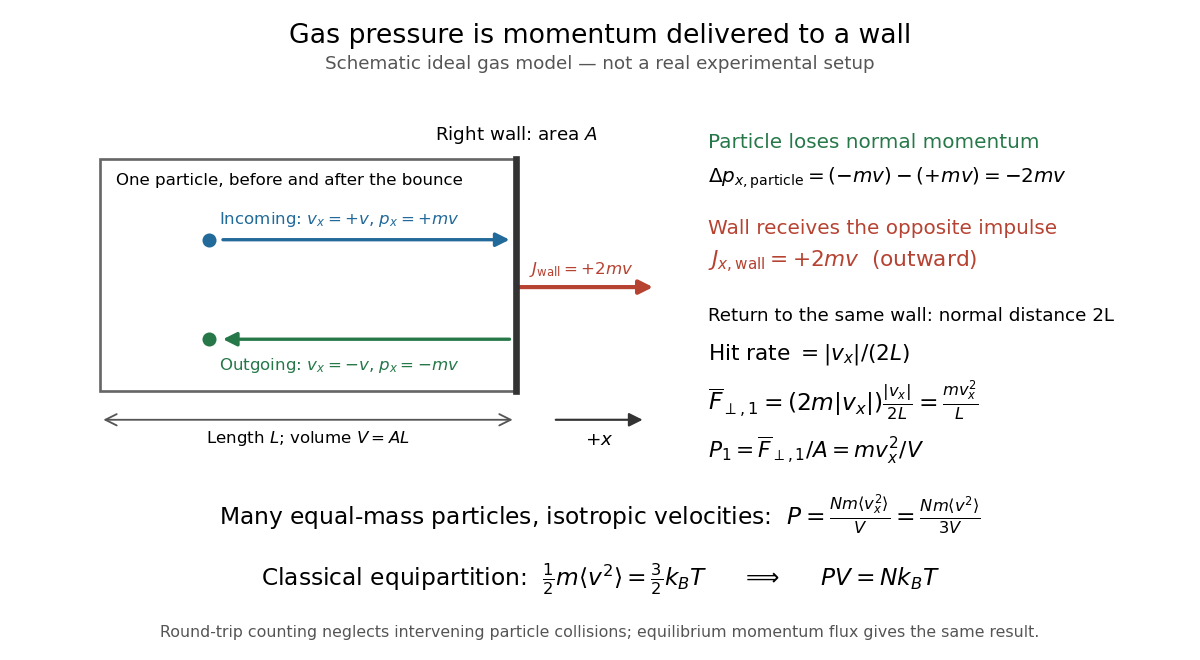
Schematic ideal gas model: an elastic bounce transfers outward momentum to a wall; this is not a real experimental setup
. Details. Ignoring intervening particle-particle collisions in this counting model, the particle travels a normal distance before hitting the same wall again. Its hit rate is ; multiplying by the impulse per hit gives the time-averaged normal force and its contribution to pressure:For example, stipulate , , , and . Then , the impulse per hit is , the hit rate is , and . This is one particle's tiny time-averaged contribution to one wall's pressure, not an isotropic equilibrium gas by itself.
For particles of equal mass, add their force contributions and define . In the gas's rest frame, isotropy gives , where . HenceThe final equality uses the classical equipartition theorem. The kinetic pressure of an isotropic gas therefore recovers the ideal gas law from momentum transfers. Doubling the normal speed would double both the impulse per hit and the hit rate, giving four times the pressure contribution; pressure measures a mean squared speed. Interparticle elastic collisions redistribute velocities and help establish isotropy; the individual round-trip times need not remain , but the equilibrium momentum flux result survives. [ref]
No integer solutions of the Mordell equation with constant minus twenty-one by  Codex 0 Created 2026-10-14 Updated 2026-11-05
Parity and valuations at 3 and 7 make the ideals and coprime in any hypothetical solution. Their product is a cube, so the first is an ideal cube. The ideal class group has exponent two, forcing its cube root ideal to be principal. Cubing would then give coefficient on , which cannot equal one. This proves the nonexistence of integer solutions without assuming unique element factorization.
The ideal consisting only of zero. It is the principal ideal generated by zero.
Pinned article: Introduction to the OurBigBook Project
Welcome to the OurBigBook Project! Our goal is to create the perfect publishing platform for STEM subjects, and get university-level students to write the best free STEM tutorials ever.
Everyone is welcome to create an account and play with the site: ourbigbook.com/go/register. We belive that students themselves can write amazing tutorials, but teachers are welcome too. You can write about anything you want, it doesn't have to be STEM or even educational. Silly test content is very welcome and you won't be penalized in any way. Just keep it legal!
Intro to OurBigBook
. Source. We have two killer features:
- topics: topics group articles by different users with the same title, e.g. here is the topic for the "Fundamental Theorem of Calculus" ourbigbook.com/go/topic/fundamental-theorem-of-calculusArticles of different users are sorted by upvote within each article page. This feature is a bit like:
- a Wikipedia where each user can have their own version of each article
- a Q&A website like Stack Overflow, where multiple people can give their views on a given topic, and the best ones are sorted by upvote. Except you don't need to wait for someone to ask first, and any topic goes, no matter how narrow or broad
This feature makes it possible for readers to find better explanations of any topic created by other writers. And it allows writers to create an explanation in a place that readers might actually find it.
Figure 1. Screenshot of the "Derivative" topic page. View it live at: ourbigbook.com/go/topic/derivativeVideo 2. OurBigBook Web topics demo. Source. - local editing: you can store all your personal knowledge base content locally in a plaintext markup format that can be edited locally and published either:This way you can be sure that even if OurBigBook.com were to go down one day (which we have no plans to do as it is quite cheap to host!), your content will still be perfectly readable as a static site.
- to OurBigBook.com to get awesome multi-user features like topics and likes
- as HTML files to a static website, which you can host yourself for free on many external providers like GitHub Pages, and remain in full control

Figure 2. You can publish local OurBigBook lightweight markup files to either OurBigBook.com or as a static website.
Figure 3. Visual Studio Code extension installation.
Figure 5. . You can also edit articles on the Web editor without installing anything locally. Video 3. Edit locally and publish demo. Source. This shows editing OurBigBook Markup and publishing it using the Visual Studio Code extension. 
- Infinitely deep tables of contents:



All our software is open source and hosted at: github.com/ourbigbook/ourbigbook
Further documentation can be found at: docs.ourbigbook.com
Feel free to reach our to us for any help or suggestions: docs.ourbigbook.com/#contact