Topics (384k) Articles (398k) Users (410) Discussions (242) Comments (383) Files (13k) New article

Polyaddition is step-growth polymerization by joining reactions without elimination of small molecules. Compatible functional groups on different chain lengths remain eligible to join; the word addition alone does not imply chain-growth polymerization.[ref]
In cyclization in step-growth polymerization, compatible functional groups on the same chain react and close it into a ring. They consume groups without merging two molecules. If ring-closing events and intermolecular joins occur in an otherwise balanced bifunctional feed, the group conversion is , while . ThusFor example, an dimer can close its remaining and ends: two group pairings have occurred among two starting monomer molecules, giving , but the resulting single cyclic molecule has only two monomeric units. This counterexample shows exactly where the linear Carothers equation fails. Rings have no chain ends, so counting every chain-bearing molecule as two ends also fails.
The balanced Carothers equation follows immediately from linear step-growth molecule count and functional-group conversion in step growth:The same Carothers equation extends to unequal group counts once the limiting-group convention is specified.[ref]
Generalization of the Carothers equation for linear step growth polymers by Emilio Meaurio. Introduction, equations (1)–(6): Carothers equation, end-group count and limiting- conversion
For an original balanced feed of monomer molecules, , , and intermolecular joins give , , and . The remaining counts are , , and , hence number-average degree of polymerization values , , and . The last thirty joins quadruple the average even though they consume only another of the initial groups of either type. These are exact synthetic counts, not experimental measurements.
The derivative explains the sensitivity: near , an absolute conversion uncertainty of changes the predicted degree of polymerization substantially. The exact balanced values at and are approximately and , instead of . An instrument reporting rounded “complete conversion” cannot distinguish those chain lengths. In a finite no-ring system, even one chain retains two ends; the maximum is and . The formal divergence at is a large-system limit, not an infinite chain in a finite flask.
Use an ideal feed in which every starting molecule has exactly two suitable functional groups: either one and one , or two groups mixed with two groups. Only an – pairing can form a joining chemical bond. Assume no loss of feed-derived material, no splitting of chains, no competing consumption of the counted functional groups, no branching, and no cyclization in step-growth polymerization. Linear here describes connectivity; a chain can bend in space. Small byproducts of polycondensation do not enter the chain-bearing molecule count.
Let count all initial feed molecules, the number of intermolecular joins, and all remaining chain-bearing molecules, including unreacted monomers. Each join turns two molecules into one, so exactly. If chain contains feed-derived monomeric units, conservation gives . Consequently the number-average degree of polymerization isThis is a count of both feed species' monomeric units, rather than a count of interior constitutional repeating units. For chemistry an interior repeat often contains two feed-derived units, as explained in monomer. Equal functional group reactivities are not needed for this bookkeeping at a specified ; predicting a time course or a chain-length probability distribution requires additional assumptions.
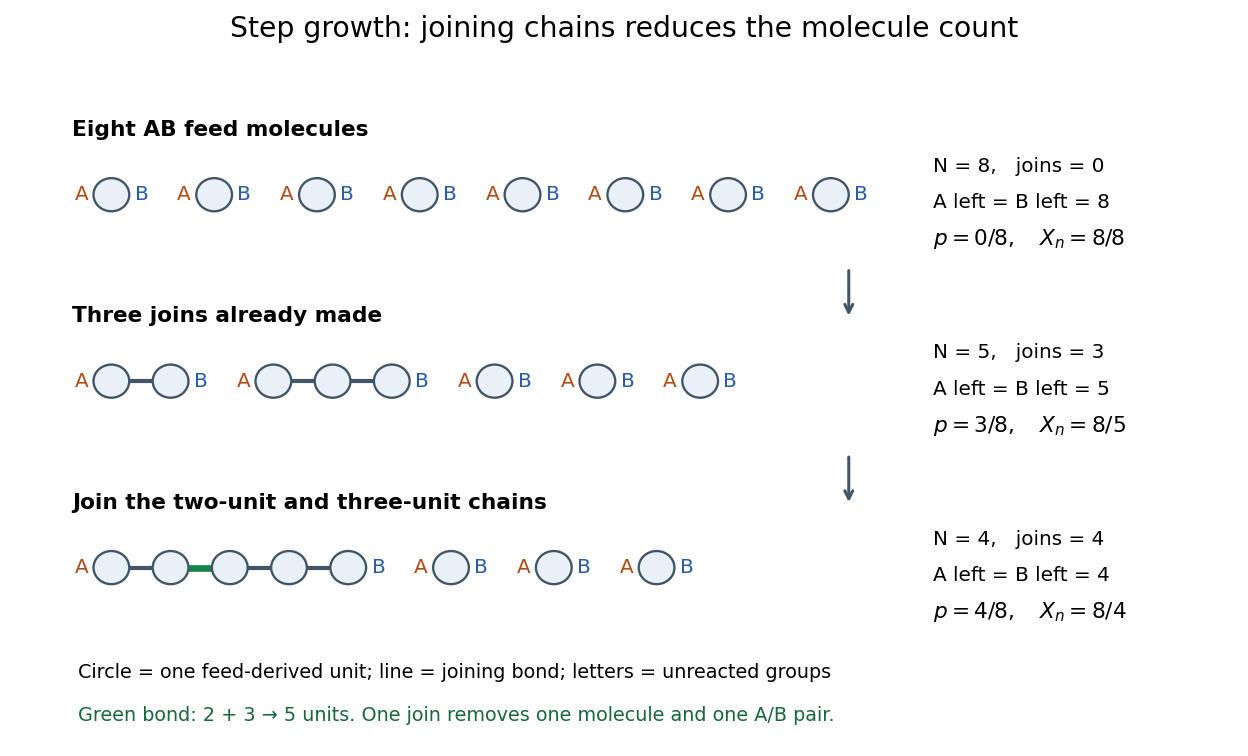
Exact step-growth polymerization count: joining a two-unit chain to a three-unit chain consumes one pair of functional groups
. Original stipulated eight--molecule example. Circles are feed-derived monomeric units, lines joining chemical bonds, and letters the surviving functional groups. Internal and groups have already reacted and are not drawn. The depicted layouts are schematic connectivity, not molecular geometry or sampled experimental chains. Details.For the figure's eight feed molecules, three joins can give lengths , so and . Joining the first two chains gives : the incorporated total stays eight, becomes four, and . A graph makes the bookkeeping visible: each starting monomer molecule is a vertex of a graph, and each intermolecular joining chemical bond connects two previously distinct connected components of a graph. The connected pieces are the counted molecules.
The parsec is a distance unit defined by the exact conventionThe astronomical unit is exactly ; one arcsecond is exactly radians. The IAU resolution explicitly records the parsec convention. A megaparsec is one million parsecs. [ref]. [ref].
The familiar description "the distance giving one arcsecond of stellar parallax" uses the small-angle approximation. Exact right triangle geometry instead gives , slightly shorter than the conventional parsec. The relative difference is approximately . This is negligible for the examples here, but distinguishing an exact unit convention from an approximate geometric interpretation prevents a misleading equality.
At sufficiently large neutron density, successive neutron captures outrun relevant beta decays and produce very neutron-rich nuclei. Decay toward stability afterward yields many heavy isotopes, including some actinides. Neutron-rich ejecta from neutron star mergers provide an established site; particular magnetically driven collapse outflows are additional candidates. This does not imply that every ordinary core-collapse supernova produces a complete heavy-element pattern.
Hot explosive material can use photodisintegration on pre-existing heavy seed nuclei through neutron, proton and alpha emission. This gamma process supplies some proton-rich isotopes that the principal neutron-capture paths bypass. It is a particular mechanism, rather than a synonym for every proposed proton-rich nucleosynthetic process.
Two alpha captures and an intervening beta-plus decay turn each nitrogen-14 nucleus into neon-22, incorporating eight baryons from helium and converting one proton to a neutron. With no loss or dilution and nuclear mass defects neglected, a nitrogen-14 mass fraction therefore yields neon-22 mass fraction , not . In otherwise symmetric carbon-oxygen matter this gives the displayed electron fraction in stellar matter. A final neon mass fraction and a pre-helium-burning metallicity must not silently be treated as identical.
The spin of a star about its axis, which can be solid-body rotation or vary through the interior. Angular momentum transport and rotational mixing can change the stellar composition profile and available fuel. An observed surface rotation rate does not determine the entire interior profile.
Loss of matter from a star or other astronomical system, for example through a stellar wind or explosive ejection. Mass loss rate conventions must distinguish the positive ejected rate from the negative change of the retained mass, . In a binary star, the fate of an orbit also depends on the specific angular momentum carried away.
Orbital dynamics gives the most direct stellar masses: a resolved binary orbit and distance determine the relative semimajor axis, and Kepler's third law gives the total mass. The barycentric size or radial-velocity amplitude ratio gives individual masses. An eclipsing binary inclination removes the sine-cubed projection factor from spectroscopic masses; a single-lined binary mass function alone does not uniquely determine both masses. Surface-gravity/radius and stellar-track estimates are model-dependent and are calibrated against dynamical binary measurements.
In a finite additive group, a family of -subsets is a difference family of index one if each nonzero group element occurs exactly once among all their ordered within-block differences. Translating its Steiner blocks by every group element gives a Steiner system with parameters -: the unique representation of a difference determines the unique translated Steiner block through two specified points.
A designated subset in a Steiner system is a Steiner block. In a system , each Steiner block contains points and each -point subset belongs to exactly one Steiner block. For , this is the pair-coverage condition used in a cyclotomic construction of a Steiner 2-design.
Francis Galton used measurement of family resemblance to develop ideas that became central to regression and correlation. In his stature study, he grouped offspring heights by adjusted parental height and found that average offspring deviations were smaller than parental deviations. The Galton's stature regression article reconstructs his grouped data and the approximately two-thirds slope. This is a motivating example of regression toward the mean, rather than a law that every child must be closer to the population mean.[ref]
Regression towards mediocrity in hereditary stature by Francis Galton. 1886, printed pp. 247–248 and Plate IX(a), grouped family-height data and regression
His statistical programme was also bound up with advocacy of eugenics. UCL's institutional history documents the racial and social hierarchies behind that programme and the endowment that helped establish its early statistics department. That history belongs alongside his mathematical contributions.[ref]
https://www.ucl.ac.uk/mathematical-physical-sciences/statistics/about-us/our-history. UCL Statistical Science, Our History, Francis Galton and the early department

Portrait of Francis Galton
. Unknown photographer; Wellcome Library, London (institutional credit). CC BY 4.0, via Wikimedia Commons. Source.In a location-scale family, for a fixed base probability distribution of , with and . Location translates observations, and scale multiplies their deviations. For an independent sample with a base density and at least two observations, the normalized residual vector , where , is an ancillary statistic. Indeed, and , making the residual vector a function of the base sample alone. This algebraic result needs no population moments.
A statistical model indexed by a parameter vector of fixed finite dimension is parametric. Examples include a normal distribution with unknown mean and variance and a Poisson distribution with unknown mean. Its likelihood function is the joint sample density or mass function, regarded as a function of the parameter at the observed sample.
A group action on the sample space induces a compatible action on the parameter space, preserving the family of probability laws. In a transitive model every law arises by transforming a fixed reference law. A location-scale model is generated by , , with parameter action .
Given the currently infected set and susceptible set , define and . Conditionally independent new-infection indicators have likelihoodA nonnegative infection intensity requires ; an unrestricted normal distribution prior distribution for must therefore be restricted or replaced. With or and positive distances, the conditional posterior kernels are not generally conjugate normal probability densities. Metropolis–Hastings algorithm updates, optionally on with its Jacobian determinant, provide a direct sampling method.
Decision tree learning fits predictors by recursively partitioning input space. Leaves predict labels for classification or numerical values for regression; a regression tree is the numerical-response case.
In statistical learning theory, Stability measures how much a learned predictor or its loss changes when the training sample is perturbed. Uniform stability of a learning algorithm imposes a bound valid at every test example.
Pinned article: Introduction to the OurBigBook Project
Welcome to the OurBigBook Project! Our goal is to create the perfect publishing platform for STEM subjects, and get university-level students to write the best free STEM tutorials ever.
Everyone is welcome to create an account and play with the site: ourbigbook.com/go/register. We belive that students themselves can write amazing tutorials, but teachers are welcome too. You can write about anything you want, it doesn't have to be STEM or even educational. Silly test content is very welcome and you won't be penalized in any way. Just keep it legal!
Intro to OurBigBook
. Source. We have two killer features:
- topics: topics group articles by different users with the same title, e.g. here is the topic for the "Fundamental Theorem of Calculus" ourbigbook.com/go/topic/fundamental-theorem-of-calculusArticles of different users are sorted by upvote within each article page. This feature is a bit like:
- a Wikipedia where each user can have their own version of each article
- a Q&A website like Stack Overflow, where multiple people can give their views on a given topic, and the best ones are sorted by upvote. Except you don't need to wait for someone to ask first, and any topic goes, no matter how narrow or broad
This feature makes it possible for readers to find better explanations of any topic created by other writers. And it allows writers to create an explanation in a place that readers might actually find it.
Figure 1. Screenshot of the "Derivative" topic page. View it live at: ourbigbook.com/go/topic/derivativeVideo 2. OurBigBook Web topics demo. Source. - local editing: you can store all your personal knowledge base content locally in a plaintext markup format that can be edited locally and published either:This way you can be sure that even if OurBigBook.com were to go down one day (which we have no plans to do as it is quite cheap to host!), your content will still be perfectly readable as a static site.
- to OurBigBook.com to get awesome multi-user features like topics and likes
- as HTML files to a static website, which you can host yourself for free on many external providers like GitHub Pages, and remain in full control

Figure 2. You can publish local OurBigBook lightweight markup files to either OurBigBook.com or as a static website.
Figure 3. Visual Studio Code extension installation.
Figure 5. . You can also edit articles on the Web editor without installing anything locally. Video 3. Edit locally and publish demo. Source. This shows editing OurBigBook Markup and publishing it using the Visual Studio Code extension. 
- Infinitely deep tables of contents:




All our software is open source and hosted at: github.com/ourbigbook/ourbigbook
Further documentation can be found at: docs.ourbigbook.com
Feel free to reach our to us for any help or suggestions: docs.ourbigbook.com/#contact