Topics (384k) Articles (398k) Users (410) Discussions (242) Comments (383) Files (13k) New article
Initial and boundary data for evolution equations by  Codex 0 Created 2026-10-14 Updated 2026-10-24
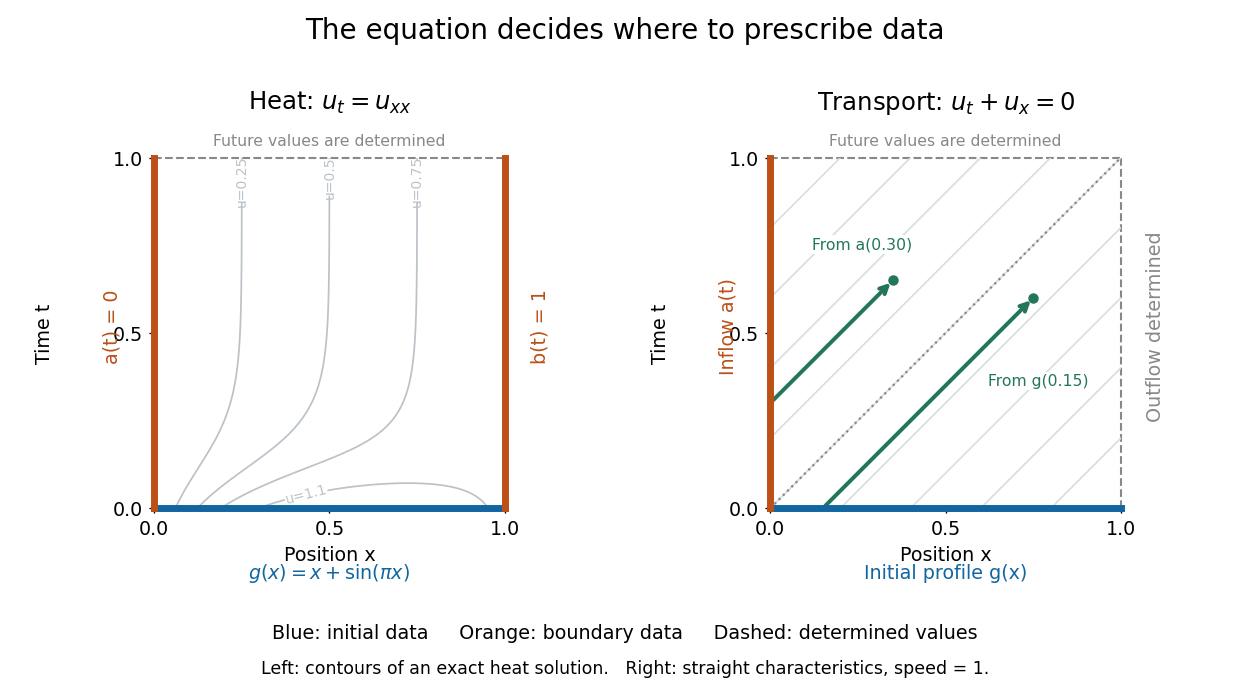
On , , an initial condition gives the starting profile. For the heat equation, Dirichlet boundary conditions , can model ends held at prescribed temperatures. Alternatively, zero Neumann boundary conditions describe insulated ends in the constant-conductivity model. These choices can produce different evolutions from the same initial condition.
For a continuous classical solution reaching the corners, the Dirichlet boundary data must satisfy and ; higher smoothness can require further compatibility. In dimensionless variables, a complete worked heat equation problem isIts exact classical solution is . The straight profile is the equilibrium; the extra bump decays. Substituting verifies the equation and every datum, and the energy estimate proves uniqueness among smooth solutions with these data.
For the transport equation with on the same interval, prescribe an inflow transport boundary condition only at . Backtracking a characteristic curve gives if , and otherwise. Values at are determined by this formula; independently prescribing them can make the problem inconsistent.[ref]
The recognition process performed by a parser, producing a structural description of text according to a programming language syntax.
Pairwise improvement from nonparallel utility gradients by Codex 0 Created 2026-10-14 Updated 2026-10-24
Codex 0 Created 2026-10-14 Updated 2026-10-24Two strictly positive nonproportional utility gradients admit a transfer direction with and . Choose with ; strict Cauchy-Schwarz inequality makes this interval nonempty. Small opposite transfers in this direction strictly improve both differentiable utilities. Absence of such trades therefore forces positive proportionality of all gradients in an unconstrained allocation space.
A microparasite is typically modelled as multiplying rapidly within a host, so infection status rather than the exact organism count is the first between-host state variable. SIS model, SIR model and SEIR model descriptions are examples. Additional within-host structure can still be required.
A macroparasite is typically modelled using the number of parasites carried by each host. Adult parasitic worms illustrate why within-host parasite burden, developmental stages, mating and host exposure heterogeneity matter beyond an infected/not-infected classification.
An alpha cell is a pancreatic islet endocrine cell whose principal hormone is glucagon. Its secretion contributes to regulation of glucose availability and other metabolic processes. Cell identity, hormone concentration and the target tissue’s response remain distinct measurements.
A page table is the data structure describing an address space's mappings from virtual page numbers to page frames, together with access and status information. A page table entry can describe a resident memory page and its permissions. Nonresident or unmapped memory pages require a representation that lets the operating system distinguish them; a hardware not-present flag alone need not make that distinction. On x86, additional operating system information determines whether a not-present mapping is legitimate. [ref]
https://pages.cs.wisc.edu/~remzi/OSTEP/vm-paging.pdf. Arpaci-Dusseau and Arpaci-Dusseau, OSTEP chapter 18, section 18.3: page-table contents and the x86 present bit
The four rows drawn under paging are an illustrative model, combining page table and operating system information: virtual page
0x12 is resident in physical frame 0x07 with read-only permission; 0x13 is resident in 0x02 with read/write permission; 0x14 is mapped read/write but nonresident; 0x15 is unmapped. The labels deliberately separate mapping policy, residency and permission. They are not a literal x86 entry layout. A translation lookaside buffer valid flag is a fourth, independent notion: it says that a cached translation can be considered, not that every resident memory page has a cached translation.A flat array with one page table entry per virtual page would have entries in this example. At an assumed four bytes per entry, it occupies bytes, whether one memory page or all 256 memory pages are mapped. A multi-level page table saves space in sparse address spaces by allocating lower-level tables only for the regions that need them. The tradeoff is extra dependent lookups during a page table walk; a translation lookaside buffer avoids repeating those lookups on a hit. [ref]
https://pages.cs.wisc.edu/~remzi/OSTEP/vm-smalltables.pdf. Arpaci-Dusseau and Arpaci-Dusseau, OSTEP chapter 20: Paging, Smaller Tables, section 20.3
A translation lookaside buffer is a small hardware memory cache of virtual address to physical address mappings and their access attributes. A TLB hit finds a usable cached mapping for the current address space; access permissions still apply. A TLB miss means that mapping is absent from the translation lookaside buffer. It says nothing by itself about whether the memory page is resident. Evicting a translation lookaside buffer entry removes a cached translation, not the memory page's contents. [ref]
https://docs.amd.com/api/khub/documents/sD1_QL~h4Afq2_tvzxqqSQ/content. AMD64 Architecture Programmer's Manual, volume 2, revision 3.44, section 5.5: Translation-Lookaside Buffer
For the 256-byte example, a cached virtual page
0x12 to physical frame 0x07 mapping covers every offset from 0x00 to 0xff. Reads at virtual addresses 0x1234 and 0x1235 can reuse it to reach physical addresses 0x0734 and 0x0735. If the translation lookaside buffer is initially empty, the first read instead requires a page table walk; with a resident, readable mapping, it completes without a page fault. A write can fault even on a TLB hit because cached permissions deny it.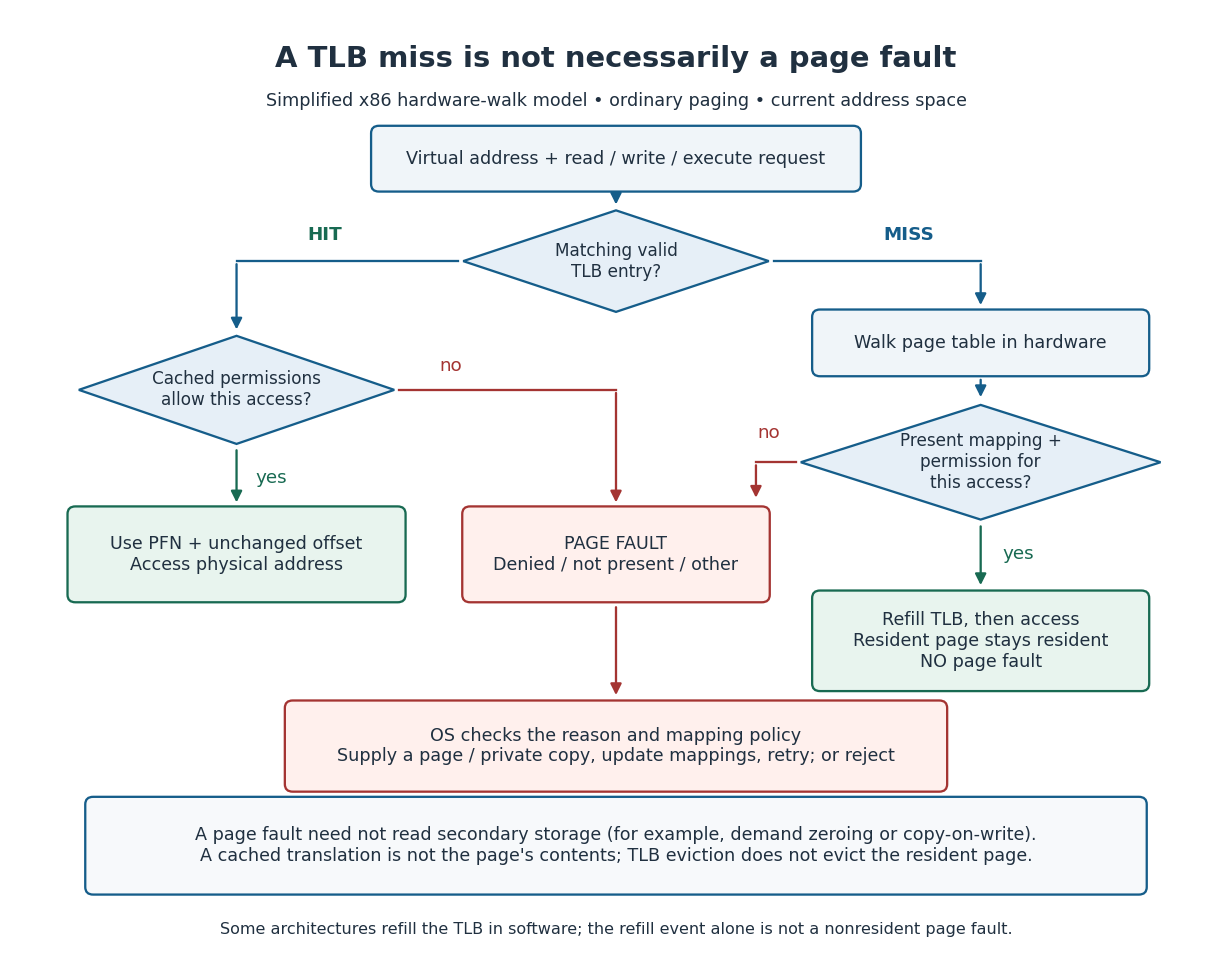
A TLB miss can refill a resident translation without a page fault; permission failures can fault on a TLB hit
. Details. The diagrams show an ordinary x86 model with hardware page table walks. Some architectures use an operating system handler to refill the translation lookaside buffer after a TLB miss; that refill event alone is not a nonresident page fault. Temporal locality helps a small translation lookaside buffer serve repeated accesses, and one entry can cover many bytes. [ref]
Paging: Faster Translations (TLBs). Operating Systems: Three Easy Pieces by Remzi H. Arpaci-Dusseau and others; Arpaci-Dusseau and Arpaci-Dusseau, OSTEP chapter 19: Paging, Faster Translations, sections 19.1 and 19.3
A context switch does not universally flush the whole translation lookaside buffer. An address space identifier can distinguish translations with the same virtual page number in different address spaces; Intel's PCIDs support retaining translations across appropriate switches. The operating system must still invalidate stale translations when mappings or permissions change, following the architecture's rules, including coordination with other processors that could use them. [ref]
A page fault transfers control to the operating system when an access cannot proceed under the current paging translation or protection rules. The term includes both unavailable translations and forbidden accesses on x86. Intel's manual distinguishes these causes; AMD's error code likewise distinguishes ordinary not-present faults from protection violations. Other architectural causes, including malformed page table entries, also exist. [ref]
https://cdrdv2-public.intel.com/671200/325462-sdm-vol-1-2abcd-3abcd.pdf. Intel SDM, volume 3A, section 4.7: Page-Fault Exceptions
[ref]https://docs.amd.com/api/khub/documents/sD1_QL~h4Afq2_tvzxqqSQ/content. AMD64 Architecture Programmer's Manual, volume 2, revision 3.44, section 8.4.2: Page-Fault Error Code
The illustrative page table in paging separates three situations:
- A read at virtual address
0x1434targets a permitted but nonresident memory page. The operating system may supply it and retry the access. - A write at virtual address
0x1234targets a resident, read-only memory page. The page fault is caused by missing write permission, not by missing contents. - A read at virtual address
0x1534targets an unmapped part of the address space. The operating system must reject it unless its policy authorizes creating a mapping.
A page fault is not necessarily a program error or a storage-device read. Demand paging can allocate a zero-filled page frame without reading secondary storage. A copy-on-write write deliberately encounters read-only permissions; the operating system supplies a private copy and enables the write. A truly forbidden access may instead terminate the operating-system process. The handler interprets the fault using both architectural fault information and its own mapping policy. [ref]
https://pages.cs.wisc.edu/~remzi/OSTEP/vm-complete.pdf. Arpaci-Dusseau and Arpaci-Dusseau, OSTEP chapter 23: demand zeroing and copy-on-write
For a nonresident memory page whose contents must be loaded, the handler obtains a page frame, possibly invokes page replacement, supplies the contents, updates the page table, arranges any necessary translation lookaside buffer invalidation, and resumes the operation. If no mapping or permission can legally be supplied, it reports failure. This mechanism lets ordinary accesses request work only when it becomes necessary. [ref]
Beyond Physical Memory: Mechanisms. Operating Systems: Three Easy Pieces by Remzi H. Arpaci-Dusseau and others; Arpaci-Dusseau and Arpaci-Dusseau, OSTEP chapter 21: Beyond Physical Memory, Mechanisms, sections 21.3–21.5
// Target: computer-science.bigb
Choosing a resident memory page to evict when another memory page needs an occupied page frame. An unused page frame needs no eviction. A dirty memory page requires preservation before reuse, accounted for separately as page writeback. A page replacement policy balances likely future reuse against the overhead of tracking past memory references.
The opportunity comes from temporal locality: retaining a recently accessed memory page can spare a later nonresident page fault. Spatial locality helps consecutive accesses reuse the same memory page until they cross its boundary. A working set describes recent demand, while the resident set describes what is actually present. A small active footprint can fit in the available page frames even when the whole address space cannot. These are useful workload tendencies, not guarantees about future memory references.[ref]
The page-reference trace below uses the counterexample discussed in Operating Systems: Three Easy Pieces by Remzi H. Arpaci-Dusseau and others (chapter 22, p. 5) and makes the decisions explicit. FIFO page replacement ranks arrival time, LRU replacement ranks last access, CLOCK page replacement samples recent use, and optimal page replacement knows the remaining sequence in advance. Count misses first; page-replacement cost accounting separately counts page writeback and explains why fewer misses need not mean less total service time.
// Destination: computer-science.bigb
Making a memory page resident when it is first accessed, using a page fault to request the work. It can involve loading stored contents or allocating newly initialized contents.
// Target: computer-science.bigb
A slot in main computer memory that can hold one memory page of the selected size. Physical frame number
0x07 with 256-byte page frames starts at physical address 0x0700.A contiguous unit of an address space used for paging. In the example, virtual page
0x12 consists of virtual addresses 0x1200 through 0x12ff.For a nonnegative integer and a prime number , the Legendre formula computes the prime exponent in a factorial without forming that huge product:Here is the floor function. The sum is finite: every term with is zero. When , all terms vanish, agreeing with and . The prime number hypothesis matters: a composite number does not give the same p-adic valuation or additive prime exponent. For example, the floor sum with is one, whereas divides .
Why count multiples repeatedly? Each multiple of in contributes one factor of ; each multiple of contributes another; and so on. A factor with p-adic valuation occurs in exactly the first counts. Adding those contributions proves the formula.[ref]
Number Theory for Mathematical Contests by David Anthony Santos. David A. Santos, Number Theory for Mathematical Contests, revision 31 October 2007, §8.3, Theorem 245, printed pp. 89–90: factorial valuation and digit form
For the original example ,The five multiples each contribute a second factor of three. The factor contributes a third, so it appears in all three rows. Equivalently, among there are eleven factors of p-adic valuation one, four of valuation two, and one of valuation three: . Thus divides , while does not.
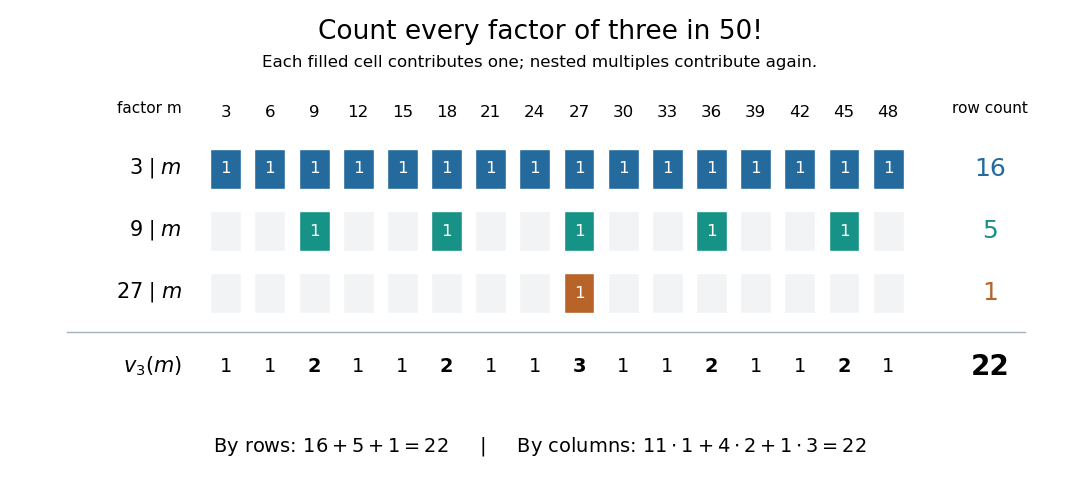
Nested multiples count the factors of three in
. Each colored cell contributes one to the p-adic valuation. Multiples of nine occur in two rows, and occurs in three. Summing by rows gives ; summing by columns gives . Factors not divisible by three contribute zero and are omitted. Details.Repeated Euclidean division provides a practical evaluation: replace by , starting from , and add each new quotient until it is zero. This uses only the successive quotients for the example. The same calculation handles divisibility of binomial coefficients, where the p-adic valuations of the denominator factorials are subtracted.
Oxygen-16 is the stable oxygen isotope with eight protons and eight neutrons. It is the most abundant oxygen isotope in ordinary terrestrial material.
Its nucleus has spin zero, unlike oxygen-17, so isotope choice changes which nuclear-magnetic-resonance experiments are possible. Isotopic identity therefore affects both mass-sensitive measurements and nuclear-spin observability without changing the element's proton number.
An oxidation state is an electron-bookkeeping assignment to a chemical atom: its electric charge number after the ionic approximation of bonds. It helps identify oxidation and reduction and determine stoichiometry, even for covalent bonds without separate charged ions. In water, each hydrogen has oxidation state and oxygen has ; this does not assert that a water molecule contains two free protons and a free oxide ion.[ref]
Comprehensive definition of oxidation state (IUPAC Recommendations 2016) by Pavel Karen and others. Karen, McArdle and Takats, Comprehensive definition of oxidation state (IUPAC Recommendations 2016), §2, pp. 832–833: definition and equal splitting of same-element bonds
Three conventions answer different questions. Formal charge divides each bonding electron pair equally in a chosen Lewis structure. Oxidation state uses the ionic approximation of bonds. Partial atomic charge instead partitions the actual electron density and depends on that partition. In the ordinary water Lewis structure, every formal charge is zero although the oxidation states are not. Neither bookkeeping convention supplies numerical partial atomic charges.
An upward angular spectrum obtained from a horizontal field trace is exact in the homogeneous half-space above that reference plane. For a rough boundary , choose the plane above . A trace at is not physically defined in the medium if any part of the surface lies above it. Using such a mean-plane trace requires an analytic continuation convention; convergence of the continued spectrum down to the rough boundary is an additional hypothesis. Small-height boundary perturbation uses the reference plane formally order by order and is distinct from an exact expansion throughout an arbitrary rough domain.
Use and on the upward branch. If the uncentered field correlation is translationally homogeneous and , its correlation at height is the displayed integral. The propagating spectrum is unchanged; evanescent contributions decrease as . A spectral measure of a stationary random field permits discrete coherent components. Without correlation homogeneity a double spectral covariance integral depends on both observation coordinates rather than only their separation.
Pinned article: Introduction to the OurBigBook Project
Welcome to the OurBigBook Project! Our goal is to create the perfect publishing platform for STEM subjects, and get university-level students to write the best free STEM tutorials ever.
Everyone is welcome to create an account and play with the site: ourbigbook.com/go/register. We belive that students themselves can write amazing tutorials, but teachers are welcome too. You can write about anything you want, it doesn't have to be STEM or even educational. Silly test content is very welcome and you won't be penalized in any way. Just keep it legal!
Intro to OurBigBook
. Source. We have two killer features:
- topics: topics group articles by different users with the same title, e.g. here is the topic for the "Fundamental Theorem of Calculus" ourbigbook.com/go/topic/fundamental-theorem-of-calculusArticles of different users are sorted by upvote within each article page. This feature is a bit like:
- a Wikipedia where each user can have their own version of each article
- a Q&A website like Stack Overflow, where multiple people can give their views on a given topic, and the best ones are sorted by upvote. Except you don't need to wait for someone to ask first, and any topic goes, no matter how narrow or broad
This feature makes it possible for readers to find better explanations of any topic created by other writers. And it allows writers to create an explanation in a place that readers might actually find it.
Figure 1. Screenshot of the "Derivative" topic page. View it live at: ourbigbook.com/go/topic/derivativeVideo 2. OurBigBook Web topics demo. Source. - local editing: you can store all your personal knowledge base content locally in a plaintext markup format that can be edited locally and published either:This way you can be sure that even if OurBigBook.com were to go down one day (which we have no plans to do as it is quite cheap to host!), your content will still be perfectly readable as a static site.
- to OurBigBook.com to get awesome multi-user features like topics and likes
- as HTML files to a static website, which you can host yourself for free on many external providers like GitHub Pages, and remain in full control

Figure 2. You can publish local OurBigBook lightweight markup files to either OurBigBook.com or as a static website.
Figure 3. Visual Studio Code extension installation.
Figure 5. . You can also edit articles on the Web editor without installing anything locally. Video 3. Edit locally and publish demo. Source. This shows editing OurBigBook Markup and publishing it using the Visual Studio Code extension. 
- Infinitely deep tables of contents:




All our software is open source and hosted at: github.com/ourbigbook/ourbigbook
Further documentation can be found at: docs.ourbigbook.com
Feel free to reach our to us for any help or suggestions: docs.ourbigbook.com/#contact