Topics (384k) Articles (398k) Users (410) Discussions (242) Comments (383) Files (13k) New article

Optical coherence describes correlations between the wave amplitudes and wave phases of light sampled at different places or times. Its most direct classical test is wave interference: combine two samples of a field and see how much the detected light intensity changes when their relative wave phase is scanned. First-order optical coherence makes this statement quantitative; temporal optical coherence compares delayed samples, while spatial optical coherence compares different positions. These properties are relative to the samples and averaging procedure, rather than a single yes-or-no label for a source. [ref]
https://www.rp-photonics.com/coherence.html. Rüdiger Paschotta, RP Photonics Encyclopedia, Coherence: field correlations and the two kinds of coherence
.A useful surprise is that two copies of a fluctuating source can interfere strongly when they have matched delays: the copies share the fluctuations. Conversely, two individually steady-looking beams need not have correlated wave phases. The ideal diffraction grating calculation requires spatial optical coherence across its illuminated elements; unequal-arm measurements with a Michelson interferometer test temporal optical coherence.
Fraunhofer diffraction is the far-field approximation for diffraction: contributions from an aperture reach a selected observation direction with approximately linear path-dependent wave phases. Adding their complex amplitudes gives a Fourier transform of the field across the aperture. It also describes the appropriate rear focal plane of an ideal optical lens under coherent plane-wave illumination. The diffraction grating examples use this regime. [ref]
Two-Dimensional Fourier Optics. Richard Fitzpatrick, Wave Optics, §10.9: Two-dimensional Fourier optics
; [ref]https://web.mit.edu/2.710/Fall06/2.710-wk10-a-sl.pdf. MIT 2.71/2.710 Optics, The ideal thin lens as a Fourier transform engine, slides 12–14: back focal plane diffraction
.For a slit of width , wavelength and screen distance , sufficient conditions near the forward direction areThe last two statements are equivalent: the important comparison is with , rather than just with the slit width. For a finite rectangular aperture, check the corresponding condition for both transverse dimensions. The single-slit diffraction calculation treats the transverse cut associated with width . [ref]
https://farside.ph.utexas.edu/teaching/315/Waves/node99.html. Richard Fitzpatrick, Wave Optics, §10.10, equations 10.93–10.96: far-field conditions
.A short explanation is that the distance from slit coordinate to an observation point at distance and angle isThe linear term supplies the phase difference; the quadratic term supplies a wave phase error of order , since the wavenumber is . Near the forward direction , so the stated condition makes this error small. This is why a distant screen permits the simple single-slit diffraction formula. [ref].
Beam divergence describes the angular spread of a beam away from its optical axis; specify the radius convention and whether the quoted angle is a half-angle or full angle. For the fundamental Gaussian beam in vacuum, the far-field light intensity radius obeysHere is the small-angle half-angle in radians under the paraxial approximation; the full angle is . The geometric asymptote has angle , approximated by in this regime. Other beam profiles need their own beam divergence definitions and propagation laws.
The entropy density of a photon gas is its entropy per physical volume, . For homogeneous equilibrium vacuum radiation with two states of electromagnetic polarization and zero photon chemical potential,The first equality is the entropy density at zero chemical potential, obtained from the thermodynamic Euler relation with internal energy . The second uses the photon gas equation of state, and . If an independently constrained photon number gives a nonzero chemical potential, the general entropy density is and need not hold. This distinction explains why the absence of a conserved number matters for entropy as well as for the spectral shape. [ref]
https://davidtong.org/teaching/statistical-physics/statmechhtml/S4#S4.SS4. David Tong, Statistical Physics, §4.4: Gibbs free energy and the thermodynamic Euler relation
A short first law of thermodynamics check, for neighboring equilibrium states with , isThe thermodynamic Euler relation fixes the additive normalization. Equivalently, this radiation entropy tends to zero with temperature at fixed volume; no contribution from the containing walls is included. Interpreting as transferred heat and as boundary work requires a reversible thermodynamic process. For a reversible thermodynamic process that is also an adiabatic process, there is no entropy production or entropy exchange, soAn irreversible adiabatic process can produce entropy even without heat exchange, so the word adiabatic alone is insufficient to infer .
For an analytic example, expand an initially equilibrated photon gas reversibly from to , keeping only the same two photon states of electromagnetic polarization. Its temperature halves, its energy density becomes , its entropy density of a photon gas becomes , and its total entropy stays . The internal energy halves rather than remaining fixed: the missing half leaves as work against radiation pressure,This is a stipulated reversible radiation model, not a report of a piston experiment. Maintaining a real cavity along this path requires controlling wall heat exchange and including the wall heat capacity in any actual apparatus balance.
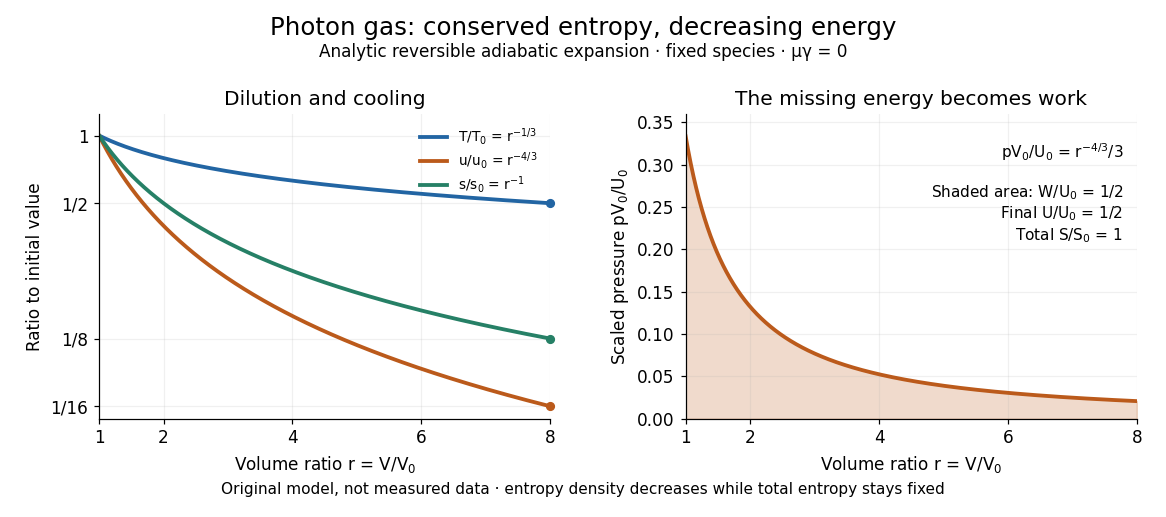
For a computed scale at stipulated , . Combining this with the photon number density givesThis is the total equilibrium radiation entropy divided by its mean photon number, not a separately assigned entropy carried by each labeled particle. During the ideal expansion, and is fixed, so the mean number also stays constant. This follows from the path; it was not imposed as the independent number constraint used to establish chemical potential.
The beautiful connection is that expansion lowers each typical photon energy and dilutes the radiation in just the proportions needed to retain its equilibrium spectral shape and total entropy. For the cosmic microwave background, homogeneous expansion of the universe has physical volume proportional to the cube of the scale factor; fixed-species cosmological entropy conservation therefore gives . This describes preservation of an already established Planck photon distribution and connects the FIRAS spectral observation in photon gas to an entropy prediction; FIRAS did not perform a direct entropy measurement. When other equilibrated species disappear and transfer energy into radiation, use the effective number of relativistic entropy degrees of freedom, : the conserved quantity for the combined sector is , under the corresponding equilibrium and no-entropy production assumptions. A changing species population, separate decoupled sectors or entropy production requires an appropriate entropy balance rather than the pure photon gas formula. [ref]
https://davidtong.org/teaching/cosmology/cosmohtml/S2#S2.SS5.SSS2. David Tong, Cosmology, §2.5.2: entropy conservation and heating when relativistic species disappear
For a photon in a fixed spatial mode, the two transverse photon polarizations span a qubit space. A pure photon polarization state is with , and a general state is a two-dimensional density matrix. Its Bloch vector gives the normalized Stokes parameters. Polarization-dependent path separation can correlate this internal degree of freedom with a path qubit.
// Target: quantum-error-correction.bigb
Luminous flux is the visually weighted counterpart of radiant flux, measured in lumens. Its value depends on the optical spectrum and the specified visual response; it is distinct from radiant flux in watts.[ref]
A photometer measures a visually weighted radiation quantity. A filtered photodiode approximates the photopic luminous efficiency function with its spectral responsivity; calibration establishes how its electric current maps to illuminance or collected luminous flux. NIST's detector-based realization traces the spectral responsivity to a cryogenic radiometer and the aperture area to length measurements. [ref]
Illuminance is incident luminous flux per receiving area, measured in lux. It is the visually weighted counterpart of irradiance. Uniform illumination of an aperture of area gives collected luminous flux . An aperture measurement alone does not give a source's total emitted luminous flux.[ref]
Luminous intensity is luminous flux per outgoing solid angle, measured in candelas. It is the visually weighted counterpart of radiant intensity. The same total luminous flux concentrated into a narrower cone can give a greater luminous intensity within that cone.[ref]
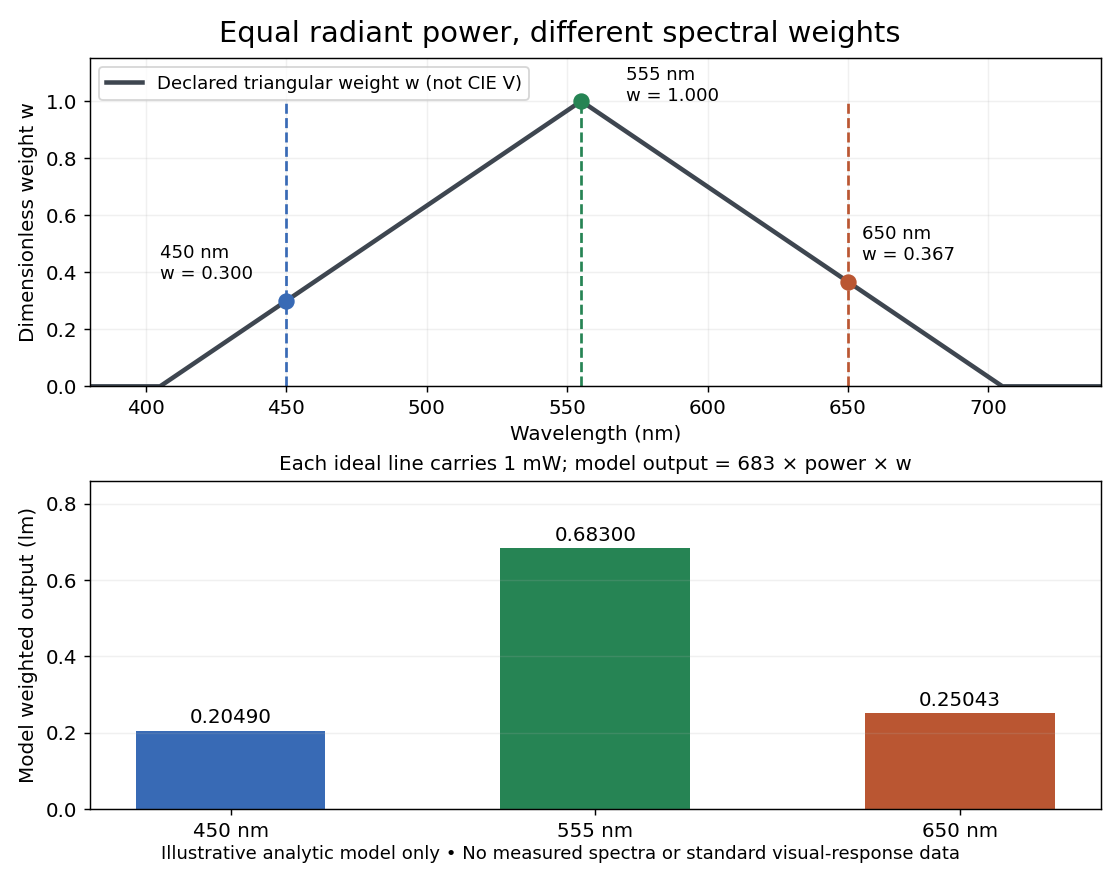
An original declared model makes the distinction visible without substituting invented numbers for the photopic luminous efficiency function. Define a triangular weightThis is an illustrative function, not a fit or table of . Three ideal spectral lines, each carrying radiant flux , at , and have weights , and . Their model weighted outputs are respectively , and approximately . These are model calculations, not standard luminous fluxes or measured data. For mixtures of these lines the model outputs add, just as the integral adds independent spectral contributions.
The luminous efficacy of radiation is luminous flux divided by total radiant flux, in , for the specified visual conditions. For nonzero radiant flux, it is a spectral weighted mean of spectral luminous efficacy. Specify the denominator: a lamp's luminous efficacy relative to electrical input power also includes conversion losses and is a different ratio. [ref]
Spectral luminous efficacy converts radiant flux at one wavelength to luminous flux. The candela convention fixes exactly at , not at an exactly specified wavelength of . [ref]
In vacuum, that frequency corresponds to , using the speed of light. In standard air it is approximately , close to the maximum of the photopic luminous efficiency function. Thus is slightly larger than ; using in ordinary calculations is a rounded convention. The exact anchor is . [ref]
Scotopic vision is vision at low illumination dominated by rod cells. It provides high sensitivity to weak light but little of the color discrimination associated with cone cells. Consequently equal radiant powers at different wavelengths need not appear equally bright, and brightness comparisons change with illumination level.
A simple observation compares colored patches as illumination is reduced after adaptation: their relative brightness can change even though the illuminating optical spectrum is held approximately fixed. Controlled measurements must allow adaptation and avoid stray illumination. A photopic luminous efficiency function is appropriate to a different viewing regime and cannot be used indiscriminately for scotopic vision.
Photopic vision means vision under light-adapted conditions. Standard photometry here uses the photopic luminous efficiency function; scotopic vision uses a different weighting for dark-adapted conditions. The response function and adaptation conditions must be stated when comparing luminous fluxes.[ref]
Mise en pratique for the definition of the candela and associated derived units for photometric and radiometric quantities in the SI. §3.1, printed p. 3: photopic and scotopic luminous efficiency functions
The photopic luminous efficiency function is dimensionless and describes standardized relative sensitivity for photopic vision. It is normalized to and tabulated over –. The wavelength coordinate is in standard air, rather than vacuum; changing coordinates requires converting the spectral radiant flux density as well. The official prescription uses linear interpolation between the specified 1 nm entries.[ref]
Mise en pratique for the definition of the candela and associated derived units for photometric and radiometric quantities in the SI. §3.1, printed pp. 2–3: wavelength convention, normalized functions and interpolation
Write for the standard-air wavelength at . With spectral radiant flux in and in nanometres, the luminous flux isThe integral has units of watts, and converts them to lumens. For radiation at a single wavelength with total radiant flux , this reduces to . For a sufficiently narrow finite band, this is an approximation requiring nearly constant across the band.[ref]
For isotropic specific intensity , absorption cross-section , and threshold frequency , the photoionization rate per target atom isFor a directed incident flux, replace by its spectral flux density. The factor converts energy flux into photon flux. This rate alone does not imply photoionization equilibrium.
A molecular nitrogen experiment used a pulsed nozzle and two skimmers. A tube raised the rotational temperature. Opposed vacuum-ultraviolet laser pulses excited selected molecular levels and, about later, selectively ionized excited nitrogen fragments. A microchannel plate detector, phosphor screen and camera recorded radii.[ref]
Accurate measurements of the bond dissociation energies of 14N2, 14N15N and 15N2 by Liya Lu and others. Lu, Jiang and Gao, §2, printed manuscript pp. 2–3: nozzle, tube, pump/probe and imaging readout
The measured squared radii were fitted against molecular excitation energies, referenced to the parent ground state:The intercept at zero radius gave the excited-product threshold; the fitted slope absorbed the detector scale. A wavemeter monitored the excitation source; scanning the probe covered the recoil Doppler shift. Subtracting the atomic excitation energies converted the intercept to ground-product .[ref]
Accurate measurements of the bond dissociation energies of 14N2, 14N15N and 15N2 by Liya Lu and others. §1: image-radius equation; §2: wavemeter and probe scan; §3 and Figure 4: fits; §4: atomic excitation correction
An apertured grounded plate and detector timing rejected faster competing channels. Selecting fragment electronic states distinguished nearby thresholds. Agreement of across isotopes after zero-point energy correction tested consistency. The method still requires correctly assigned levels, adequate near-threshold signal and stable imaging; a signal drop alone can reflect another channel or a barrier.[ref]
Accurate measurements of the bond dissociation energies of 14N2, 14N15N and 15N2 by Liya Lu and others. §2: shielding plate and timing; §3: state-selected channels; §4 and Table 2: isotope consistency and limitations
This measurement determines a state-resolved ground-state dissociation energy. Obtaining a finite-temperature bond-dissociation enthalpy requires the thermal increments above; obtaining a bond potential-well depth requires the zero-point energy correction. The three quantities describe different starting conditions for the same specified separation.
Sphingomyelin is a phospholipid whose backbone is based on sphingosine, rather than glycerol. One long hydrocarbon region belongs to that backbone and another comes from an attached fatty acid. It is a counterexample to defining every phospholipid by the illustrated glycerol scaffold. See Cooper, The Cell: the molecular composition of cells.
Glycerophospholipids are phospholipids built on a glycerol-phosphate scaffold. The illustrated two-acyl group form is common, but the subclass also includes other substitutions and one-chain derivatives. See IUPAC–IUB lipid nomenclature, Lip-2.2 and Lip-2.6.
For unit-mass motion in , the mechanical energy is . The origin is a center equilibrium, and is a saddle equilibrium. Energies have trapped periodic orbits around the origin as well as a separate escaping component to the right. The barrier energy has a homoclinic orbit returning to the saddle after a turn at , plus two saddle branches on . Above the barrier, particles traverse the well and eventually escape to the right.
Pinned article: Introduction to the OurBigBook Project
Welcome to the OurBigBook Project! Our goal is to create the perfect publishing platform for STEM subjects, and get university-level students to write the best free STEM tutorials ever.
Everyone is welcome to create an account and play with the site: ourbigbook.com/go/register. We belive that students themselves can write amazing tutorials, but teachers are welcome too. You can write about anything you want, it doesn't have to be STEM or even educational. Silly test content is very welcome and you won't be penalized in any way. Just keep it legal!
Intro to OurBigBook
. Source. We have two killer features:
- topics: topics group articles by different users with the same title, e.g. here is the topic for the "Fundamental Theorem of Calculus" ourbigbook.com/go/topic/fundamental-theorem-of-calculusArticles of different users are sorted by upvote within each article page. This feature is a bit like:
- a Wikipedia where each user can have their own version of each article
- a Q&A website like Stack Overflow, where multiple people can give their views on a given topic, and the best ones are sorted by upvote. Except you don't need to wait for someone to ask first, and any topic goes, no matter how narrow or broad
This feature makes it possible for readers to find better explanations of any topic created by other writers. And it allows writers to create an explanation in a place that readers might actually find it.
Figure 1. Screenshot of the "Derivative" topic page. View it live at: ourbigbook.com/go/topic/derivativeVideo 2. OurBigBook Web topics demo. Source. - local editing: you can store all your personal knowledge base content locally in a plaintext markup format that can be edited locally and published either:This way you can be sure that even if OurBigBook.com were to go down one day (which we have no plans to do as it is quite cheap to host!), your content will still be perfectly readable as a static site.
- to OurBigBook.com to get awesome multi-user features like topics and likes
- as HTML files to a static website, which you can host yourself for free on many external providers like GitHub Pages, and remain in full control

Figure 2. You can publish local OurBigBook lightweight markup files to either OurBigBook.com or as a static website.
Figure 3. Visual Studio Code extension installation.
Figure 5. . You can also edit articles on the Web editor without installing anything locally. Video 3. Edit locally and publish demo. Source. This shows editing OurBigBook Markup and publishing it using the Visual Studio Code extension. 
- Infinitely deep tables of contents:




All our software is open source and hosted at: github.com/ourbigbook/ourbigbook
Further documentation can be found at: docs.ourbigbook.com
Feel free to reach our to us for any help or suggestions: docs.ourbigbook.com/#contact