Topics (384k) Articles (398k) Users (410) Discussions (242) Comments (383) Files (13k) New article

For , , the energy satisfies . At , its compact level sets give two families of closed periodic orbits around and an outer family around both; is a figure-eight homoclinic orbit pair through the saddle point at the origin. The two minima of are center equilibria for zero damping, stable foci for small negative , and unstable foci for small positive . For , strict monotonicity along nonconstant solutions excludes periodic orbits and homoclinic orbits.
For , the difference vanishes on and multiplies by . Its operator norm is therefore . Choosing the nearest angle on the grid , with circular distance, gives and a uniform bound of this size on the output-state norm error. This bound concerns state vectors, not an asserted equality with measurement-probability error.
Wick theorem expresses a time-ordered product of free fields as its normal-ordered product plus the sum over every possible contraction. It turns the Dyson series into Feynman diagrams.
A permutation with no fixed points. Applying the inclusion-exclusion principle to the events that each element is fixed gives . Therefore , and the alternating-series remainder is at most .
// Destination: foundations-of-mathematics.bigb
In a uniformly random permutation of objects, the cycle containing one specified object has a uniform length on . For length , choose the other objects, arrange their order around the tagged object, and permute all remaining objects. The count is , independent of . Its mean is , while the mean number of other elements in that cycle is .
A uniform random permutation of distinct objects gives each of the permutations the same probability. Restricting the order to any fixed subset gives a uniform ordering on that subset. Relative ranks encode such a permutation bijectively by independent choices of an insertion position.
A finitely supported permutation fixes every element outside some finite subset. The finitely supported permutations of are the union of the finite symmetric groups acting on , and hence form a countable set. All permutations of form an uncountable set: independently swapping or fixing each pair injects the power set of into this larger set.
A cyclic permutation, also called a permutation cycle, sends distinct elements and fixes every element outside this list. Its notation is . For example, is the permutation with image list : all four labels lie on one directed loop. In contrast,has two separate loops, exchanging with and with . It is a permutation composed of two transpositions, rather than a single cyclic permutation.
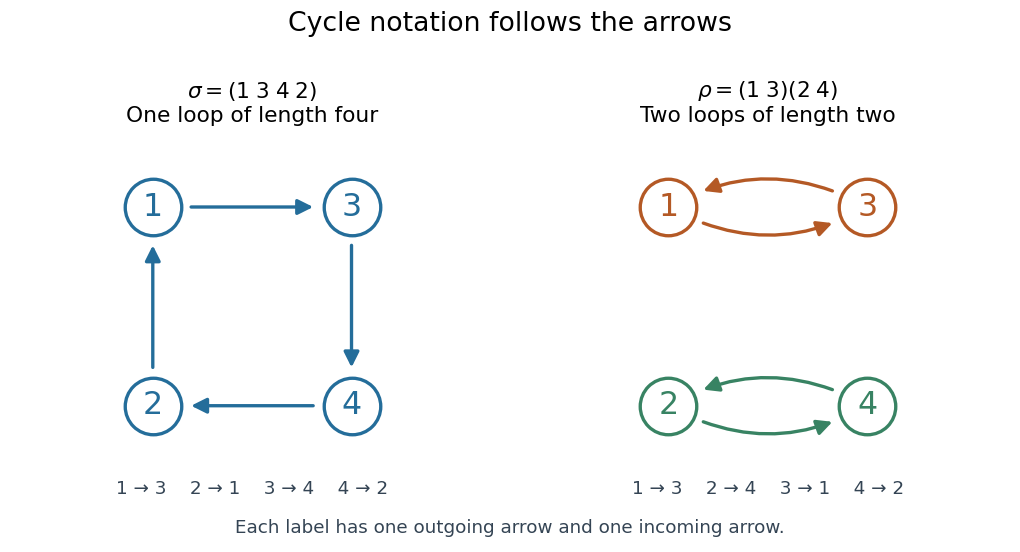
Two permutations on four labels: one cyclic permutation and two disjoint permutation cycles , with arrows showing every image
. Details. Starting at a different point of the same loop changes the written list but preserves the cyclic permutation: . Reversing the direction generally changes the permutation; it gives the inverse function, here . A transposition is a cyclic permutation of length two; a one-element permutation cycle records a fixed point. In a cycle decomposition of a permutation, one-element permutation cycles are usually omitted, with the underlying set understood.
The beauty of this representation is that repeated rearrangements become motion around independent loops. Applying four times returns every label to its start, while applying twice already does so. Disjoint permutation cycles commute under function composition, since each moves only labels the others fix. On labels, there are cyclic permutations whose single loop contains every label: fix as the first written entry and order the other labels freely, giving a factorial. This is also the count of cyclic orderings; choosing a starting position would otherwise count each loop times. Rotations are identified here, while reversing direction is allowed to give a different cyclic ordering.
Proof outline for decomposition. Starting at any label in a finite set, repeatedly apply the permutation. The pigeonhole principle forces a repeated label. If the first repetition were at a label other than the starting one, its two predecessors would be different labels with the same image, contradicting the injective function property. This produces a permutation cycle returning to the start. Start again at a label not yet visited; the new permutation cycle cannot meet an earlier one, since the bijection gives every label a unique predecessor. Continue until every label belongs to a loop. The resulting cycle decomposition of a permutation is unique up to the order of the disjoint permutation cycles and the starting point written in each one. [ref]
https://math.mit.edu/~fgotti/docs/Courses/C.%20Combinatorial%20Analysis/11.%20Permutations%20I/Permutations%20I.pdf. Felix Gotti, MIT 18.211, lecture 11, definitions 1–2 and the preceding argument
The motivating observation is that inserting an insulating material between fixed capacitor plates increases its capacitance. [ref]
https://www.feynmanlectures.caltech.edu/II_10.html#Ch10-S1. Feynman, Leighton and Sands, II.10–1, opening paragraphs: observed increase in capacitance with an inserted insulator
. To investigate this response, use two flat parallel metal electrodes with measured overlapping area and separation , a uniform specimen filling the gap, and an instrument that measures electrical impedance. Record the capacitance with and without the specimen at the same small applied electric potential difference, frequency and temperature, after capacitance measurement calibration. An increase in corrected capacitance indicates a larger permittivity, provided the geometry is unchanged. A guard electrode reduces the contribution of the fringing field of a capacitor. [ref].For negligible dielectric loss in the parallel-plate capacitor approximation,An air reference approximates ; it is not an exact vacuum reference. For the following synthetic example, stipulate , and the rounded vacuum permittivity . Then in this model, and relative permittivity four gives . A residual parallel capacitance of would make an uncorrected sample/reference ratio , rather than four. This additive error does not cancel in a ratio.
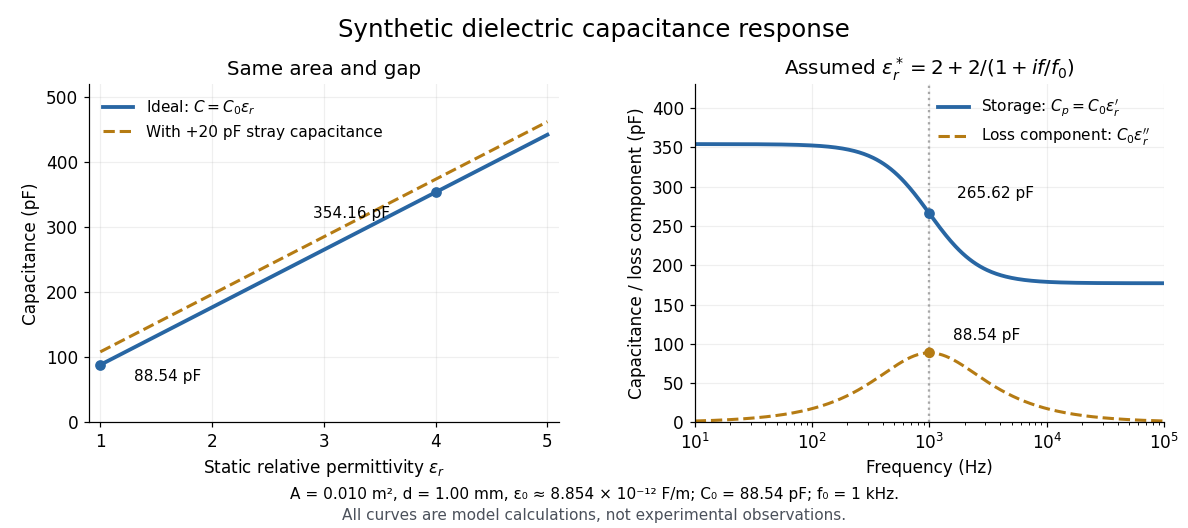
At nonzero frequency , measure both magnitude and phase of the electric current relative to the applied electric potential difference. Define , where is electrical impedance. For the stated complex permittivity convention, the ideal uniform specimen givesThus a parallel capacitor and electrical conductance describe the readout at that frequency; a single scalar capacitance cannot describe both components. The diagram's assumed dielectric relaxation gives and at . These are model predictions, not observations.
Repeat the reference measurement after removing the specimen and vary the small applied electric potential difference to test drift and linearity. Record specimen thickness, electrode area, contact conditions, frequency and temperature. Air gaps act as additional layers in series and can lower inferred relative permittivity; roughness, uncertain thickness and the fringing field of a capacitor limit the geometric formula. At sufficiently high frequency, the fixture itself changes the electromagnetic field, so low-frequency guarding and a lumped capacitor model require reassessment. [ref].
For harmonic electric fields with time convention , write for their complex amplitudes, where is angular frequency. The real part describes the in-phase electric displacement field; the minus imaginary part describes the loss component. The sign reverses with the opposite time convention. Complex permittivity can also be a tensor in a linear anisotropic dielectric.
A dielectric is a material in which an electric field produces electric polarization while transport of electric charge is sufficiently small for the intended use. An insulating solid in a capacitor is an example; real dielectrics can still have dielectric loss and nonzero electrical conductivity.
The important distinction is between rearranging bound electric charge and transporting mobile charge carriers through the specimen. Bound electric charges can move a little within a chemical atom or molecule, or an existing electric dipole can turn. Their averaged electric dipole moments produce electric polarization even if there is negligible steady electric current between the electrodes. A changing electric polarization does give a bound current; the absence of steady conduction does not mean that the material is electrically unresponsive.[ref]
For uniform electric polarization in a rectangular slab, polarization density gives zero bound volume charge density in the interior and opposite bound surface charge densities on the left and right faces. The electric charge has been redistributed, not created. More generally, the divergence theorem makes the cancellation explicit:Here is the outward normal vector on the material boundary. This accounts for both bound volume charge density and bound surface charge density; omitting either can falsely suggest that an initially neutral dielectric acquired net electric charge.
An electrical insulator between capacitor plates supports a useful combination: appreciable electric polarization, little leakage electric current, and tolerance of the intended electric field. This lets a small parallel-plate capacitor store separated electric charge and recoverable capacitor energy. The comparison in dielectric capacitor response explains why specifying fixed electric charge or fixed electric potential difference changes the answer. High relative permittivity alone does not establish good insulation or a large usable energy density; dielectric loss and dielectric breakdown matter as well.
Thawing permafrost makes previously frozen organic matter available for decomposition, releasing carbon dioxide and, in waterlogged oxygen-poor conditions, methane. These greenhouse gases amplify warming, which can cause further thaw. The amount reaching the atmosphere depends on decomposition, transport and oxidation; this feedback does not imply an inevitable abrupt release of an entire carbon reservoir.
A periodic table period is a horizontal row of the periodic table, read in increasing atomic number. Periodic table period 2 runs from lithium, , to neon, : chemical elements. In these neutral ground states, the second electron shell gains electrons while the first retains two.
A periodic group is a vertical column of the periodic table. For example, fluorine and chlorine are in periodic group 17, with seven valence electrons in each neutral ground state chemical atom. A shared outer electron configuration supports similarities in chemical reactions, rather than equality of every property.
A periodic orbit of a differentiable interval map is superstable when its periodic-orbit multiplier vanishes. A cycle passing through a critical point has zero multiplier because the derivative product includes . For the nonconstant quadratic family , a superstable cycle satisfies and does not have a smaller critical period.
// Target: dynamical-systems.bigb
Somatostatin is a peptide hormone that inhibits secretion in several endocrine and digestive contexts. Pancreatic delta cells release it locally, where it can restrain insulin and glucagon secretion. Its effects depend on receptor subtype and target cell rather than a universal suppression of all cellular activity. Processing of a common precursor generates biologically active peptide forms of different lengths. [ref]
UniProtKB by the UniProt Consortium. P61278, Function, Catalytic activity and Subunit structure
With Hardy-Weinberg equilibrium, let count copies of the risk allele. The penetrance must lie in for every possible genotype. Writing and gives and .
For a binary disease trait with genotype , the genetic variance of penetrance is the between-genotype term in the law of total variance. The averaged within-genotype term is . Under multiplicative diallelic penetrance, the genetic term is . This decomposition attributes variance to the modeled locus, not automatically to all hereditary causes.
Pinned article: Introduction to the OurBigBook Project
Welcome to the OurBigBook Project! Our goal is to create the perfect publishing platform for STEM subjects, and get university-level students to write the best free STEM tutorials ever.
Everyone is welcome to create an account and play with the site: ourbigbook.com/go/register. We belive that students themselves can write amazing tutorials, but teachers are welcome too. You can write about anything you want, it doesn't have to be STEM or even educational. Silly test content is very welcome and you won't be penalized in any way. Just keep it legal!
Intro to OurBigBook
. Source. We have two killer features:
- topics: topics group articles by different users with the same title, e.g. here is the topic for the "Fundamental Theorem of Calculus" ourbigbook.com/go/topic/fundamental-theorem-of-calculusArticles of different users are sorted by upvote within each article page. This feature is a bit like:
- a Wikipedia where each user can have their own version of each article
- a Q&A website like Stack Overflow, where multiple people can give their views on a given topic, and the best ones are sorted by upvote. Except you don't need to wait for someone to ask first, and any topic goes, no matter how narrow or broad
This feature makes it possible for readers to find better explanations of any topic created by other writers. And it allows writers to create an explanation in a place that readers might actually find it.
Figure 1. Screenshot of the "Derivative" topic page. View it live at: ourbigbook.com/go/topic/derivativeVideo 2. OurBigBook Web topics demo. Source. - local editing: you can store all your personal knowledge base content locally in a plaintext markup format that can be edited locally and published either:This way you can be sure that even if OurBigBook.com were to go down one day (which we have no plans to do as it is quite cheap to host!), your content will still be perfectly readable as a static site.
- to OurBigBook.com to get awesome multi-user features like topics and likes
- as HTML files to a static website, which you can host yourself for free on many external providers like GitHub Pages, and remain in full control

Figure 2. You can publish local OurBigBook lightweight markup files to either OurBigBook.com or as a static website.
Figure 3. Visual Studio Code extension installation.
Figure 5. . You can also edit articles on the Web editor without installing anything locally. Video 3. Edit locally and publish demo. Source. This shows editing OurBigBook Markup and publishing it using the Visual Studio Code extension. 
- Infinitely deep tables of contents:




All our software is open source and hosted at: github.com/ourbigbook/ourbigbook
Further documentation can be found at: docs.ourbigbook.com
Feel free to reach our to us for any help or suggestions: docs.ourbigbook.com/#contact