Topics (384k) Articles (398k) Users (410) Discussions (242) Comments (383) Files (13k) New article

Jöns Jacob Berzelius developed an alphabetic system of chemical symbols for expressing composition. Combining element symbols with numerical proportions made a chemical formula compact enough to write and print while retaining information about a compound's constituents. His original notation placed the numbers differently from the subscripts familiar in modern formulas.[ref]
https://web.lemoyne.edu/giunta/berzelius.html. 1813–1814 Essay on the Cause of Chemical Proportions: final discussion of letter symbols and numerical composition

Portrait of Jöns Jacob Berzelius
. Charles W. Sharpe, after Olof Johan Södermark. Public domain (PD-old; Public Domain Mark). Source and usage information on the linked Wikimedia file page. Source.Wilhelm Ostwald made catalysis, chemical equilibrium, and reaction rates central subjects of physical chemistry. His account of catalysis emphasized changes in the speed of a chemical reaction; this connects a catalyst's practical effect with the time needed to approach chemical equilibrium.[ref]
Official lecture page, with a portrait: www.nobelprize.org/prizes/chemistry/1909/ostwald/lecture/

Portrait of Wilhelm Ostwald
. Unknown photographer; Smithsonian Institution Libraries source noted on Commons. Public domain (PD-old). Source and usage information on the linked Wikimedia file page. Source.S. P. L. Sørensen introduced the pH scale in 1909 while investigating the importance of acidity for biochemical processes. Expressing acidity logarithmically made it practical to compare conditions spanning many powers of ten and to describe the conditions affecting an enzyme or other biochemical chemical reaction.[ref]
https://carlsberggroup.com/pursuit-of-better/scientific-discoveries/ph-scale/. Carlsberg Laboratory history: 1909 pH scale and biochemical motivation

Portrait of S. P. L. Sørensen
. Julie Laurberg & Franziska Gad (studio attribution stated on Commons). Public domain; Public Domain Mark 1.0. Source and usage information on the linked Wikimedia file page. Source.An organic acid is an organic compound capable of donating a proton in an acid-base reaction. Carboxylic acids and sulfonic acids are important families, but acidic organic compounds need not all contain the same functional group.
Acid strength, quantified by an acid dissociation constant, depends on the stability and solvation of the conjugate base. Comparing different organic acids therefore requires a specified solvent and a defined equilibrium, rather than simply counting acidic hydrogen atoms.
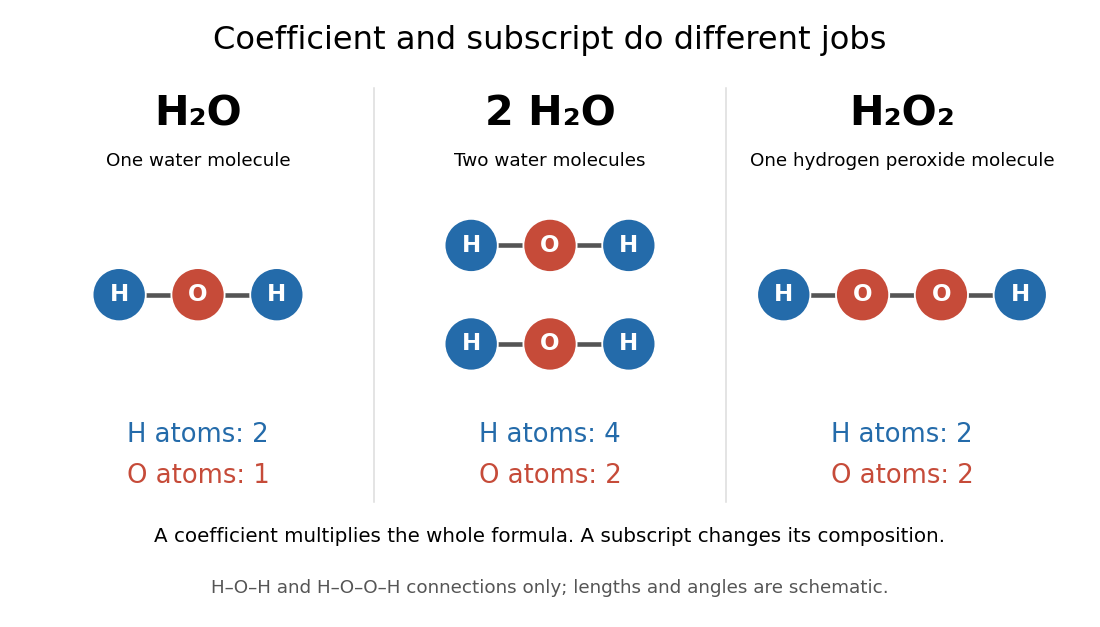
A chemical formula uses symbols of chemical elements and numerical subscripts to record composition. In the molecular formula of water, the subscript counts two hydrogen chemical atoms, and the omitted subscript after means one oxygen chemical atom. A molecular formula describes one molecule; a chemical formula need not describe a discrete molecule.
Read a preceding coefficient separately from the subscripts. One contains two hydrogen and one oxygen chemical atom; contains four hydrogen and two oxygen chemical atoms distributed between two water molecules. In , the second subscript instead puts two oxygen chemical atoms into each hydrogen peroxide molecule. Thus : the coefficient scales the whole chemical formula, while a subscript specifies its composition. See Flowers et al., Chemistry 2e, §2.4: chemical formulas.
For crystalline , the chemical formula specifies a ratio of sodium ions to chlorine ions . Its formula unit is the accounting entity; the ordinary crystal is an extended arrangement of ions, rather than a collection of discrete molecules. Specifying the entity matters when assigning an amount of substance. See formula unit and 2.6 Ionic and Molecular Compounds (§2.6: ionic and molecular compounds).
A molecular formula gives an atom inventory, not the full arrangement of chemical bonds or the molecular geometry. For example, counts six carbon, twelve hydrogen, and six oxygen chemical atoms in a glucose molecule, but does not specify the pattern shown by its Fischer projection. Different structures can share a molecular formula. This compact inventory is useful for chemical equation accounting precisely because it leaves the structural detail to other representations.
The choice of letters has an early explanation in Jöns Jacob Berzelius, Essay on the Cause of Chemical Proportions (1813–1814), §III, transcribed by Carmen Giunta: letters made chemical signs easier to write and print, and formulas compressed information about composition. His numerical notation differed from modern subscripts; the lasting idea was to make proportions readable in ordinary text.
Carbohydrates are a family of chemical substances encompassing monosaccharides, combinations of monosaccharides, and their derivatives. Glucose is a small carbohydrate; cellulose is a long-chain polysaccharide. Deoxyribose illustrates why composition alone does not define the family: replacing a hydroxy group in ribose by hydrogen still leaves a carbohydrate. See IUPAC Gold Book: carbohydrates.
Many familiar monosaccharides have a molecular formula of the form , equivalently . This explains the historical name, “hydrate of carbon”, but does not mean the molecule consists of carbon mixed with intact water molecules. Nor is it a universal formula: deoxyribose has . The family is defined through chemical structure and relationships, not that ratio. See IUPAC's definition and origin of the name carbohydrate.
The useful surprise is the variety of roles obtainable from related building blocks. Glucose participates in metabolism, ribose forms part of RNA, and linked glucose units make structural cellulose in a plant cell wall. Understanding carbohydrates therefore connects cellular energy, molecular information, and material structure. See Alberts et al., Molecular Biology of the Cell: the chemical components of a cell.
Lipids are a chemically diverse family of chemical substances, conventionally associated with biological origin and solubility in nonpolar solvents. They include triglycerides, phospholipids, and cholesterol. The name does not specify one molecular formula, one repeating monomer, or one kind of polymer. Some lipids have both hydrophilic and hydrophobic regions rather than being uniformly nonpolar. See IUPAC Gold Book: lipids.
Structure explains the different jobs. A triglyceride has three fatty acid-derived acyl groups attached to glycerol and serves as an energy store. A typical glycerophospholipid instead combines two such chains with a phosphate-containing head, making it an amphiphile suited to a lipid bilayer. Cholesterol has a different structure and also contributes to cell membrane properties. Thus a lipid is a chemical building material, while a lipid bilayer is an organization of many molecules. See Clark, Douglas and Choi, Biology 2e, 3.3: lipid structures and functions.
A zwitterion has opposite formal electric charges in different regions of a molecule, with zero net electric charge. Phosphatidylcholine provides a membrane-related example. This is stronger than merely having chemical polarity through fractional partial atomic charges. See IUPAC Gold Book: zwitterions.
Sphingosine is an eighteen-carbon amino alcohol with a long unsaturated hydrocarbon chain. Its amino group can form an amide with a fatty acid, producing a ceramide; the long chains help anchor these lipids in a cell membrane.
Sphingosine therefore supplies a structural backbone for many sphingolipids, whereas glycerol supplies the backbone of glycerophospholipids. The two lipid families can have similar membrane roles while differing in their underlying chemical bonds.[ref]
https://www.ebi.ac.uk/chebi/CHEBI:16393. ChEBI: sphingosine, structure and classification
For the carboxylic acid-derived examples here, an acyl group is the group remaining after formal removal of from . It includes the oxygen at the end of the fatty acid-derived chain, so it is more than just a hydrocarbon region. See IUPAC class names: carboxylic acids and derivatives.
Hydrogen peroxide is , containing an oxygen-oxygen single bond. Each oxygen has formal oxidation state , unlike the state in ordinary water.
It can act as either an oxidant or reductant depending on its reaction partner. Its decomposition gives water and oxygen; catalysts alter the rate without changing that overall stoichiometry.
Here an amide means a carbonyl group whose carbon is bonded directly to nitrogen; each of , and may be hydrogen or a group attached through carbon. A peptide bond contains this linkage. Chemical resonance distinguishes its nitrogen from that of an amine. [ref]
https://openstax.org/books/organic-chemistry/pages/24-3-basicity-of-amines. McMurry: amide resonance
and [ref]https://openstax.org/books/chemistry-2e/pages/20-4-amines-and-amides. Flowers et al., Chemistry 2e, 20.4: amide and peptide connectivity
A simple neutral amine has nitrogen bonded to one, two, or three groups attached through carbon, with hydrogen filling the remaining positions in the neutral three-bond form. These are the primary, secondary, and tertiary forms respectively. An amide has different connectivity to a carbonyl group. [ref]
https://openstax.org/books/organic-chemistry/pages/24-1-naming-amines. McMurry: classification of amines
Copper(II) sulfate is , with copper formally in oxidation state +2. Hydrated crystals include water of crystallization, so the hydrate must be specified when converting a weighed mass into a chemical amount.
In the catalysed peroxide comparison, dissolved copper sulfate is treated with sodium hydroxide to form a precipitate. That experiment tests the resulting solid-forming treatment; it does not establish identical catalytic behaviour for every dissolved copper species.
[ref]
Chemistry 2e by Paul Flowers and others. Chemical equations, oxidation-state conventions and solution equilibria; chapters4,14–17
A chemical species on which a reagent or catalyst acts in a chemical reaction. An enzyme acts on a biochemical substrate, a particular instance of this broader reaction role.
A product is a species formed by a chemical reaction. In a balanced reaction equation, products are conventionally written on the right, although a reversible reaction can produce the original reactants in its reverse direction.
A reaction mixture can contain a desired product, by-products, intermediates, and unreacted starting material. Chemical yield measures the amount of a specified product relative to a stated reference, whereas selectivity concerns preference among competing transformations or products. Identifying a product therefore requires both composition and its role in the reaction being described.
Pinned article: Introduction to the OurBigBook Project
Welcome to the OurBigBook Project! Our goal is to create the perfect publishing platform for STEM subjects, and get university-level students to write the best free STEM tutorials ever.
Everyone is welcome to create an account and play with the site: ourbigbook.com/go/register. We belive that students themselves can write amazing tutorials, but teachers are welcome too. You can write about anything you want, it doesn't have to be STEM or even educational. Silly test content is very welcome and you won't be penalized in any way. Just keep it legal!
Intro to OurBigBook
. Source. We have two killer features:
- topics: topics group articles by different users with the same title, e.g. here is the topic for the "Fundamental Theorem of Calculus" ourbigbook.com/go/topic/fundamental-theorem-of-calculusArticles of different users are sorted by upvote within each article page. This feature is a bit like:
- a Wikipedia where each user can have their own version of each article
- a Q&A website like Stack Overflow, where multiple people can give their views on a given topic, and the best ones are sorted by upvote. Except you don't need to wait for someone to ask first, and any topic goes, no matter how narrow or broad
This feature makes it possible for readers to find better explanations of any topic created by other writers. And it allows writers to create an explanation in a place that readers might actually find it.
Figure 1. Screenshot of the "Derivative" topic page. View it live at: ourbigbook.com/go/topic/derivativeVideo 2. OurBigBook Web topics demo. Source. - local editing: you can store all your personal knowledge base content locally in a plaintext markup format that can be edited locally and published either:This way you can be sure that even if OurBigBook.com were to go down one day (which we have no plans to do as it is quite cheap to host!), your content will still be perfectly readable as a static site.
- to OurBigBook.com to get awesome multi-user features like topics and likes
- as HTML files to a static website, which you can host yourself for free on many external providers like GitHub Pages, and remain in full control

Figure 2. You can publish local OurBigBook lightweight markup files to either OurBigBook.com or as a static website.
Figure 3. Visual Studio Code extension installation.
Figure 5. . You can also edit articles on the Web editor without installing anything locally. Video 3. Edit locally and publish demo. Source. This shows editing OurBigBook Markup and publishing it using the Visual Studio Code extension. 
- Infinitely deep tables of contents:




All our software is open source and hosted at: github.com/ourbigbook/ourbigbook
Further documentation can be found at: docs.ourbigbook.com
Feel free to reach our to us for any help or suggestions: docs.ourbigbook.com/#contact